
A production line can leave the wellhead carrying crude oil smoothly, then begin losing pressure for reasons that are not immediately obvious. Flow rates decline, pumping power rises, and a pig that normally travels without difficulty encounters unexpected resistance.
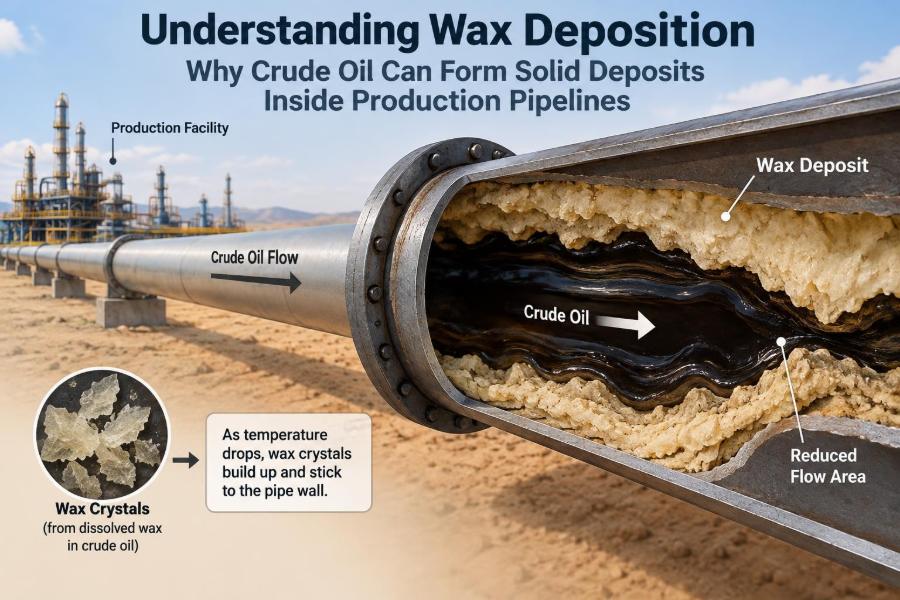
One possible cause is wax deposition: solid, wax-rich material accumulating on the inside wall of a pipeline. The deposit may begin as a thin film, but it can progressively reduce the effective bore available for flow.
This matters because many crude oils contain components that are liquid at reservoir temperature yet become less soluble as the fluid cools. A pipeline is therefore not just a conduit; it is a changing thermal and hydraulic environment that can alter the fluid moving through it.
Understanding why deposits form helps engineers select practical controls, interpret operating data, and avoid treating every restriction as the same flow-assurance problem.
🧪 What Wax Deposition Means in Petroleum Production
In petroleum engineering, “wax” usually refers to paraffinic hydrocarbons: predominantly straight-chain or near-straight-chain molecules that can crystallize from crude oil when conditions favor it. These molecules are commonly called n-paraffins when their carbon chains are unbranched.
Wax deposition occurs when crystals form in the bulk fluid or near a cold pipe wall, then become retained at that wall. The resulting layer can contain oil, entrained solids, water, and other organic material; it is rarely a perfectly pure wax solid.
The problem is most visible in subsea flowlines, long export pipelines, and wells with substantial temperature decline. It can also occur in surface gathering systems during cold weather or low-throughput operation.
🌡️ Why Cooling Changes the Behavior of Crude Oil
Crude oil is a complex mixture rather than a single substance with one freezing point. At high enough temperature, wax molecules remain dissolved in the liquid oil. As temperature falls, their solubility decreases.
At a certain point, the oil becomes saturated with respect to some wax components. Further cooling can cause those components to come out of solution as tiny solid crystals, much like dissolved material forming crystals as a solution cools.
Cooling alone does not guarantee severe deposition. Crystallization, transport to the wall, attachment, and survival of the deposited layer must all occur. Still, temperature is usually the first variable engineers investigate.
❄️ The Wax Appearance Temperature
The wax appearance temperature, often abbreviated WAT, is the temperature at which wax crystals first become detectable under a specified test method. It is also called cloud point in some contexts, although terminology and methods should be used carefully.
WAT is not a universal “pipeline safe” temperature. Laboratory method, pressure, crude composition, and the sensitivity of the measurement can influence the reported value. A fluid can also deposit wax under some conditions even when its bulk temperature is near, rather than far below, a measured WAT.
For design and operations, engineers need more than one WAT value. They need to understand the fluid’s wax precipitation behavior across the expected temperature and pressure range.
🧱 Wax Crystals Are Not Yet a Plug
Seeing wax crystals in an oil sample does not mean a line will plug. Crystals must reach a surface, adhere, and build a layer faster than shear forces, warm fluid, or chemical treatment can remove or dissolve them.
Early deposits may be soft and oil-rich. With time, some layers can age: liquid oil diffuses out, additional wax precipitates within the deposit, and the structure becomes denser and more difficult to remove.
This distinction matters operationally. A system can have wax precipitation without a serious restriction, while another system with modest precipitation can develop a persistent deposit because its thermal and flow conditions strongly favor wall growth.
🧊 The Cold Pipe Wall Effect
The pipe wall is often colder than the flowing oil, especially when a hot wellstream enters a cooler environment. Heat moves from the fluid through the steel wall and insulation, then into seawater, air, soil, or another surrounding medium.
Near that wall, the oil can cool below the temperature of the faster-moving fluid in the pipe center. This creates a near-wall region where wax solubility is lower and where crystals can form or accumulate.
Subsea systems are particularly demanding because seawater provides a large, persistent heat sink. Good insulation slows heat loss, but it does not eliminate the need to evaluate wax risk over the full operating life of the line.
🔄 How Material Reaches the Pipe Wall
Several mechanisms may contribute to wax deposition, and their relative importance can change from one system to another. The most widely discussed mechanism is molecular diffusion: dissolved wax molecules move from warmer, wax-rich oil toward the colder wall region, where lower solubility supports deposition.
Other contributions can include transport of suspended crystals, shear-induced processes, and interactions with existing roughness or deposits. The exact behavior depends on crude composition, flow regime, temperature gradient, water content, and operating history.
Because the mechanism is system-specific, a laboratory result should be connected to realistic pipeline conditions rather than interpreted in isolation.
📉 Why Deposits Restrict Flow
A deposit reduces the internal diameter of the pipe. Even a relatively thin layer can matter because pressure loss is sensitive to flow area and velocity. As the flow area narrows, the same liquid rate must pass through a smaller opening.
Restriction can lead to higher pressure drop, reduced production capacity, increased pump or compression demand, and less predictable pigging behavior. The deposit also changes wall roughness, which can further alter hydraulic performance.
In severe cases, wax combines with other material and forms a restriction that cannot be managed by normal operating adjustments. The response then may require a planned shutdown, thermal treatment, chemical intervention, or mechanical removal.
🛢️ Crude Composition Determines the Starting Risk
Not all crude oils have the same wax behavior. A crude with a meaningful fraction of high-molecular-weight paraffins may have stronger deposition potential than one with less wax, but total wax content alone is not enough to predict field performance.
The distribution of carbon numbers, the presence of resins and asphaltenes, aromatic content, and the oil’s solvent quality all influence whether wax stays dissolved. Two oils with similar reported wax content can behave differently as they cool.
Produced-fluid sampling is therefore foundational. A sample must be representative of the flowing stream, protected from inappropriate cooling or flashing, and analyzed with clear knowledge of its sampling conditions.
🧭 Pressure Also Affects Phase Behavior
Pressure changes can modify crude-oil phase behavior and can occur alongside gas liberation as fluids move from reservoir conditions to surface facilities. When gas comes out of solution, the composition and cooling behavior of the remaining liquid phase can change.
The relationship is not simple enough to reduce to “lower pressure means more wax.” Engineers use pressure-temperature-composition models, laboratory data, and operating observations together to assess likely behavior.
This is one reason why a well test, a choke change, or a new tie-in can affect flow assurance even when the pipeline hardware itself has not changed.
🌊 Water, Emulsions, and Multiphase Flow
Many production lines carry oil, water, and gas simultaneously. Water can change heat transfer, flow patterns, and the physical nature of deposits. An oil-in-water or water-in-oil emulsion may behave quite differently from a dry oil system.
Water does not automatically cause wax deposition, but it complicates diagnosis. A restriction may include wax, scale, corrosion products, sand, hydrates, or emulsion-stabilized material. Treating it as a wax-only problem can waste time and create new risks.
Multiphase flow also produces slugs and varying liquid holdup. Those changing conditions can create local cooling and shear environments that a steady-state assumption may miss.
⚙️ Flow Rate and Shear Have Two-Sided Effects
Higher flow rates often increase wall shear stress, which can discourage the retention of soft deposits. At the same time, higher velocity can increase heat transfer between the fluid and wall, potentially cooling the near-wall liquid more rapidly.
Lower flow rates usually give the fluid more residence time to cool and may reduce the shear available to remove deposits. Yet the exact outcome depends on insulation, inlet temperature, pipe geometry, and whether flow is single-phase or multiphase.
There is no universally safe velocity. Engineers should evaluate the combined thermal and hydraulic effect rather than assuming that “faster” or “slower” always improves wax control.
🌙 Shut-Ins Create a Different Wax Hazard
During a shutdown, flow-driven heat input and wall shear largely disappear. The fluid cools toward the surroundings, and wax can precipitate throughout portions of the line.
When production restarts, the restart pressure may be much higher than during normal operation because the cooled fluid can have an elevated yield stress or viscosity. A gelled, waxy oil may resist movement until sufficient pressure is applied.
Restart planning must consider equipment pressure limits, the likely cooldown profile, and whether controlled heating, displacement, or a gradual startup sequence is required. Restart pressure should never be treated as a guess.
🧫 Gelation and Wax Deposition Are Related but Different
Wax deposition is a wall phenomenon: material accumulates on the pipe interior. Gelation is a bulk-fluid phenomenon in which a network of wax crystals gives cooled oil a yield stress, meaning a minimum stress is needed before it begins to flow.
A line may experience one issue without the other, although both can occur after cooling. Confusing them can lead to poor mitigation choices. For example, pigging can address a wall deposit but may not resolve a long section of gelled oil during restart.
Operational plans should identify which mechanism dominates and what evidence supports that conclusion.
🧩 Wax, Asphaltenes, and Hydrates Are Not Interchangeable
Wax deposits are hydrocarbon-rich solids associated mainly with paraffin crystallization. Asphaltenes are a different heavy organic fraction that can precipitate when pressure, composition, or solvent conditions change. Hydrates are ice-like crystalline solids formed from water and small gas molecules under suitable low-temperature, high-pressure conditions.
These materials can coexist or interact, but they require different diagnostic tools and control strategies. A chemical selected for wax inhibition may not prevent hydrate formation, and a hydrate inhibitor does not solve paraffin deposition.
| Issue | Primary driver | Typical concern |
|---|---|---|
| Wax | Cooling and reduced wax solubility | Wall deposits and gelled oil |
| Asphaltenes | Pressure/compositional change | Organic precipitation and plugging |
| Hydrates | Water, gas, pressure, and low temperature | Rapid solid plugs in wet gas systems |
🔍 Recognizing Early Warning Signs
Wax deposition rarely announces itself with one definitive signal. Engineers look for trends: increasing pressure drop at comparable rates, declining throughput, changing pump performance, unusual pig returns, or a mismatch between measured and expected hydraulic behavior.
A cold section of line, a declining outlet temperature, or repeated difficulty after shut-ins may strengthen the suspicion. However, these signals are not unique to wax and should be tested against other explanations.
- Compare pressure and temperature data at similar operating rates.
- Review whether the problem follows colder ambient conditions or prolonged shutdowns.
- Inspect pig debris where safe and representative samples can be obtained.
- Check for scale, sand, corrosion products, and hydrate history before assigning a cause.
📏 Measuring Deposit Growth Indirectly
Directly observing deposits inside an operating pipeline is often difficult. Instead, operators infer growth through pressure-drop trends, flow-rate response, pigging data, thermal models, and, where available, internal inspection or specialized monitoring tools.
Trend quality matters more than a single reading. A pressure increase may reflect changing fluid properties, a choke adjustment, meter uncertainty, or a developing restriction. Comparing periods with similar rates, water cuts, and temperatures gives a more useful basis for interpretation.
Models can estimate deposit thickness, but their results are only as reliable as the fluid characterization, boundary conditions, and operating data supplied to them.
🧪 Laboratory Testing Supports, Not Replaces, Field Evidence
Laboratory work can measure WAT, wax precipitation, viscosity, gel strength, and the response to candidate chemicals. Flow-loop tests may provide additional insight into deposition tendencies under controlled conditions.
These tests are valuable because they make comparisons possible. But a small-scale experiment cannot reproduce every aspect of a long pipeline: terrain, heat loss, changing flow regimes, water behavior, solids, and operating transients can all matter.
The best interpretation combines lab results with a field operating envelope. A chemical that looks promising in a bottle test still needs to be evaluated at realistic dosage, injection location, temperature, and residence time.
🧰 Pigging as a Mechanical Control
Pigging sends a purpose-built device through a pipeline to displace liquids, remove loose deposits, or provide evidence about internal conditions. For wax management, regular pigging can prevent a soft layer from becoming thick and aged.
Pigging is not automatically low-risk. A pig can stall, bypass deposits, compact debris, or create excessive differential pressure if the line condition is poorly understood. Launchers, receivers, valves, and operating procedures must be designed for the task.
Pig selection depends on geometry, bends, diameter changes, branch connections, and the expected deposit consistency. Foam pigs, brush pigs, scraper pigs, and intelligent tools serve different purposes; one type is not a substitute for all others.
🧴 Chemical Treatments and Their Limits
Wax inhibitors, pour-point depressants, crystal modifiers, dispersants, and solvents are often discussed together, but they do not all work in the same way. Some chemicals alter crystal growth or crystal interactions, while solvents aim to dissolve or soften existing deposits.
Performance depends strongly on the specific crude and application conditions. An inhibitor must contact the fluid before problematic crystals develop, and it must be delivered at an effective concentration after accounting for dilution, phase partitioning, and residence time.
Solvent treatment can be useful for remediation, but it introduces handling, compatibility, recovery, and safety considerations. It should be planned as an engineered operation, not assumed to be a quick universal fix.
🔥 Thermal Management Keeps Oil Above Critical Conditions
Insulation, pipe-in-pipe systems, buried lines, active electrical heating, and hot-fluid circulation can reduce cooling and extend the time before a line reaches problematic temperatures. These approaches are particularly relevant where external surroundings are cold.
Thermal solutions can be highly effective, but they involve capital cost, power demand, installation complexity, and reliability requirements. They may also be designed around specific operating scenarios, so a major change in throughput can alter their effectiveness.
The key question is not simply whether the line is insulated. It is whether the full system retains enough heat during normal flow, turndown, and credible shutdown durations.
🏗️ Designing Pipelines with Wax in Mind
Wax management begins before the pipeline is installed. Route length, diameter, burial depth, insulation level, elevation profile, access for pigging, injection points, and shutdown philosophy all influence future operability.
An oversized line may lower velocity and increase residence time, while an undersized line may create excessive pressure drop. The best diameter is a system decision, balancing production forecasts, hydraulics, heat transfer, piggability, and economics.
Design should also include practical features: pig launch and receive facilities, reliable chemical injection quills, pressure and temperature measurement, drainage where appropriate, and procedures that match the actual line configuration.
🗺️ Operating Envelopes Turn Analysis into Decisions
An operating envelope defines conditions under which the system is expected to remain manageable, such as ranges of inlet temperature, rate, water cut, ambient conditions, and shut-in duration. It translates complex flow-assurance analysis into usable limits for operations teams.
For example, an envelope may indicate when a line needs chemical injection, when pigging frequency should increase, or when a prolonged shutdown requires a specific restart plan. These are not arbitrary rules; they should reflect validated thermal, hydraulic, and fluid-property understanding.
Because reservoirs and facilities change over time, operating envelopes should be reviewed after major production changes, new wells, facility modifications, or repeated unexplained restrictions.
🚧 Common Mistakes During Wax Troubleshooting
A frequent mistake is diagnosing wax solely because the weather is cold or the crude is described as “waxy.” Cold conditions are relevant, but they do not exclude hydrates, scale, mechanical damage, instrument error, or other flow restrictions.
Another mistake is escalating chemical dosage without verifying injection performance. A blocked line, poor injection point, incorrect chemical selection, or inadequate mixing can make a treatment appear ineffective even when the chemistry itself is suitable.
- Do not assume a single WAT value predicts all field behavior.
- Do not pig aggressively without assessing line condition and differential-pressure limits.
- Do not restart a cooled line without considering gel strength and available pressure.
- Do not treat debris samples as fully representative without considering where and how they were collected.
🧑🔧 A Practical Investigation Sequence
When wax is suspected, begin by stabilizing and documenting the operating condition. Gather current and historical pressures, temperatures, rates, fluid samples, water cut, chemical records, pigging history, shutdown duration, and equipment changes.
Next, compare observations with a hydraulic and thermal expectation for the same conditions. If pressure loss is higher than expected, identify whether the likely cause is increased viscosity, reduced bore, a flow-regime change, or a measurement problem.
Then select the least disruptive diagnostic or intervention that can reduce uncertainty. This may involve reviewing pig returns, obtaining deposit analysis, running a controlled pigging campaign, checking chemical injection, or updating fluid-property testing.
📚 Why Deposit Samples Matter
A recovered deposit can reveal whether wax is dominant and whether other materials are present. Laboratory analysis may identify hydrocarbons, inorganic scale, corrosion products, sand, water, or emulsion components.
That information changes the treatment strategy. A wax-rich, soft deposit may respond to different methods than a hard, mineral-rich restriction with a thin organic coating.
Sampling has limitations. Material recovered at a receiver may have been altered by pigging, mixing, temperature changes, and transport. The sample is evidence, not a perfect snapshot of every point in the pipeline.
🧠 Digital Models Need Good Physical Inputs
Modern flow-assurance software can simulate heat transfer, pressure drop, wax precipitation, cooldown, and restart scenarios. These models help engineers test alternatives before changing hardware or operations.
However, a detailed model can still be misleading if its inputs are weak. Representative PVT data, wax characterization, insulation properties, ambient conditions, production profiles, and boundary conditions are essential.
Field calibration is equally important. If predicted and observed temperatures or pressures diverge, the difference should be investigated rather than hidden by adjusting a result until it appears convenient.
🔐 Safety and Environmental Considerations
Wax control activities can involve pressurized hydrocarbons, hot fluids, solvents, chemicals, and pigging equipment. Each introduces hazards that require site-specific procedures, competent personnel, isolation planning, and emergency preparedness.
A blocked or restricted line can also raise containment risk if pressure is managed poorly. Operational decisions must respect maximum allowable pressures and the mechanical condition of the full system, not just the pipeline segment believed to contain deposits.
Chemical and solvent selection should consider handling, emissions, waste management, compatibility, and discharge controls. Effective flow assurance is inseparable from safe, responsible operations.
📈 Balancing Prevention and Remediation
Prevention usually aims to keep deposits from reaching an operationally significant thickness through thermal management, chemical treatment, flow control, and routine pigging. Remediation addresses deposits that are already present through mechanical, thermal, or chemical means.
The right balance depends on the consequence of restriction, access to the line, production value, intervention cost, and uncertainty in the deposit mechanism. A subsea flowline with limited intervention options may justify more conservative prevention than an accessible onshore gathering line.
Neither approach is universally superior. The practical objective is to maintain safe, predictable flow with a strategy that remains workable as conditions change.
🎓 What Students and New Engineers Should Remember
Wax deposition is a classic example of coupled petroleum engineering. It links fluid composition, thermodynamics, heat transfer, multiphase flow, hydraulics, chemistry, mechanical design, and operations.
The most useful habit is to ask a connected set of questions: What is in the fluid? How is temperature changing? What is happening near the wall? How is the line being operated? What evidence distinguishes wax from other restrictions?
That approach is more reliable than memorizing one temperature threshold or one preferred treatment. Field problems are rarely solved by a single discipline acting alone.
✅ The Core Principle Behind Wax Control
Wax deposits form when crude-oil components that were dissolved at warmer conditions become able to crystallize and accumulate under colder pipeline conditions. The risk becomes operationally serious when the deposit remains attached and grows faster than it is removed or controlled.
Successful management therefore combines representative fluid characterization, realistic thermal-hydraulic analysis, careful monitoring, and a response suited to the actual mechanism. It may involve insulation, chemicals, pigging, operating limits, or several measures working together.
The central lesson is simple: wax is not merely a property of the crude; deposition is a behavior of the crude, pipeline, environment, and operating history acting as one system.
When engineers understand those interactions, wax deposition becomes a manageable flow-assurance challenge rather than an unexplained loss of pipeline performance. 🛢️❄️🔧