
A well can be producing smoothly for months, then begin showing a puzzling combination of falling rates, rising pressure losses, and repeated equipment problems. A choke may plug more often. A downhole safety valve may become difficult to operate. Samples may show dark, sticky solids that were not expected when the well was completed.
One possible culprit is asphaltene precipitation: the separation of heavy, polar crude-oil molecules from the liquid phase. Once these molecules form particles and deposit on a surface, the problem can affect the reservoir, wellbore, tubing, flowlines, and production facilities.
The challenge is not simply that solids form. It is that precipitation depends on fluid composition, pressure, temperature, gas evolution, mixing, and operating history—all of which can change from one location in a producing system to another.
For petroleum engineers, recognizing the mechanism early matters. A treatment selected for wax, scale, or sand may not solve an asphaltene problem, and an apparently successful cleanup may fail if the underlying fluid instability remains.
🧪 What Asphaltenes Are
Asphaltenes are the heaviest and most chemically complex fraction of crude oil. They are commonly defined operationally: they are insoluble in light normal alkanes such as n-pentane or n-heptane, but soluble in aromatic solvents such as toluene.
They contain relatively high proportions of carbon, hydrogen, sulfur, nitrogen, oxygen, and trace metals. Their molecular structures include aromatic ring systems and polar groups, which encourages association between molecules.
Despite the name, asphaltenes are not necessarily a separate solid phase inside the reservoir. In a stable crude oil, they can exist as dispersed material or small aggregates stabilized by the surrounding liquid.
🧩 The Role of the Crude-Oil Colloidal System
Crude oil is often described as a complicated colloidal system. In this simplified picture, asphaltene-rich particles are dispersed within a continuous oil phase and are stabilized in part by resins—less heavy, surface-active molecules that interact with both asphaltenes and the rest of the oil.
Resins do not act like a universal shield. Their effectiveness depends on concentration, molecular character, temperature, and the solvency of the surrounding oil. A fluid can therefore look stable under reservoir conditions but become unstable after a change in pressure or composition.
An everyday analogy is a well-mixed paint: pigments remain distributed while the formulation is balanced. Change the solvent quality enough, and pigment particles clump and settle.
⚖️ Precipitation Is Not the Same as Deposition
Precipitation occurs when asphaltenes come out of their stable state and form separate particles or aggregates in the fluid. Deposition occurs when those particles attach to a surface and build a layer.
This distinction is operationally useful. A fluid sample may contain precipitated particles without a severe deposit problem if particles are carried through the system. Conversely, modest precipitation can cause serious damage where flow slows, pressure changes abruptly, or surfaces provide attachment sites.
Engineers must therefore ask two related questions: where does the fluid become unstable, and where are solids most likely to accumulate?
📉 Pressure Depletion and Bubble-Point Effects
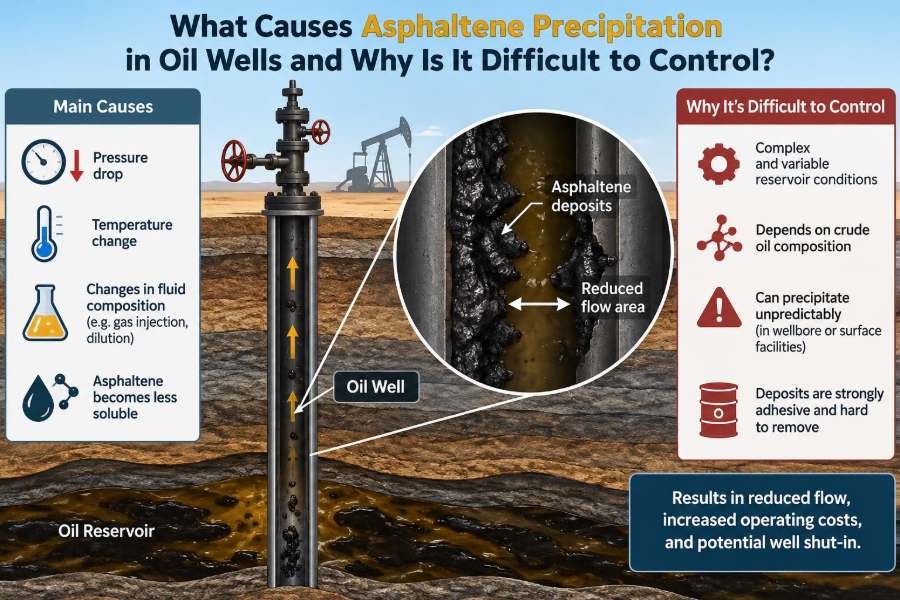
Pressure decline is one of the most common triggers. As reservoir pressure falls, dissolved gas can begin to evolve from the oil when pressure reaches the bubble point. The liquid then loses some of the light components that contributed to its overall solvent environment.
For some oils, this compositional shift makes the remaining liquid less able to keep asphaltenes dispersed. The highest risk may occur near, at, or below bubble-point conditions, but there is no single rule that applies to every crude.
As production continues, the pressure path experienced near the wellbore can differ substantially from the average reservoir pressure. That local path is often more relevant to precipitation risk than a single fieldwide pressure value.
💨 Gas Liberation Changes Oil Solvency
Gas evolution affects more than pressure. When methane and other light hydrocarbons leave the oil phase, the composition of the remaining liquid changes. In some systems, the liquid becomes a poorer solvent for heavy aromatic-rich material.
Rapid gas liberation can also create intense mixing and flow disturbances. These conditions can increase particle collisions and encourage aggregation after instability has begun.
Gas lift, drawdown changes, and multiphase flow do not automatically cause asphaltene deposition. They can, however, move the fluid across a stability boundary if the oil is already close to one.
🛢️ Why Oil Composition Matters
Two crude oils with similar density or API gravity can behave very differently. Asphaltene stability depends on the full fluid composition, including the balance between aromatic compounds, resins, saturates, and light components.
Aromatic-rich components generally provide better solvency for asphaltenes than paraffinic components. Adding or enriching a fluid with lighter paraffinic material can therefore destabilize certain oils, while aromatic material may improve dispersion.
Bulk property correlations can be useful screening tools, but they cannot fully replace fluid-specific laboratory testing. The molecular diversity of crude oils is too large for a single simple indicator to predict every case.
🌡️ Temperature Has Competing Effects
Temperature can affect solubility, viscosity, diffusion, and the rate at which particles attach to surfaces. Its net effect is not always intuitive. A temperature decrease may reduce molecular mobility and alter phase behavior, but a temperature increase can also change equilibrium relationships and promote precipitation in some fluids.
The key is the actual pressure-temperature-composition path. Fluid moving from a hot reservoir into a cooler wellhead, subsea line, or separator does not experience one isolated temperature change; it experiences coupled changes in pressure, gas content, and flow regime.
This is why a laboratory observation at one temperature should not be extrapolated casually across an entire production system.
🧯 Gas Injection Can Create a Compatibility Problem
Gas injection for pressure maintenance or enhanced recovery can alter crude-oil composition near the displacement front. Carbon dioxide, lean hydrocarbon gas, rich gas, or nitrogen may each affect phase behavior differently.
For certain crude oils, injection gas extracts or redistributes lighter components and changes the liquid’s solvency. The result may be asphaltene instability near the injector-producer flow path, around the producing well, or during miscibility-related compositional changes.
This does not mean gas injection should be avoided whenever asphaltenes are present. It means fluid compatibility and precipitation-envelope work should be part of injection design and surveillance.
🧪 Incompatible Fluid Mixing at the Wellsite
Mixing is a frequent and preventable trigger. Produced oil may contact condensate, diluent, completion fluid residues, workover fluids, or another crude with a different composition. A paraffinic diluent that improves transport viscosity can still reduce asphaltene solvency.
For example, a hypothetical heavy-oil blending plan may lower pipeline viscosity successfully but cause dark deposits in downstream equipment if the selected diluent destabilizes the blend. Viscosity alone is not an adequate compatibility criterion.
Before a major blend change, representative samples should be tested under anticipated ratios and operating conditions. The test should consider both immediate precipitation and delayed deposition tendencies.
🕳️ Near-Wellbore Drawdown Concentrates the Risk
The near-wellbore region is where pressure gradients are steepest and flow converges into perforations. A reservoir fluid that remains stable farther from the well can cross into an unstable region as it approaches the completion.
Deposits in pore throats are particularly damaging because they reduce effective permeability. Even a thin layer can restrict oil flow through narrow passages, increasing skin and lowering well productivity.
This form of damage is difficult to observe directly. Declining productivity may also be caused by fines migration, water blockage, scale, or mechanical completion issues, so diagnosis needs more than a rate trend.
🧱 Porous-Media Deposition Can Raise Skin
In the reservoir, asphaltene particles can be captured by mechanical straining, adsorption, or surface interactions with rock minerals. The extent depends on particle size, pore geometry, wettability, mineralogy, brine chemistry, and flow velocity.
Once deposition begins, it can create a feedback loop. Reduced pore space raises local resistance, changing flow paths and increasing the tendency for additional particles to be retained.
Not every precipitated particle causes formation damage. Some may pass through the pore network, while others may form at conditions that exist mainly after fluid enters the wellbore. Locating the deposition zone is central to selecting a remediation method.
🔩 Tubing and Completion Hardware Provide Attachment Sites
Downhole tubulars, nipples, valves, gauges, and artificial-lift equipment present surfaces where particles can adhere. Roughness, corrosion products, scale crystals, and existing organic films can make attachment easier.
Deposits may accumulate at restrictions and pressure-drop locations, including chokes and valve seats. Such locations combine changing fluid properties with turbulence, particle impacts, and locally altered shear conditions.
Operational symptoms can include rising pressure drop, reduced valve reliability, erratic production, and increased intervention frequency. These symptoms are suggestive rather than conclusive; laboratory examination of recovered material remains valuable.
🚰 Water, Brine, and Emulsion Effects
Water does not dissolve asphaltenes, but water production can influence how asphaltenes behave. Asphaltenes are surface-active and can accumulate at oil-water interfaces, helping stabilize tight water-in-oil emulsions.
Salinity, pH, divalent ions, and the presence of solids can change interfacial behavior. The result may be a linked problem: deposits in the oil system, more persistent emulsions, and separation difficulties at facilities.
It is a mistake to assume that every emulsion problem is caused by asphaltenes. Demulsifier performance, shear history, water cut, fine solids, and natural surfactants must all be considered.
🪨 Mineral Fines and Scale Can Make Deposits Stickier
Asphaltene deposits are often mixed deposits rather than pure organic solids. Clay fines, corrosion debris, iron sulfides, carbonate scale, or sand can become embedded in an asphaltene-rich matrix.
This mixture may be harder to dissolve or mechanically remove than a relatively clean organic deposit. It also complicates sample interpretation: a solvent may loosen the organic fraction while leaving an inorganic skeleton behind.
Integrated treatment planning matters when multiple solids are present. Acidizing, solvent treatments, dispersants, and mechanical cleaning each have different roles and compatibility limits.
🔬 The Precipitation Envelope Explains Why Timing Matters
A precipitation envelope maps conditions under which a specific fluid is expected to become unstable. It is often represented in pressure-temperature space, though composition must be understood because it strongly influences the boundary.
For some oils, asphaltenes begin to precipitate at an upper onset pressure as pressure decreases. Under further depletion, the behavior may change again as gas and liquid compositions evolve. The exact shape is fluid-specific.
The practical lesson is that risk may be concentrated in a particular operating window rather than increasing smoothly with depletion. A well can move into and out of an unfavorable region as conditions evolve.
🧫 Laboratory Tests Turn Suspicion Into Evidence
Laboratory work can characterize the fluid and test its response to pressure, temperature, gas contact, and blending. Common approaches include precipitation onset testing, filtration-based methods, microscopy, centrifugation, compositional analysis, and high-pressure visual-cell studies.
No individual test answers every operational question. A simple titration can indicate sensitivity to a precipitant, while high-pressure testing can better represent reservoir depletion or gas-contact scenarios.
Sampling quality is critical. A flashed stock-tank sample may not represent live reservoir oil, and a sample taken after chemical treatment may obscure the original behavior. Preserve pressure and document handling whenever possible.
🔍 Deposit Analysis Is Different From Fluid Analysis
Analyzing produced fluid helps identify instability potential. Analyzing an actual deposit helps identify what has accumulated at a particular location. Both are needed when a field problem is already underway.
Useful deposit characterization may distinguish organic material from carbonates, sulfides, iron oxides, waxes, formation fines, and polymer residues. Solubility behavior in selected solvents can also guide cleanup options.
A dark solid is not automatically asphaltene. Visual appearance is an unreliable diagnostic method, especially where wax, corrosion products, and fine solids coexist.
📊 Field Surveillance Looks for Patterns, Not One Signal
Asphaltene problems often emerge through patterns across operating data. Engineers may compare production rate, flowing pressure, choke setting, gas-oil ratio, temperature, chemical usage, pigging debris, separator performance, and intervention records.
Changes after a specific event can be revealing: a sharp drawdown increase, gas-lift adjustment, injection breakthrough, fluid transfer, or start of a new blending operation. The timing does not prove causation, but it provides a focused hypothesis to test.
- Track pressure and temperature at meaningful locations, not only at the surface.
- Retain representative solids samples with location and date information.
- Record chemical dosage, batch treatment volumes, and observed response.
- Compare similar wells that operate under different drawdown or lift conditions.
🧭 Locating the Deposit Determines the Treatment
A treatment that clears tubing may not repair permeability loss in the near-wellbore formation. Likewise, a reservoir solvent soak may not prevent recurring deposits across a surface choke.
Diagnosis should separate likely zones: reservoir matrix, perforations, completion hardware, tubing, flowline, and surface equipment. Pressure-transient interpretation, production logging, inspection, recovered solids, and operational history can help narrow the location.
This disciplined step prevents expensive but poorly targeted interventions. The objective is not merely to remove solids; it is to remove them where they limit performance and reduce the conditions that recreate them.
💊 Chemical Inhibitors and Dispersants Have Different Jobs
Asphaltene inhibitors are formulated to reduce aggregation or surface deposition by altering intermolecular and interfacial interactions. Dispersants aim to keep formed particles suspended and transportable. In practice, products may perform both functions to varying degrees.
Performance depends on dosage, injection location, contact time, fluid composition, water cut, and the severity of instability. A product that works in a bottle test may underperform in a well if it is injected too far downstream or cannot reach the critical zone.
Chemical selection should be based on representative fluids and deposits, then validated in the field with measurable operating criteria. More chemical is not inherently better; overdosing can add cost and sometimes complicate separation.
🧴 Solvent Treatments Can Remove Deposits but Not Always Prevent Them
Aromatic solvents are often considered for dissolving or softening asphaltene-rich deposits because of their solvency for heavy aromatic structures. The practical response depends on deposit composition, temperature, contact time, accessibility, and the presence of inorganic material.
Solvent treatments can be useful for tubing or near-wellbore cleanup, but they are not automatically a lasting solution. If the producing fluid still crosses a precipitation boundary under the same operating conditions, deposits may return.
Solvent use requires careful handling, compatibility checks, containment planning, and evaluation of facility impacts. It should be treated as part of a managed program, not a generic quick fix.
⚙️ Operating Conditions Are a Control Lever
When fluid behavior permits, changing drawdown, choke strategy, artificial-lift settings, or gas-handling conditions may reduce exposure to the most unstable region. The best adjustment depends on production objectives and reservoir constraints.
For example, moderating a rapid pressure drop can sometimes reduce the intensity of local compositional change. Yet reducing drawdown can also reduce production, so the decision is an economic and technical trade-off rather than a universal recommendation.
Operating changes should be evaluated with fluid modeling and field data. An intervention that helps one well may have little benefit in another with a different pressure path or crude composition.
🧰 Mechanical Removal Has a Place
When deposits are concentrated in accessible tubulars or surface equipment, mechanical methods may be appropriate. Scraping, coiled-tubing cleanouts, pigging, or component replacement can restore flow area quickly.
Mechanical removal addresses the material that is already present. It does not necessarily change the fluid chemistry, and disturbed deposits can move downstream and cause new restrictions if cleanup is poorly managed.
Combining mechanical removal with a post-cleanup inhibitor plan, solvent stage, or operating adjustment is often more durable than relying on mechanical action alone.
🧱 Completion Design Can Reduce Vulnerable Locations
Completion and flow-path design influence where deposits accumulate. Avoiding unnecessary sharp restrictions, selecting appropriate injection points, providing access for cleanup, and monitoring pressure losses can make an asphaltene-prone well easier to manage.
Material selection may also matter where corrosion, scale, and roughness create favorable attachment surfaces. No material eliminates deposition by itself, but designs that limit secondary solids can reduce the number of places where organic deposits anchor.
For high-risk wells, asphaltene management should be considered during design rather than after repeated plugging events establish the problem.
🧠 Common Diagnostic Mistakes
A frequent mistake is labeling every dark deposit as asphaltene without analysis. Another is assuming that an increase in skin proves asphaltene formation damage when water blockage, fines migration, scale, or completion issues may explain the same trend.
- Using stock-tank oil alone: it may not represent live-oil phase behavior.
- Testing at one condition: real wells experience changing pressure, temperature, and composition.
- Ignoring mixing events: a new diluent or treatment fluid can be the trigger.
- Treating only the symptom: repeated cleanouts without prevention can become routine and costly.
- Assuming one chemistry fits all wells: crude oils and deposit compositions differ.
🧑🔧 A Practical Investigation Workflow
An effective workflow begins with the production history and a precise problem statement: what changed, when, and where is the restriction suspected? The next step is to obtain representative fluid and solids samples before treatment changes the evidence.
- Review pressure, temperature, rate, gas-oil ratio, water cut, and recent operational changes.
- Identify likely deposition zones from symptoms, inspections, and available diagnostics.
- Characterize deposits and test representative fluids under realistic conditions.
- Screen chemical, solvent, mechanical, and operational options against the identified mechanism.
- Implement a monitored trial with clear success criteria and contingency plans.
- Update the model as new data reveal whether the chosen mechanism was correct.
This approach recognizes uncertainty while still moving toward practical action.
🧾 Comparing Asphaltenes With Other Common Solids
| Solid problem | Primary trigger | Typical character | Useful diagnostic clue |
|---|---|---|---|
| Asphaltenes | Changes in pressure, composition, gas contact, or mixing | Dark organic, aromatic-solvent soluble fraction | Association with depletion, blending, or gas evolution |
| Wax | Cooling below wax appearance conditions | Paraffinic crystals, often temperature-sensitive | Deposits strengthen in colder flow sections |
| Scale | Brine incompatibility, pressure change, or temperature change | Inorganic mineral solids | Mineral analysis and water-chemistry evidence |
| Fines | Flow, salinity, pH, or wettability changes | Mobilized formation particles | Clay or mineral content in produced solids |
These mechanisms can coexist. A reliable diagnosis identifies the dominant restriction mechanism and any secondary materials that affect treatment response.
🔄 Why Control Is Difficult Over a Well’s Life
Asphaltene management is difficult because the system is dynamic. Reservoir pressure declines, water cut changes, gas breakthrough may occur, lift settings are adjusted, and fluids from different zones or wells may eventually mix.
A chemical program that worked during early life may require reevaluation later. Likewise, a well with no early deposition history can develop problems after an operational or compositional transition.
Control is therefore less like installing a permanent filter and more like managing a changing phase-behavior risk through surveillance, prediction, and timely adjustment.
🎯 The Core Principle for Reliable Control
The most reliable strategy is to manage the chain from fluid instability to particle growth to surface deposition to flow restriction. Breaking that chain at the earliest practical point is usually more effective than repeatedly removing deposits after they form.
That requires fluid-specific data, an understanding of the pressure-temperature-composition path, careful attention to mixing and operations, and confirmation of what the deposited material actually is. There is no single chemical or operating rule that controls every asphaltene-prone oil.
When engineers distinguish precipitation from deposition and identify the vulnerable location, they can choose interventions with a clearer mechanism and a more realistic expectation of performance.
Asphaltene precipitation is difficult to control because it is a phase-behavior and flow-assurance problem that changes with the fluid, the well, and the way the well is operated; successful management starts with diagnosis, not a one-size-fits-all treatment. 🛢️🔬⚙️