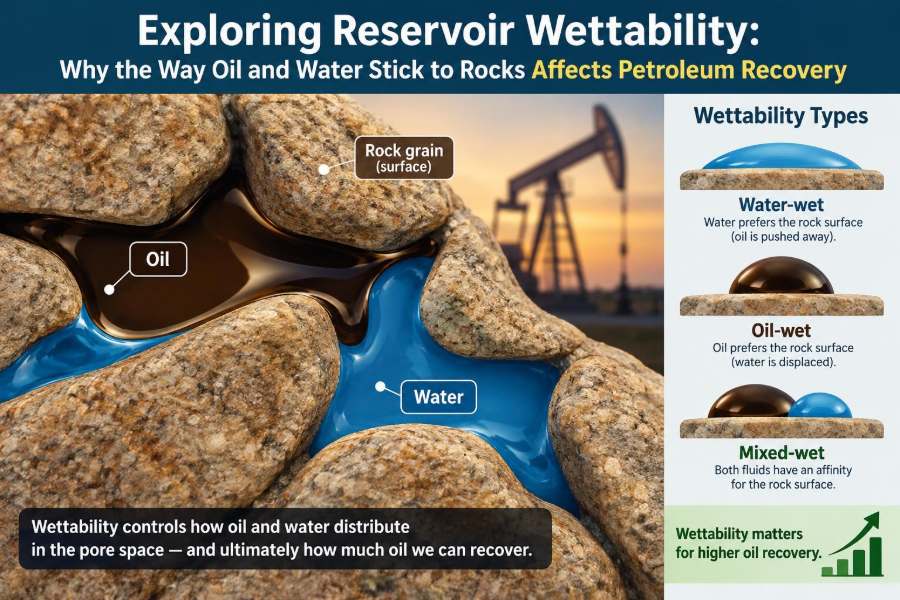

A reservoir can contain a large volume of oil and still leave much of it behind after production begins. The reason is not always poor permeability, weak pressure support, or an undersized well. At pore scale, the surfaces of the rock may simply prefer to be in contact with water rather than oil—or the other way around.
Think about rinsing a greasy pan. Water may bead up and slide over some areas while clinging to others, and detergent changes the behavior again. Reservoir fluids do something similar inside an extremely complex network of microscopic pores, except the result can determine where oil sits, how it moves, and how much remains trapped.
This preference is called wettability. It is easy to describe but difficult to characterize accurately in a real reservoir, where mineralogy, brine chemistry, crude-oil components, pressure, temperature, and production history all interact.
For petroleum engineers, wettability is a practical recovery variable. It influences capillary pressure, relative permeability, waterflood performance, log interpretation, and the design of enhanced oil recovery processes.
🪨 What Wettability Means in a Reservoir
Wettability is the tendency of one fluid to spread on, adhere to, or preferentially contact a solid surface when another immiscible fluid is present. In most oil reservoirs, the relevant fluids are oil, formation water, and rock.
If water has the stronger attraction to the rock surface, the system is water-wet. If oil has the stronger attraction, it is oil-wet. Many reservoirs fall between those end members and are described as mixed-wet or intermediate-wet.
🔬 The Pore-Scale View
Reservoir rock is not a bundle of identical tubes. Its pores have irregular bodies connected by narrower pore throats, and their walls can contain several minerals. Wettability determines which phase tends to coat these walls and which phase occupies the centers of pores.
In a strongly water-wet pore, water commonly forms thin films along rock surfaces and occupies the smallest pores. Oil is more likely to occupy larger pore spaces. This arrangement strongly affects displacement when water is injected.
💧 Oil, Water, and Rock Are a Three-Phase System
Wettability cannot be assigned meaningfully to a rock alone. It belongs to the combined rock-fluid system. A quartz-rich sandstone exposed to one brine and one crude oil may behave differently after contact with a brine of different salinity or a crude containing more surface-active polar compounds.
The key interfaces are oil-water, oil-rock, and water-rock. Their interfacial energies determine which arrangement requires less energy and is therefore more stable.
📐 Contact Angle: A Useful Visual Measure
At the point where oil, water, and solid meet, the fluids form a contact angle. Conventionally, the angle is measured through the water phase. A small angle suggests water preferentially spreads on the solid; a large angle suggests oil preference.
Contact angle is conceptually useful, but it should not be treated as a complete reservoir description. A polished mineral surface in a laboratory is far simpler than a rough, chemically variable pore wall under reservoir conditions.
🧲 Why Rock Surfaces Develop Fluid Preferences
Minerals carry surface charges and chemical groups that interact with ions in brine and molecules in crude oil. Clay minerals, carbonates, quartz, feldspars, and organic coatings can each contribute different surface behavior.
Crude oils may contain polar fractions, including acids, bases, resins, and asphaltenes. Some of these compounds can adsorb onto mineral surfaces and make portions of the rock more oil-wet, especially after long contact times.
🏜️ Water-Wet Reservoir Behavior
In a water-wet reservoir, water tends to coat the rock and reside in smaller pores or corners. During water injection, the injected water can advance through films and fine pore pathways while displacing oil from larger pore bodies.
This geometry often gives water a favorable ability to imbibe into the rock. It does not mean all oil will be recovered: oil can still become disconnected into isolated ganglia held by capillary forces.
🛢️ Oil-Wet Reservoir Behavior
In an oil-wet system, oil preferentially contacts the rock surface. Water may occupy the central portions of pores, while oil remains in films, corners, and smaller openings.
Water injection can be less effective at spontaneously entering oil-filled rock in this case. However, an oil-wet condition is not automatically disastrous; the full outcome depends on saturation history, pore structure, viscosity ratio, pressure gradients, and the displacement process being used.
🎭 Mixed Wettability Is Often the Real Case
Many productive reservoirs are not uniformly wet by one fluid. In mixed-wet rock, some surfaces or pore sizes are water-wet while other locations are oil-wet. Oil may have altered surfaces in larger pores while water remains associated with smaller pores and corners.
This distribution can sometimes support favorable oil connectivity at intermediate water saturation. But it also makes simple interpretations risky: an average laboratory result may conceal strongly different local conditions.
🧭 Initial Water Saturation Sets the Starting Geometry
Before hydrocarbons enter or accumulate in a reservoir, water commonly occupies much of the pore system. As oil migrates in, it displaces some water but usually leaves behind connate water, also called irreducible or initial water in particular contexts.
The saturation path matters. A rock drained by oil from a water-filled state may retain water differently than a rock later invaded by water during production. Wettability and saturation history are therefore inseparable in practical analysis.
🫧 Capillary Pressure Connects Wettability to Flow
Capillary pressure is the pressure difference between two immiscible fluid phases across a curved interface. Its magnitude depends on interfacial tension, pore geometry, and the contact angle associated with wettability.
Small pores create stronger capillary effects than large pores. In a water-wet medium, water is generally the wetting phase and can be drawn into smaller spaces; in an oil-wet medium, the roles are reversed. This controls fluid distributions even when no pump is operating.
📈 Drainage and Imbibition Are Not Mirror Images
Drainage describes a process in which a nonwetting phase displaces a wetting phase. Imbibition describes the wetting phase displacing the nonwetting phase. Their capillary-pressure paths often differ because fluids become trapped, interfaces rearrange, and pore access changes.
This difference is called hysteresis. Engineers need it when modeling a reservoir that has experienced hydrocarbon charging, depletion, waterflooding, shut-ins, or repeated injection cycles.
🚰 Relative Permeability Shows Who Can Move
Absolute permeability describes how readily a rock transmits a single fluid. When oil and water flow together, each phase has an effective ability to flow described by relative permeability.
Wettability influences the shapes and endpoints of relative-permeability curves because it changes where each fluid resides. A phase spread as a connected film may remain mobile at a saturation where a disconnected phase would not.
🧱 Residual Oil Is More Than “Oil Left Behind”
After a waterflood, oil usually remains as disconnected droplets, elongated ganglia, films, or oil held in poorly swept zones. The term residual oil saturation refers to oil that is immobile under the conditions of that displacement, not necessarily oil that can never move.
Changing pressure gradients, interfacial tension, or wettability may mobilize some of it. The technical question is whether the proposed change reaches enough of the reservoir safely and economically.
⚖️ Capillary Number Explains Mobilization Limits
The capillary number compares viscous forces that push fluids with capillary forces that retain them. Raising flow velocity or lowering oil-water interfacial tension can increase this ratio and help mobilize trapped oil.
Wettability remains part of the picture because it controls interface shape and adhesion to pore walls. A process that lowers interfacial tension but ignores the rock-fluid system may not deliver the expected recovery response.
🧪 How Core Analysis Measures Wettability
Core analysis offers direct evidence from reservoir rock, but each test has a scope and limitations. Samples must be cleaned, preserved, restored, and handled carefully; otherwise, drilling mud, evaporation, oxidation, or inappropriate solvents can alter surface conditions.
Common approaches include:
- Contact-angle measurements on mineral or core surfaces.
- Amott testing, which compares spontaneous and forced displacement behavior.
- USBM testing, which compares areas under forced-displacement capillary-pressure curves.
- Relative-permeability and capillary-pressure experiments, interpreted with saturation history in mind.
🧫 What the Amott Method Reveals
The Amott approach evaluates whether a core spontaneously imbibes water or oil, then measures additional displacement caused by forcing the fluid through the sample. A tendency for spontaneous water imbibition is evidence of water-wet behavior; spontaneous oil imbibition points toward oil-wet behavior.
It is valuable because spontaneous imbibition resembles a meaningful physical tendency. Yet results depend on fluid selection, aging, sample condition, and test procedure, so an index should not be treated as an immutable property of an entire field.
🧮 Why USBM Indices Need Context
The USBM method uses capillary-pressure work associated with forcing oil and water through a core. It provides another numerical indication of wetting preference.
A number is convenient for comparison, but it cannot reveal every pore-scale pattern. Combining USBM results with imaging, fluid chemistry, capillary-pressure data, and production history is generally more informative than relying on one index.
📡 Logs Infer Fluids Indirectly
Resistivity, nuclear magnetic resonance, dielectric, and other logs can help estimate saturation and pore-fluid behavior. Their interpretation often uses assumptions that are sensitive to wettability, particularly in models of electrical conduction and bound water.
For example, a water-wet rock can sustain conductive water films along grain surfaces. In shaly or heterogeneous formations, clay-bound water and variable salinity further complicate the relationship between resistivity and hydrocarbon saturation.
🧩 Mineralogy Makes “The Reservoir” Too Broad
A reservoir interval may contain clean sandstone, clay-rich laminations, carbonate cement, fractures, and organic-rich patches. Calling the whole interval water-wet or oil-wet can hide the variations that matter for flow.
Thin sections, scanning electron microscopy, X-ray methods, and modern imaging can help connect mineral distribution with pore structure. The most useful model is often facies-specific rather than field-wide.
🌡️ Temperature, Pressure, and Brine Chemistry Matter
Reservoir conditions differ substantially from room-temperature laboratory conditions. Temperature and pressure can alter fluid properties and interfacial behavior, while brine salinity and ion composition influence surface charge and adsorption.
Divalent ions such as calcium and magnesium are often relevant in carbonate systems because they can participate in interactions between brine, mineral surfaces, and polar oil compounds. The direction and size of any wettability response depend on the actual system, not on ion names alone.
🧂 Low-Salinity Waterflooding and Wettability
Low-salinity or modified-salinity waterflooding aims to change rock-fluid interactions by adjusting injected-water composition. In some candidate systems, this may alter surface charge, ion exchange, pH-related behavior, or the stability of adsorbed organic material.
It is not a universal recipe. Compatibility with formation water, clay sensitivity, scaling risk, injectivity, and the mechanism demonstrated in representative corefloods all require evaluation before field decisions are made.
🧴 Surfactants Can Change Interfaces
Surfactants are molecules designed to accumulate at interfaces. They can reduce oil-water interfacial tension and, depending on formulation and rock chemistry, may also alter wettability.
Surfactant flooding faces practical constraints: adsorption onto rock can consume chemical, salinity can affect formulation behavior, and contact with unswept oil is never uniform. Laboratory success must be tested under conditions that represent reservoir temperature, brine, and crude oil.
🌫️ Gas Injection Adds Another Wettability Question
When gas is present with oil and water, engineers must consider three-phase wettability. A water-wet rock may still show complex gas distribution because gas, oil, and water compete for pore space under changing pressure and composition.
In gas storage, gas injection, and miscible or near-miscible recovery projects, contact angles, spreading behavior, and hysteresis can affect trapping and relative permeability. Two-phase intuition is useful, but not always sufficient.
🪨 Carbonates and Sandstones Often Behave Differently
Sandstones commonly contain silica-based minerals and clays, whereas carbonates are dominated by minerals such as calcite or dolomite. Their surface chemistry differs, and carbonate reservoirs are frequently associated with mixed to oil-wet behavior, though no lithology guarantees a wettability state.
Carbonate pore systems can also include vugs, moldic pores, and fractures, adding geometries that are hard to reproduce in a small plug. Representative sampling is especially important.
🧯 Fractures Change the Recovery Picture
In naturally fractured reservoirs, matrix wettability can control whether water transfers from fractures into the rock matrix by spontaneous imbibition. A water-wet matrix can support this transfer under suitable conditions, while an oil-wet matrix may resist it.
Fracture flow can cause early water breakthrough even when substantial oil remains in the matrix. Production data must therefore be interpreted alongside the distinct roles of fracture conductivity and matrix capillarity.
🧠 A Simple Thought Experiment
Imagine two identical rock plugs saturated with oil and containing the same pore sizes. In the first, water strongly wets the grain surfaces. In the second, oil does. If both are exposed to water, the first plug may draw water into surface films and small pores more readily, whereas the second may require a larger applied pressure for the same invasion pattern.
This is hypothetical, not a prediction for every reservoir. Real plugs may differ in mineral coatings, pore connectivity, crude aging, and brine composition—the very reasons wettability work must be system-specific.
⚠️ Common Interpretation Mistakes
Several shortcuts lead to poor decisions:
- Assuming every sandstone is water-wet or every carbonate is oil-wet.
- Using a single cleaned core test as a direct representation of native conditions.
- Equating high water cut with uniformly water-wet rock.
- Ignoring saturation history when comparing capillary-pressure data.
- Applying a chemical EOR formulation without checking fluid compatibility and retention.
Each mistake replaces a rock-fluid system with a label. Useful reservoir engineering requires the mechanism behind the label.
🧰 Building a Practical Wettability Workflow
A disciplined workflow begins with a clear decision: improve saturation estimates, explain waterflood behavior, select an EOR process, or calibrate a simulation model. The evidence needed depends on that decision.
- Define reservoir units by rock type, depth, fluids, and production behavior.
- Review native-state core handling and identify possible alteration.
- Measure brine and crude properties at representative conditions where possible.
- Combine wettability tests with capillary pressure, relative permeability, and imaging.
- History match against field observations, then test sensitivity rather than assuming one fixed value.
💻 Putting Wettability into Reservoir Simulation
Simulation models usually express wettability through relative-permeability and capillary-pressure functions, endpoint saturations, and hysteresis models. These are not merely curve-fitting parameters: they determine predicted displacement, breakthrough, recovery, and pressure behavior.
Because data are uncertain, modelers should examine ranges that are physically defensible. A calibration that matches one production period with unrealistic rock-fluid functions can fail when injection strategy or operating conditions change.
📊 A Quick Comparison of Wettability States
| Feature | Water-wet tendency | Oil-wet tendency |
|---|---|---|
| Fluid preferentially contacting rock | Water | Oil |
| Typical location of wetting phase | Films, corners, smaller pores | Films, corners, smaller pores |
| Waterflood implication | Water may imbibe into matrix more readily | Water entry may require greater capillary forcing |
| Key uncertainty | Trapping and heterogeneity still limit sweep | Mixed wettability may dominate local behavior |
🎯 The Core Principle for Petroleum Recovery
Wettability is the link between molecular-scale attraction and field-scale recovery. It helps determine which fluid coats the rock, how capillary pressure develops, which pathways remain connected, and whether injected water or chemicals can contact and displace oil.
The best engineering approach is neither to seek a universally “best” wettability nor to trust a single laboratory index. It is to characterize the actual rock-fluid system, preserve uncertainty, and select recovery methods that fit the reservoir’s pore structure, fluids, and operating constraints.
Oil recovery is shaped not only by how much oil a rock contains, but by which fluid the rock prefers to hold onto at its smallest surfaces. That pore-scale preference can guide better measurements, better models, and better recovery decisions. 🛢️💧🪨