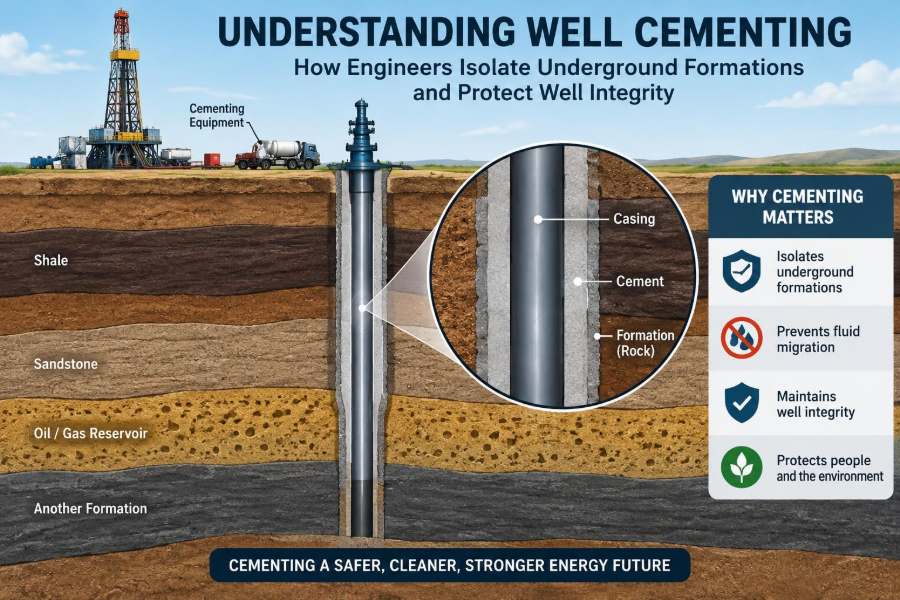

A well may begin as a narrow hole drilled thousands of metres below the surface, but it eventually becomes a long-term barrier system. The steel casing and cement placed around it must keep fluids where they belong—not only while the rig is operating, but often for decades after production begins.
Consider a well passing through a shallow freshwater aquifer, a salt-bearing interval, several hydrocarbon zones, and a high-pressure gas reservoir. Those layers formed separately over geological time. Drilling connects them temporarily, and poor isolation can allow unwanted communication between them.
That is why cementing is much more than “pouring concrete down a well.” It is a carefully engineered operation involving fluid design, pressure control, placement mechanics, verification, and contingency planning.
For petroleum engineers, understanding well cementing means understanding one of the foundations of well integrity: the ability of a well to contain pressure and control fluid movement throughout its life.
🧱 What Well Cementing Means
Well cementing is the process of pumping a cement slurry into the annulus—the ring-shaped space between casing and the drilled formation, or between one casing string and another. The slurry hardens into a cement sheath that supports and seals the well.
Oilwell cement is usually based on Portland cement, but it is formulated for conditions very different from those at the surface. Temperature, pressure, salinity, formation fluids, placement time, and required mechanical properties all influence the final design.
🎯 The Central Purpose: Zonal Isolation
The primary objective is zonal isolation: preventing fluid flow between underground formations through the wellbore. A competent cement sheath separates permeable zones and blocks migration paths along the casing.
For example, a producing reservoir may lie below a water-bearing interval. If the barrier between them is ineffective, water can enter the production zone or travel behind casing, reducing well performance and complicating remediation.
🛡️ Cement as One Layer of Well Integrity
Cement is essential, but it is not the only barrier. Well integrity normally depends on multiple components working together: cement, casing, wellhead equipment, packers, tubing, valves, and operating procedures.
This layered approach matters because each component has limits. Cement can restrict annular flow, while steel casing provides pressure containment; neither should be assumed to replace the other.
🔩 Why Casing Is Run Before Cementing
Casing is steel pipe lowered into the drilled hole. It stabilizes weak formations, enables pressure control, protects freshwater zones, and provides a durable conduit for later drilling and production operations.
Once a casing string reaches its planned depth, cement is pumped through the casing and exits near the bottom. It then rises outside the pipe in the annulus, where it hardens and bonds to both casing and formation.
🗺️ The Casing Program Shapes the Cementing Plan
Most wells use several casing strings rather than one continuous pipe. A typical sequence may include conductor casing, surface casing, intermediate casing, production casing or a liner, depending on the geology and well objective.
Each string addresses a different drilling risk. Accordingly, each cement job has a different purpose: protecting shallow groundwater, isolating troublesome salt or shale, controlling pressure transitions, or securing the production interval.
| Casing section | Typical role | Cementing focus |
|---|---|---|
| Surface casing | Protects shallow formations and supports well-control equipment | Reliable isolation across shallow sensitive zones |
| Intermediate casing | Manages unstable, pressured, or problematic intervals | Isolation of hazards before deeper drilling |
| Production casing or liner | Provides access to the reservoir | Reservoir isolation and durable production barriers |
⚙️ The Main Components of a Cement Job
A cementing operation involves more than a mixing unit and pump. Equipment must guide the slurry, separate fluids, and help confirm the intended displacement.
- Float shoe and float collar: components near the bottom of the casing that help prevent slurry backflow.
- Cementing head: connects pumping lines to the casing and releases plugs.
- Bottom and top plugs: wipers that separate drilling fluid, cement, and displacement fluid.
- Centralizers: devices that help keep casing away from the borehole wall.
- Mixing and pumping equipment: prepares slurry at the required density and rate.
🧪 Why Cement Slurry Design Is Not One-Size-Fits-All
A slurry must remain pumpable long enough to reach its placement location, yet develop useful strength after placement. It also needs suitable density, fluid-loss control, free-water behaviour, rheology, and durability for the expected environment.
Rheology describes how a fluid flows under shear. In cementing, it affects pump pressure, the ability to move drilling fluid, and the risk of excessive friction or losses.
🧫 Additives Tailor Cement to Downhole Conditions
Cement systems often include additives that modify performance. The goal is not to use the most additives, but to achieve predictable behaviour under the particular well conditions.
- Accelerators can shorten setting time in relatively cool intervals.
- Retarders can extend pumpability at elevated temperatures.
- Dispersants can improve flow characteristics at a chosen water content.
- Fluid-loss additives limit water filtration into permeable formations.
- Extenders can reduce slurry density where the formation is fragile.
- Weighting materials can increase density for pressure control when appropriate.
Interactions matter. A formulation that performs well in a laboratory at one temperature may behave differently if the actual circulating temperature, water chemistry, or mixing energy changes.
🌡️ Temperature Changes Everything
Downhole temperature strongly affects thickening time, hydration rate, and strength development. In broad terms, hotter conditions can cause a slurry to set too quickly unless it is properly retarded, while colder conditions can delay strength development.
Engineers use expected bottomhole circulating temperature rather than simply the undisturbed formation temperature when designing the job. Pumping cool fluids down the well can temporarily alter the temperature profile substantially.
⚖️ Managing Pressure Without Breaking the Formation
The hydrostatic pressure of the cement column must be high enough to maintain well control where required, but not so high that it fractures a weak formation. This is one of the central balancing acts in cementing.
If formation fractures open, cement may be lost into the rock rather than rising in the intended annulus. Losses can leave part of the interval uncemented and may create operational complications.
🌊 Displacing Drilling Fluid Is Often the Hard Part
Before cement can seal an annulus, it must displace drilling fluid effectively. Drilling mud can form a filter cake on the wellbore wall and may remain in narrow, poorly swept areas, especially in deviated or horizontal wells.
A cement sheath containing channels of residual mud may not provide continuous isolation. Good displacement is therefore a placement problem as much as a cement-strength problem.
🧼 Spacer Fluids Create a Cleaner Interface
A spacer is a specially designed fluid pumped between drilling mud and cement. It helps separate incompatible fluids, remove mud from surfaces, and improve displacement efficiency.
Compatibility testing is practical rather than optional. If spacer, mud, and cement interact badly, they can create unstable mixtures, unexpected viscosity, or settling that undermines the job.
📐 Centralization Prevents Narrow-Side Channels
In a vertical well, casing may still rest against one side of the borehole. In deviated sections, gravity makes this tendency more pronounced. When casing is off-centre, the narrow annular side is difficult to clean and can become a likely channeling path.
Centralizers improve standoff, meaning the degree to which casing is held away from the borehole wall. The design must also consider running forces; excessive centralization hardware can make casing difficult to reach depth in tight or complex wells.
🚚 A Typical Primary Cementing Sequence
Primary cementing is the first cement job performed after a casing string is run. The exact program varies, but the operational logic follows a recognizable sequence.
- Condition the drilling fluid so its properties support displacement.
- Pressure-test lines and confirm volumes, rates, and contingency plans.
- Pump preflushes or spacer fluid as specified.
- Release the bottom plug and pump the cement slurry.
- Release the top plug and displace the cement with a separate fluid.
- Stop when the top plug lands, then verify the pressure response.
- Allow time for the cement to develop adequate strength before further operations.
🧩 Bottom and Top Plugs Keep Fluids Separated
The bottom plug travels ahead of the cement and separates it from the spacer. When it reaches the float collar, a diaphragm ruptures so cement can flow onward through the shoe.
The top plug follows behind the slurry and separates it from displacement fluid. A distinct pressure increase when it lands is commonly called a bump; it indicates the displacement has reached its planned endpoint, but it does not by itself prove full annular isolation.
⏱️ Waiting on Cement Is a Safety Decision
After placement, operations pause for waiting on cement, often shortened to WOC. The required time is based on the cement system, temperature, planned next operation, and the strength needed to safely drill out or pressure-test.
Proceeding too early can damage immature cement. Waiting longer than the minimum may be operationally inconvenient, but the barrier function is more important than saving a short interval of rig time.
📊 How Engineers Evaluate Cement Placement
Several sources of evidence contribute to a cementing assessment: pumped volumes, returns at surface, pressure trends, displacement data, drilling observations, pressure tests, and, where appropriate, logging tools.
No single measurement gives a complete picture in every well. Interpretation should consider the well geometry, formation properties, tool limitations, and the barrier objective being evaluated.
📡 Cement Bond Logs and Their Limits
A cement bond log uses acoustic measurements to help assess coupling between casing, cement, and formation. Other logging methods can provide complementary information about annular material and isolation quality.
These tools are valuable, but a log response is not a simple photograph of cement. Poor centralization, lightweight systems, complex formations, and tool conditions can affect interpretation. Engineers combine logs with job data instead of relying on a single curve.
🔍 Pressure Testing Verifies Specific Barriers
Pressure testing applies a controlled pressure to evaluate whether a component or barrier holds within the tested arrangement. The test procedure, acceptance criteria, and safe limits are defined by the operation and applicable requirements.
A successful test provides evidence for that configuration and test condition. It should not be overextended into a claim that every part of the annulus is fully characterized under all future loads.
🚧 Common Causes of Poor Zonal Isolation
Cementing problems rarely have one universal cause. They often arise from a chain of decisions involving hole condition, casing placement, fluid compatibility, pumping execution, and the subsurface response.
- Inadequate mud removal in eccentric or washed-out annuli.
- Unexpected lost circulation during pumping.
- Incorrect slurry density or inconsistent on-the-fly mixing.
- Insufficient centralization across critical intervals.
- Premature setting or excessive free water.
- Gas migration during the transition from liquid slurry to set cement.
- Inaccurate hole-volume estimates caused by washouts.
💨 Gas Migration Requires Special Attention
As cement changes from a pumpable slurry into a solid, it passes through a transition period in which it may no longer transmit hydrostatic pressure effectively. If an adjacent gas-bearing formation has sufficient pressure, gas can enter or migrate through the developing cement.
Specialized cement systems and sound placement practices can reduce this risk, but the appropriate solution depends on the pressure regime, formation behaviour, and operational window. It should be evaluated before pumping, not only after a problem appears.
🪨 Lost Circulation Changes the Job
Lost circulation occurs when fluid enters fractures, vugs, or highly permeable pathways instead of returning through the annulus. Partial losses may still allow a modified job; severe losses can prevent the planned cement column from being placed.
Possible responses include reducing equivalent circulating density, using loss-control materials, changing slurry design, placing cement in stages, or applying remedial methods. The best choice depends on well control, formation strength, and the location of the loss zone.
🪜 Stage Cementing Helps in Difficult Intervals
In stage cementing, cement is placed in more than one interval rather than pumped in a single continuous column. A stage tool can open ports higher in the casing after the lower section has been cemented.
This approach can reduce hydrostatic pressure on weak formations and help reach long annular intervals. It also adds equipment and operational complexity, so it introduces its own reliability and verification considerations.
🔧 Remedial Cementing Repairs or Supplements Barriers
When primary cementing does not meet the required objective, a remedial job may be needed. Common categories include squeeze cementing, plug placement, casing repair support, and treatments intended to isolate a specific leak path.
Squeeze cementing places cement under controlled pressure against a targeted interval, often through perforations or a leak path. It requires careful diagnosis; pumping more cement without identifying the flow route may not solve the underlying problem.
🕳️ Cement Plugs Serve More Than Abandonment
Cement plugs are columns of cement placed inside the wellbore. They may be used for sidetracking, temporary isolation, well-control support, or permanent abandonment operations.
A reliable plug depends on clean placement conditions, appropriate slurry behaviour, sufficient length for the purpose, and verification suited to the operation. The plug must remain where intended while it sets and later withstand the planned loads.
♻️ Cementing During Plug and Abandonment
At the end of a well’s useful life, barriers are installed to isolate permeable zones and protect the environment over the long term. Cement plugs and existing annular cement can form part of the abandonment barrier system, subject to the governing requirements and verified well condition.
Abandonment design begins with understanding what is already in the well. Historical cementing records, casing condition, reservoir pressures, and potential flow zones all influence where barriers are needed.
🌍 Environmental Protection Starts with Isolation
Effective cementing helps protect usable groundwater, prevents unwanted crossflow between formations, and supports containment of produced fluids and gases. These outcomes depend on the complete well design and operating discipline, not on cement alone.
The environmental case for cementing is therefore practical: keep different pressure and fluid systems separated through engineered barriers, monitor those barriers, and address evidence of impairment promptly.
🏗️ Cement Must Survive the Well’s Entire Life
A cement sheath experiences changing loads after the rig leaves. Pressure cycles, temperature changes, reservoir depletion, injection, hydraulic stimulation, and casing movement can alter stresses at the cement interfaces.
Engineers may consider properties beyond compressive strength, including flexibility, bonding, permeability, and resistance to chemical exposure. A very strong but brittle material is not automatically the best design for every service condition.
🧠 Designing for Thermal and Mechanical Cycling
Production and injection can heat or cool tubulars, causing steel to expand or contract. Since cement and steel respond differently to stress and temperature, repeated cycling can contribute to debonding or microannulus formation in some circumstances.
A microannulus is a very small gap that may develop at an interface. Whether it creates a meaningful flow path depends on its geometry, pressure conditions, fluid properties, and the surrounding barrier system.
🧑🔬 Laboratory Testing Reduces Uncertainty
Before field use, cement systems are commonly tested under simulated conditions. Tests may examine thickening time, rheology, fluid loss, free water, stability, compressive-strength development, and compatibility with field fluids.
Laboratory work cannot reproduce every downhole uncertainty. Its value is in identifying likely behaviour, comparing candidate systems, and setting operating limits before the crew is committed to the job.
🗣️ Execution Depends on Cross-Disciplinary Communication
A successful cement job requires coordination among drilling engineers, fluids specialists, cementing service personnel, directional drilling teams, geologists, and rig crews. Changes in hole condition or drilling fluid can invalidate assumptions made during the original design.
Pre-job discussions should identify critical intervals, volume uncertainties, expected pressures, displacement rates, loss scenarios, and decision points. Clear communication is especially valuable when operations depart from the written plan.
🧾 Data Quality Is Part of Barrier Quality
Accurate depth control, hole-volume estimates, mud properties, casing tally, centralizer placement, slurry density records, and pump data all support sound decisions. Poor data can make a technically capable design fail in execution.
For instance, an underestimated washout can consume more cement than planned. If the crew does not recognize the discrepancy, the intended top of cement may not reach a critical zone.
⚠️ Mistakes to Avoid When Interpreting Cement Jobs
One common mistake is treating a “job pumped as planned” result as proof that isolation is complete. Operational execution is encouraging evidence, but formation losses, channeling, and geometry can still affect the final barrier.
Another mistake is focusing only on compressive strength. Strength matters for many operations, yet fluid displacement, interface bonding, gas migration control, and long-term load response may be equally decisive.
📚 Practical Questions for Students and New Engineers
When reviewing a cementing program, ask what barrier the job must create and where that barrier is most critical. Then trace the design backward: what fluids must be displaced, what pressures will occur, and what evidence will demonstrate acceptable placement?
- Which formations must be isolated, and why?
- What is the expected annular volume, including uncertainty?
- Could the planned density fracture a weak interval?
- How will casing be centralized across the critical zone?
- Are mud, spacer, and cement compatible?
- What will the team do if returns are lost or pressures deviate?
- How will the barrier be verified before the next operation?
🔭 Emerging Directions in Cementing Practice
Industry development continues around improved placement modelling, real-time data quality, lower-carbon cementitious systems, materials designed for difficult temperature ranges, and systems with enhanced mechanical resilience. Their usefulness must be demonstrated for the intended environment rather than assumed from a product label.
Digital tools can improve planning and interpretation, but they do not remove the need for reliable measurements and engineering judgment. The subsurface remains variable, and contingency planning remains essential.
✅ The Core Principle: Build a Barrier, Not Just a Cement Column
The most useful way to think about well cementing is as barrier engineering. The objective is not simply to fill annular space with hardened material; it is to create and verify isolation across specific formations under realistic loads and operating conditions.
That perspective connects every part of the job: casing design, centralization, fluid compatibility, slurry properties, pressure management, placement data, evaluation, and remediation. When those elements are aligned, cement becomes a dependable part of the well’s long-term integrity system.
Well cementing succeeds when engineers design, place, and verify cement as a durable barrier between underground pressure systems—not merely as a material pumped behind pipe. 🛢️🧱🌍