
A production engineer opens the morning dashboard and sees a familiar problem: one well’s oil rate has slipped, water production is rising, and the separator pressure changed overnight. The field has hundreds of measurements, but no single alarm can explain the decline.
Traditionally, the team may compare trends, inspect well tests, review nearby workovers, and update a reservoir simulation model. Those steps remain essential, yet the volume and speed of modern field data can make it difficult to recognize patterns soon enough to act.
Machine learning offers another set of tools for this task. It can search large, imperfect data sets for relationships between geology, fluid behavior, operating conditions, and production response—then turn those relationships into forecasts, classifications, or recommendations.
The value is not that an algorithm “takes over” reservoir engineering. Its value is helping engineers focus their judgment on the wells, uncertainties, and operating choices that deserve attention first.
🧠 Machine Learning in a Reservoir Context
Machine learning (ML) is a branch of artificial intelligence in which algorithms learn patterns from examples rather than being programmed with a fixed equation for every situation. In petroleum engineering, those examples may include logs, core data, pressure measurements, production histories, seismic attributes, and facility operating data.
A useful distinction is that ML usually learns an input-output relationship from data. A conventional reservoir simulator, by contrast, represents flow through porous rock using physical conservation equations. Both can be valuable, but they answer questions in different ways.
🧩 Why Reservoir Decisions Are Data-Rich and Uncertain
A reservoir is hidden below the surface, heterogeneous, and only partially sampled by wells. Engineers infer its properties from indirect measurements, sparse core, pressure behavior, production performance, and geological interpretation.
That means decisions are made under uncertainty. ML can identify recurring signatures in available data, but it cannot reveal information that was never measured or reliably inferred. A confident prediction is not automatically a correct geological explanation.
📚 The Main Data Sources
Successful applications start with data that describe both the subsurface and the operating system. Combining sources is often more useful than relying on one stream alone.
- Static data: well logs, core analysis, formation tops, faults, facies interpretations, and seismic-derived attributes.
- Dynamic data: oil, gas, and water rates; flowing pressures; shut-in pressures; injection rates; well tests; and tracer observations.
- Operational data: choke positions, artificial-lift settings, pump conditions, separator pressures, downtime records, and intervention history.
- Economic and constraint data: water-handling capacity, gas limits, equipment availability, and operating rules.
Data sources collected for different purposes rarely align perfectly. Reconciling time stamps, depth references, units, and well identifiers is therefore real engineering work, not clerical cleanup.
🧹 Data Quality Comes Before Model Choice
An advanced model trained on incorrect rates, duplicated records, inconsistent units, or unrecorded downtime will learn misleading relationships. In production data, a zero rate might mean a shut-in well, a failed meter, a communications loss, or true zero production; these cases should not be treated as identical.
Quality control commonly includes range checks, missing-data treatment, sensor calibration review, outlier investigation, and reconciliation against official allocation systems. The question is not simply whether a value looks unusual, but whether there is a plausible physical or operational reason for it.
🗂️ Building a Usable Feature Set
ML models work with features: selected input variables that represent conditions likely to influence an outcome. For a well-rate forecast, features might include recent production trends, choke setting, flowing tubing pressure, water cut, nearby injection, calendar time, and days since a workover.
Feature engineering can also create physically meaningful quantities, such as pressure drawdown, cumulative production, decline slope, rolling averages, or distance-weighted injector support. Good features encode context without leaking future information into a historical prediction.
🎯 Matching the Model to the Engineering Question
The most useful model is determined by the decision, not by popularity. A classification model may identify wells at elevated risk of scale deposition, while a regression model estimates a continuous quantity such as water cut or bottomhole pressure.
| Engineering question | Typical ML task | Possible output |
|---|---|---|
| Which wells are likely to fail soon? | Classification | Risk category or probability score |
| What rate may occur next week? | Regression or time-series forecasting | Rate forecast with uncertainty range |
| Which wells behave similarly? | Clustering | Well groups or operating regimes |
| What choke setting best meets constraints? | Optimization | Candidate operating settings |
Defining the decision first also prevents a common failure: creating an accurate-looking model that does not change any operational action.
🪨 Predicting Reservoir Properties Between Wells
Logs and core describe rock properties near a wellbore, while reservoir models need estimates between wells. ML can combine log responses, seismic attributes, geological coordinates, and interpreted facies to estimate porosity, permeability classes, or net reservoir distribution.
These predictions should be treated as conditioned interpretations, not direct measurements. Cross-validation must reflect spatial reality: testing on intervals from the same well may exaggerate performance compared with testing on an entirely withheld well.
🧱 Facies Classification and Geological Consistency
Facies classification assigns rock intervals to depositional or petrophysical groups with distinct expected behavior. Supervised models learn from intervals labeled by geologists, while unsupervised clustering searches for natural groupings in log or core-derived variables.
The output becomes more useful when checked against depositional concepts, log character, core descriptions, and structural setting. A model that produces a patchwork of geologically implausible facies may fit numerical patterns while failing the reservoir interpretation.
📈 Production Forecasting Beyond Simple Decline Curves
Decline-curve analysis remains a practical production forecasting method, especially where behavior is sufficiently stable. ML can complement it by incorporating changing operating conditions, neighboring-well effects, intervention records, and nonlinear production responses.
For example, a model may learn that oil-rate changes after choke adjustments differ depending on water cut and flowing pressure. That does not replace decline analysis; it adds operational context where a single mathematical decline trend may be inadequate.
⏱️ Time-Series Forecasting Requires Discipline
Production history is ordered in time, so model validation must preserve that order. Randomly mixing older and newer records can let a model learn from future conditions while predicting the past, producing an unrealistically strong result.
A better approach trains on an earlier period and tests on a later holdout period. Engineers should also ask whether future inputs—such as planned choke settings or injection rates—will truly be available when the forecast is made.
💧 Water Breakthrough Detection
Rising water cut can reflect water coning, channeling, fracture communication, aquifer influx, completion issues, or changing allocation. ML can detect unusual combinations of water rate, pressure response, drawdown, and nearby injection that warrant investigation.
Detection is not diagnosis. An alert should trigger checks of well integrity, production logs, pressure data, completion history, and reservoir context before an expensive water-control treatment is selected.
💉 Injection Surveillance and Voidage Management
Waterflood and gas-injection projects depend on maintaining effective pressure support and sweep. ML can help identify injector-producer relationships, rank possible communication pathways, and flag injectors whose response differs from historical behavior.
However, correlation between an injector change and a producer response does not by itself prove a direct flow path. Shared operating schedules, fieldwide pressure changes, and delayed responses can create misleading correlations.
🔗 Learning Interwell Connectivity
Connectivity analysis estimates which wells influence each other and over what time scale. Inputs may include injection histories, production rates, pressures, well spacing, stratigraphic position, and fault interpretation.
In a hypothetical mature waterflood, a model might suggest that a producer’s water-rate increase consistently follows changes at one injector more than others. The surveillance team can then examine streamline simulations, pressure interference tests, or tracer evidence before changing injection allocation.
🧭 History Matching With Data-Driven Support
History matching adjusts uncertain reservoir-model parameters until simulated pressures, rates, and other observations reasonably match field history. It is computationally demanding because many combinations of permeability, relative permeability, faults, aquifer strength, and controls may be plausible.
ML surrogate models can approximate selected simulator outputs much faster after training on simulation runs. This allows wider exploration of uncertainty, but the surrogate is reliable only within the range of cases used to train it.
⚡ Surrogate Models for Faster Screening
A surrogate, sometimes called an emulator, is a simplified model that mimics a more expensive simulation. It can screen development concepts, evaluate sensitivities, or support optimization where running a full-physics simulator thousands of times would be impractical.
Surrogates should be checked regularly against new full-physics simulations. If a proposed development lies outside the training domain—for example, much higher injection rates or a new completion strategy—the quick answer may be unreliable.
🎛️ Choke and Artificial-Lift Optimization
Surface choke settings and artificial-lift controls influence drawdown, liquid loading, gas handling, water production, and equipment stability. ML-assisted optimization can estimate how alternative settings may affect a well or network while respecting operating limits.
The objective should never be reduced to “maximum oil rate.” A practical objective may balance oil production against water handling, gas constraints, sand risk, pump operating envelope, and the desire to avoid damaging pressure transients.
🏭 Production Network Optimization
Wells share separators, compressors, flowlines, water-treatment systems, and export limits. Improving one well can reduce performance elsewhere if the system has a bottleneck.
Network optimization combines well-response models with facility constraints to allocate chokes, lift gas, compression capacity, or injection volumes. ML may accelerate response estimates, while process models and operator knowledge remain necessary to preserve safe, feasible operations.
🔧 Predictive Maintenance for Production Equipment
Artificial-lift systems, compressors, pumps, and sensors often generate condition data. ML can search for patterns that precede failure, such as shifts in vibration, motor current, temperature, pressure, or production instability.
A maintenance prediction is most useful when linked to a clear action: inspect, adjust operating conditions, order a part, or plan a workover. False alarms have a cost, but missed failures can create deferred production and safety exposure, so alert thresholds need deliberate tuning.
🚨 Anomaly Detection and Early Warning
Anomaly detection identifies observations that differ from expected behavior. It is particularly valuable where labeled examples of failures are scarce, because the model can learn a normal operating envelope rather than requiring hundreds of known fault cases.
Common targets include abrupt pressure changes, unexpected gas-oil ratio shifts, injection-rate deviations, meter inconsistencies, and unstable pump behavior. The best alerts include the variables driving the flag, so an engineer can investigate rather than blindly react.
🔬 Physics-Informed Machine Learning
Purely data-driven models may predict impossible behavior when they encounter unfamiliar conditions. Physics-informed approaches constrain models using engineering relationships, conservation principles, known operating limits, or simulator-generated training cases.
For instance, a forecast can be restricted to nonnegative rates, or pressure-related features can be structured around known flow relationships. These safeguards do not make a model perfect, but they can reduce nonsensical outputs and improve engineer confidence.
🔍 Explainability Is an Engineering Requirement
Engineers need to know why a model recommended an action, especially when safety, capital, or reservoir recovery is affected. Explainability methods can show which variables most influenced an individual prediction or the model’s overall behavior.
These explanations describe the model, not necessarily the reservoir’s causal physics. If a model emphasizes a particular sensor, the team should ask whether that sensor reflects a real mechanism or merely correlates with an unrecorded operating practice.
📏 Measuring Performance the Right Way
Model metrics must match the decision. Mean absolute error may suit a rate forecast, while precision and recall may suit a failure-risk alert. For an imbalanced problem where failures are rare, simple accuracy can be deceptive because a model that predicts “no failure” almost every time may appear accurate.
Operational testing matters too. Compare a model against current practice, examine results by well type and operating regime, and measure whether decisions improve—not only whether a statistical score looks attractive.
🧪 Validation Across Wells and Operating Regimes
Reservoir data are often nonstationary: water cut rises, pressure depletes, wells are recompleted, and facilities change. A model trained on early-life performance may degrade as the field matures.
Validation should therefore include withheld wells, later time periods, and distinct operating regimes where possible. Monitoring after deployment is essential; models require retraining, recalibration, or retirement when their assumptions no longer hold.
⚠️ Correlation Is Not a Completion Design
ML is especially vulnerable to confusing correlation with causation. Suppose high oil rates are associated with a certain choke setting. That setting may have been chosen precisely because those wells were already strong, rather than causing the strong performance.
Interventions should be evaluated with engineering controls: compare similar wells where possible, account for changes in operating conditions, use mechanistic models, and design trials that can separate cause from coincidence.
🧑💻 The Human-in-the-Loop Workflow
Reliable implementation keeps reservoir engineers, production engineers, geoscientists, data specialists, and operations personnel involved from problem definition to deployment. Each group sees different failure modes that a data set alone may hide.
- Define a decision with a measurable operational consequence.
- Review data provenance, quality, and physical relevance.
- Build a baseline using existing engineering practice.
- Train and validate models using realistic time and spatial splits.
- Test recommendations under controlled constraints.
- Monitor outcomes, model drift, and unintended effects.
This workflow makes ML a decision-support system rather than an isolated analytics project.
🛡️ Safety, Cybersecurity, and Governance
Production optimization can affect pressures, flow rates, rotating equipment, and process safety margins. Recommendations should pass through approved operating procedures, hard limits, and accountable human review; a prediction model should not bypass protective systems.
Data pipelines also need access control, version tracking, and auditability. Teams should be able to identify which data, model version, and assumptions generated a recommendation, particularly after an incident or unexpected production response.
💰 Selecting Projects With Real Value
Not every ML opportunity deserves equal effort. A useful starting point is a repetitive decision with sufficient historical data, a meaningful value lever, and an outcome that can be measured within a reasonable period.
Examples may include prioritizing well reviews, detecting allocation anomalies, forecasting short-term facility loads, or screening artificial-lift issues. A narrowly defined use case often delivers more learning than an ambitious fieldwide platform with vague objectives.
🚧 Common Implementation Mistakes
Many projects fail for ordinary reasons rather than algorithmic weakness. Teams may start with a fashionable model, ignore missing intervention records, or deploy a dashboard without assigning anyone responsibility to act on it.
- Training with future information accidentally included in features.
- Using poorly reconciled production allocations as unquestioned truth.
- Optimizing a single well while ignoring facility and reservoir constraints.
- Reporting one aggregate metric that hides weak performance on critical wells.
- Treating predictions as decisions instead of inputs to engineering review.
The remedy is usually disciplined problem framing and data governance, not simply a more complex neural network.
📚 Skills That Strengthen Petroleum ML Work
Students and professionals do not need to become full-time software developers to contribute. Strong fundamentals in reservoir engineering, production operations, statistics, and uncertainty are often the most valuable foundation.
Useful complementary skills include data visualization, structured querying, Python or similar analytical tools, version control, and clear communication. The goal is to ask technically sound questions of the data and recognize when a model conflicts with physical reality.
🌍 Machine Learning and the Energy Transition
The same methods can support carbon storage, geothermal operations, methane-emissions monitoring, and energy-efficiency improvements in petroleum facilities. Subsurface characterization, pressure management, anomaly detection, and asset reliability remain relevant across these applications.
The transfer is not automatic. Each domain has different fluids, regulations, measurement systems, risks, and objectives. Still, the habit of combining physical understanding with carefully validated data models is broadly useful.
🏁 The Core Principle: Better Decisions, Not Black Boxes
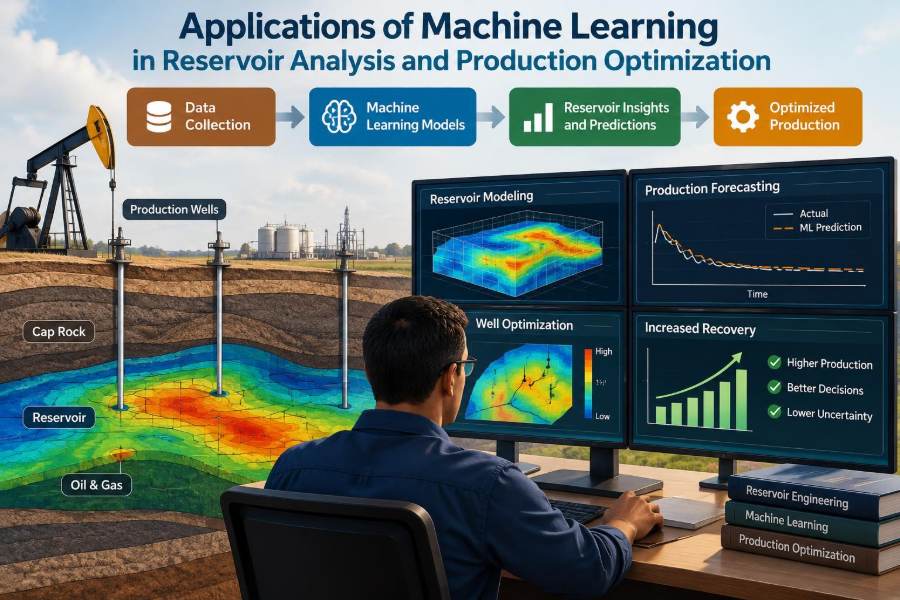
Machine learning can make reservoir analysis and production optimization faster, more systematic, and more responsive to large data streams. It is particularly effective for pattern recognition, forecasting, surveillance prioritization, and rapid approximation of computationally expensive workflows.
Its limits are equally clear: subsurface uncertainty remains, measurements can be wrong, correlations can mislead, and operational constraints cannot be ignored. The strongest applications connect ML outputs to reservoir physics, field knowledge, transparent validation, and accountable engineering decisions.
The most valuable machine-learning system in petroleum engineering is not the one with the most complicated algorithm; it is the one that helps people make safer, better-supported, and economically sensible decisions under uncertainty. 🛢️📊⚙️