
A production well begins delivering less oil than expected. Pressure readings drift, water appears in the stream, and several explanations seem plausible. Is the reservoir losing energy? Is a valve malfunctioning? Has scale formed in the tubing? Or is a measurement misleading the team?
That situation may feel far from everyday life, yet its structure is familiar. A project slips behind schedule, a process produces inconsistent results, or a team is asked to make a costly decision with incomplete information. The hard part is rarely a shortage of ideas. It is deciding what to investigate first, what evidence to trust, and which action is safe to take.
Petroleum engineering is built around such decisions. Engineers work with systems that are hidden underground, operate under high pressure and temperature, involve large capital commitments, and carry meaningful safety and environmental consequences.
The discipline therefore offers more than technical methods for finding and producing hydrocarbons. It provides a practical way to reason when the system is complex, the data are imperfect, and the consequences of being confidently wrong are serious.
🧭 Start With the Real Problem, Not the First Symptom
A falling production rate is a symptom, not a diagnosis. Treating it as proof of one cause can send a team toward an expensive and ineffective intervention.
Petroleum engineers separate the observed condition from the mechanism behind it. For example, low well output may result from reservoir pressure decline, restrictions near the wellbore, liquid accumulation, equipment limits, or an operating constraint at the surface.
The general lesson is simple: state the problem in observable terms before naming its cause. “Customer wait time increased” is better than “the support team is understaffed,” because it leaves room for evidence to reveal the actual constraint.
🔎 Frame the Question So It Can Be Tested
Useful engineering questions are specific enough to guide data collection. Instead of asking, “Why is this well underperforming?” an engineer might ask, “Has the pressure loss between the reservoir and separator increased relative to prior operating conditions?”
A testable question identifies what would count as supporting or conflicting evidence. It also prevents a familiar failure mode: gathering large volumes of data without knowing what decision the data are meant to inform.
- What changed, and when did it change?
- Which measurable variables could explain that change?
- What alternative explanation would produce a similar symptom?
- What decision will this investigation support?
🗺️ See the Whole System Before Optimizing One Part
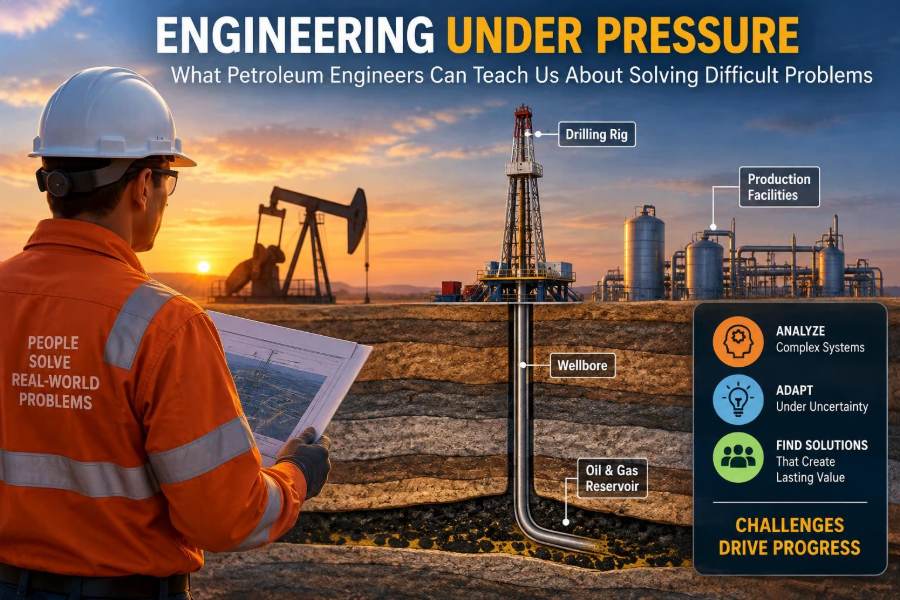
A petroleum production system spans reservoir rock, fluids, wells, pumps or gas lift equipment, flowlines, separators, storage, and export facilities. Improving one element can shift a limitation somewhere else.
Opening a choke may increase a well’s rate, for instance, but it may also lower bottomhole pressure, increase sand-production risk, overload a separator, or disrupt production from nearby wells sharing facilities.
This is systems thinking: local performance is not automatically system performance. Before proposing a fix, map inputs, outputs, constraints, feedback loops, and interfaces. The same discipline matters in supply chains, software platforms, hospitals, and project teams.
🪨 Respect What You Cannot Directly Observe
Reservoirs are thousands of metres below ground. Engineers cannot inspect them directly, so they infer rock and fluid behavior from seismic data, core samples, well logs, pressure tests, production history, and models.
Every source offers a partial view. A core sample gives direct rock information but represents a tiny volume. Production data represent behavior over time but can be influenced by operating changes. No single measurement tells the whole story.
When a problem is partly hidden—such as organizational culture, consumer intent, or a complex biological process—adopt the same humility. Build an explanation from multiple lines of evidence rather than treating one convenient metric as reality.
📏 Measure What Matters, Not Only What Is Easy
Surface rate is easy to see, but it is rarely enough to explain well performance. Engineers also consider pressures, temperatures, fluid composition, water cut, gas-oil ratio, flowing conditions, and equipment status.
The principle applies widely: accessible metrics can become misleading proxies. A team may track number of tasks closed while overlooking rework, customer outcomes, safety exposure, or the growing backlog of hard problems.
Choose measures that connect to the physical or operational mechanism. If the concern is flow restriction, pressure differences across the system can be more informative than rate alone. If the concern is quality, inspect errors at the point where they originate.
📊 Distinguish Signal From Operating Noise
Field data are noisy. Sensor drift, intermittent tests, changing choke settings, separator conditions, and short shutdowns can create apparent trends that do not reflect a lasting reservoir change.
Engineers compare like with like. They check data quality, align time periods, account for operating conditions, and look for patterns across related variables. A rate decline that occurs during reduced flowing pressure means something different from the same decline at comparable conditions.
Do not treat every change as a trend. Before escalating a response, ask whether the observation is repeatable, whether the measurement is credible, and whether a known operating change explains it.
🧪 Use Models as Decision Tools, Not Crystal Balls
Reservoir simulation models represent subsurface geology, fluid flow, wells, and facilities through equations and assumptions. They help compare scenarios such as different well locations, injection strategies, or production limits.
But a model is not the reservoir. Its output depends on inputs that may be uncertain, including permeability distribution, relative permeability, fault behavior, and fluid properties. A visually detailed model can still be wrong in an important way.
Good practice is to use models to test choices: “If this interpretation is broadly correct, what outcomes should we expect?” Then compare those expectations with new field evidence and revise the model when needed.
⚖️ Make Uncertainty Visible
In difficult work, uncertainty does not disappear because a deadline arrives. Petroleum engineers describe ranges, scenarios, and assumptions rather than presenting one forecast as inevitable.
For a development decision, teams may consider lower, central, and higher cases for reservoir volume, well productivity, recovery, cost, and schedule. The purpose is not to avoid commitment; it is to understand what the commitment is exposed to.
A useful uncertainty statement names three things: what is uncertain, why it is uncertain, and what decision it could affect. That is more actionable than vague caution or unjustified precision.
🎯 Separate Consequence From Probability
Some events are unlikely but unacceptable because their consequences are severe. Others occur often but have limited impact. Risk management requires attention to both dimensions.
For example, a minor instrumentation fault may be common and manageable, while loss of containment is designed against with multiple barriers even if it is not expected. Engineers do not rank hazards solely by how often they have occurred.
In nontechnical work, this distinction prevents distorted priorities. A low-probability data breach, a safety-critical error, or a single-point supplier failure may deserve preparation that routine inconveniences do not.
🛡️ Build Layers of Protection
High-hazard operations rely on barriers: engineered equipment, operating procedures, alarms, shutdown systems, inspection, training, and emergency response. No single barrier should carry the entire burden.
This approach recognizes that people, instruments, and hardware can all fail. A pressure relief device, for example, is not a substitute for sound design and disciplined operating limits; it is one layer in a broader defense.
For everyday problem solving, layers may include peer review, version control, backups, approval limits, checklists, and clear escalation paths. Resilience comes from designing for mistakes, not assuming they will never occur.
⏱️ Act Early When Warning Signs Are Cheap
Small anomalies often cost less to investigate than mature failures cost to correct. A gradual pressure deviation, unexpected water trend, or increasing vibration may justify closer monitoring before it becomes a production or integrity problem.
Early action does not mean reacting impulsively to every alarm. It means creating thresholds that trigger proportionate checks, then using evidence to decide whether intervention is needed.
The practical habit is to ask: what leading indicator would appear before the major outcome we are trying to avoid? Track that indicator and give someone clear responsibility for responding to it.
🔧 Diagnose Constraints Before Adding Capacity
When production is lower than desired, adding equipment is an intuitive response. Yet additional pumping power will not solve a restriction in a flowline, and a larger separator will not improve a well limited by poor inflow from the reservoir.
Petroleum engineers use pressure and flow relationships to locate where the largest restriction occurs. The limiting point may move as rates and conditions change, so diagnosis must reflect the current operating state.
This is a powerful general rule: find the bottleneck before funding the solution. More people, software, budget, or effort can simply increase work upstream of the true constraint.
🔄 Understand Feedback Loops
Production decisions can alter the conditions that later determine production. Increasing drawdown—the difference between reservoir pressure and flowing well pressure—may raise short-term rates, yet it can also affect water or gas movement, sanding, coning, or long-term recovery depending on the reservoir.
These are feedback loops: an action changes the system, and the changed system influences later results. They make straight-line thinking unreliable.
When managing any dynamic system, consider both immediate output and second-order effects. Ask what behavior the intervention encourages, what resource it consumes, and which constraint it may tighten later.
💧 Manage Interfaces, Where Many Problems Begin
Petroleum operations involve interfaces between water and hydrocarbons, reservoir and wellbore, steel and corrosive fluids, operator and control system, contractor and site procedure. These boundaries are often where assumptions collide.
Water production can create scaling, corrosion, treatment, and disposal challenges. A handover between teams can lose crucial context. A design may work on paper but become difficult to inspect or maintain in the field.
Look closely at transitions: between departments, stages of a process, data systems, and physical components. Problems commonly emerge not because each individual part is poor, but because the handoff is poorly defined.
🧰 Prefer Reversible Tests When the Stakes Are High
When uncertainty is large, engineers often seek information through controlled tests before committing to a full-scale intervention. A pressure transient test, a production test, or a carefully monitored operating change can help distinguish among competing explanations.
The best test is not necessarily the biggest. It is the one that produces decision-relevant evidence while controlling safety, environmental, and operational risk.
In other settings, reversible pilots serve the same role: trial a workflow with one team, prototype a feature with safeguards, or test a supplier before changing the entire operation. Learning is valuable, but only if the test is designed to answer a real question.
💰 Evaluate Value Over Time, Not Just First Cost
Petroleum projects require choices between spending now and creating value, reducing risk, or avoiding cost later. A cheaper material may have a shorter service life in a corrosive environment. A delayed integrity program may increase future exposure.
Engineers weigh capital expenditure, operating cost, production timing, reliability, abandonment obligations, and uncertainty. The exact economics vary by project, but the discipline is consistent: compare alternatives on a common, lifecycle basis.
A low purchase price is not always a low total cost. Conversely, a more expensive option is not automatically prudent unless it solves a defined problem and its benefits justify the added commitment.
🌍 Treat Environmental Performance as an Engineering Constraint
Responsible petroleum engineering includes managing emissions, produced water, waste, land disturbance, energy use, and the potential for releases. These are not side issues that can be considered after technical design is complete.
For example, equipment selection can affect methane emissions, energy demand, maintenance needs, and reliability. Water-management choices must consider quality, treatment, transport, reuse where feasible, and disposal requirements under applicable regulation.
Constraints often improve design discipline. When environmental limits are explicit early, teams can compare alternatives before a layout, contract, or operating method becomes difficult to change.
👷 Design for the Person Who Must Operate It
An elegant process design can fail operationally if it depends on inaccessible valves, ambiguous displays, excessive manual calculations, or procedures that do not match field conditions.
Human factors engineering considers how people perceive information, make decisions, communicate, and perform tasks under normal and abnormal conditions. It does not excuse poor practice; it makes good practice easier and error traps more visible.
Ask operators, technicians, and maintainers early: Can this be inspected? What alarms are meaningful? Which task is most likely to be misunderstood at 2 a.m.? Their answers often reveal risks that drawings alone cannot show.
🗣️ Make Assumptions Explicit Across Disciplines
Petroleum developments require geoscientists, reservoir engineers, drilling engineers, production engineers, facilities engineers, commercial teams, and field personnel to work from connected assumptions.
A reservoir engineer may forecast a target rate while a facilities engineer sizes equipment around a different fluid composition or pressure range. Neither discipline is necessarily careless; the failure may be that assumptions were not shared and reconciled.
Write down critical assumptions, their owners, their evidence base, and the consequences if they change. Cross-functional reviews work best when they test interfaces rather than merely collect approvals.
📚 Learn From Near Misses, Not Only Failures
A near miss is an event that could have led to harm or loss but did not, often because a barrier worked or conditions happened to be favorable. Treating it as irrelevant wastes useful warning.
Investigations should look beyond “who made the error?” toward conditions that made the error possible: unclear procedures, poor design, inadequate training, conflicting incentives, fatigue, or weak verification.
The goal is learning, not blame avoidance. Accountability still matters, but a system that only punishes visible mistakes encourages people to hide the very information needed to prevent recurrence.
🧠 Challenge the First Plausible Story
Complex systems invite cognitive shortcuts. If a well recently had scale problems, a team may attribute every rate reduction to scale. If a reservoir model has performed well before, people may overtrust its next forecast.
Counter this by deliberately generating alternatives. What else could produce the observation? Which explanation predicts a different measurement? What evidence would make us abandon the favored view?
This is not indecision. It is disciplined skepticism. A short “disconfirming evidence” discussion before a major decision can expose assumptions that would otherwise remain invisible.
🧱 Avoid Optimizing for the Best-Case Scenario
Designs based only on expected conditions can be fragile. Fluid properties vary, equipment degrades, wells behave differently, weather disrupts logistics, and data interpretations evolve.
Engineering margins are not invitations to waste. They are allowances for uncertainty, variability, and the fact that systems must remain safe and functional outside a narrow ideal condition.
The appropriate margin depends on consequence, uncertainty, inspectability, and the ability to recover from failure. A reversible, low-consequence choice can tolerate more experimentation than an irreversible safety-critical one.
🧩 Turn Big Decisions Into Smaller Gates
Field development is often staged. Early data may justify appraisal, which may justify a pilot or initial phase, which can then inform broader development. Each gate asks whether the evidence supports the next commitment.
Staging protects learning. Rather than treating a large decision as one dramatic moment, it links investment to the reduction of specific uncertainties.
Use this method outside engineering by defining what must be true before expanding a program. Name the evidence required, the decision owner, the maximum exposure before review, and the conditions that would stop or redirect the work.
🧮 Document Decisions So They Can Be Revisited Intelligently
Months later, teams often remember a decision but not the assumptions, alternatives, or constraints that shaped it. That makes it difficult to learn when conditions change.
A concise decision record should capture the problem, options considered, evidence used, key uncertainties, selected action, owner, and review trigger. It is not bureaucracy for its own sake; it preserves reasoning.
Documentation also distinguishes a poor outcome from a poor decision. A well-reasoned choice can still encounter an unfavorable outcome under uncertainty. The review should ask whether the process was sound and what information would improve the next choice.
🤝 Communicate Technical Risk Without Hiding Behind Jargon
Decision-makers do not need every equation, but they do need an honest explanation of what drives the recommendation. Terms such as permeability, drawdown, and integrity should be translated into their practical implications.
Strong communication pairs a clear conclusion with the reasoning behind it: what is known, what remains uncertain, what could change the decision, and what happens if no action is taken.
A useful format is: “We recommend this option because it addresses the identified constraint. The main uncertainty is this. We will monitor these indicators. If they cross this threshold, we will reassess.” Clarity supports better oversight.
🚦Know When Not to Intervene
Engineers are trained to solve problems, which can create pressure to act even when evidence is weak. But interventions can introduce new risks, interrupt production, consume capital, and obscure the natural behavior needed for diagnosis.
Watchful waiting is not passivity when it includes defined monitoring, credible thresholds, and a time-bound review. It is an active choice to gather better evidence before changing a system.
The key distinction is between delay without ownership and deliberate observation with a plan. When the risk of waiting is low and the value of information is high, restraint can be the more technical response.
🔁 Treat Operations as Continuous Learning
A reservoir changes as fluids are produced or injected. Equipment ages, operating strategies evolve, and new data alter interpretations. The work is therefore a repeated cycle: observe, interpret, act, monitor, and update.
Static plans fail when they are not connected to feedback. Surveillance programs—regular pressure, rate, fluid, integrity, and equipment checks—help teams recognize whether actual behavior remains consistent with expectations.
This mindset applies to any difficult problem. Implementation is not the end of analysis. It is the beginning of a new evidence stream that should refine the next decision.
🏁 The Core Principle: Think in Systems, Decide With Humility
Petroleum engineering does not eliminate uncertainty, nor does it offer a single formula for difficult choices. Its value lies in combining physical understanding, measurement, risk awareness, operational discipline, and continuous learning.
The strongest problem solvers resist easy stories. They define the observable problem, locate constraints, test assumptions, protect against high-consequence failure, and revise their view when evidence changes.
That approach works whether the system is a reservoir, a manufacturing line, a software service, or a team under pressure. The tools differ, but the habit is durable: make the next decision more informed, more reversible where possible, and safer than the last.
Difficult problems become more manageable when we replace confident guesses with structured observation, explicit uncertainty, and disciplined feedback. Those are lessons worth carrying far beyond the wellsite. 🛢️🧭🔧