
Oil and gas reservoirs are hidden thousands of meters beneath the Earth’s surface, where engineers cannot directly observe how fluids are moving from day to day. Once production begins, pressure changes, oil moves toward wells, gas expands, water may enter the reservoir, and the behavior of each well can change over time.
So how can engineers estimate what a field might produce five, ten, or even twenty years into the future? 🤔
One of the most powerful tools for this task is reservoir simulation.
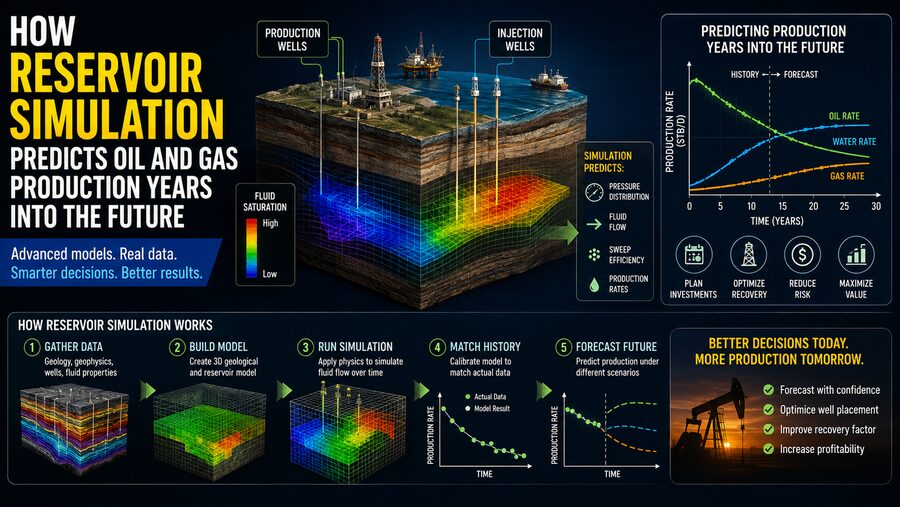
Reservoir simulation uses mathematical equations, geological models, fluid-property data, production history, and numerical computing to create a virtual representation of an underground oil or gas reservoir. Engineers can then use this model to predict how the reservoir may respond to different development strategies.
Instead of physically testing every possible decision underground—which would be enormously expensive and often impossible—engineers can test scenarios inside a computer first. 💻🛢️
🌍 What Is an Oil and Gas Reservoir?
An oil or gas reservoir is not usually a huge underground cavern filled with liquid.
Instead, hydrocarbons are commonly stored inside the tiny pores of porous rocks such as:
- Sandstone
- Carbonate rock
- Dolomite
- Fractured formations
These rocks contain interconnected spaces that can hold:
- Oil
- Natural gas
- Formation water
A useful comparison is a sponge. 🧽
The solid rock forms the structure, while fluids occupy the pores inside it.
For oil or gas to reach a well, those fluids must move through the connected pore spaces.
How easily they move depends on properties such as porosity and permeability.
🪨 Porosity and Permeability
Two geological properties are especially important in reservoir simulation.
🧽 Porosity
Porosity describes how much empty pore space exists within the rock.
For example, a rock with 20% porosity has approximately 20% of its bulk volume occupied by pore space.
Higher porosity generally means the rock can store more fluid.
🚰 Permeability
Permeability describes how easily fluids can flow through the rock.
A reservoir may have high porosity but low permeability if the pores are poorly connected.
Permeability can also vary dramatically across a field.
One area may allow oil to flow easily, while another acts as a barrier.
This geological variation is one of the major reasons reservoir simulation is necessary.
🗺️ Building a 3D Reservoir Model
The first major step in simulation is building a three-dimensional representation of the reservoir.
Geologists and geophysicists combine information from sources such as:
- Seismic surveys
- Well logs
- Core samples
- Pressure measurements
- Fluid samples
- Geological interpretation
The underground reservoir is then divided into many small three-dimensional cells.
This is called a simulation grid.
Conceptually:
Reservoir ➡️ Thousands or millions of grid cells
Each grid cell can contain properties such as:
- Porosity
- Permeability
- Rock type
- Pressure
- Oil saturation
- Gas saturation
- Water saturation
By dividing the reservoir into cells, the simulator can calculate how fluids move from one part of the reservoir to another. 🧩
💧 What Is Fluid Saturation?
A reservoir pore may contain several fluids simultaneously.
The fraction of pore volume occupied by a particular fluid is called its saturation.
For example, a grid cell might contain:
- 60% oil saturation
- 30% water saturation
- 10% gas saturation
These values change during production.
As oil is removed, water may enter the pore space.
Gas may also come out of solution if reservoir pressure falls.
Reservoir simulation tracks these changing saturations throughout the model.
⚙️ The Physics Behind Reservoir Simulation
Reservoir simulators solve equations based on fundamental physical principles.
The most important include:
- Conservation of mass
- Fluid-flow relationships
- Pressure behavior
- Fluid compressibility
- Rock properties
- Phase behavior
One commonly used flow relationship is based on Darcy’s law.
In simplified terms, Darcy’s law says fluid flow through porous rock depends on factors such as:
Flow rate ∝ permeability × pressure difference / fluid viscosity
This means fluid tends to flow more easily when:
- Permeability is high
- Pressure differences are large
- Fluid viscosity is low
A thick heavy oil generally moves less easily than a low-viscosity fluid under the same conditions.
📉 Pressure Drives Production
Reservoir pressure is a major force behind oil and gas production.
When a well is drilled and opened for production, pressure near the well becomes lower than pressure farther inside the reservoir.
Fluids then move toward the lower-pressure region.
Conceptually:
High reservoir pressure ➡️ Flow toward lower well pressure ➡️ Production
As hydrocarbons are removed, average reservoir pressure may decline.
This can reduce future production rates.
A simulator calculates how pressure changes through time and throughout the reservoir.
Different regions may experience different pressure declines depending on well locations and rock connectivity.
⏱️ How a Simulator Predicts the Future
Reservoir simulation proceeds through a series of time steps.
Suppose engineers want to predict production for the next 20 years.
The simulator does not simply jump directly from today to year 20.
Instead, it repeatedly calculates what happens over short intervals.
For each time step, the simulator may:
- 🧮 Calculate pressures in the grid cells.
- 💧 Determine how oil, gas, and water move between cells.
- 🛢️ Calculate production from each well.
- 🔄 Update fluid saturations.
- 📉 Update reservoir pressure.
- ⏭️ Advance to the next time step.
The process repeats thousands of times.
By the end, engineers obtain predicted production curves extending years into the future.
🛢️ Predicting Oil Production
A simulator can estimate the future oil production rate from individual wells and from the entire field.
A typical field may show:
Early years ➡️ High production
Later years ➡️ Declining production
The exact shape depends on:
- Reservoir pressure
- Number of wells
- Well locations
- Permeability
- Fluid properties
- Water influx
- Gas behavior
- Production constraints
The model may forecast both daily production rates and cumulative oil recovered over the field’s life.
🔥 Predicting Gas Production
Gas reservoirs behave differently from oil reservoirs because gas is highly compressible.
As reservoir pressure drops, gas expands significantly.
Gas may also exist dissolved in oil and begin separating when pressure falls below the bubble-point pressure.
A reservoir simulator can model:
- Free gas movement
- Gas expansion
- Gas coming out of solution
- Gas production rates
- Gas-oil ratio changes
This is essential because increasing gas production can dramatically affect field operations and processing requirements.
🌊 Predicting Water Production
Water is another critical part of reservoir forecasting.
Many reservoirs contain water beneath or around the hydrocarbon zone.
As production continues, water can move toward the wells.
Eventually, a producing well may begin bringing significant amounts of water to the surface.
This phenomenon is often called water breakthrough.
A simulator can predict:
- When water may reach a well
- Which wells may experience breakthrough first
- Future water production rates
- Water-cut trends
Water handling can become a major operating cost in mature oil fields, so these predictions are extremely valuable. 💧
💉 Simulating Water Injection
Natural reservoir pressure often declines during production.
To maintain pressure and improve oil recovery, operators may inject water through dedicated wells.
A water-injection project can help push oil toward producing wells.
Conceptually:
Injection well 💧 ➡️ Water moves through reservoir ➡️ Oil is displaced ➡️ Production well 🛢️
But placing an injection well in the wrong location may be ineffective.
Water could travel too quickly through high-permeability channels and reach producers before displacing much oil.
Reservoir simulation helps engineers test alternative injection plans before drilling.
💨 Simulating Gas Injection
Gas can also be injected into reservoirs.
Depending on pressure and fluid properties, injected gas may:
- Maintain reservoir pressure
- Push oil toward producing wells
- Reduce oil viscosity
- Mix with reservoir oil
- Improve hydrocarbon recovery
Some projects inject natural gas, nitrogen, or carbon dioxide.
CO₂ injection is particularly interesting because it may combine enhanced oil recovery with geological carbon-storage objectives. 🌍
Simulation helps determine how injected gas is likely to spread through the reservoir.
🕳️ Where Should New Wells Be Drilled?
Drilling a new well can cost millions or tens of millions of dollars, especially offshore.
Choosing the location carefully is therefore critical.
Engineers can place hypothetical wells inside the reservoir model and simulate their future performance.
For example:
Scenario A: Drill one well in the north.
Scenario B: Drill two wells in the central region.
Scenario C: Add one producer and one injector.
The simulator predicts how much oil or gas each strategy could recover.
Engineers can then compare the economic value of the options.
↔️ Horizontal Wells in Reservoir Models
Modern fields frequently use horizontal wells.
Instead of entering the reservoir vertically at one location, a horizontal well travels through the productive formation for hundreds or thousands of meters.
This increases contact with the reservoir.
Simulation can help optimize:
- Well orientation
- Horizontal length
- Well spacing
- Completion intervals
- Production rates
In unconventional reservoirs such as shale formations, simulation may also incorporate hydraulic fractures.
🧱 Modeling Faults and Geological Barriers
Real reservoirs are rarely uniform.
They may contain:
- Faults
- Shale layers
- Fractures
- High-permeability channels
- Low-permeability barriers
A geological fault might block flow completely or allow partial communication between two regions.
These details can dramatically influence production.
For example, two wells located relatively close together may behave very differently if a sealing fault lies between them.
Reservoir simulation lets engineers represent these geological complexities explicitly.
📚 What Is History Matching?
One of the most important stages of reservoir simulation is history matching.
Before trusting a model to predict the future, engineers test whether it can reproduce the field’s known past behavior.
Suppose a field has been producing for five years.
Engineers know historical data such as:
- Oil rates
- Gas rates
- Water rates
- Bottom-hole pressure
- Well shut-ins
- Injection volumes
The simulator is run over those same five years.
If the model predicts values very different from the actual field data, something in the model may need adjustment.
Engineers may revise uncertain properties such as permeability, fault behavior, aquifer strength, or relative permeability.
The objective is to create a model that reasonably reproduces observed reservoir behavior.
🎯 Why History Matching Matters
Imagine a model predicts that a particular well should produce 5,000 barrels per day, but the real well has consistently produced only 1,500.
That mismatch may indicate that:
- Permeability is overestimated
- A geological barrier is missing
- Well productivity is incorrect
- Fluid properties are inaccurate
- Pressure support is weaker than expected
By investigating these mismatches, engineers improve their understanding of the reservoir.
A model that matches the past is not guaranteed to predict the future perfectly, but historical agreement provides an important level of confidence.
📊 Running Multiple Future Scenarios
Once a reservoir model has been calibrated, engineers can test many development strategies.
Examples might include:
- Continue current production
- Drill five additional wells
- Increase water injection
- Reduce pressure in selected producers
- Add gas injection
- Shut down high-water-producing wells
- Install artificial lift
- Change injection patterns
Each scenario produces different predictions.
Engineers compare:
- Oil recovery
- Gas production
- Water production
- Reservoir pressure
- Project cost
- Revenue
- Net present value
Reservoir simulation therefore connects subsurface engineering with business decision-making. 💰
🎲 Reservoir Predictions Contain Uncertainty
No reservoir model is a perfect representation of reality.
Engineers only have direct information from a limited number of wells.
Large regions between those wells must be inferred using geological and geophysical data.
Important uncertainties may include:
- Reservoir size
- Permeability distribution
- Fault transmissibility
- Aquifer strength
- Fluid contacts
- Relative permeability
- Well productivity
Rather than relying on only one model, engineers may create multiple plausible reservoir models.
These are sometimes called realizations.
Each realization represents a different possible interpretation of the underground geology.
📉 Low, Medium, and High Forecasts
By simulating multiple geological possibilities, engineers can generate a range of future production outcomes.
For example:
Low case: 150 million barrels recovered
Expected case: 220 million barrels recovered
High case: 290 million barrels recovered
This approach is more realistic than claiming that one simulation provides a perfectly certain prediction.
Reservoir forecasting is fundamentally probabilistic because the underground system cannot be known completely.
🖥️ Why Reservoir Simulations Require Powerful Computers
A detailed reservoir model may contain millions of grid cells.
For every time step, the simulator may need to calculate:
- Pressure
- Oil saturation
- Gas saturation
- Water saturation
- Fluid flow between neighboring cells
- Well production
- Phase behavior
These equations are strongly interconnected.
Changing pressure in one cell can influence nearby cells, which can influence others throughout the reservoir.
Large simulations therefore require substantial computational power.
Modern reservoir simulators often use:
- Multicore processors
- Parallel computing
- High-performance computing clusters
- GPU acceleration in some workflows
This allows engineers to test many scenarios more quickly. ⚡
🤖 Machine Learning and Reservoir Simulation
Machine learning is increasingly used alongside traditional reservoir simulation.
A full physics-based simulation may require significant computational time.
Engineers can sometimes train reduced-order or data-driven models using results from many previous simulation runs.
These faster models can help evaluate large numbers of scenarios.
Machine learning may assist with:
- History matching
- Parameter optimization
- Production forecasting
- Well-placement screening
- Uncertainty analysis
However, physics-based simulation remains important because reservoir behavior is governed by physical conservation laws and complex fluid interactions.
🧪 Different Types of Reservoir Simulators
Different reservoirs require different physical models.
A black-oil simulator is commonly used when oil, water, and gas behavior can be described using simplified phase relationships.
A compositional simulator tracks individual hydrocarbon components more explicitly.
This is useful when fluid composition changes significantly, especially during gas or CO₂ injection.
Thermal simulators may be used for heavy-oil recovery methods involving heat or steam.
The correct simulator depends on the reservoir and recovery process being studied.
📈 What Does a Production Forecast Look Like?
A typical simulation result may show production rate versus time.
For example:
Oil Rate
│\
│ \
│  \____
│       \____
│            \__
└────────────────── Time
Production may rise as new wells are added and then decline as reservoir pressure falls and fluids become depleted.
Other plots can show:
- Reservoir pressure versus time
- Water cut versus time
- Gas-oil ratio
- Cumulative production
- Recovery factor
These forecasts help engineers and managers plan future facilities and investments.
🏗️ Reservoir Simulation Helps Design Surface Facilities
Production forecasts do more than estimate how much oil may ultimately be recovered.
They also tell engineers how much fluid surface facilities may need to handle.
A field development could require:
- Oil separators
- Gas compressors
- Water-treatment plants
- Pipelines
- Storage systems
- Injection pumps
If gas production is expected to increase sharply after five years, compression equipment may need to be designed accordingly.
If water production is predicted to become enormous, sufficient water-treatment capacity will be necessary.
Subsurface simulation therefore affects major infrastructure decisions above ground.
⚠️ Simulation Is a Model, Not a Crystal Ball
Reservoir simulation is extremely powerful, but its predictions are not guaranteed.
The simulator solves the equations it is given using the geological and fluid information provided.
If those inputs are wrong or incomplete, the forecast can also be wrong.
A useful engineering principle is:
Better data ➡️ Better model ➡️ Better forecast
As new wells are drilled and additional production data becomes available, reservoir models are updated.
Forecasts therefore evolve throughout the life of a field.
🔄 Reservoir Models Are Continuously Updated
Suppose a simulator predicts that water will reach a well in year seven.
Instead, the real well starts producing water in year four.
That new information tells engineers something important about underground connectivity.
Perhaps a high-permeability channel exists that was not previously recognized.
The model can be updated, history matched again, and used to produce a revised forecast.
Reservoir simulation is therefore not usually a one-time activity.
It is a continuous cycle:
Collect data ➡️ Update model ➡️ Match history ➡️ Forecast ➡️ Observe field ➡️ Repeat
🌟 The Bigger Picture
Reservoir simulation allows engineers to predict how a hidden underground oil or gas field may behave years into the future by creating a numerical representation of its geology, fluids, wells, and physical flow processes.
The simulator divides the reservoir into many grid cells and calculates how pressure and fluid saturation change through time.
Using physical relationships such as conservation of mass and Darcy’s law, it estimates how oil, gas, and water move through porous rock and into wells.
Historical production data is used to calibrate the model through history matching, while future scenarios allow engineers to test different development strategies.
A reservoir simulation might answer questions such as:
- 🛢️ How much oil could the field ultimately produce?
- 🕳️ Where should the next well be drilled?
- 💧 When will water breakthrough occur?
- 💉 Would water injection improve recovery?
- 💨 Would gas or CO₂ injection be worthwhile?
- 📉 How quickly will production decline?
- 🏗️ How large should future processing facilities be?
The power of reservoir simulation comes from combining geology, physics, mathematics, engineering, and high-performance computing into one predictive framework. 🧠💻
It cannot eliminate uncertainty, because no engineer can observe every detail of a reservoir buried kilometers underground. But it allows uncertainty to be explored systematically and gives decision-makers a much clearer picture of possible future outcomes.
In an industry where a single well can represent a major investment, being able to test the future virtually before committing equipment and capital in the real world makes reservoir simulation one of the most valuable tools in petroleum engineering. 🛢️📊🌍