
An oil well can appear healthy for years: oil flows steadily, water production is manageable, and surface facilities operate within their design range. Then the produced-water rate climbs sharply. Oil output falls, lifting and treatment costs rise, and the well that once looked profitable becomes difficult to operate.
One possible explanation is water coning. The name describes a physical shape that develops below the well: water from an underlying aquifer is pulled upward toward the producing interval, forming a cone-like crest.
This is not simply a case of “water arriving early.” It is a competition between the pressure drawdown created by production and the natural tendency of fluids to remain arranged by density, with water below oil.
Understanding that competition helps engineers choose sensible rates, interpret surveillance data, and avoid expensive responses that treat the symptom while missing the reservoir mechanism.
💧 What Water Coning Means
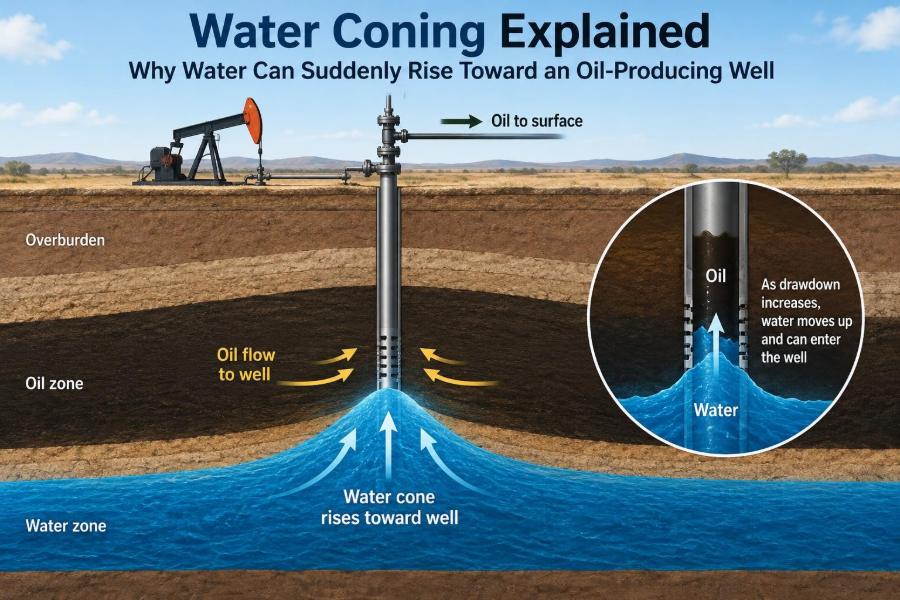
Water coning is the upward deformation of the oil-water contact near a producing well. In a reservoir with oil above water, producing oil lowers pressure around the wellbore. That local pressure reduction pulls nearby fluids toward the completion.
If the upward pull is strong enough, water rises beneath the well faster than gravity can keep the oil-water contact relatively flat. The water crest may eventually reach the perforations, causing water breakthrough.
The word “cone” is useful but simplified. In real reservoirs, the shape may be asymmetric, finger-like, or constrained by layering and faults. The central idea is localized upward water movement driven by production.
🧭 The Starting Point: Oil Above Water
Many oil reservoirs have an underlying aquifer, a water-bearing rock volume connected to the oil-bearing zone. Because water is generally denser than oil, gravity tends to place water below oil, separated by an oil-water contact.
At equilibrium, that contact need not be perfectly horizontal at every scale, but it is governed by hydrostatic pressure and capillary forces. Away from a producing well, the arrangement can remain stable for a long time.
Production changes the local balance. A well does not remove oil uniformly from an entire field; it creates its strongest pressure disturbance close to the wellbore.
⚖️ Drawdown Versus Gravity
Drawdown is the difference between reservoir pressure and flowing pressure near the well. It is the driving force that moves fluids through porous rock into the well.
Higher drawdown usually increases production rate, but it also intensifies the vertical pressure gradient below the completion. Gravity resists this movement because lifting denser water upward requires energy.
Water coning begins when the production-induced force near the well becomes large enough to overcome the stabilizing gravitational tendency. It is therefore a rate-sensitive problem, not merely a property of how much water exists in the reservoir.
🪨 Why Permeability Controls the Response
Permeability measures how readily rock transmits fluids. In a highly permeable vertical pathway, water can move upward with relatively little resistance. In lower-permeability rock, the same pressure difference may create a smaller or slower response.
Vertical permeability is especially important. Engineers often refer to the permeability ratio, comparing vertical permeability with horizontal permeability. A reservoir that flows easily sideways but poorly upward can be more resistant to coning than one with strong vertical communication.
Thin shale layers, cemented streaks, and other barriers can slow water movement. But a discontinuous barrier may be bypassed through a more permeable window elsewhere.
📏 Completion Distance Matters
The vertical distance between the lowest open perforation and the original oil-water contact is one of the most practical coning variables. More separation gives the water crest farther to travel before reaching the well.
That extra distance is not a guarantee of long water-free production. Strong drawdown, high vertical permeability, or a changing regional contact can still bring water upward. Yet, all else equal, completing higher above the contact generally provides a larger operating margin.
Completion placement is therefore a reservoir decision, not just a mechanical one. The most productive-looking interval may not be the most resilient interval.
🛢️ Why Higher Rates Can Trigger Breakthrough
Increasing a well’s rate lowers flowing pressure near the wellbore and steepens the pressure gradients that draw fluids inward. Initially, the extra oil rate can look attractive because the response is immediate.
Below the perforations, however, the water crest may be rising. Once it reaches the completion, water can enter rapidly because water is often mobile in the swept zone. The oil rate may then decline as water occupies more of the flow capacity.
This is why an aggressive rate increase can have delayed consequences. A short production test may not reveal the longer-term movement of the oil-water contact.
⏱️ Why the Water Increase Can Seem Sudden
Coning usually develops over time, but the surface signal can look abrupt. Before breakthrough, the water crest remains below the perforations and contributes little direct water inflow. After contact is made, a connected water pathway can deliver substantial water.
The transition may be especially sharp in a high-permeability interval or where the well has a short, efficient path from the crest to an open perforation. Surface measurements also average flow over time, which can hide early changes.
“Sudden” water production does not automatically prove coning. It describes the observed behavior, while diagnosis must distinguish among several possible water-entry mechanisms.
🔍 Coning, Cusping, and Water Cresting
These terms are sometimes used loosely. Water coning commonly describes a three-dimensional upward deformation around a vertical well. Cusping may describe a sharper local upward shape, particularly in simplified cross-sectional discussions.
Water cresting is a broader phrase for the upward movement of the water interface toward a completion. In horizontal wells, the interface may rise unevenly along the well length rather than form one symmetric cone.
The vocabulary matters less than the flow geometry. Engineers need to know where water enters, whether it is connected to an aquifer, and which pressure gradients are controlling the movement.
➡️ Water Coning Is Not the Same as Channeling
Channeling occurs when injected or formation water moves preferentially through a high-permeability pathway, fracture, fault, thief zone, or poor cement channel. It can reach a well much faster than the average reservoir movement would suggest.
Coning is primarily a near-wellbore response to vertical drawdown against gravity. Channeling is primarily a preferential-flow-path problem, although both mechanisms can coexist.
| Feature | Water coning | Water channeling |
|---|---|---|
| Main driver | Localized drawdown near the well | Fast flow through a preferential path |
| Typical geometry | Upward movement from below | Directional movement along a streak, fracture, or leak |
| Key question | Is the completion pulling water upward? | Where is water bypassing normal reservoir flow? |
🧱 Reservoir Heterogeneity Changes Everything
Textbook coning models often assume uniform rock properties. Real reservoirs rarely behave that neatly. Sand bodies may contain thin high-permeability layers, shale breaks, inclined bedding, natural fractures, and changes in pore structure.
A water crest can advance faster through one vertical corridor than another. Consequently, a well may produce water from only part of a perforated interval while nearby intervals remain predominantly oil-bearing.
Heterogeneity makes predictions uncertain, but it also creates opportunities. A well-resolved entry profile can support selective interventions instead of treating the entire completion as uniformly watered out.
🌊 Aquifer Strength and Water Support
An active aquifer can help maintain reservoir pressure as oil is produced. This water support may improve recovery by replacing produced fluid volume and reducing the pressure decline that would otherwise occur.
That benefit comes with a trade-off. A strong, well-connected aquifer provides an available water source beneath the oil column. If wells are completed too close to the contact or produced too aggressively, the support can become an early water-production problem.
Aquifer strength alone does not determine coning. Connection, reservoir geometry, completion depth, and operating rate all influence the result.
🧪 Relative Permeability Shapes Fluid Competition
Oil and water share pore space, but they do not flow with equal ease at every saturation. Relative permeability describes how effectively each fluid flows when other fluids are present.
As water saturation rises near a well, water relative permeability may increase while oil relative permeability falls. This can make the production response nonlinear: modest additional water saturation may lead to a disproportionate increase in water flow.
Wettability, rock type, and saturation history influence these relationships. For that reason, a generic coning equation should never replace reservoir-specific fluid and rock data where decisions carry significant value.
🧲 Capillary Pressure Adds a Smaller-Scale Effect
Capillary pressure arises from surface tension and the tendency of fluids to occupy different pore sizes. It affects the transition zone between mostly oil-bearing and mostly water-bearing rock.
In fine-grained rock, the transition zone can be thick, meaning water saturation may increase gradually above the nominal oil-water contact. In coarser rock, the transition can be sharper.
Capillary effects do not eliminate coning, but they influence the initial fluid distribution and the way water saturation changes as the interface moves. They are particularly relevant when completion decisions are made close to the contact.
🕳️ Vertical Wells and Horizontal Wells Behave Differently
Vertical wells concentrate inflow around a relatively short interval, often producing a localized water cone below the perforations. Completion depth and drawdown are central design variables.
Horizontal wells spread inflow across a longer reservoir distance, which can reduce local drawdown when the load is distributed evenly. This can delay coning in favorable settings.
However, horizontal wells can experience heel-toe effects, where pressure and inflow differ along the wellbore. Water may crest first at a localized segment, so a horizontal well is not automatically protected from water encroachment.
📉 Water Cut Is the Surface Warning Signal
Water cut is the fraction of produced liquid that is water. A rising water cut means the well is producing a larger share of water relative to oil, but it does not by itself identify the source.
Engineers examine the trend alongside oil rate, total liquid rate, flowing pressure, choke changes, and nearby well behavior. A sharp water-cut increase after a rate increase can be consistent with coning, while a step change after mechanical work may point elsewhere.
Water-cut data are valuable because they are routinely available. Their limitation is that they are a surface-level symptom rather than a direct image of downhole flow.
📊 Rate History Often Tells a Story
Production history should be reviewed as a sequence, not as isolated monthly values. Did water rise after the well was opened wider? Did it respond after artificial lift was intensified? Was there a prolonged shut-in before the change?
A hypothetical example illustrates the logic: a well produces at a stable liquid rate with low water cut, then is placed on a substantially larger drawdown. If water cut rises soon afterward while neighboring wells remain stable, localized coning becomes a reasonable hypothesis to test.
That is still not proof. A rate-history correlation is a diagnostic clue, not a substitute for downhole evidence.
🧰 Downhole Diagnostics Locate the Entry Point
Production logging tools can help identify where oil, water, and gas enter a wellbore. Temperature, noise, spinner, density, and holdup measurements may reveal active inflow zones or behind-pipe movement, depending on the completion and tool selection.
Other useful evidence can include pulsed-neutron logs for saturation changes, pressure surveys, and cased-hole integrity evaluations. The appropriate program depends on well construction, reservoir uncertainty, and the decision that the data must support.
Diagnostics cost time and money, but blind water shutoff treatments can cost more when water is entering through an unrecognized path.
🧱 Mechanical Problems Can Mimic Coning
Not all unexpected water comes through the reservoir face. Leaks in tubing, failed packers, poor cement isolation, or flow behind casing can allow water from another interval to reach the production stream.
These failures can produce a sudden water increase and may be incorrectly labelled as coning if the well also sits above an aquifer. The remedy is very different: mechanical isolation or repair rather than simply reducing the production rate.
A careful diagnosis asks two separate questions: where is the water entering the wellbore? and what reservoir or mechanical route brought it there?
🚦 The Critical Rate Concept
The critical rate is commonly described as the highest production rate that avoids water breakthrough under specified reservoir assumptions. It is useful because it links operating rate to coning risk.
In practice, it is not a universal fixed number. It depends on fluid densities, anisotropy, completion location, mobility, well geometry, boundaries, and the time horizon considered. A rate that is safe for a brief period may not be safe over years.
Simple analytical estimates are helpful for screening and intuition. Reservoir simulation and field surveillance are often needed when investment or operating decisions depend on a narrow margin.
🧮 Why Simple Equations Have Limits
Analytical coning models usually make simplifying assumptions: homogeneous rock, ideal geometry, stable fluid properties, and clean communication between layers. They may not capture fractures, partial penetration, complex completions, or changing operating conditions.
Use these models to ask structured questions: Does greater separation help? Does reducing rate plausibly delay breakthrough? Which variables deserve more data? Do not use a single calculated critical rate as an unquestionable operating limit.
Model uncertainty should be visible in the decision process. A range of plausible outcomes is often more informative than one precise-looking answer.
🖥️ Reservoir Simulation Tests Scenarios
A numerical reservoir model can represent layered permeability, anisotropy, aquifer connection, relative permeability, multiple wells, and evolving pressure. Engineers can compare completion locations and rate strategies before applying them in the field.
Simulation is most credible when it is calibrated against production, pressure, fluid-contact, and surveillance data. A detailed model built on weak inputs can still produce misleadingly confident forecasts.
The practical value is scenario comparison rather than prediction theater. For example, a model may show whether distributing a target field rate across several wells causes less water risk than forcing the same liquid rate through one low-lying completion.
🎛️ Rate Management Is Often the First Lever
If coning is suspected and the well remains economically valuable, reducing drawdown is often the first response. This can mean lowering choke size, adjusting pump settings, or changing gas-lift operation.
A lower liquid rate may reduce water production and improve oil efficiency, but it also reduces immediate throughput. The best setting is an economic and reservoir-management decision, not necessarily the lowest possible water cut.
Rate reduction may stabilize a cone or slow its growth. It may not reverse a mature water channel or restore oil flow if the watered interval has already become the dominant inflow path.
🧩 Selective Completion and Isolation Options
When water entry is localized, selective shutoff may be considered. Depending on the completion, options include mechanical plugs, bridge plugs, cement squeezes, straddle systems, packers, sleeves, or zonal isolation devices.
These methods work best when the water-entry interval is clearly identified and the isolation can be placed without sacrificing too much productive oil pay. In layered reservoirs, shutting off the wrong interval can damage valuable oil production.
Some wells are designed with future selectivity in mind. Segmented completions and controllable inflow devices can provide more flexibility than a long, commingled open interval.
🧫 Chemical Treatments Need a Specific Target
Polymer gels, resins, and other conformance chemicals may be used in selected water-control applications. Their purpose is generally to reduce water mobility in a particular path, not to perform a universal cure for water production.
Chemical placement is difficult. A treatment that enters the most permeable route may reduce water flow, but it can also impair oil productivity if it invades the wrong zone or cannot be confined.
Before selecting a chemical approach, engineers need a credible mechanism, compatible fluid and rock information, and a realistic plan for placement and verification. “Water shutoff” is an objective, not a diagnosis.
🧯 Artificial Lift Can Influence the Problem
Artificial lift does not cause water coning by itself, but changing pump intake pressure or gas-lift performance can change well drawdown. A more aggressive lift setting may pull harder on the reservoir and accelerate water entry.
Conversely, inefficient lifting can allow fluid loading and suppress oil production even when the reservoir could deliver oil. The operational task is to match lift performance to an appropriate reservoir drawdown.
Reservoir and production engineers should evaluate lift changes together. Treating lift optimization and water management as separate problems can produce conflicting decisions.
🏗️ Surface Facilities Feel the Consequences
Produced water must be separated, treated, handled, reinjected, or disposed of under the field’s operating and regulatory framework. Higher water volumes can consume separator capacity, pumping power, chemicals, and disposal capacity.
Water can also worsen scaling, corrosion, emulsion handling, and solids-management challenges, depending on its chemistry. The economic impact is therefore broader than the lost oil fraction at the wellhead.
A well may still flow substantial liquid while contributing little useful oil. Looking only at gross liquid production can hide that operational burden.
💰 The Economic Decision Is Not Always “Cut Water”
A high-water-cut well is not automatically uneconomic. If it produces enough oil, has available water-handling capacity, and supports broader reservoir objectives, continued operation may be justified.
Likewise, a low-water-cut strategy is not automatically optimal if it sacrifices disproportionate oil value or leaves infrastructure underused. Decisions should compare incremental oil, water-handling cost, intervention risk, deferred production, and reservoir effects.
The relevant question is often: what operating condition creates the best value while preserving future options? That answer can differ between mature fields, offshore facilities, and constrained onshore operations.
⚠️ Common Mistakes in Water-Coning Decisions
- Calling every water increase coning: mechanical leaks and channeling require different remedies.
- Using only water cut: rates, pressures, completion history, and entry profiles provide essential context.
- Chasing maximum short-term liquid rate: this can create drawdown that harms longer-term oil performance.
- Trusting a single critical-rate estimate: real reservoirs rarely satisfy every analytical assumption.
- Applying shutoff treatment without entry diagnosis: poor placement can sacrifice oil while leaving the water source active.
🧠 A Practical Diagnostic Workflow
- Confirm data quality for oil, water, gas, pressure, and operating changes.
- Review completion depth, original fluid contacts, nearby wells, and aquifer interpretation.
- Compare water behavior with rate and drawdown history.
- Screen plausible mechanisms: coning, channeling, advancing contact, or mechanical crossflow.
- Use downhole surveillance when the intervention decision warrants it.
- Test rate-management or isolation scenarios, then monitor the response.
This workflow does not eliminate uncertainty. It reduces the risk of acting on the first convenient explanation.
🧭 Designing Wells to Reduce Future Risk
Prevention begins before first production. Reservoir characterization should define fluid contacts, transition-zone thickness, vertical permeability, barriers, and aquifer behavior as well as the data allow.
Completion strategy can then balance productivity against water risk. Useful choices may include leaving vertical standoff above the contact, avoiding unnecessary perforations near the transition zone, using selective zones, and planning surveillance access.
For development planning, well spacing and aggregate field offtake also matter. Several wells can interact through shared pressure depletion and water movement even if each one appears acceptable in isolation.
🔄 Can a Water Cone Recede?
Reducing drawdown or shutting in a well can allow pressure gradients to relax, and gravity may encourage the water crest to move downward over time. The degree of reversal depends on reservoir mobility, capillary effects, heterogeneity, and how far the water has advanced.
In a simple, clean system, recovery of the interface may be meaningful. In a heterogeneous reservoir, water may remain in high-permeability paths or altered saturation regions, so the production response after restart can differ from the original state.
For this reason, a shut-in is sometimes diagnostic as well as operational. Its result should be interpreted carefully rather than assumed to prove one mechanism.
🎯 The Core Principle to Remember
Water coning is fundamentally a balance problem. A producing well creates drawdown that pulls fluids inward; gravity and rock-fluid behavior resist the upward movement of water beneath the oil zone.
Risk increases when wells are completed close to the oil-water contact, produced at high drawdown, connected vertically through permeable rock, or supported by a strong water source. But no single variable tells the whole story.
The most reliable response combines reservoir understanding, production trends, targeted diagnostics, and proportionate intervention. Manage the pressure gradient, identify the real water path, and avoid treating a complex reservoir response as a one-number problem.
Water coning is best managed by balancing production ambition with the reservoir’s ability to keep water below the completion. That balance protects oil recovery, operating flexibility, and the value of information gained from each well. 🛢️💧📈