
When an oil reservoir is first discovered, underground pressure often helps push hydrocarbons naturally toward production wells. Over time, however, producing oil and gas removes fluids from the reservoir and causes that pressure to decline. As pressure falls, production rates usually decrease, and a significant amount of oil can remain trapped in the porous rock.
One of the most widely used methods for improving recovery is waterflooding. 🛢️💦
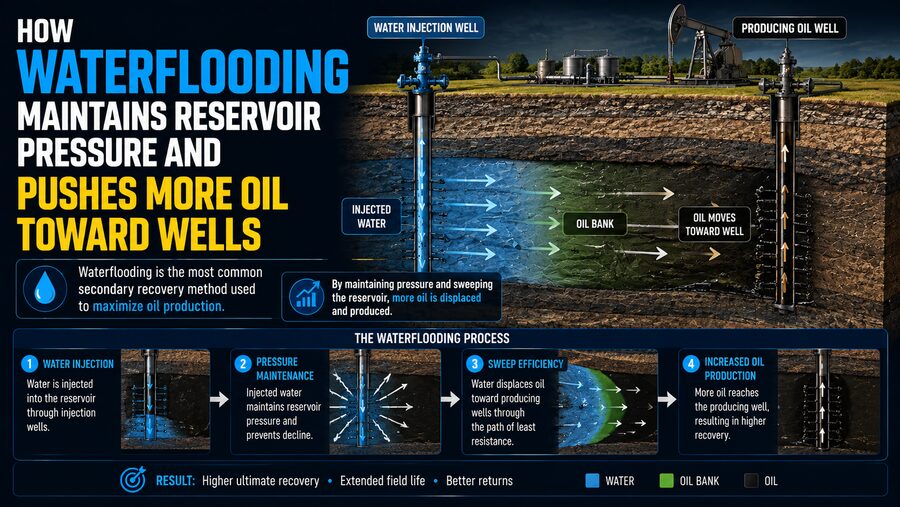
Waterflooding is a form of secondary oil recovery in which water is injected into a reservoir through dedicated injection wells. The injected water helps replace some of the fluid volume being withdrawn, supports reservoir pressure, and physically displaces oil through the rock toward producing wells.
The concept sounds simple—inject water and push oil—but successful waterflooding depends on reservoir geology, fluid properties, well placement, injection pressure, water quality, and careful monitoring.
🪨 Understanding an Oil Reservoir
An underground oil reservoir is not usually a giant open cavern filled with liquid.
Instead, oil occupies extremely small spaces called pores within permeable rock such as sandstone or carbonate formations.
These pores may also contain:
- 💧 Formation water
- 🛢️ Crude oil
- 🔥 Natural gas
If the pores are sufficiently interconnected, fluids can move through the rock.
The ability of a rock to transmit fluids is called permeability.
Its ability to contain fluids is related to porosity.
For oil to reach a production well, it must flow through these connected pore spaces under a pressure gradient.
📉 Why Reservoir Pressure Declines
Before production begins, a reservoir may exist under substantial natural pressure.
When a well is opened, the pressure near the well becomes lower than the pressure farther into the reservoir.
This pressure difference drives oil toward the well.
As oil is continuously removed, however, the reservoir loses fluid and energy.
Unless natural mechanisms replace enough of that energy, average reservoir pressure declines.
Possible natural reservoir-drive mechanisms include:
- Expansion of oil and dissolved gas
- Gas-cap expansion
- Natural water influx
- Rock and fluid compressibility
Eventually, natural energy may no longer be sufficient to maintain desirable production rates.
This is where water injection becomes useful.
💦 What Is Waterflooding?
Waterflooding involves injecting water into selected wells while producing oil from other wells.
The injection wells and production wells are connected through the same reservoir rock.
As water enters the formation, it raises or supports pressure around the injection area.
The injected water also moves through the pore network.
As it advances, it displaces some of the oil occupying the pore spaces and directs that oil toward production wells.
A simplified sequence is:
Injection well → Water enters reservoir → Reservoir pressure supported → Oil displaced through pores → Oil reaches production well
The produced fluids at the production well may eventually contain both oil and water.
⚡ How Waterflooding Maintains Reservoir Pressure
The pressure-support role of waterflooding is extremely important.
Imagine repeatedly removing liquid from a sealed container.
As material is removed, internal pressure can fall.
If another liquid is introduced while production continues, some of the lost volume is replaced.
A reservoir is vastly more complex than a simple container, but the principle is similar.
Injected water helps compensate for the volume of fluids removed during production.
This reduces the rate at which reservoir pressure declines.
Maintaining pressure provides several benefits:
- Sustains oil flow toward wells
- Helps maintain production rates
- Preserves reservoir energy
- Can reduce unwanted gas liberation in some oil systems
- Improves the amount of reservoir contacted by displacement
Engineers carefully monitor how much fluid is injected relative to how much reservoir fluid is produced.
🛢️ How Water Actually Pushes Oil
Inside reservoir rock, both oil and water move through microscopic interconnected channels.
When injection begins, water enters pore spaces near the injector.
The flowing water creates a pressure gradient toward production wells.
As the water front advances, it pushes and redirects oil ahead of it.
Imagine slowly injecting water into one side of a sponge containing oil.
The new water occupies some pore spaces and forces part of the oil toward another side.
The reservoir behaves much more complexly because pore sizes, rock properties, and fluids vary, but the analogy illustrates the basic mechanism.
Waterflooding therefore acts as both:
Pressure support + fluid displacement
These two effects help increase oil recovery.
🧲 Why Water Does Not Remove All the Oil
Even after water passes through a portion of the reservoir, some oil remains trapped.
Capillary forces can hold tiny droplets of oil within pore spaces.
Surface chemistry and rock wettability also influence how easily oil moves.
The remaining oil after water displacement is often described using residual oil saturation.
This means waterflooding cannot normally recover every drop of oil.
Its effectiveness depends partly on how efficiently water can displace oil at the microscopic pore scale.
🔬 Microscopic Displacement Efficiency
Microscopic displacement efficiency describes how effectively injected water removes oil from the pores it actually contacts.
Several factors influence it, including:
- Oil viscosity
- Water viscosity
- Interfacial tension
- Rock wettability
- Capillary pressure
- Pore geometry
If oil strongly adheres to rock surfaces or becomes trapped as isolated droplets, water may flow around it rather than removing it.
This is one reason enhanced oil recovery methods may later be considered after conventional waterflooding.
🗺️ What Is Sweep Efficiency?
Water may efficiently displace oil in one small region but completely miss another.
The fraction of the reservoir reached by injected water is related to sweep efficiency.
There are two important concepts.
↔️ Areal Sweep Efficiency
Areal sweep describes how much of the reservoir’s horizontal area is contacted by injected water.
Poor well spacing or uneven permeability can cause water to travel preferentially through only part of the reservoir.
↕️ Vertical Sweep Efficiency
Vertical sweep describes how effectively water moves through the reservoir’s thickness.
If one rock layer is highly permeable while another is tight, injected water may mainly travel through the high-permeability layer.
Oil in the less permeable layer can remain largely untouched.
Good waterflood design tries to maximize both areal and vertical sweep.
🚰 Injection Wells and Production Wells
Waterflooding requires a planned arrangement of wells.
Some wells are converted to injectors, while others remain producers.
Water is pumped down the injection wells and enters the reservoir through selected perforated intervals.
Oil and water move toward nearby production wells.
The arrangement of injectors and producers is called the well pattern.
Choosing an appropriate pattern helps control how the flood front moves through the reservoir.
🔷 Common Waterflood Patterns
Several well arrangements are used in practice.
A common design is the five-spot pattern.
In a simplified five-spot arrangement, one type of well is placed at the center and the opposite type is positioned around it at the corners of a square pattern.
Other configurations include:
- Line-drive patterns
- Seven-spot patterns
- Nine-spot patterns
- Peripheral injection
- Irregular patterns adapted to geology
The best pattern depends on reservoir shape, existing wells, faults, permeability, and economics.
🌊 Peripheral Water Injection
Some fields use peripheral injection.
Instead of placing injectors throughout the central productive area, water is injected around the edges of the reservoir.
The objective is to move oil inward toward production wells and provide broad pressure support.
This approach can be particularly useful where reservoir geometry and natural aquifer behavior make edge-water displacement favorable.
🧪 Where Does Injection Water Come From?
Water used for flooding can come from several sources.
Possible sources include:
- Produced formation water
- Seawater
- Freshwater
- Brackish groundwater
- Treated industrial water
Offshore oil fields commonly have access to large quantities of seawater.
However, water generally cannot simply be pumped directly into a reservoir without treatment.
Its chemistry and cleanliness must be controlled.
🧼 Why Injection Water Must Be Treated
Poor-quality injection water can damage the reservoir or equipment.
Possible problems include:
- Suspended solids blocking pore spaces
- Bacterial growth
- Corrosion
- Mineral scale formation
- Chemical incompatibility with formation water
- Oxygen-related corrosion
Water-treatment systems may therefore include:
- Filtration
- Deoxygenation
- Biocide treatment
- Scale control
- Chemical adjustment
The objective is to produce water that can be injected reliably without damaging wells, pipelines, or reservoir permeability.
⚠️ Injection Pressure Must Be Controlled
More injection pressure is not always better.
If water is injected at excessively high pressure, it may fracture the reservoir rock.
In some operations, fracturing is deliberately allowed under controlled conditions, but in conventional waterflooding uncontrolled fractures can create serious problems.
A fracture may provide a fast pathway from an injector to a producer.
Water could then bypass large volumes of oil.
Engineers therefore monitor:
- Wellhead pressure
- Bottom-hole pressure
- Injection rate
- Formation fracture pressure
- Reservoir pressure
This helps keep injection within the desired operating range.
🌊 The Advancing Water Front
As injection continues, water gradually moves away from the injector.
The boundary between increasingly water-swept rock and oil-rich rock is often described conceptually as a waterflood front.
In an ideal reservoir, this front would advance relatively uniformly toward production wells.
Real reservoirs rarely behave so neatly.
Rock layers, fractures, faults, and permeability variations distort the front.
Some sections of water may move much faster than others.
This uneven behavior can reduce oil recovery.
⚖️ Mobility Ratio and Flood Stability
An important concept in waterflood performance is the mobility ratio.
Fluid mobility depends on both permeability and viscosity.
If injected water moves much more easily than the oil being displaced, the water may develop unstable pathways or “fingers” through the oil.
This phenomenon is known as viscous fingering.
Instead of forming a smooth displacement front, water penetrates quickly along preferred routes.
This can cause early water arrival at production wells and leave oil behind in unswept regions.
A more favorable mobility relationship generally improves flood stability.
🚿 What Is Water Breakthrough?
Eventually, injected water may reach a producing well.
This event is known as water breakthrough.
After breakthrough, the well begins producing increasing quantities of water along with oil.
This does not necessarily mean the waterflood has failed.
Water production is a normal part of many mature waterfloods.
However, if water arrives too early, it may indicate:
- High-permeability channels
- Fractures
- Poor sweep efficiency
- Incorrect injection distribution
Engineers then investigate the reservoir response.
📊 Understanding Water Cut
Water cut describes the fraction of produced liquid that is water.
For example, if a well produces:
- 200 barrels of oil per day
- 800 barrels of water per day
the total liquid production is:
1,000 barrels per day
The water cut is:
800 / 1,000 = 80%
Mature waterfloods can produce very high water cuts while still recovering economically valuable amounts of oil.
However, handling this water creates significant operational costs.
♻️ Produced Water Recycling
Water produced with oil is usually separated at the surface.
Oil is sent for additional processing, while produced water may be treated.
In many operations, suitably treated produced water is reinjected into the reservoir.
This provides several advantages:
- Reduces demand for new water
- Supports reservoir pressure
- Reduces disposal volumes
- Creates a more closed-loop system
Produced-water management is a major part of waterflood operations.
📈 How Waterflooding Increases Recovery
Primary production alone often leaves a large fraction of the original oil in place.
Waterflooding can increase recovery because it adds reservoir energy and sweeps additional oil toward producing wells.
The exact improvement varies enormously from one reservoir to another.
Factors affecting recovery include:
- Rock permeability
- Reservoir heterogeneity
- Oil viscosity
- Well spacing
- Injection strategy
- Geological continuity
- Wettability
- Faults and fractures
A well-designed flood can significantly extend the productive life of an oil field.
🧠 Reservoir Simulation and Waterflood Design
Before and during a waterflood, engineers often use numerical reservoir simulation.
A reservoir model divides the underground formation into many grid cells.
Each cell can contain information about:
- Porosity
- Permeability
- Oil saturation
- Water saturation
- Pressure
- Rock type
- Fluid properties
The simulator calculates how fluids are expected to move as wells produce and inject.
Engineers can test different scenarios, such as:
- Changing injection rates
- Adding new wells
- Converting producers to injectors
- Altering well patterns
Simulation helps estimate future production and improve flood design.
🛰️ Monitoring the Flood
Waterflooding is not a “set it and forget it” process.
Engineers continually monitor reservoir behavior.
Useful information can come from:
- Injection rates
- Production rates
- Well pressures
- Water cut
- Pressure surveys
- Production logging
- Tracer studies
- Seismic monitoring
If one producer suddenly experiences rapidly increasing water cut, engineers may investigate whether an injector has developed a direct communication pathway.
Monitoring helps operators modify the injection program before significant oil is bypassed.
🧪 Tracer Tests
Tracer materials can sometimes be added to injection water.
These tracers are detectable at very low concentrations.
If a particular tracer later appears in a production well, engineers learn that injected water from a specific injector is communicating with that producer.
The arrival time can provide clues about underground flow paths.
Tracer studies are therefore useful for understanding reservoir connectivity and identifying unexpected high-flow channels.
🪨 Reservoir Heterogeneity
One of the biggest challenges in waterflooding is heterogeneity.
Natural reservoirs are not uniform blocks of rock.
Permeability can change dramatically from one location to another.
Some layers may allow water to flow easily, while neighboring layers resist flow.
Faults may divide the reservoir into compartments.
Natural fractures may create extremely conductive pathways.
Water naturally follows paths of lower resistance.
As a result, it can bypass large quantities of oil.
Understanding geology is therefore critical to successful waterflood design.
🧱 Improving Poor Sweep
If water is bypassing oil, operators may attempt to improve sweep efficiency.
Possible techniques can include:
- Adjusting injection rates
- Shutting off highly watered-out zones
- Selective injection into specific layers
- Installing downhole flow-control devices
- Using gel treatments
- Applying polymer flooding
These methods attempt to redirect injected water toward parts of the reservoir that have not been effectively swept.
🧴 Polymer-Assisted Waterflooding
One advanced technique adds small amounts of polymer to injected water.
The polymer increases the water’s viscosity.
More viscous water may have a more favorable mobility relationship with oil.
This can reduce fingering and improve sweep efficiency.
Polymer flooding is generally considered an enhanced oil recovery technique rather than ordinary waterflooding, but it builds directly on the same displacement principle.
🧼 Surfactants and Enhanced Recovery
After conventional waterflooding, significant residual oil may remain trapped by capillary forces.
Surfactants can reduce the interfacial tension between oil and water.
This may help mobilize some of the trapped oil.
Other advanced processes may use chemicals, gases, heat, or combinations of techniques.
These methods are typically more expensive and complex than ordinary water injection, so engineers evaluate whether the additional recovery justifies the cost.
💰 Why Waterflooding Is Economically Attractive
Waterflooding became widespread partly because water is often relatively inexpensive and readily available compared with many enhanced-recovery fluids.
The technology is also well understood.
Existing wells can sometimes be converted into injectors, reducing the need for entirely new drilling programs.
A successful flood can:
- Increase cumulative oil recovery
- Extend field life
- Stabilize production
- Improve use of existing infrastructure
However, economics depend on water-treatment costs, injection energy, well maintenance, produced-water handling, and oil prices.
🌍 Environmental and Operational Considerations
Waterflooding involves handling enormous volumes of water.
Responsible operations must manage:
- Water sourcing
- Chemical treatment
- Produced-water disposal
- Leakage prevention
- Injection-well integrity
- Groundwater protection
Injection wells must be designed and monitored so fluids remain inside the intended geological formation.
Surface pipelines and treatment equipment also require corrosion management and routine inspection.
⚙️ Waterflooding vs. Primary Recovery
During primary recovery, production relies mainly on the reservoir’s natural energy and sometimes artificial-lift equipment.
Waterflooding adds external pressure support and displacement.
Therefore, it is typically classified as secondary recovery.
A simplified recovery sequence is:
Primary recovery → Water or gas injection → Enhanced recovery methods
Not every reservoir follows exactly this sequence, but it illustrates how waterflooding fits within broader field-development strategies.
🔬 Why Timing Matters
Starting a waterflood at the right time can influence its effectiveness.
If injection begins early enough, reservoir pressure can be supported before it falls dramatically.
Waiting too long may allow pressure depletion and fluid changes that make later recovery more difficult.
On the other hand, beginning water injection too early without sufficient reservoir understanding may create inefficient sweep.
Reservoir engineers therefore use production history, pressure data, laboratory fluid studies, and simulation to decide when injection should begin.
📐 Voidage Replacement Ratio
A useful operating concept is the voidage replacement ratio, often abbreviated VRR.
It compares the volume of fluid injected into the reservoir with the volume of reservoir fluids being withdrawn.
Conceptually:
VRR = Reservoir-volume injection ÷ Reservoir-volume production
A value near 1 indicates that injected volume roughly replaces produced reservoir volume.
This does not automatically guarantee ideal reservoir pressure, because compressibility and fluid movements complicate the system, but VRR provides a useful indicator for managing pressure support.
🤖 Smart Waterflood Management
Modern oil fields increasingly use automation, sensors, and data analytics.
Digital systems can continuously compare:
- Injection rates
- Well pressures
- Oil production
- Water production
- Historical trends
Engineers can use these data to optimize injection allocation.
For example, if one injector is sending too much water toward a highly watered-out producer, its injection rate may be reduced while another injector receives more water.
This type of continuous optimization can improve recovery while reducing unnecessary water handling.
🛢️ Why Waterflooding Remains Important
Despite its age, waterflooding remains one of the most important oil-recovery technologies worldwide.
Its strength comes from combining several advantages:
- Relatively simple operating principle
- Effective reservoir pressure support
- Ability to displace additional oil
- Compatibility with many reservoir types
- Extensive industrial experience
- Potential integration with enhanced recovery techniques
However, its success depends heavily on understanding how water actually moves underground.
Injecting more water does not automatically mean producing more oil.
The goal is to place the right amount of water in the right part of the reservoir at the right pressure.
✨ Conclusion
Waterflooding helps maintain reservoir pressure and increase oil recovery by injecting water into underground rock formations while oil is produced from neighboring wells. 💧🛢️
The injected water replaces part of the fluid volume removed from the reservoir, reducing pressure decline. At the same time, it moves through connected pore spaces and displaces oil toward production wells.
The effectiveness of this process depends on much more than injection volume. Engineers must consider permeability, porosity, oil viscosity, mobility ratio, well spacing, sweep efficiency, water quality, geological heterogeneity, and injection pressure.
Ideally, the injected water advances uniformly through the reservoir and contacts as much oil-bearing rock as possible. In reality, high-permeability layers, fractures, and other geological features may allow water to bypass valuable oil.
That is why modern waterfloods rely on reservoir simulation, pressure measurements, tracer studies, production monitoring, and continuous optimization.
When properly designed and managed, waterflooding can support reservoir pressure, slow production decline, extend field life, and recover oil that primary production would otherwise leave behind.
In simple terms, waterflooding turns injected water into a controlled underground driving force—using pressure and fluid flow to guide more oil through microscopic rock pores and toward the wells where it can be produced. 🌊⚙️