
A producing well rarely stays at its best rate forever. The first warning may be subtle: a monthly report shows a smaller oil volume, water handling costs rise, or a compressor runs harder to deliver the same amount of gas.
For an operator, declining production affects revenue and field planning. For an engineer, it raises a more useful question: what is restricting the flow? The answer may lie in the reservoir, the rock around the wellbore, the completion, the tubing, the lifting system, or surface facilities.
A falling rate is not automatically a failure, and it does not always mean a well needs an expensive intervention. Many reservoirs decline naturally as pressure and accessible fluids change. The engineering challenge is to separate expected decline from a correctable loss of well performance.
Restoring or improving output begins with diagnosis, not a treatment catalog. The most successful workovers and stimulation jobs match a specific mechanism with a technically justified remedy.
📉 Natural Decline Is Part of Field Life
Hydrocarbon reservoirs contain finite energy. As fluids are withdrawn, reservoir pressure commonly falls, and the driving force that moves oil or gas toward the well becomes smaller. A lower rate can therefore be an expected outcome even when the well is mechanically sound.
Decline may also reflect changing fluid behavior. Gas can come out of solution in oil reservoirs, water can advance from an aquifer, and relative permeability can shift as fluid saturations change. Relative permeability describes how easily one fluid flows when other fluids are present in the same pore space.
Engineers compare actual performance with the expected decline behavior of the well and nearby wells. A sudden departure from the expected trend is often more informative than a gradual decrease.
🧭 First, Separate Reservoir Problems From Well Problems
A reservoir problem limits the amount of fluid the formation can deliver. A well problem adds resistance between the reservoir and the sales line. These categories can occur together, which is why simple assumptions can lead to costly mistakes.
For example, a low reservoir pressure may genuinely limit inflow. But a well with the same pressure might still underperform because scale has narrowed the tubing, perforations are plugged, or artificial lift is poorly matched to current conditions.
The practical question is: if the restriction were removed, would the reservoir deliver materially more fluid? Answering that question requires measurements rather than relying on the production rate alone.
🧪 Build a Reliable Production Diagnosis
Production diagnosis combines current data, well history, and direct evidence. Engineers review oil, gas, and water rates; flowing pressures; operating conditions; fluid samples; intervention history; and nearby well behavior.
Data quality matters. A faulty meter, an allocation error at a commingled facility, or an unstable test separator can make a healthy well appear to be declining. Before approving an intervention, the team should confirm that the observed change is real.
A useful diagnosis also establishes timing. Did production fall after a pump change, a shut-in, chemical treatment, nearby drilling activity, or an increase in water production? The sequence of events can narrow the list of plausible causes quickly.
📊 Use Decline Curves as a Screening Tool
Decline-curve analysis plots production rate against time to identify broad performance trends. It can help forecast future production under continued operation and flag wells that behave differently from expectations.
However, a decline curve does not identify a blockage, a leaking valve, or a damaged perforation tunnel by itself. It is a screening tool, not a complete diagnosis. Changes in choke settings, downtime, compression, artificial lift, and operating practices can distort the curve.
Engineers often normalize the history where possible, distinguishing lost production caused by downtime from true reductions in productive capacity. That distinction prevents a maintenance issue from being treated as a reservoir mystery.
🧱 Understand Inflow Performance
Inflow performance describes the relationship between reservoir pressure and the rate entering the wellbore. For a given reservoir, a larger pressure difference between the formation and flowing wellbore generally supports greater inflow.
This relationship is often represented by an inflow performance relationship, or IPR. It helps engineers estimate whether reducing wellbore pressure, such as by improving artificial lift, could increase the rate.
An IPR also reveals limits. If the reservoir cannot deliver more fluid at a practical flowing pressure, changing the pump alone will not create a lasting production increase. The constraint must be addressed in the reservoir or near-wellbore region.
🔩 Measure Outflow and Backpressure
Even a capable reservoir can be restricted by outflow pressure losses. Fluid must travel through perforations, completion hardware, tubing, flowlines, chokes, separators, and sometimes gathering systems. Each component consumes pressure.
Vertical lift performance, often called VLP, describes the pressure needed to lift fluids through the well at different rates. Plotting VLP against IPR identifies an operating point where inflow and outflow are in balance.
If a smaller tubing string, high surface pressure, liquid loading, or an incorrectly sized choke shifts the VLP upward, the well may produce below its potential. This is why production optimization often starts with an integrated system view.
🧰 Nodal Analysis Connects the Whole System
Nodal analysis evaluates pressure losses across linked parts of the production system. The “node” may be the sandface, bottomhole, wellhead, or separator. Engineers model what happens when one element changes while the others remain realistic.
For instance, the model may compare a larger tubing size, lower separator pressure, a different gas-lift injection rate, or a cleaner near-wellbore region. The aim is not merely to predict a higher rate, but to find the option with a credible operating window.
Models depend on fluid properties and good input data. They should guide decisions, then be checked against pressure surveys and actual well response.
🪨 Formation Damage Can Choke a Productive Well
Formation damage is a reduction in permeability near the wellbore. It may result from fine-particle migration, clay swelling, drilling-fluid invasion, incompatible water, emulsions, scale, organic deposits, or solids left after a completion or stimulation treatment.
Because flow converges into a small wellbore area, even a relatively thin damaged zone can create a large pressure drop. Engineers sometimes describe this added resistance with skin: positive skin indicates extra flow resistance near the well.
Damage is not assumed simply because a well is weak. Pressure-transient testing, production behavior, fluid chemistry, and operational history help determine whether it is likely and what caused it.
🧴 Matrix Acidizing Targets Near-Wellbore Damage
Matrix acidizing injects reactive fluid below the pressure that would intentionally fracture the formation. In carbonate reservoirs, acid can dissolve portions of the rock and create conductive flow paths. In sandstone formations, treatment design may target mineral deposits or damage with carefully selected fluid systems.
The treatment must be compatible with the formation minerals, formation water, and produced fluids. An unsuitable acid system can precipitate solids, mobilize fines, corrode equipment, or create new damage.
Acidizing is most defensible when evidence points to removable near-wellbore restriction. It is not a universal cure for a depleted reservoir, poor completion placement, or excessive water production.
⚡ Hydraulic Fracturing Creates New Flow Pathways
Hydraulic fracturing pumps fluid at sufficient pressure to create fractures in the formation. Proppant, commonly a strong granular material, is placed to help keep those fractures conductive after pumping stops.
Fracturing can increase contact between the well and a low-permeability reservoir, bypass localized damage, or reconnect compartments that have limited communication with the well. In appropriate settings, it can substantially alter the well’s inflow capacity.
Results depend on rock stress, fluid behavior, natural fractures, placement quality, and containment. A fracture that grows toward unwanted water or gas can impair economics, so design relies on subsurface interpretation rather than simply maximizing pumped volume.
🕳️ Perforations Need to Communicate With the Reservoir
Perforations are channels created through casing and cement to connect the wellbore with the formation. Their depth, density, phasing, orientation, and cleanup condition influence how effectively fluids enter the well.
Debris, crushed rock, perforation damage, scale, or inadequate penetration can restrict flow. In cased-hole wells, reperforating or adding perforations across a productive interval may improve access when logs and completion records support the case.
More perforations are not automatically better. New intervals may introduce water, gas, sand, or zonal communication. Completion changes require a view of the reservoir layers, barriers, and fluid contacts.
🌊 Water Production Changes the Economics
Increasing water cut—the fraction of produced liquid that is water—can reduce oil output, overload lifting equipment, and raise handling and disposal requirements. Water may arrive through coning, channeling behind pipe, fractures, high-permeability streaks, or movement of a natural water drive.
The source matters because the solution changes. Water entering through a casing leak cannot be solved with a reservoir treatment. Water drawn upward by aggressive production may respond to a different drawdown strategy, while water from a distinct zone may require isolation.
Reducing water is not always the main goal. In some fields, water production supports reservoir pressure or remains economically manageable. The decision should compare recoverable oil, water-management capacity, and intervention risk.
🧱 Control Unwanted Water Selectively
Water-control methods include mechanical isolation, cement squeezes, bridge plugs, packers, gels, resin systems, and selective recompletions. Each is intended to block or reduce a specific pathway without sacrificing valuable hydrocarbon flow.
Selective placement is the central challenge. A chemical treatment placed indiscriminately may reduce permeability to oil as well as water. A plug may isolate both a water-bearing interval and a potentially productive interval.
Production logs, temperature surveys, noise logs, and pressure information can help locate entry points. These tools do not eliminate uncertainty, but they are far safer guides than treating the entire well because its water cut rose.
🧂 Scale, Wax, and Asphaltenes Restrict Flow
Production fluids can deposit solids as pressure and temperature change. Mineral scale may form when incompatible waters mix or dissolved minerals become less soluble. Wax can precipitate as crude cools, while asphaltenes can destabilize under changing pressure or fluid composition.
These deposits may accumulate in perforations, tubing, valves, flowlines, and surface equipment. The result is higher pressure loss, restricted flow, stuck equipment, or unreliable operation.
Effective removal depends on identifying the deposit. Mechanical scraping, solvents, dissolvers, hot-oil practices, chemical inhibitors, and coiled-tubing cleanouts each have limits. Treating wax with a scale dissolver, for example, wastes time and can complicate operations.
🏗️ Sand Production Requires a Balance
Some formations produce unconsolidated sand when pressure drawdown exceeds the rock’s ability to remain stable. Sand can erode valves and chokes, fill the wellbore, damage pumps, and create safety risks at surface facilities.
Yet lowering drawdown enough to stop sand entirely may leave valuable production behind. Engineers balance rate, sand tolerance, equipment capability, and long-term well integrity.
Possible responses include drawdown management, screens, gravel packs, frac packs, chemical consolidation, or periodic cleanouts. The best approach depends on formation strength, completion geometry, fluid properties, and whether the well can tolerate some solids production.
⬆️ Artificial Lift Restores Flowing Capability
When reservoir energy cannot lift fluids efficiently to surface, artificial lift reduces the effective bottomhole flowing pressure or provides additional lifting energy. It does not add hydrocarbons to the reservoir; it helps the well produce what the reservoir can deliver.
Common systems include rod pumping, electric submersible pumps, gas lift, progressive cavity pumps, and hydraulic lift methods. Their suitability changes as fluid rate, gas fraction, solids content, well depth, deviation, power availability, and water cut change.
A lift system that was appropriate at startup may become inefficient later. Periodic redesign is a normal part of mature-well management.
⚙️ Match the Lift Method to Well Conditions
| Lift method | Often useful when | Key limitation to assess |
|---|---|---|
| Rod pump | Moderate liquid rates and accessible mechanical servicing | Rod wear, gas interference, deviation, and solids |
| Electric submersible pump | High liquid volumes and adequate electrical infrastructure | Free gas, scale, solids, and motor operating range |
| Gas lift | Deviated wells, variable rates, or wells with available injection gas | Gas supply, valve design, and compressor capacity |
| Progressive cavity pump | Viscous fluids or solids-prone service | Elastomer compatibility, temperature, and gas handling |
No table can replace detailed design. For example, gas lift may provide operational flexibility, but compression requirements and gas availability can control feasibility. A pump’s name is less useful than its ability to operate reliably within the well’s expected range.
💨 Gas Interference Can Reduce Pump Efficiency
Free gas entering a pump can reduce the volume of liquid moved per stroke or revolution. In severe cases, gas interference or gas locking prevents a pump from developing sufficient pressure to move fluids.
The cause may be high gas-oil ratio, excessive drawdown, poor pump intake placement, depleted fluid level, or changing reservoir behavior. Simply installing a bigger pump can worsen the problem by lowering intake pressure further.
Possible remedies include gas separators, gas-handling pump designs, adjusted speed, changed intake depth, or a different lift method. The remedy should address how gas enters and behaves at the pump, not merely the surface symptom.
🧯 Liquid Loading Limits Gas Wells
Gas wells can decline until gas velocity is insufficient to carry produced water and condensate to surface. Liquids then accumulate in the tubing, creating hydrostatic pressure that further suppresses gas flow. This self-reinforcing condition is called liquid loading.
Engineers may reduce wellhead backpressure, install velocity strings, use plunger lift, cycle the well, add compression, or select deliquification technologies suited to the well’s pressure and liquid rate.
Frequent shut-ins can sometimes allow a well to unload, but cycling also affects equipment, emissions management, and production stability. The right operating strategy depends on the well’s unloading behavior and facility constraints.
🔧 Tubing and Completion Hardware Can Become Bottlenecks
Corrosion, scale, leaks, collapsed tubing, failed packers, malfunctioning subsurface safety valves, and restricted downhole equipment can all reduce production. These failures may mimic reservoir decline because the surface rate falls either way.
Pressure tests, tubing integrity tests, caliper surveys, production logging, and workover findings can identify mechanical restrictions. A change in annulus behavior, unexpected pressure communication, or recurring equipment failures deserves investigation.
Workovers can restore access and integrity, but they bring cost and operational risk. Pulling equipment without a clear failure hypothesis may turn a manageable issue into extended downtime.
🛰️ Surveillance Turns Symptoms Into Evidence
Modern well surveillance includes flowing pressure measurements, downhole gauges, fluid-level surveys, production tests, chemical samples, fiber-optic sensing in some completions, and diagnostic logs. The appropriate tool depends on what question needs answering.
Pressure-transient tests can help estimate reservoir properties and near-wellbore skin. Production logs can identify which intervals contribute oil, gas, or water. Fluid analysis can reveal scale tendency or incompatibility. Each tool has uncertainty and must be interpreted in context.
The value comes from combining evidence. A single anomalous measurement is a clue; a consistent pattern across pressure, rate, chemistry, and history is a stronger basis for intervention.
🧠 Build a Cause-and-Effect Hypothesis
Before selecting a remedy, engineers should state the mechanism in plain terms: “A scale restriction in the tubing is raising pressure loss,” or “water is entering through a channel behind casing.” This makes the proposed action testable.
A good hypothesis predicts observable evidence and a likely response. If a tubing restriction is suspected, pressure profiles and cleanout returns should be consistent with that interpretation. If they are not, the plan should change.
This discipline helps teams avoid solution-first thinking, where a familiar treatment is chosen because it is available rather than because it solves the identified problem.
💰 Compare Incremental Value, Not Just Peak Rate
A successful intervention is not defined only by an impressive initial production rate. Engineers evaluate incremental hydrocarbon recovery, sustained rate, operating cost, water handling, chemical use, equipment life, deferred production during the job, and the probability of failure.
A lower-cost optimization that adds a modest but durable rate may be preferable to a high-risk stimulation with a larger early response and uncertain decline. Conversely, a workover may be justified when it prevents repeated failures and protects long-term access to the reservoir.
Economic evaluation should include realistic uncertainty. Reservoir response, commodity prices, disposal capacity, and service availability can all change the outcome.
🛡️ Well Integrity and Safety Set the Boundaries
Production enhancement must not compromise barriers, casing integrity, pressure-control equipment, or safe operating limits. Higher drawdown, higher injection pressure, corrosive fluids, and added compression can increase mechanical and process hazards.
Well-control planning, compatible materials, pressure testing, chemical handling procedures, and contingency plans are essential parts of intervention design. Environmental controls for produced water, emissions, spills, and waste also belong in the plan from the beginning.
A technically promising job is not acceptable if the well cannot safely contain the planned pressures or fluids. Integrity is a prerequisite for sustainable production.
🌱 Reduce the Footprint While Improving Performance
Better production engineering can reduce unnecessary energy use and waste. Examples include optimizing pump speed instead of overpumping, repairing leaks, reducing excess water production, using chemicals only where justified, and minimizing repeated interventions through better diagnosis.
There are trade-offs. A treatment that restores output may require water, fuel, chemicals, or additional equipment. Engineers assess these impacts alongside production value and regulatory obligations rather than assuming every incremental barrel has the same operational footprint.
Reliable surveillance also supports efficiency: earlier detection of scale, gas interference, or equipment deterioration can allow smaller corrective actions before a full workover becomes necessary.
🧩 Integrated Asset Teams Improve Decisions
Declining-well decisions benefit from collaboration among reservoir, production, completion, facilities, geoscience, integrity, operations, and commercial personnel. Each group sees a different part of the system.
A reservoir engineer may identify pressure depletion, a production engineer may find excessive tubing losses, and an operations team may know that a separator constraint began after a facility change. Combining those observations prevents narrow diagnoses.
Clear handoffs matter after the intervention too. The team should define how performance will be measured, how long the well will be monitored, and what result would trigger a revised operating plan.
🗂️ A Practical Workflow for Candidate Selection
- Confirm the production loss with reliable tests and operating records.
- Compare the well with its expected decline and relevant offset wells.
- Screen reservoir inflow, wellbore outflow, lift performance, integrity, and facility constraints.
- Gather targeted diagnostics to distinguish the most likely mechanisms.
- Develop options that directly address those mechanisms.
- Assess technical risk, safety, environmental requirements, cost, and expected sustained value.
- Execute with clear acceptance criteria and monitor the response.
This workflow is deliberately iterative. A diagnostic result may rule out the original theory, which is useful progress—not a reason to force the original intervention.
🚫 Common Mistakes That Waste Intervention Money
- Treating the rate, not the cause: applying acid, chemicals, or a pump change without evidence of the restriction.
- Ignoring system constraints: improving downhole inflow while a flowline, separator, or compressor remains the bottleneck.
- Chasing short tests: calling a job successful before cleanup, stabilization, and decline behavior are understood.
- Using outdated assumptions: designing lift or stimulation from old fluid properties and pressure data.
- Skipping post-job learning: failing to compare actual results with the pre-job prediction.
These errors are especially costly in mature fields, where individual wells often have complex histories and narrow economic margins.
📈 Judge Success Over the Right Time Frame
After an intervention, production may be affected by cleanup fluids, changing choke settings, temporary facility limits, or operational instability. Immediate rates are therefore not always representative of sustained value.
Post-job evaluation should compare actual performance with the pre-job forecast and with a reasonable “no-action” baseline. It should also track water cut, gas behavior, pressure, equipment reliability, and operating cost—not just oil or gas rate.
Documenting both successes and disappointments builds a field-specific knowledge base. Over time, that record improves candidate selection and prevents the same weak assumptions from being repeated.
🔭 The Core Principle: Diagnose Before You Optimize
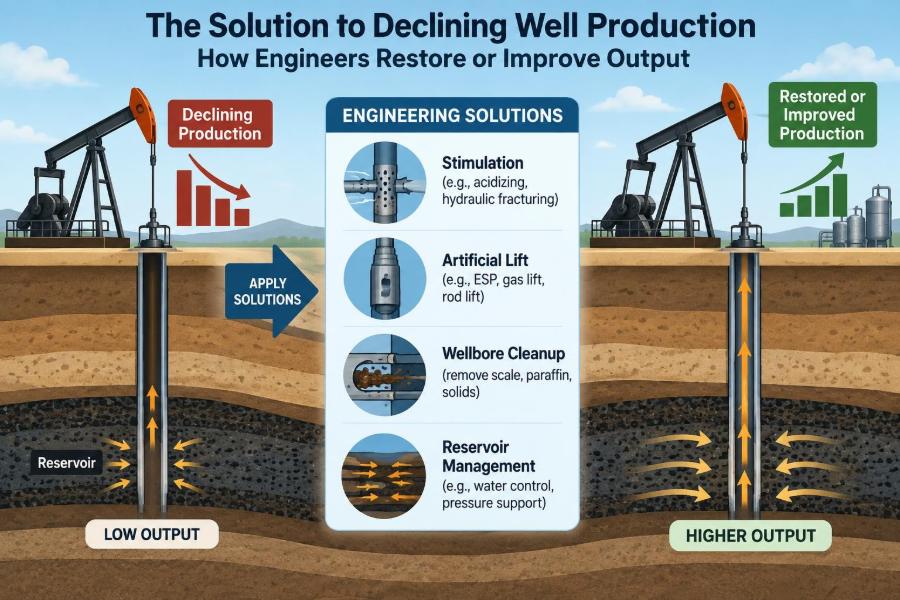
There is no single solution to declining well production. Reservoir depletion may call for pressure management or revised expectations; near-wellbore damage may justify stimulation; a mechanical restriction may need a workover; and insufficient lifting capacity may require redesign.
The strongest decisions connect reservoir behavior, wellbore hydraulics, completion condition, artificial lift, surface constraints, economics, and safety. An intervention succeeds when it removes the actual limiting resistance while preserving well integrity and producing value over time.
For students, this is a useful way to organize technical knowledge. For working professionals, it is a reminder that the fastest-looking answer is not always the most productive one.
Well production improves most reliably when engineers find the true bottleneck, quantify it, and apply the least-risky remedy that fits the entire system. 🛢️⚙️📈