
A producing oil field can look healthy from the surface: wells are flowing, separators are operating, and tankers or pipelines are still moving crude. Yet the central question for an asset team is rarely whether oil remains underground. It is whether that oil can still be recovered safely and profitably.
This distinction matters because most reservoirs retain substantial hydrocarbons long after primary production declines. The remaining oil may be trapped in small pores, bypassed by injected water, or too costly to reach through existing wells.
For a student, this is one of the most useful ways to connect reservoir engineering with economics. For a working professional, it is the question behind workover decisions, infill drilling, waterflood expansion, facility upgrades, and eventual abandonment planning.
An oil reservoir does not have a fixed “expiry date.” Its producing life is shaped by geology, well performance, operating costs, market conditions, regulations, and the quality of decisions made throughout the field’s life.
🛢️ Production Life Is Not the Same as Reservoir Depletion
A reservoir can continue producing for decades, but production life should not be confused with complete depletion. Depletion means pressure and recoverable fluid energy have been substantially reduced; production life means the field is still being operated.
Oil in place is the estimated volume originally contained in the reservoir. Recoverable reserves are the portion expected to be produced under defined technical and economic conditions. When those conditions change, the economically recoverable volume can change too.
A field may be physically capable of producing small amounts of oil long after its commercial life has ended. Conversely, a new production method or a favorable change in net revenue can extend its economic life.
📉 The Basic Meaning of an Economic Limit
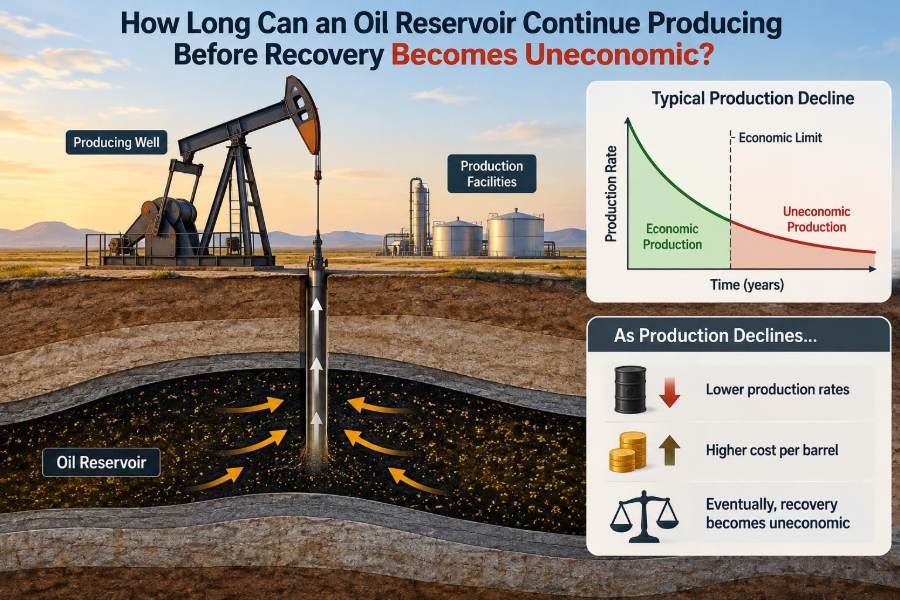
The economic limit is reached when continuing operations no longer generates sufficient value to justify the costs, risks, and obligations of keeping the asset active. It is not necessarily the day a well’s revenue exactly equals its cash operating cost.
Companies may use an internal economic threshold that includes expected maintenance, produced-water disposal, royalties, transport charges, emissions costs, required integrity work, and the cost of eventual abandonment. The precise threshold depends on the operating agreement, fiscal system, and company decision criteria.
At the well level, the limit can arrive earlier than at the field level. A low-rate well may be unprofitable alone but remain useful if it shares facilities with stronger wells at little additional cost.
🧮 Revenue Begins With More Than the Oil Rate
A simple starting point is net operating cash flow: oil and gas sales revenue minus royalties, taxes where applicable, transport, treatment, energy use, chemicals, labor, maintenance, and other operating costs.
Oil rate matters, but the realized price matters just as much. The realized price is not always the headline market benchmark because crude quality differentials, pipeline tariffs, location, blending requirements, and sales terms can reduce what the operator receives.
Gas can add revenue, but it can also create expense. Associated gas may require compression, fuel, processing, reinjection, or flaring controls. Therefore, a higher total fluid rate does not automatically mean a better economic outcome.
💧 Water Cut Often Determines the Endgame
Water cut is the fraction of produced liquid that is water rather than oil. In mature waterflooded fields, wells may lift large volumes of water to produce a modest oil rate.
That water must be separated, treated, sampled, pumped, and commonly reinjected or disposed of. Each step consumes power and facility capacity, while scale, corrosion, solids, and bacteria can increase maintenance needs.
A well producing 20 barrels of oil per day may look viable in isolation. If it produces several thousand barrels of water per day, however, the cost and handling constraints may make it uneconomic. Water management is often the practical limit before the reservoir itself is exhausted.
🪨 Reservoir Drive Sets the Starting Advantage
Reservoirs produce because pressure and fluid movement provide energy. Common drive mechanisms include solution-gas drive, gas-cap drive, edge-water drive, bottom-water drive, and compaction drive. Most real reservoirs show a combination rather than a perfectly pure mechanism.
A strong natural water drive can maintain pressure and support long production, but it can also bring early water breakthrough in unfavorable settings. Solution-gas-drive reservoirs may decline rapidly as pressure falls below the bubble point and gas comes out of solution.
The initial drive mechanism does not determine the final outcome by itself. It establishes the production challenge that later reservoir management must address.
📊 Decline Curves Describe Behavior, Not Destiny
Production decline analysis uses historical rates to estimate future performance. In its simplest form, it asks how rapidly production has been falling and whether that trend is changing.
Exponential, hyperbolic, and harmonic decline forms are commonly used descriptions. They can be useful, especially for wells or producing segments with stable operating conditions, but they are not physical proof of what the reservoir will do next.
Changes in choke settings, artificial lift, workovers, water breakthrough, compression, shut-ins, or new wells can alter the trend. A forecast should therefore be checked against pressure data, fluid behavior, well events, and reservoir understanding.
🧱 Rock Quality Controls How Easily Oil Can Move
Porosity tells engineers how much fluid-holding space the rock contains. Permeability describes how easily fluids can flow through connected pore spaces. A reservoir can have high porosity but poor permeability if the pore throats are small or poorly connected.
Low permeability tends to require larger pressure gradients, longer production times, or stimulation to sustain useful rates. Layering, shale barriers, faults, and cemented intervals can compartmentalize the reservoir and leave oil disconnected from existing wells.
These properties explain why two wells only a short distance apart can have sharply different productive lives. The wellbore accesses a small part of a much more complex flow system.
🧪 Fluid Properties Change the Recovery Challenge
Light, low-viscosity oil generally moves more readily than heavy, viscous oil under the same pressure conditions. Oil viscosity, gas-oil ratio, formation volume factor, wax tendency, asphaltene behavior, and emulsion characteristics all influence production costs and deliverability.
As pressure declines, oil may release dissolved gas. This can contribute energy, but gas near the wellbore can also reduce oil relative permeability and complicate pumping. In other cases, gas handling capacity becomes the constraint.
Fluid samples and pressure-volume-temperature analysis help engineers model these changes. Assumptions that were reasonable early in field life should be revisited as produced-fluid behavior evolves.
🧭 Recovery Factor Is a Moving Target
The recovery factor is the fraction of original oil in place expected to be recovered. It is often discussed as a single percentage, but operationally it is an evolving estimate based on current knowledge, technology, and economics.
Primary recovery uses natural reservoir energy and artificial lift. Secondary recovery, commonly water injection or gas injection, aims to maintain pressure and displace oil. Tertiary or enhanced oil recovery methods seek to mobilize oil that remains after conventional methods.
A higher recovery factor is not automatically the best business decision. Extra recovery must be measured against capital needs, energy use, project risk, timing, and the cost of handling additional water or gases.
🌊 Waterflooding Can Extend Life—or Accelerate Costs
Waterflooding injects water to support pressure and sweep oil toward producing wells. When reservoir connectivity, injection conformance, and well placement are favorable, it can materially improve recovery and stabilize field output.
The main difficulty is that water follows paths of least resistance. High-permeability streaks, fractures, poorly isolated intervals, or thief zones may allow injected water to reach producers quickly while leaving less-accessible oil behind.
Successful waterflood management requires surveillance: injection rates and pressures, produced-water trends, tracer information where used, pressure response, and regular review of voidage replacement. Injecting more water without understanding where it goes can add cost without improving sweep.
🧯 Gas Injection Has Different Trade-Offs
Gas injection may maintain pressure, create miscible or near-miscible displacement under suitable conditions, or cycle gas through a reservoir. It can be attractive where a field has available hydrocarbon gas or where carbon dioxide supply and infrastructure are suitable.
Its effectiveness depends on pressure, fluid composition, gravity segregation, reservoir heterogeneity, containment, and the ability to recycle and handle produced gas. Compression can be energy-intensive, and poor conformance can lead to early gas breakthrough.
Gas injection is therefore a reservoir-development strategy rather than a universal late-life remedy. A technically promising process can fail commercially if the facilities and recycle system are disproportionate to the incremental oil.
🧫 Enhanced Oil Recovery Requires a Strong Case
Enhanced oil recovery, or EOR, includes thermal methods, chemical flooding, miscible gas processes, and other techniques intended to improve displacement or reduce oil viscosity. It is most compelling when the mechanism directly addresses a known recovery limitation.
For example, thermal methods can reduce heavy-oil viscosity, while surfactant or polymer approaches may improve sweep or mobilize residual oil in appropriate reservoirs. These projects require careful laboratory work, pilot design, and scale-up planning.
They also introduce risks: chemical compatibility, injectivity loss, heat losses, produced-fluid treatment, supply reliability, and uncertain reservoir response. An EOR project should be evaluated on incremental value, not on the appeal of a high theoretical recovery factor.
🛠️ Artificial Lift Can Postpone—but Not Remove—the Limit
As reservoir pressure declines, many wells need artificial lift to bring fluids to surface. Common systems include rod pumps, electric submersible pumps, gas lift, progressing cavity pumps, and hydraulic lift arrangements.
Choosing a system depends on depth, fluid rate, gas fraction, solids, viscosity, deviation, power availability, and workover access. A pump that performs well in a low-gas, moderate-water well may struggle badly in a gassy, scaling, high-water environment.
Artificial lift can restore or maintain production, but it adds energy demand, equipment failures, intervention costs, and operating complexity. The objective is not the highest possible fluid rate; it is an economically sustainable rate.
🔩 Well Integrity Can End Production Early
A reservoir may still contain profitable oil while the well that accesses it becomes unsafe or unreliable. Casing corrosion, tubing leaks, failed cement, sustained annulus pressure, packer problems, and loss of barrier integrity can require costly intervention or permanent abandonment.
Integrity issues are particularly consequential in older wells, corrosive service, high-pressure systems, and fields with extensive water handling. A temporary production loss may become a permanent closure if repair costs exceed expected future value.
Routine inspection, corrosion management, pressure monitoring, barrier testing, and accurate well records are not merely compliance activities. They preserve options for continued production, recompletion, conversion to injection, or safe abandonment.
⚙️ Surface Facilities Create Their Own Bottlenecks
Field life is constrained by more than downhole performance. Separators, heaters, produced-water systems, compressors, tanks, pipelines, electrical supply, export specifications, and disposal wells all have finite capacity and reliability.
In late life, a facility may be oversized for oil but constrained by water, gas, or solids. A corroded water line or limited injection capacity can force oil shut-ins even though producing wells remain mechanically capable of flowing.
Debottlenecking may extend a field’s economic life, but projects need a full-system view. Expanding separation capacity provides little value if downstream disposal, power supply, or export capacity remains limiting.
💸 Fixed Costs Make Mature Fields Sensitive
Many operating costs do not fall in proportion to oil production. Staffing, inspections, leases, control systems, permits, minimum facility operation, and emergency response readiness may remain necessary even as output declines.
This creates a familiar late-life problem: declining barrels must carry a relatively stable cost base. A field that was highly profitable at plateau production can become marginal without any sudden reservoir failure.
Shared infrastructure can soften this effect. Nearby wells, satellite fields, or tie-backs may spread costs across more production, while a standalone field may face closure sooner. Economic life is partly a question of network configuration.
📈 Oil Price Matters, but So Does Price Exposure
Higher oil prices can extend the economic life of a reservoir, while lower prices can accelerate shut-ins and abandonment decisions. But using a short-term price spike to justify long-lived commitments can be risky.
Operators commonly test projects against a range of price assumptions rather than a single optimistic case. The relevant question is whether expected future net cash flow supports the work, not whether current revenue looks attractive for one month.
Price exposure also interacts with costs. Inflation in diesel, electricity, steel, chemicals, rigs, and services can offset stronger crude prices. A mature field is most resilient when its operating structure can absorb normal market volatility.
🧾 Taxes, Royalties, and Contracts Affect the Cutoff
Fiscal terms influence the revenue retained by the operator and partners. Royalties, production taxes, cost-recovery rules, transportation commitments, and abandonment security requirements can all change the economic limit.
Joint ventures add another layer. Partners may have different capital priorities, risk tolerances, or views of future price and reservoir performance. A technically attractive intervention requires agreement on funding and execution.
These commercial factors should be included early in technical screening. A forecast of incremental barrels is not a decision-ready business case until ownership, fiscal treatment, timing, and obligations are considered.
🌱 Environmental Obligations Continue Through Late Life
Mature-field operations must control spills, emissions, produced-water handling, waste, chemical use, and land or offshore impacts. These obligations do not disappear when production declines; in some cases, unit environmental cost rises as volumes fall.
Methane management deserves particular attention where gas systems, tanks, compressors, and pneumatic equipment are involved. Reducing avoidable emissions can improve compliance and operational efficiency, but it may require maintenance and capital investment.
The field’s final economic assessment should include closure and remediation responsibilities. Deferring abandonment without maintaining integrity can increase future environmental and financial exposure.
🦺 Safety and Reliability Are Economic Variables
Safety is not a trade-off against economics. Unsafe operations expose people and the environment to harm, interrupt production, damage equipment, and can remove a field’s license to operate.
Late-life assets often face aging equipment, reduced staffing, deferred maintenance pressure, and more frequent interventions. These conditions require disciplined process safety management, competent supervision, emergency preparedness, and clear operating procedures.
A decision to continue producing should demonstrate that barriers remain effective and critical maintenance is funded. Producing a few extra barrels is never a sound reason to accept uncontrolled well or facility risk.
🔍 Surveillance Turns Uncertainty Into Better Decisions
Reservoir management depends on seeing changes early enough to act. Useful surveillance may include well tests, flowing pressures, static pressures, fluid samples, production allocation, injection data, pressure-transient analysis, logs, and facility measurements.
No single dataset tells the whole story. A rising water cut might indicate reservoir encroachment, a casing leak, channeling behind pipe, changing choke conditions, or allocation error. Engineers need to test competing explanations.
Good surveillance is purposeful rather than excessive. The value of a measurement comes from whether it can change a decision, reduce uncertainty, or prevent a costly mistake.
🧠 Integrated Models Improve Forecast Discipline
Reservoir, well, and facility models are most useful when they are connected. A reservoir simulation may forecast fluids reaching a well, but a well model estimates whether lift can bring those fluids to surface, and a network model checks whether facilities can handle them.
Integrated asset modeling helps reveal interactions that isolated studies miss. For example, increasing injection may improve pressure support while exceeding water-processing capacity, or a larger pump may raise fluid production but worsen gas interference.
Models remain approximations. Their credibility depends on calibration to observed data, transparent assumptions, and regular updates when field behavior diverges from the forecast.
🧰 Workovers and Recompletion Can Recover Stranded Value
A workover is an intervention to repair, clean out, stimulate, change lift equipment, isolate water, or otherwise improve a well. A recompletion moves production to another interval or opens additional zones.
These options can be highly valuable when a problem is localized: scale has restricted flow, water is entering through a specific interval, or an untapped layer is behind pipe. They are less attractive when low productivity reflects broad reservoir depletion.
A useful screening question is simple: what mechanism will create incremental oil, and how will it be verified? “The well is underperforming” is an observation, not yet a workover justification.
🧩 Infill Drilling Depends on Remaining Connectivity
Infill drilling adds wells between existing wells or targets less-drained compartments. It can recover bypassed oil, reduce drainage distances, and improve sweep, especially in heterogeneous reservoirs.
However, infill wells may merely accelerate production that existing wells would have recovered later. They can also encounter early water or gas breakthrough, interfere with neighboring wells, or add drilling and completion risk.
Static maps alone are not enough. Infill candidates should be supported by production history, pressure behavior, geological interpretation, saturation evidence where available, and a realistic assessment of facility and disposal capacity.
🚦Well-Level, Field-Level, and Portfolio Decisions Differ
A company may shut in one uneconomic well while keeping the field active, or retain a marginal field because it supports a pipeline system serving more valuable assets. These are different decision scales with different cash-flow boundaries.
At portfolio level, capital may be directed to projects with better risk-adjusted returns even if a mature field could technically continue. This does not mean the field has no remaining oil; it means capital and operating resources have alternatives.
Understanding the decision level prevents misleading conclusions. A well can be “uneconomic” under standalone accounting yet worthwhile within an integrated field operation.
🛑 Temporary Shut-In Is Not Always Abandonment
Wells are sometimes shut in because of low prices, facility outages, regulatory issues, integrity investigations, or planned work. A shut-in well may later return if conditions improve and the well remains mechanically viable.
Permanent abandonment is a different step. It involves isolating formations and securing the well according to applicable regulations and approved practices. Once abandoned, re-entry is usually impractical or costly.
Before choosing abandonment, operators should distinguish between a reversible commercial pause and an irreversible loss of access. The decision should account for future liabilities, well condition, and the probability of a credible restart case.
🏗️ Decommissioning Cost Belongs in the Economic Picture
Decommissioning can include well plugging, facility removal, pipeline treatment, site remediation, waste handling, and long-term monitoring where required. Offshore projects may also involve subsea infrastructure and platform removal.
These costs are often incurred after production ends, but they are connected to the decision to operate today. A responsible economic evaluation recognizes the obligation rather than treating it as someone else’s future problem.
Planning early can reduce surprises. Accurate inventories, integrity records, access planning, and realistic cost estimates help operators sequence abandonment work safely and budget for it over the life of the asset.
📋 A Practical Late-Life Evaluation Sequence
When production declines, the best response is usually a structured review rather than an automatic push for higher rates. The goal is to identify the limiting mechanism and compare credible options.
- Confirm production, allocation, pressure, fluid, and cost data quality.
- Diagnose whether the main limitation is reservoir depletion, water handling, lift performance, integrity, facilities, or commercial terms.
- Estimate base-case future cash flow and required abandonment obligations.
- Screen interventions such as optimization, water shutoff, workover, recompletion, infill drilling, facility changes, or injection adjustments.
- Test each option across realistic price, cost, performance, and execution scenarios.
- Set clear decision gates and surveillance indicators for continuing, suspending, or abandoning operations.
This sequence does not remove uncertainty, but it makes assumptions visible and helps teams avoid treating symptoms as root causes.
⚠️ Common Mistakes in Estimating Economic Life
One frequent mistake is extending a decline curve without accounting for rising water-handling cost or failing equipment. Another is assuming every barrel shown by a reservoir model can be produced through the existing well and facility system.
Teams can also overvalue gross production while overlooking net revenue, royalties, transport, power, and intervention frequency. On the other side, premature abandonment can leave valuable oil behind when a targeted repair or facility solution would have been justified.
- Do not confuse oil in place with economically recoverable oil.
- Do not use peak or current prices as the only economic case.
- Do not ignore integrity, safety, emissions, and abandonment liabilities.
- Do not evaluate a reservoir plan without checking well and facility constraints.
🧭 The Core Principle: Value, Not Just Volume, Determines Life
There is no universal number of years that defines how long an oil reservoir can produce. Some wells decline quickly, while carefully managed fields can remain active for long periods through pressure management, artificial lift, workovers, new wells, and infrastructure renewal.
The decisive issue is whether future production creates enough value to cover the full consequences of producing it: operating expenditure, capital investment, safety controls, environmental performance, regulatory duties, and eventual closure. That answer must be revisited as the reservoir and external conditions change.
For petroleum engineers, the practical task is to connect subsurface behavior with surface constraints and commercial reality. The strongest late-life decisions are integrated, evidence-based, and honest about uncertainty.
An oil reservoir continues producing not until it is empty, but until the remaining recoverable barrels no longer justify the cost, risk, and responsibility of bringing them to surface. 🛢️📉⚙️