
A petroleum engineer may spend years solving problems that never appear in a job description. You may be the person who notices that a production decline is not a reservoir problem, that a well test was interpreted too quickly, or that a drilling program contains avoidable cost and risk.
Inside an operating company, those observations are part of the job. Outside it, the same capability can become a professional service—provided it is translated into a clear deliverable, bounded responsibly, and offered to people who can act on it.
That does not mean every engineer should leave employment or market generic “expert advice.” Technical side income and independent practice require credibility, ethics, communication, and careful handling of uncertainty.
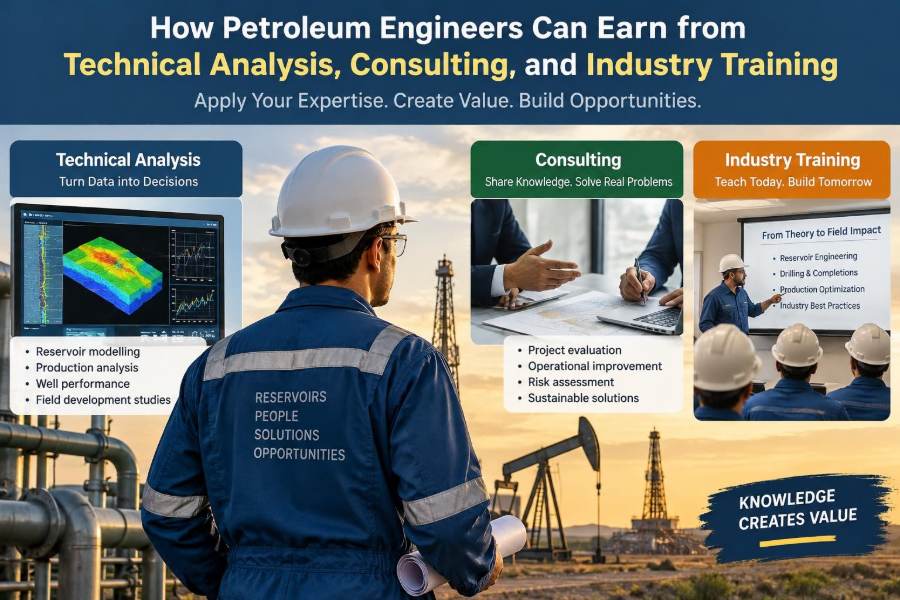
For engineers who want to diversify their income, technical analysis, consulting, and industry training offer three connected paths. Each turns practical engineering judgment into something clients, teams, and learners can use.
🧭 Start with the real value you create
Clients do not usually buy reservoir engineering, production engineering, or drilling engineering as abstract subjects. They buy clearer decisions: whether to intervene in a well, how to prioritize candidates, why production is underperforming, or how to prepare a team for a technical workflow.
Your commercial offer should therefore connect technical work to a decision or capability. “Nodal analysis” is a method; “a ranked list of production constraints and intervention options” is a usable outcome.
🧱 Build on a credible technical foundation
Independent work magnifies both strengths and weaknesses. Before offering services, be honest about the problems you have repeatedly solved, the tools you can use competently, and the assumptions behind your recommendations.
Early-career engineers can still earn through structured analysis or training support, but should avoid presenting themselves as final decision-makers on high-consequence matters. Experience, supervision, and scope must match the assignment.
🔎 Choose a commercially useful niche
A niche is not merely a software package or a job title. It is the overlap between your expertise, a recurring problem, and a group able to pay for a solution.
- Production surveillance for mature oil fields
- Well-performance diagnostics using nodal analysis
- Reserves and decline-curve support for small operators
- Drilling offset-well review and lessons-learned analysis
- Technical data cleanup for subsurface teams
- Practical training for graduate engineers
Narrow positioning makes referral easier. A client can remember “the engineer who helps diagnose water-loading candidates” more readily than “a consultant who does everything.”
📊 Understand technical analysis as a service
Technical analysis converts raw operating data into an interpretation and a recommendation. The data may include production histories, pressure information, well files, PVT properties, drilling reports, artificial-lift records, or seismic and petrophysical inputs.
The value is not the spreadsheet alone. It is the chain of reasoning: data quality checks, assumptions, method selection, sensitivity testing, limitations, and a practical next step. A polished chart with weak inputs is not a reliable engineering conclusion.
🛢️ Production surveillance can be a strong entry point
Many assets generate more daily data than small teams can review deeply. A focused surveillance service can identify unusual rate behavior, increasing water cut, pressure changes, downtime patterns, lift-performance concerns, and candidates for further investigation.
A useful monthly deliverable might include a concise dashboard, a list of exceptions, likely explanations, data gaps, and recommended follow-up. It should not claim that a trend proves a reservoir mechanism when several explanations remain possible.
📉 Use decline analysis with appropriate caution
Decline-curve analysis estimates future production from historical rate behavior. It is widely useful for screening, forecasting, and comparing cases, but it is not a substitute for understanding operating changes, well interventions, constraints, or reservoir drive mechanisms.
For example, a hypothetical well may show a sharper decline after compressor downtime. Fitting a single decline curve across that period without recognizing the operational event can create a misleading forecast. Good analysis separates history, context, and forecast assumptions.
⚙️ Diagnose well performance systematically
Production problems can originate in the reservoir, completion, tubing, choke, flowline, separator conditions, artificial lift system, or measurement process. A disciplined workflow prevents engineers from jumping immediately to an expensive intervention.
Nodal analysis is especially helpful because it represents the pressure-loss relationship from reservoir to surface. It can test whether the limiting restriction appears to be inflow, tubing performance, lift capacity, or surface backpressure—subject to the quality of fluid-property and pressure inputs.
🧪 Make data quality part of the deliverable
Clients often request an answer when they first need a data audit. Missing test conditions, inconsistent units, questionable allocation, outdated PVT data, and unexplained shut-ins can materially change an interpretation.
Rather than silently repairing every issue, document it. A data-quality register can classify inputs as usable, uncertain, missing, or requiring field verification. This protects the integrity of the analysis and gives the client a practical improvement plan.
🧠 Turn calculations into decision-ready reports
A decision-ready report answers four questions: What was observed? What may explain it? What are the viable options? What information would change the recommendation?
Keep the technical appendix available, but lead with the operational implication. A manager may need a one-page summary, while a reservoir engineer may need equations, assumptions, model files, and sensitivity cases. One analysis can serve both audiences when organized well.
🧰 Use tools without selling the tool
Python, Excel, Power BI, commercial simulators, well-test software, and database tools can make work faster and more repeatable. They do not replace engineering judgment.
Describe the tool only where it helps a client understand the workflow. Selling “a dashboard” can lead to disappointment if no one owns the data refresh or decision process. Sell a surveillance workflow with defined inputs, outputs, and review routines instead.
🧾 Productize repeatable analysis
Productized services have a defined scope, timeline, client input list, and output. They are easier to price than open-ended advisory work and reduce misunderstandings at the start.
| Service format | Typical output | Best use |
|---|---|---|
| Well diagnostic review | Constraints, sensitivities, action options | A specific underperforming well |
| Asset surveillance review | Exception list and priorities | Busy operating teams |
| Data-readiness audit | Gap register and cleanup plan | Before modeling or reserves work |
| Technical workshop | Exercises and applied workflow | Capability development |
Standardization should not mean generic conclusions. It means using a reliable process while tailoring the engineering interpretation.
🤝 Consulting begins with a defined problem
Consulting is broader than analysis. It can include problem framing, independent review, project planning, technical assurance, decision facilitation, and implementation support.
The strongest consulting engagements begin with a question that is specific enough to investigate: “Which three wells deserve detailed intervention screening?” is more workable than “Improve field production.” The broader ambition can remain, but the first scope should be testable.
📋 Write a scope before doing the work
A good scope describes objectives, provided data, tasks, deliverables, schedule, client responsibilities, exclusions, and review points. It also distinguishes an engineering opinion from a guarantee of operational or financial results.
For instance, a well-performance study may recommend candidates for field validation; it does not authorize a workover or promise incremental barrels. That boundary is professionally necessary, not bureaucratic.
💰 Price the work around uncertainty and effort
Common pricing models include fixed fees for clearly bounded deliverables, daily or hourly rates for advisory work, retainers for recurring support, and milestone-based fees for multi-stage projects. The best model depends on how stable the scope is.
Fixed fees are attractive to clients but risky when data quality or revision cycles are unknown. A practical approach is to price an initial diagnostic phase separately, then agree on deeper work after the findings are reviewed.
⚖️ Separate advice from regulated sign-off
Engineering work can intersect with reserves reporting, safety-critical design, environmental obligations, procurement, and professional licensure requirements. The applicable rules vary by location, operator, and assignment.
Do not sign, certify, or represent work beyond your authority or competence. Where formal approval is required, work with the appropriately qualified and authorized professionals. A consultant’s report should clearly state its purpose, basis, and limitations.
🔐 Protect confidential technical information
Field data, well files, commercial assumptions, and operating practices may be confidential even when they look routine. Use written confidentiality terms where appropriate and follow the client’s approved systems for storing and transferring information.
Do not reuse a client’s curves, screenshots, model templates, or sensitive examples in marketing or training without explicit permission. Build anonymized examples from public concepts or synthetic datasets when teaching.
🚫 Manage conflicts of interest openly
A conflict can arise when you advise competing operators, recommend a vendor from which you receive compensation, or work on a side engagement that overlaps with your employer’s business. The issue is not always that a conflict exists; it is whether it is disclosed and managed.
Review your employment agreement, intellectual-property rules, and client commitments before accepting work. If independence matters to an assignment, disclose relevant relationships early and in writing.
🎓 Training is a separate engineering product
Industry training is not simply presenting slides about a familiar topic. Learners need a sequence: concepts, inputs, decisions, examples, practice, feedback, and a way to apply the method after the session.
A useful course can serve graduates, geoscientists moving into production roles, operations personnel, analysts, or managers. Each audience needs different depth, language, and exercises.
🧑🏫 Teach workflows, not just theory
Participants remember how to approach a real problem better than a long list of definitions. A production-surveillance session, for example, can move from data checks to trend interpretation, exception ranking, hypothesis formation, and escalation to a detailed study.
Include why each step exists. If trainees understand that a rate change may reflect allocation or downtime rather than reservoir behavior, they are less likely to misuse a chart after the course.
🧩 Design exercises with realistic ambiguity
Real petroleum datasets are incomplete and occasionally contradictory. Training exercises should reflect that without becoming confusing. Give learners enough information to reason, while deliberately identifying what remains uncertain.
A hypothetical case might include falling oil rate, rising water cut, a recent choke change, and incomplete pressure data. The learning objective is not to guess one “correct” diagnosis; it is to propose a defensible investigation plan.
🖥️ Choose delivery formats deliberately
Live in-person workshops work well for discussion, group exercises, and software coaching. Virtual sessions broaden access and can be effective when broken into shorter modules with polls, shared files, and structured practice.
Recorded courses can scale, but they require especially clear demonstrations and learner support. A blended model—short recorded foundations plus a live case workshop—often preserves flexibility without losing interaction.
📚 Create training materials you actually own
Course materials should be original, properly licensed, or used with permission. This includes diagrams, software screenshots, datasets, equations, photographs, and client-derived examples.
Build a library of your own figures, synthetic cases, calculation templates, and facilitator notes. It takes time, but it reduces legal and ethical risk while making the course more consistent each time it is delivered.
🗣️ Develop communication as an engineering skill
Technical credibility can be weakened by unclear communication. Avoid hiding uncertainty behind jargon or presenting assumptions as facts. State what the data supports, what it does not support, and what should happen next.
Practice explaining the same conclusion at three levels: a one-sentence operational summary, a short management briefing, and a technical explanation for specialists. This skill is valuable in consulting, training, and full-time engineering roles.
🌐 Build a professional reputation slowly
Reputation usually grows through useful work, not aggressive self-promotion. Share general lessons from publicly discussable topics, explain methods carefully, contribute to professional discussions, and maintain contact with former colleagues.
A concise portfolio can show the type of problem you address, your workflow, sample anonymized outputs, and training topics. Never imply that a hypothetical exercise was client work or disclose client information to make a portfolio look stronger.
🧪 Use pilot projects to validate an offer
Before building a large consultancy or course catalog, test one focused service. A limited-scope review for a small team, a short workshop for a professional group, or a carefully designed internal training session can reveal what people actually need.
Ask for feedback on usefulness, clarity, timing, and deliverables—not merely whether participants enjoyed the experience. Then improve the offer based on recurring friction points.
⏱️ Protect time and quality as work grows
Side work can quickly become unmanageable when analysis, proposals, revisions, teaching preparation, administration, and client communication compete with a full-time role. Capacity is a technical risk as well as a personal one.
Use checklists, reusable templates, version control, and clear review limits. Declining poorly scoped work is often wiser than accepting an assignment that cannot receive the attention it deserves.
⚠️ Avoid common early mistakes
- Offering everything: broad claims make it hard for clients to understand your value.
- Underpricing discovery: early conversations and data review can consume substantial time.
- Skipping assumptions: undocumented inputs make results difficult to defend.
- Teaching software clicks only: learners need engineering judgment, not a memorized menu path.
- Promising outcomes: production and project results depend on operational conditions beyond a consultant’s control.
These mistakes are usually corrected through clearer positioning, better contracts, and more disciplined workflows.
🪜 Build a practical first-year path
Start by selecting one problem area, documenting your workflow, and creating one sample deliverable based on synthetic or permitted data. Then speak with potential users of the service to learn how they currently make the decision.
- Define a narrow offer and its exclusions.
- Create a repeatable analysis or teaching template.
- Set confidentiality, conflict, and approval practices.
- Run a small pilot with a clear feedback process.
- Refine pricing, scope, and delivery before expanding.
This sequence is less glamorous than launching broadly, but it produces evidence about what you can reliably deliver.
🌱 Keep learning connected to market needs
New skills are most valuable when they strengthen a real service. Data automation can improve surveillance; facilitation skills can improve workshops; economics can make recommendations more decision-ready; and understanding emissions management can broaden the context of field optimization.
Do not chase every trend. Ask whether a skill helps you solve a defined client problem more accurately, efficiently, or responsibly.
🏁 The core principle: earn trust before scale
Technical analysis, consulting, and training all depend on the same foundation: sound engineering applied to a clearly defined need. The engineer earns not because they possess confidential formulas, but because they can make careful reasoning useful to another person.
Start with work you can defend, communicate the limits of what you know, protect client interests, and create deliverables that help someone decide or perform better. Revenue becomes more sustainable when it follows trust rather than trying to substitute for it.
The most durable way for petroleum engineers to earn beyond a salary is to turn proven technical judgment into clear, ethical, decision-useful services. Build carefully, improve with each engagement, and let credibility compound over time. 🛢️📈🎓