
A drilling crew preparing for a night shift may face hazards that are familiar across the industry: high-pressure equipment, moving loads, flammable hydrocarbons, fatigue, and decisions that must be made correctly the first time. But the setting changes what happens when a barrier fails.
On land, a rig may sit near farms, roads, homes, water supplies, or industrial facilities. Offshore, the same basic well-control challenge unfolds far from shore, where crews depend on helicopters, marine vessels, and a platform that must withstand wind, waves, and corrosion.
That makes the question “Which is safer?” more complicated than it first appears. A low-frequency event may have severe consequences offshore, while routine transportation and public-exposure risks can be more prominent onshore.
For students and professionals, the useful comparison is not a simple verdict. It is an exercise in understanding hazards, barriers, consequences, and the operating context that determines whether those barriers will work.
🧭 Safety Is More Than the Number of Accidents
Safety performance is often discussed through injury rates, spills, or equipment failures. These measures matter, but they do not tell the whole story. A site can have few recorded injuries while still carrying substantial major-accident potential.
Petroleum operations use a useful distinction: personal safety concerns individual events such as slips, strains, or hand injuries; process safety concerns loss of containment, fire, explosion, blowout, or structural failure. Both offshore and onshore operations must manage both categories.
So, safer does not mean “risk-free.” It means hazards are identified, consequences are understood, and multiple independent controls reduce the chance that a credible failure becomes a serious event.
⚖️ The Short Answer: Neither Setting Is Automatically Safer
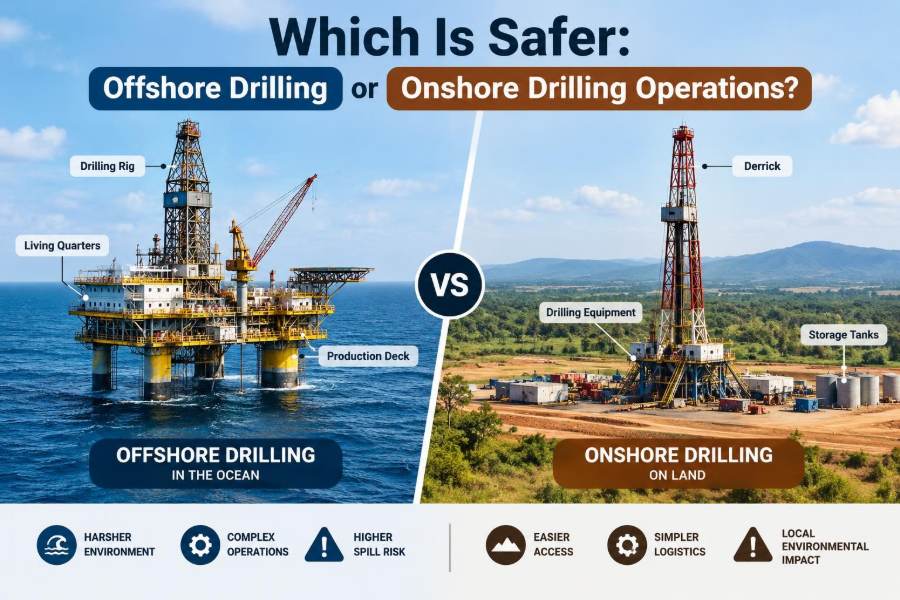
Offshore drilling usually adds isolation, weather exposure, marine logistics, and difficult evacuation. Onshore drilling usually adds road traffic, nearby communities, land-use conflicts, and more frequent interaction with public infrastructure.
The safer operation is the one with an appropriate design, competent workforce, disciplined procedures, reliable barriers, and a realistic emergency plan. A well-managed land rig can be safer than a poorly managed offshore campaign, and the reverse is equally true.
Risk must be evaluated well by well. Reservoir pressure, well trajectory, water depth, distance from sensitive receptors, contractor capability, local infrastructure, and regulatory oversight can all change the answer.
🧮 Risk Depends on Likelihood and Consequence
A practical way to compare operations is to think of risk as the combination of how likely an event is and how serious its consequences could be. This is not a promise that risk can be reduced to one number; it is a structured way to make decisions.
For example, lifting a load is routine on both types of rig. A dropped object may be relatively contained at a remote land location, but it can become more complex offshore if it damages critical equipment, falls into the sea, or creates a rescue challenge on a confined facility.
Conversely, a minor release or traffic incident from an onshore operation can affect members of the public because roads and communities may be close by. The same event offshore may have no direct public exposure but could still threaten personnel and the marine environment.
🛢️ Shared Hazards at Every Drilling Site
The drilling environment has a common hazard base regardless of location. Crews handle rotating equipment, heavy tubulars, high-pressure lines, drilling fluids, fuel, electrical systems, chemicals, and sometimes hydrogen sulfide.
- Well-control hazards: influxes of formation fluid or gas entering the wellbore.
- Mechanical hazards: pinch points, suspended loads, rotating machinery, and pressurized hoses.
- Energy hazards: ignition sources near flammable vapors, stored pressure, and electrical faults.
- Human-factor hazards: rushed work, unclear authority, fatigue, and poor handovers.
The controls also overlap: engineered equipment, written procedures, training, permit systems, maintenance, supervision, and stop-work authority. Location changes the details, not the need for disciplined fundamentals.
🌊 What Makes Offshore Drilling Different
An offshore rig is a workplace, industrial plant, and marine installation at the same time. A fixed platform, jack-up, or floating unit has limited space and depends on marine systems that a land rig does not need.
On floating units, vessel motion must be considered during operations. Dynamic positioning systems, mooring systems, risers, and marine logistics become part of the safety case. A failure can affect drilling stability even if the drilling equipment itself is functioning properly.
Distance from shore also shapes every response. Replacement parts, medical support, firefighting resources, and specialist expertise may take longer to arrive than they would at an accessible land site.
🏜️ What Makes Onshore Drilling Different
Onshore drilling generally offers easier physical access. Crews can reach the location by road, supplies can be staged nearby, and emergency services may be closer. This can simplify maintenance and response, but it also creates different exposure pathways.
Truck movements, temporary roads, pipelines, water handling, and equipment deliveries can create substantial risk outside the rig floor. In many land campaigns, driving is among the most persistent routine hazards because it occurs every day and often over long distances.
Land sites can also be close to homes, agriculture, waterways, or other businesses. Good planning must therefore consider neighbors and the public, not only people inside the lease boundary.
🧯 Well Control Is the Central High-Consequence Challenge
A kick occurs when formation fluids enter the well because bottomhole pressure is insufficient to prevent influx. If not detected and controlled, the event can escalate into a blowout: uncontrolled flow from the well.
Both offshore and onshore operations use primary well control through drilling-fluid density and hydraulics, then secondary well control through blowout preventers, or BOPs. The equipment arrangement varies with the well and location, but the barrier philosophy is the same.
Offshore well control can be more technically complex because of subsea BOP stacks, marine risers, and the difficulty of accessing equipment on the seabed. Onshore BOP equipment is usually more physically accessible, though accessibility alone does not guarantee correct operation.
🔩 Barrier Management Matters More Than Equipment Presence
Having a BOP, gas detector, alarm, or emergency shutdown system is not the same as having a functioning barrier. A barrier must be correctly specified, tested, maintained, understood by the crew, and available when demanded.
Barrier management tracks the health of these defenses. It asks questions such as: Is the test current? Has a bypass been introduced? Does the crew know the response? Could one failure disable multiple supposedly independent barriers?
This discipline is particularly valuable during non-routine work, such as casing operations, pressure testing, maintenance, or changes in drilling parameters. Major events often develop when several small weaknesses align.
🔥 Fire and Explosion Consequences Offshore
Offshore facilities are compact. Hydrocarbon processing, power generation, accommodation, drilling equipment, and escape routes may all be located within a limited footprint. If a large release ignites, heat and smoke can spread quickly through connected areas.
Ventilation, hazardous-area classification, gas detection, firewater systems, blast-resistant design, and emergency shutdown arrangements are therefore crucial. Layout matters: equipment should be arranged to limit escalation from one system to another.
Evacuation can be harder because personnel cannot simply leave by road. Lifeboats, life rafts, helidecks, and muster systems require inspection, training, and realistic consideration of weather conditions.
🏘️ Community Exposure Is Often Higher Onshore
Onshore sites vary widely. Some are remote, while others operate near communities or alongside established roads and utility corridors. The consequences of noise, dust, light, odors, traffic, and accidental releases depend heavily on this proximity.
Planning should identify sensitive receptors before construction starts. These may include residences, schools, water wells, farms, hospitals, wildlife habitat, and local roads with pedestrian or agricultural traffic.
Community risk management is not limited to meeting a setback requirement. It includes communicating schedules, controlling truck routes, maintaining site security, responding to complaints, and ensuring an emergency plan can coordinate with local authorities.
🚛 Transportation Changes the Onshore Risk Picture
A land rig requires movement of rigs, tubulars, drilling fluids, fuel, water, waste, and personnel. Each journey introduces driving risk, particularly when roads are narrow, weather is poor, or drivers work irregular schedules.
Transportation planning should address route surveys, vehicle inspections, load securement, journey management, driver fitness, rest, and communication. A technically excellent drilling program can still have weak overall safety performance if road logistics are unmanaged.
Offshore operations also rely on vessels and helicopters. Their journeys are fewer in some cases but can carry high consequence because weather, sea state, aviation limits, and passenger transfer all matter.
🚁 Offshore Logistics Have a Different Failure Pattern
Personnel transfers offshore can involve helicopters, crew boats, gangways, and basket transfers, depending on the facility and conditions. These tasks require strict weather limits, clear roles, communications, and authority to stop the transfer.
Supply vessels must work close to installations while managing currents, waves, deck cargo, and potential collision hazards. On dynamically positioned drilling units, loss of position can become a critical threat to riser integrity and well-control equipment.
The lesson is not that marine logistics are inherently unsafe. Rather, they are specialized operations that need competent marine coordination and contingency plans unavailable at a typical roadside location.
🌦️ Weather Has More Direct Influence Offshore
Wind, wave height, swell, currents, lightning, fog, and tropical storms can affect offshore lifting, transfers, drilling operations, and emergency response. Weather forecasts support decisions, but forecasts contain uncertainty and conditions can change faster than work plans.
Offshore teams use operating limits for cranes, marine activities, and helicopter movements. Respecting these limits is a safety control, not an administrative inconvenience. Pressure to maintain schedule must not override a deteriorating weather window.
Onshore sites also face storms, heat, cold, flooding, dust, and lightning. However, the effect is often more localized and evacuation by road may be possible, provided the roads themselves remain safe.
🧊 Fatigue, Isolation, and Human Performance
Offshore crews commonly work extended rotations away from home in a confined environment. Sleep disruption, noise, shared accommodation, shift changes, and limited privacy can affect alertness and decision-making.
Land crews may face a different fatigue pattern: long commutes, driving before or after shifts, camp living, and frequent mobilization. Neither arrangement is automatically better for human performance.
Effective fatigue management considers task timing, workload, overtime, travel, sleep opportunity, and whether workers feel able to report fatigue without being blamed. A procedure is only useful if people are alert enough to apply it.
🧑🤝🧑 Workforce Competence and Contractor Interfaces
Drilling is a multi-company activity. The operator, drilling contractor, service companies, marine providers, and specialist vendors may all have responsibilities at one location. Confusion at these interfaces can create gaps.
Critical work requires a shared understanding of who directs the task, who verifies barriers, who can stop work, and how changes are communicated. This is especially important during simultaneous operations, often called SIMOPS, when different activities can interfere with one another.
Competence includes technical qualifications, but it also includes local familiarity. A worker who understands pressure control may still need site-specific training on marine evacuation, local wildlife restrictions, road hazards, or hydrogen sulfide response.
📣 Communication During Abnormal Events
Early warning is valuable only when it reaches the right people and produces the right action. A pit gain, gas alarm, unexpected pressure change, or weather alert should trigger a response that the crew has rehearsed.
Offshore teams may rely on control rooms, public-address systems, radios, and emergency command structures. Onshore teams may need rapid communication with nearby landowners, local emergency responders, and road authorities in addition to onsite personnel.
Clear language matters. Vague messages such as “watch it closely” are weaker than a direct instruction defining the condition, immediate action, decision authority, and escalation threshold.
🛟 Emergency Response and Evacuation
An emergency plan should be based on credible scenarios, not a document written only to satisfy a requirement. It must identify how people will detect an event, protect themselves, account for personnel, obtain medical care, and recover safely.
Offshore evacuation can involve refuge areas, lifeboats, life rafts, helicopters, and standby vessels. The plan must account for smoke, sea conditions, limited medical capacity, and the possibility that the normal route is unavailable.
Onshore response may involve sheltering, site evacuation, road closures, fire departments, medical transport, and public notification. The ability to call external help is useful, but responders need accurate site information and safe access.
🌱 Environmental Risk Is Location-Specific
A spill offshore can spread through marine waters and affect coastlines, fisheries, or sensitive habitats depending on currents, weather, product type, and response capacity. Containment and recovery can be difficult in rough seas.
Onshore releases can affect soil, surface water, groundwater, wetlands, and agricultural land. Topography, drainage, soil type, nearby water bodies, and the volume released influence consequences.
Prevention remains the first priority in either setting. Secondary measures—such as berms, drip trays, closed drainage, spill kits, blowout contingency arrangements, and waste controls—limit damage when prevention fails.
💧 Water Handling Creates Distinct Onshore Concerns
Land drilling may require sourcing, transporting, storing, treating, and disposing of water and drilling fluids. Poorly managed tanks, hoses, transfers, and containment can create releases even without a well-control event.
Good practices include inspecting secondary containment, verifying valves before transfers, controlling hose connections, monitoring tank levels, and separating clean stormwater from potentially contaminated drainage.
Offshore drilling also handles fluids and waste, but discharge controls, closed systems, transport arrangements, and marine environmental conditions shape the management approach differently.
⚓ Structural Integrity and Marine Stability
Offshore facilities must maintain structural integrity under corrosion, wave loading, wind, vibration, and, for floating units, motion. Marine systems can be safety-critical even though they are not visibly part of the drilling process.
For a jack-up, seabed conditions and leg penetration affect stability. For a floating rig, mooring integrity or dynamic-positioning performance affects station keeping. These issues can influence riser loads and the ability to maintain a safe well configuration.
Onshore operations have their own civil concerns, including pad construction, soil bearing capacity, drainage, flood exposure, and ground stability. The mechanisms differ, but the principle is identical: the site must support safe equipment operation.
🔊 Noise, Light, and Daily Operational Effects
Onshore drilling can affect nearby residents through truck noise, engine noise, bright nighttime lighting, dust, and temporary traffic congestion. These effects may not be major-accident hazards, but unmanaged disruption can erode trust and lead to unsafe interactions around the site.
Controls can include directional lighting, noise barriers where practical, dust suppression, approved traffic windows, and clear contact channels. The right measure depends on the local setting rather than a generic checklist.
Offshore installations have less direct neighborhood impact, but light, noise, vessel activity, and discharges can still affect marine users and ecosystems. Distance does not remove the need for environmental awareness.
📋 Regulation Sets a Baseline, Not a Safety Ceiling
Offshore and onshore operations are subject to different legal frameworks depending on the country, water jurisdiction, land ownership, and type of operation. Requirements can govern well design, environmental permits, worker protection, emergency preparedness, and inspections.
Compliance is necessary, but a company should not treat the absence of a specific rule as permission to ignore a credible hazard. Regulations cannot anticipate every geological condition, equipment modification, or contractor interface.
A mature safety system uses legal requirements as a baseline and then applies risk assessment to the actual operation. That is especially important when adopting new equipment or working in unfamiliar areas.
🔍 Leading Indicators Reveal Weakness Earlier
Injury counts are lagging indicators: they describe events that have already occurred. Leading indicators seek evidence that critical controls are being maintained before an incident happens.
Useful examples include overdue safety-critical maintenance, failed pressure tests, alarm impairments, unresolved audit findings, repeated permit deviations, drill quality, and fatigue reports. Metrics should encourage honest reporting rather than cosmetic compliance.
A site with few injuries but recurring barrier-test failures should not be considered safe simply because its personal injury record looks favorable. Process-safety signals deserve equal attention.
🧠 Common Comparison Mistakes
The first mistake is assuming offshore is always more dangerous because an offshore disaster can be dramatic. Severe consequences are possible, but day-to-day risk depends on controls and exposure.
The second is assuming onshore is safer because help is closer. Road incidents, public exposure, and proximity to water or communities can create serious consequences that are not present offshore.
- Comparing only spill potential and ignoring workforce hazards.
- Comparing only injury rates and ignoring major-accident barriers.
- Assuming newer equipment eliminates the need for competent operation.
- Using a generic risk assessment without accounting for local conditions.
🧪 A Practical Way to Compare Two Proposed Wells
Suppose a company is considering a deep, high-pressure well on land and a moderate-pressure offshore appraisal well. It would be misleading to declare the land well safer solely because it is accessible, or the offshore well safer solely because it is remote.
A structured comparison would examine well pressure and fluid characteristics, BOP configuration, competence, emergency response time, local population, transport routes, weather exposure, environmental sensitivity, and recovery resources.
The result may identify different priority controls rather than a single winner. The land well might require stronger traffic and community protections; the offshore well might require enhanced marine assurance and evacuation planning.
🛠️ Design Choices Reduce Risk Before Work Begins
The best time to remove a hazard is during planning and design. Well trajectory, casing design, mud-weight window, location selection, pad layout, equipment spacing, and logistics strategy all influence risk long before the rig arrives.
For example, selecting a location with safe road access and adequate drainage can reduce onshore exposure. Designing an offshore layout with protected escape routes, reliable communications, and segregation of hazardous equipment can limit escalation.
This is the hierarchy of controls in practice: eliminate or reduce hazards through design where possible, then add engineered and administrative controls, rather than relying entirely on workers to avoid danger.
🗣️ Safety Culture Turns Plans Into Practice
Safety culture is not a slogan on a noticeboard. It is visible in whether a floorhand can challenge an unsafe lift, whether supervisors welcome bad news, and whether production pressure changes a decision about a known barrier problem.
Strong operations encourage reporting of near misses and weak signals. They investigate to learn how work conditions, decisions, equipment, and supervision contributed, rather than looking only for someone to blame.
Both settings benefit from the same cultural standard: no task is so urgent that it justifies bypassing a critical safety control.
🎯 The Core Takeaway: Context Determines Safety
Offshore drilling often concentrates high-consequence hazards in a remote, harsh, and logistically demanding environment. Onshore drilling more often combines industrial hazards with road transport, public proximity, and local land and water concerns.
Neither profile is inherently “safer” in every case. The meaningful comparison asks which hazards are present, who or what is exposed, which barriers are required, how those barriers are assured, and whether the emergency plan is credible.
For petroleum engineers, this is the central lesson: safety is created through sound well design, reliable equipment, competent people, clear authority, and continuous attention to changing conditions.
Offshore and onshore drilling can both be conducted responsibly, but safety depends less on the map location than on how rigorously each operation manages its specific risks. 🛢️🌊🏜️