
A well may be producing steadily at the surface while a problem is already developing far below it. A falling oil rate might be blamed on the reservoir, a choke setting, or a pump—but the real answer often begins with pressure at the bottom of the well.
For a production engineer, bottomhole pressure turns surface observations into a picture of what the reservoir and wellbore are doing together. It helps distinguish a depleted reservoir from a restricted completion, a healthy drawdown from damaging overproduction, and a pump limitation from a flow problem.
For students, it can initially feel like just another pressure term in an equation. In practice, it is the connection between rock physics, fluid flow, artificial lift, well testing, and day-to-day operating decisions.
The numbers are never perfect. They are measured or estimated under specific conditions and must be interpreted with care. But when bottomhole pressure is understood in context, it becomes one of the most useful variables in well performance analysis.
📍 What Bottomhole Pressure Actually Means
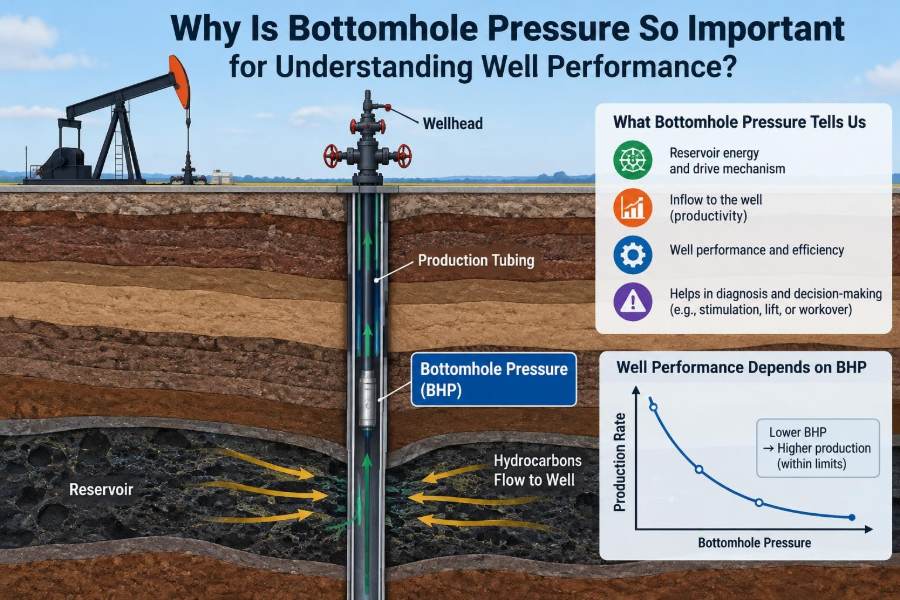
Bottomhole pressure (BHP) is the pressure at a specified point near the bottom of a well. In production work, that point is often the sandface—the location where reservoir fluids enter the completion—or a nearby downhole gauge depth.
The phrase is simple, but its precise meaning matters. Pressure varies along the wellbore because of hydrostatic head, friction, acceleration, and restrictions. A pressure recorded at 8,000 ft is not automatically the pressure at a perforated interval below it.
Engineers therefore state the gauge depth and, when needed, correct the value to a common datum. Without that reference, comparisons can be misleading.
🔄 Flowing Versus Shut-In Bottomhole Pressure
The most important distinction is between flowing bottomhole pressure and shut-in bottomhole pressure. Flowing BHP is measured or estimated while fluid is moving from the reservoir into the well and toward surface facilities.
Shut-in BHP is observed after the well has been closed long enough for pressure near the wellbore to recover toward reservoir conditions. It is often used as an estimate of average reservoir pressure, although complete equilibration may take considerable time in low-permeability or complex reservoirs.
The gap between these pressures is not a nuisance in the data. It is a direct expression of the pressure driving production.
🚗 Pressure Difference Is the Production Engine
Reservoir fluid moves only when there is a pressure gradient. A useful simplified concept is drawdown: reservoir pressure minus flowing bottomhole pressure. If average reservoir pressure is higher than flowing BHP, the reservoir has a reason to deliver fluid into the well.
Think of a water tank feeding a pipe. The water level creates a driving force, but flow also depends on pipe resistance. Similarly, a large drawdown may encourage higher inflow, yet rock permeability, fluid properties, completion quality, and multiphase effects determine how much fluid actually arrives.
Drawdown is therefore powerful, but it is not a production-rate guarantee.
🪨 The Reservoir Response to Drawdown
In a simple single-phase oil system, production rate generally rises as flowing BHP falls, assuming reservoir pressure remains unchanged. The relationship is represented by the inflow performance relationship, or IPR.
Real reservoirs complicate that picture. As pressure falls below bubble point, gas may come out of solution. Water may move toward the well, relative permeability may change, and near-wellbore pressure losses can become significant.
This is why a rate increase after opening a choke does not by itself prove that a well has improved. The well may simply be operating at a lower BHP and using more of the available pressure energy.
📉 Why a Production Rate Alone Can Mislead
A well making 500 barrels per day says little without pressure context. That same rate could come from a strong, high-productivity reservoir with modest drawdown or from a damaged, low-productivity well being pulled hard by artificial lift.
Rate also changes with fluid handling, separator pressure, choke size, water cut, gas-liquid ratio, and operating uptime. BHP helps separate a reservoir-delivery question from a surface-operating question.
When engineers compare wells, they ask not only, “Which well produces more?” but also, “What flowing BHP is each well producing against?”
🧮 The Productivity Index Connection
For undersaturated oil flow under suitable assumptions, the productivity index (PI) is commonly expressed as production rate divided by drawdown. A higher PI means the well delivers more liquid for a given pressure difference.
PI is useful because it normalizes rate against pressure. A declining rate may be expected if reservoir pressure declines, while a declining PI may suggest changing flow capacity, damage, liquid loading, scale, or altered relative permeability.
It should not be treated as a fixed property forever. Multiphase flow and changing saturation make the simple PI concept less reliable, especially when pressure falls below bubble point.
📐 Reading the Inflow Performance Relationship
An IPR curve describes how a well’s inflow rate changes with flowing BHP. Its upper end approaches zero flow at reservoir pressure. Its lower-pressure portion reflects the well’s potential to deliver more fluid if the pressure at the sandface is reduced.
For wells producing below bubble point, engineers often use curved IPR models rather than a straight line. The curvature reflects the changing mobility of oil and gas near the wellbore.
An IPR is only as credible as its inputs. Reservoir pressure, fluid behavior, water cut, test quality, and the actual pressure datum all influence the resulting curve.
🛤️ Outflow Is the Other Half of Well Performance
Inflow describes what the reservoir can deliver. Outflow, often represented by vertical lift performance (VLP), describes the pressure required to move that fluid from the bottomhole to the separator.
Outflow pressure requirements depend on tubing size, depth, fluid density, gas fraction, friction, well trajectory, choke restrictions, and surface backpressure. A deep well carrying water-rich fluid can need substantial bottomhole pressure simply to lift its contents.
A well performs where the inflow and outflow curves intersect. That operating point is one of the clearest ways to understand why BHP matters.
✖️ The Operating Point Where Curves Meet
At the intersection of IPR and VLP, the reservoir can supply exactly the rate that the wellbore and surface system can transport. The corresponding BHP is the well’s flowing operating pressure.
Changing a choke, separator pressure, gas-lift rate, tubing condition, or pump setting shifts the outflow behavior. Changing reservoir pressure, skin, permeability, or saturation behavior shifts the inflow behavior.
This framework prevents a common oversimplification: assuming every rate problem belongs either entirely to the reservoir or entirely to equipment. It is usually a system problem.
🌡️ Pressure Must Be Referenced to Depth
Pressure data must be tied to a clear vertical reference. A gauge may sit above the perforations, below them, or in a horizontal section. The difference can be meaningful, especially in long intervals or multiphase wells.
To estimate sandface BHP from another depth, engineers account for the fluid column and flow losses between points. Hydrostatic correction is relatively straightforward for a known single-phase fluid, but multiphase flow makes density and pressure-gradient estimates more uncertain.
Comparing uncorrected pressures from different depths is a fast route to false conclusions.
🧪 How Bottomhole Pressure Is Measured
Permanent downhole gauges can continuously record pressure and temperature. They are valuable for observing transients, tracking operating changes, and reducing dependence on intermittent surveys.
Memory gauges are run on wireline, slickline, or other conveyance methods and retrieve data after the survey. They can provide high-quality pressure records, but they capture only the period during which they are deployed.
Gauge selection depends on completion design, expected temperature and pressure, access, cost, reliability needs, and whether the well is flowing, shut in, or undergoing a test.
🧠 Estimating BHP When No Gauge Is Available
Many wells do not have a sensor at the desired depth. In those cases, BHP may be estimated from wellhead or tubing-head pressure using a pressure-gradient model and measured production conditions.
The calculation needs credible inputs: fluid rates, water cut, gas-oil ratio, temperatures, tubing geometry, deviation survey, separator conditions, and fluid-property correlations. An error in gas rate or liquid holdup can noticeably affect the estimate.
Estimated BHP is often operationally useful, but it should be labeled as a model result—not treated as equivalent to a direct downhole measurement.
🌊 Multiphase Flow Makes Pressure Harder to Predict
Oil wells commonly carry oil, water, and gas together. These phases do not always travel at the same velocity, and their distribution changes with depth, inclination, and rate. Gas may expand upward while liquids accumulate in sections of the tubing.
Flow patterns such as bubbly, slug, churn, and annular flow affect pressure losses. Slugging can cause pressure fluctuations that make a single instantaneous reading unrepresentative of normal operation.
For this reason, production allocation and BHP estimation benefit from stabilized tests, time-series data, and realistic multiphase-flow modeling.
💧 Water Production Changes the Pressure Picture
Increasing water cut often raises the hydrostatic load that the well must lift, particularly when gas support is limited. Water can also change frictional losses and reduce the effective oil mobility near the wellbore.
A falling oil rate accompanied by rising water rate does not automatically mean lower reservoir pressure. The total liquid rate, flowing BHP, pump performance, and water-handling constraints must be examined together.
In some cases, reducing water influx or improving lift can lower the required flowing BHP and recover oil production without changing the reservoir itself.
🫧 Gas Behavior Can Transform Inflow
When pressure near the wellbore falls below bubble point, dissolved gas evolves from oil. Some free gas can assist lifting by reducing the average fluid density in the tubing. Too much gas near the formation, however, can reduce oil relative permeability and restrict oil flow.
This dual effect explains why aggressively lowering BHP may have mixed results. The tubing may become easier to unload while the reservoir’s oil inflow becomes less efficient.
The right operating pressure depends on the full inflow-and-outflow response, not on a general rule that lower is always better.
🩹 Skin Factor Reveals Near-Wellbore Resistance
Skin represents additional pressure loss near the wellbore beyond what an ideal radial-flow model would predict. Positive skin may arise from formation damage, inadequate perforation connectivity, fines migration, scale, or completion restrictions.
Negative skin can result from stimulation or highly conductive flow paths, although interpretation must remain grounded in the well’s geology and completion design. A low BHP with disappointing production can point toward excessive skin rather than insufficient drawdown.
Pressure-transient testing is one method used to distinguish reservoir behavior from near-wellbore impairment.
🔬 Pressure-Transient Tests Add Diagnostic Depth
During a buildup test, a producing well is shut in and pressure recovery is recorded. During a drawdown test, pressure response is observed as production begins or changes. The shape of these responses contains information beyond one BHP value.
Interpretation can indicate permeability-thickness, skin, wellbore storage, boundaries, fractures, and communication with other parts of the reservoir. The analysis requires appropriate test design and careful data-quality checks.
A short or poorly stabilized test may still be useful operationally, but it may not support every reservoir conclusion engineers hope to make.
⛽ Artificial Lift Works Through Bottomhole Pressure
Artificial lift does not create reservoir energy; it changes the pressure environment that the reservoir sees. A rod pump, electric submersible pump, gas lift system, or other lift method can lower flowing BHP and allow more inflow.
Each method has limits. A pump may be gas locked, worn, or set too shallow. Gas lift may be constrained by injection-gas availability, valve behavior, or unstable unloading. The BHP response helps show whether a lift change is actually reducing backpressure at the sandface.
More lift capacity is helpful only if the reservoir can provide additional fluid economically and safely.
⚙️ Chokes and Surface Backpressure Matter Downhole
A choke is installed at surface, yet its effect can extend all the way to the reservoir. Opening it generally lowers upstream pressure and can reduce flowing BHP, while closing it raises backpressure and may reduce production.
The result is not always proportional. A well may encounter flow instability, hydrate risk, sand production, liquid loading changes, or facility constraints as conditions shift.
Choke management should therefore use stabilized production data and BHP or reliable BHP estimates, rather than reacting only to a short-term rate increase.
🧱 Completion Design Influences the Measured Response
Perforation density, penetration, phasing, interval selection, gravel packs, screens, liners, and inflow-control devices all affect how pressure is distributed near the well. In a long horizontal well, different sections may contribute very different amounts of fluid.
A single BHP reading is still valuable, but it may not reveal local inflow imbalance. High-permeability sections can dominate early flow, while water or gas breakthrough in one zone can alter the total well response.
Completion diagnostics may be needed when a whole-well pressure trend does not explain changing fluid behavior.
🧭 Horizontal Wells Need Extra Interpretation Care
In a horizontal well, pressure can vary along the lateral because fluid enters continuously and flows toward the heel. Frictional pressure loss inside the completion can make conditions near the toe different from conditions near the heel.
Flow contribution also depends on geology, completion geometry, and phase segregation. In an inclined lateral, gas and water may preferentially occupy different parts of the wellbore.
Using one bottomhole value as though every perforation experiences identical pressure can oversimplify the problem. Distributed measurements and segmented models are valuable when the decision justifies them.
📊 A Practical Well-Surveillance Workflow
Good BHP interpretation is usually a repeatable workflow, not a single calculation. Start by defining the question: is the concern falling rate, unexpected water, pump performance, a stimulation candidate, or a reservoir-pressure trend?
- Verify gauge depth, datum, calibration status, and time synchronization.
- Confirm operating conditions: choke, lift settings, separator pressure, rates, temperatures, and uptime.
- Determine whether the pressure is flowing, shut in, stabilized, or transient.
- Compare current conditions with like-for-like historical data.
- Use inflow and outflow analysis to test plausible explanations before changing operations.
Documentation is not administrative clutter; it is what makes a pressure trend interpretable months later.
🗂️ What to Compare in a Well History
A useful surveillance plot may combine oil, water, gas, flowing BHP, tubing-head pressure, choke position, lift parameters, and separator pressure on aligned time axes. Events such as workovers, chemical treatments, shutdowns, and equipment changes should be marked.
Look for cause-and-effect timing. Did BHP rise before oil rate fell? Did water cut increase while pump intake pressure changed? Did a separator-pressure increase coincide with a production loss across multiple wells?
Trends are usually more informative than isolated readings, provided the operating conditions are comparable.
🚨 Recognizing Common Pressure Signatures
Patterns do not provide automatic diagnoses, but they guide investigation. A rising flowing BHP with stable reservoir conditions may indicate greater outflow resistance, such as a choke change, tubing restriction, or higher surface backpressure.
A falling BHP with little rate gain may indicate poorer inflow, excessive gas interference, equipment limitations, or inaccurate rate data. A declining shut-in pressure over time can reflect reservoir depletion, but interference, incomplete buildup, and changing datum assumptions must be ruled out.
The safest interpretation is one supported by several independent observations.
❌ Mistake: Treating BHP as a Single “True” Number
Pressure is dynamic. It changes during startup, shut-in, slugging, choke adjustments, gas-lift cycling, and changing separator conditions. Reporting one value without its time, depth, operating state, and measurement method strips away essential meaning.
For example, a pressure taken seconds after a choke change is not comparable with a pressure measured after the well has stabilized. Likewise, a short shut-in pressure is not necessarily average reservoir pressure.
Always attach context to the number before using it for decisions.
⚠️ Mistake: Confusing Wellbore Losses With Reservoir Decline
A lower production rate can result from reservoir depletion, but it can also result from a more demanding outflow path. Scale, wax, liquid loading, rising line pressure, or a deteriorating pump can raise the pressure required to produce at a given rate.
If the reservoir-side inflow remains capable but the wellbore requirement rises, an intervention focused only on the reservoir may miss the problem. Conversely, changing equipment cannot restore flow if reservoir pressure or inflow capacity is the limiting factor.
Comparing IPR and VLP is a disciplined way to avoid this costly confusion.
🧰 Using BHP to Plan Interventions
Before acidizing, reperforating, changing tubing, optimizing gas lift, resizing a pump, or adjusting a choke, engineers can model the expected BHP effect. The goal is to identify which change moves the operating point in a favorable direction.
A hypothetical example illustrates the logic: if a tubing restriction is causing high outflow losses, removing it may lower flowing BHP at the same rate and unlock more inflow. If the limitation is high skin, stimulation may improve the inflow curve instead.
Predictions should include uncertainty, facility limits, sand-management concerns, and the possibility that actual response differs from the model.
💰 Economic Decisions Need Pressure Context
Additional rate is not automatically valuable if it requires disproportionate compression, water disposal, power, chemical use, or frequent interventions. BHP helps estimate whether a proposed operating change taps genuine incremental reservoir potential or merely shifts fluids and costs.
It also supports abandonment and redevelopment decisions. A low-rate well with favorable BHP behavior may respond to a focused intervention, while a well operating near its practical pressure limit may have limited upside.
Technical potential and economic potential should be evaluated together.
🛡️ Operating Limits and Well Integrity
Pressure management must remain within equipment, formation, and facility limits. Excessive drawdown can contribute to sand production, fines migration, coning, completion damage, or unstable flow in susceptible wells.
High pressure may challenge tubing, packers, valves, seals, and surface equipment. Pressure changes during shut-in and restart can also create operational risks that a steady-state model will not capture.
BHP analysis is therefore not only about maximizing production. It helps identify an operating envelope that balances recovery, reliability, and integrity.
🤝 Reservoir and Production Teams Need the Same Datum
Reservoir engineers often focus on average reservoir pressure, drainage, and recoverable volumes. Production engineers focus on flowing pressure, lift performance, and deliverability. Bottomhole pressure is a shared variable, but only if both teams use compatible depths, fluid assumptions, and measurement definitions.
A reservoir model calibrated to sandface pressure cannot be meaningfully compared with an uncorrected tubing pressure. Similarly, an artificial-lift design based on an outdated reservoir-pressure estimate may miss its intended target.
Clear data handoffs turn BHP from a departmental metric into a field-development tool.
🧾 Data Quality Sets the Limit on Confidence
Even sophisticated models cannot repair fundamentally poor inputs. Check sensor drift, calibration history, gauge resolution, unit consistency, depth reference, fluid-property assumptions, and whether reported rates were stable and properly allocated.
Temperature matters too because it affects fluid density and gas behavior. A pressure survey without a corresponding temperature profile may carry more uncertainty than it first appears.
When uncertainty is material, present a range of plausible BHP values and test whether the decision changes across that range.
🎓 A Useful Mental Model for Students
Picture the well as two connected systems. The reservoir is the supplier, and the wellbore plus surface facilities are the transport route. Flow occurs only when the supplier can overcome the transport route’s pressure requirement.
Bottomhole pressure sits at their interface. It tells you how hard the reservoir is being asked to work and how much pressure the well needs to move fluids upward.
This model is more useful than memorizing isolated equations because it works across naturally flowing wells, pumped wells, gas-lifted wells, vertical wells, and complex completions.
🏁 The Core Principle to Carry Forward
Bottomhole pressure matters because it connects reservoir energy, inflow capacity, wellbore losses, artificial lift, and surface constraints in one operating variable. Rate tells you what the well produced; BHP helps explain why it produced that amount.
A reliable interpretation asks several questions at once: What is the pressure at the correct depth? Is it flowing or shut in? Is the well stable? What has changed in the reservoir, the completion, the lift system, or the surface network?
Used with sound measurements and system analysis, BHP turns well surveillance from observation into diagnosis.
Bottomhole pressure is most valuable not as an isolated reading, but as the pressure link that reveals whether the reservoir can deliver and whether the well system can carry what it delivers. 🛢️📈🔧