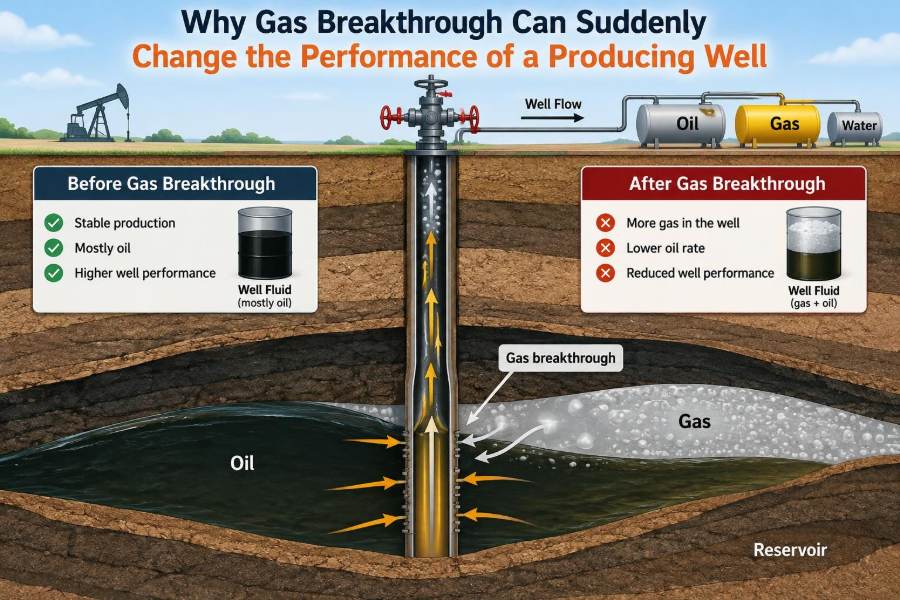

A producing oil well can appear stable for months: liquid rate is predictable, the separator handles a familiar gas volume, and the production team is focused on routine optimization. Then a trend changes. Gas rate rises sharply, oil rate falls, flowing pressure behaves differently, and the well may begin cycling or loading up with liquid.
This is often described as gas breakthrough. The phrase sounds simple, but it covers several different reservoir and wellbore mechanisms. The consequences can range from a manageable increase in gas-oil ratio to a rapid loss of oil productivity and costly compression or artificial-lift problems.
For students, gas breakthrough is a useful example of how reservoir flow, rock properties, pressure management, completion design, and surface facilities are connected. For working professionals, it is a reminder that a changing gas rate is not itself a diagnosis.
The central question is not merely whether more gas is being produced. It is where that gas is coming from, how it is moving, and whether the well can still lift liquids efficiently.
🧭 What Gas Breakthrough Actually Means
Gas breakthrough occurs when gas finds a preferential route from a gas-bearing region of the reservoir to a producing well. The gas may come from an original gas cap, liberated solution gas, an injected gas process, a neighboring gas-bearing layer, or a high-permeability feature connected to the well.
Breakthrough does not require the reservoir to be “full of gas.” A relatively small, highly conductive pathway can deliver enough gas to dominate the well’s produced-fluid behavior. In many cases, the gas reaches the well before a large volume of reservoir oil has been displaced.
That distinction matters. Gas production can rise because pressure declines below bubble point and oil releases dissolved gas, even without a direct gas-channeling problem. Engineers must separate normal depletion behavior from premature gas arrival.
📈 Why the Change Can Feel So Sudden
Reservoir changes are usually gradual, but well response can be nonlinear. Once a gas pathway becomes connected to the completion, gas mobility may increase quickly and the produced gas-oil ratio can jump over a relatively short period.
Gas is much less viscous than oil. Under comparable pressure conditions, it can move more easily through a connected high-permeability path. As gas saturation increases near the well, its relative permeability can rise while oil relative permeability falls.
Think of a crowded hallway where a side door suddenly opens. The hallway did not vanish, but people now favor the easier route. In a reservoir, the “side door” may be a fracture, a high-permeability streak, or a coning pathway near the wellbore.
🧪 The Core Role of Relative Permeability
Oil, gas, and water commonly flow together in porous rock. Each phase interferes with the others, so its ability to flow is described by relative permeability, a fraction of the rock’s effective permeability available to that phase at a given saturation.
When gas saturation near a producer is below its critical value, gas may be present but largely immobile. Once saturation exceeds a threshold, gas becomes mobile. A further increase can reduce the effective flow capacity available to oil.
This explains why gas breakthrough can damage oil production even if reservoir pressure remains adequate. The issue may be a changing phase distribution around the well, rather than simply insufficient pressure energy.
🪨 Reservoir Heterogeneity Creates Fast Paths
Real reservoirs are rarely uniform blocks of rock. Permeability can vary vertically and laterally because of bedding, grain-size changes, channels, cementation, natural fractures, faults, and depositional boundaries.
Gas preferentially enters zones with lower resistance to flow. A thin, highly permeable interval can contribute a disproportionate share of produced gas, while lower-permeability oil-bearing intervals remain poorly drained.
This is why an average core permeability or a single log-derived value is not enough to forecast breakthrough. The connectivity of high-permeability material between gas source and well is often more decisive than the average property.
⛰️ Gas-Cap Drive and Downward Gas Movement
In a gas-cap-drive reservoir, free gas occupies the upper part of the hydrocarbon accumulation. As pressure declines, the gas cap can expand and help displace oil downward and toward producing wells.
That energy can be valuable when withdrawal is controlled. However, aggressive production from wells close to the gas-oil contact can pull the contact downward locally and create early gas entry into upper perforations.
Vertical permeability is especially influential. A reservoir with strong vertical communication may allow gas to move downward more readily than one separated by tight shale barriers. The initial contact depth alone does not determine the risk.
🌀 Gas Coning Near the Wellbore
Gas coning is the upward or downward deformation of a gas-oil contact toward a producing completion because of the pressure drawdown created by production. In the common case of a gas cap above oil, gas moves downward toward the well.
High production rates increase drawdown and steepen the pressure gradient toward the wellbore. If viscous forces pulling gas toward the completion overcome gravity forces tending to keep gas above oil, a cone can form.
Coning is not always an irreversible event. Reducing drawdown may allow a cone to relax in some reservoirs. But if prolonged production creates a stable gas channel or enlarges the swept region, the oil-rate recovery may be incomplete.
📏 Completion Depth Changes the Risk
Perforations placed close to the gas-oil contact have less vertical separation from potential gas entry. This can improve access to an upper oil interval, but it also leaves little buffer against contact movement or coning.
Completion strategy must balance several objectives: access to productive rock, avoidance of gas and water contacts, pressure support, sand-control needs, and future intervention options. There is no universally safe distance from a contact because anisotropy, rate, fluid properties, and barriers differ by reservoir.
Selective completions can help. If gas enters primarily through the upper interval, isolating or restricting that interval may preserve production from deeper oil-bearing layers.
🧱 High-Permeability Streaks and Layered Flow
Layered reservoirs frequently contain intervals with very different permeability. A high-permeability layer connected to a gas source can break through early even though most of the reservoir volume remains oil saturated.
The producing well then sees a mixed response: high gas contribution from one layer and reduced oil contribution from others. Without production logging or reliable zonal surveillance, this can be mistaken for a uniform reservoir-wide gas increase.
Layered flow is a strong argument for preserving zonal control. Commingling intervals may maximize early production but can make later diagnosis and selective shutoff more difficult.
⚡ Natural Fractures and Fault-Related Pathways
Natural fractures can provide rapid flow paths because their permeability may be much higher than that of the surrounding matrix. If fractures connect a producer to a gas cap or gas-charged fault zone, gas can arrive earlier than matrix-based models predict.
Faults are more complicated than simple barriers or conduits. Their behavior depends on displacement, clay smear, cementation, stress state, and the juxtaposition of reservoir units. A fault may seal in one location and transmit fluids in another.
A sudden gas increase accompanied by a strong pressure connection to another interval can justify a structural and fracture-focused review. It should not, however, be assumed that every abrupt change proves a fault leak.
💨 Solution Gas Is Different from Gas Breakthrough
Oil contains dissolved gas at reservoir conditions. When pressure falls below the bubble-point pressure, gas begins to evolve from the oil. This is expected in many depletion scenarios and can raise the produced gas-oil ratio.
Initially, much of that released gas may remain trapped in pore spaces. When gas saturation becomes high enough to flow, it can move toward the well and alter production behavior. This process can be widespread rather than confined to a narrow breakthrough channel.
Distinguishing solution-gas liberation from gas-cap breakthrough requires multiple lines of evidence: pressure history, fluid samples, production trends, reservoir structure, and where possible, zonal flow measurements.
🔄 Gas Injection Can Also Break Through
In gas-injection projects, injected gas may provide pressure maintenance or miscible displacement. The objective is normally to contact as much oil as practical before the gas reaches producers.
Early injected-gas breakthrough can occur through unfavorable mobility ratio, channeling in high-permeability zones, fractures, poor areal sweep, or injector-producer communication that is stronger than expected. It may increase recycle volumes and reduce displacement efficiency.
Tracer programs, compositional analysis, pressure interference observations, and pattern-level surveillance can help determine whether produced gas is likely to be injected gas. Such interpretation should account for operational timing and reservoir mixing.
🧮 Mobility Ratio Explains Why Gas Can Outrun Oil
Mobility is permeability available to a phase divided by its viscosity. Because gas often has low viscosity, its mobility can become high once a connected gas saturation is present.
An unfavorable mobility ratio means the displacing fluid moves more readily than the displaced oil. The displacement front can become unstable, allowing the gas to finger through the oil instead of pushing it in a broad, efficient front.
This is a reservoir-scale problem, not merely a well problem. Adjusting rates at one producer may reduce its symptoms, but field-wide injection patterns and conformance may need attention if channeling is established.
📊 The First Warning Signs in Production Data
The most visible signal is often a rise in gas-oil ratio, or GOR. Yet GOR should be read with oil rate, gas rate, flowing pressure, choke position, water cut, and artificial-lift conditions rather than in isolation.
A GOR increase caused mainly by rising gas rate suggests something different from one caused mainly by falling oil rate. A sharp change after a choke adjustment, compressor outage, or separator-pressure change may reflect operating conditions rather than a reservoir event.
- A rising gas rate with declining oil rate can indicate gas channeling or coning.
- A rising GOR during broad pressure depletion may be consistent with solution-gas evolution.
- Erratic gas measurements may point to metering, allocation, or separator problems.
- A gas increase limited to one completion may indicate zonal inflow rather than field-wide depletion.
🧾 Read Trends, Not a Single Test
A single well test or daily allocation can be misleading. Wells cycle, separators fluctuate, test conditions change, and multiphase metering has uncertainty. The value of surveillance lies in consistent trends under known operating conditions.
Engineers commonly compare normalized rates, GOR versus cumulative oil, flowing tubing pressure, and drawdown estimates. Sudden departures from the well’s historical relationship can be more informative than any isolated number.
Context is essential. If several offset wells show similar behavior at the same time, regional pressure depletion or a facility change may be more plausible than a unique channel to one well.
🛢️ Why Oil Rate Often Falls After Breakthrough
Gas entering the near-wellbore region occupies pore space and competes with oil for flow capacity. The oil relative permeability falls, so a larger pressure drop may be required to produce the same oil rate.
Some reservoir energy is also spent moving gas. If the gas repeatedly cycles through an injection-production system, the operation may handle substantial volumes without proportionate oil recovery.
The oil-rate loss is not always immediate. A well can initially show a gas increase while holding oil rate, particularly if lifting capacity is ample. Over time, worsening gas saturation, changing drawdown, or lift limitations may expose the underlying productivity loss.
🏗️ Surface Facilities Feel the Impact Too
Extra gas affects more than reservoir performance. Separators, flowlines, compressors, dehydration units, flare systems, and export capacity may all become constraints when gas volumes rise.
Higher gas throughput can increase pressure losses and backpressure. If compression capacity is limited, the well may need to be choked back even when the reservoir could deliver fluid. Thus, a reservoir breakthrough can become a facility-limited production problem.
Gas composition also matters. Changes in carbon dioxide, hydrogen sulfide, heavier hydrocarbons, or water vapor can alter corrosion, treating, emissions, and safety requirements. Composition changes should be assessed through appropriate sampling and operating procedures.
⬆️ Artificial Lift Can Become Unstable
Most artificial-lift systems are sensitive to gas in different ways. Gas interference can reduce the efficiency of rod pumps, gas lock can prevent a pump from displacing liquid, and free gas can complicate electric submersible pump performance.
Gas lift systems intentionally use gas, but an uncontrolled increase in produced gas can still upset injection allocation, flowing gradients, and valve performance. The result may be unstable unloading or inefficient lift rather than a simple production gain.
A key practical lesson is that a falling liquid rate after gas breakthrough does not automatically mean the reservoir has failed. The well may be limited by its lift system, and a wellbore-focused remedy could recover some production.
🧯 Flow Assurance and Operational Risks
Changes in gas fraction change flow regimes in tubing and pipelines. Slugging, liquid fallback, unstable separator feed, and pressure cycling can become more likely, especially in long flowlines or systems with significant elevation changes.
Rapid gas expansion may cool fluids, which can worsen hydrate or liquid-dropout risks under suitable pressure and temperature conditions. The exact risk depends on composition, water content, thermal environment, and operating envelope.
These effects need disciplined operating review rather than assumptions. A reservoir diagnosis and a flow-assurance assessment should proceed together when gas behavior changes materially.
🔍 Production Logging Locates the Entry Zone
A production logging tool survey can help identify where gas, oil, and water enter or leave the wellbore. Depending on well conditions and available tools, engineers may combine spinner flowmeters, temperature, pressure, density, noise, and holdup measurements.
The goal is to determine whether gas is entering through an upper perforated interval, a leak path behind pipe, a fracture-connected zone, or multiple layers. This information can change a vague “high GOR well” into a specific intervention target.
Interpretation has limits. Multiphase flow is complex, tool responses depend on completion geometry, and production conditions may differ from prior operating periods. Logging results are strongest when integrated with completion records and pressure data.
🧬 Fluid Sampling and Gas Composition Clues
Gas composition can offer evidence about origin. For example, a compositional shift may be consistent with communication to a different reservoir compartment, an injected-gas stream, or changing liberation of solution gas.
It is not a fingerprint by itself. Gas can mix in the reservoir, wellbore, flowline, and surface equipment, while sampling quality can affect conclusions. Repeated, representative samples are more useful than one unverified result.
When combined with pressure and zonal data, composition can support a reservoir model that explains both the source and the path of the gas.
🧠 Build a Diagnosis Before Choosing a Fix
Prematurely installing a gas shutoff device or reducing rate without diagnosis can sacrifice oil unnecessarily. The same production symptom can arise from coning, channeling, liberated gas, casing leaks, lift problems, or measurement errors.
A practical diagnostic sequence is often:
- Verify allocation, metering, test conditions, and recent operating changes.
- Review rate, pressure, GOR, water cut, and artificial-lift trends together.
- Update the structural, completion, and reservoir-context picture.
- Use targeted surveillance to locate gas entry or establish communication.
- Compare intervention options against expected oil recovery, risk, and remaining well life.
This sequence is not a substitute for field-specific engineering judgment, but it reduces the chance of treating symptoms while missing the mechanism.
🎚️ Rate Management Can Delay or Reduce Coning
If coning is the dominant mechanism, lowering drawdown can reduce the force pulling gas toward the completion. This may mean reducing choke size, changing artificial-lift settings, or operating within a defined liquid-rate limit.
The tradeoff is immediate: lower rate can preserve oil productivity and reduce gas handling, but it also defers production. The economically sensible rate depends on oil value, gas constraints, facility capacity, intervention cost, and predicted recovery.
Rate reduction is least effective when a permanent high-permeability channel or fracture has already become the dominant flow path. In those cases, selective isolation or conformance treatment may be considered.
🔒 Mechanical Isolation and Selective Completion
Mechanical methods include bridge plugs, packers, sliding sleeves, straddle systems, and selective reperforation. Their purpose is to isolate the gas-producing interval while retaining access to productive oil zones.
These methods work best when the gas source is clearly localized and completion integrity allows effective isolation. If gas is entering behind casing or through multiple connected layers, simply closing visible perforations may not solve the problem.
Every isolation decision should consider future access. Permanently abandoning an interval can protect current oil production, but it may limit later recompletion or reservoir-management options.
🧫 Chemical and Conformance Treatments Have Limits
Gels, foams, relative-permeability modifiers, and other conformance treatments may be used to reduce gas mobility or divert flow from high-conductivity pathways. Their applicability depends on rock type, temperature, salinity, fracture geometry, and treatment placement.
These treatments are not universal “gas blockers.” A treatment that enters the wrong zone can reduce oil productivity, and a fracture network can make placement difficult to control. Laboratory screening and reservoir-specific design are therefore essential.
In gas-injection settings, foam-assisted processes and injection-profile control can improve sweep in some cases. Their effectiveness must be evaluated at the pattern and reservoir scale, not only by a short-term well response.
🕳️ Well Integrity Must Not Be Overlooked
Not all unexpected gas production originates from the intended reservoir interval. Leaks in tubing, packer failures, poor cement isolation, or behind-casing flow can allow gas to communicate with the wellbore.
Integrity issues may present as abnormal annulus pressure, unexpected zonal communication, or gas entry that does not match the perforated interval. They require a different response from reservoir coning or channeling.
Pressure testing, temperature and noise logging, cement evaluation, and mechanical inspection may be appropriate depending on the well’s construction and risk profile. Safety and barrier-management procedures should govern this work.
🧩 A Hypothetical Well Example
Consider a hypothetical oil producer completed across several sandstone layers below a gas cap. For a long period, it produces stable oil with moderate gas. After an artificial-lift adjustment increases liquid drawdown, gas rate rises, oil rate begins declining, and the upper perforations are suspected.
A production log indicates that most gas enters through the uppermost interval, while deeper layers continue to contribute oil. The history and zonal evidence are consistent with localized gas coning or gas-cap encroachment rather than uniform solution-gas liberation.
The team might compare reduced drawdown, upper-zone isolation, and a recompletion focused on lower intervals. The best choice would depend on expected incremental oil, operational risk, remaining reserves, and the confidence of the diagnosis—not on GOR alone.
📐 Modeling Helps Test Competing Explanations
Reservoir simulation can test whether observed behavior is consistent with gas-cap movement, layered permeability, injection channeling, or pressure depletion. A well model can also examine tubing performance and artificial-lift response as gas fraction changes.
Models are most useful when calibrated against dependable data. A detailed model built on uncertain contacts, permeability distribution, or production allocation can create false confidence.
Use models to compare plausible scenarios and make assumptions visible. They should support surveillance and decisions, not replace field evidence.
⚠️ Common Interpretation Mistakes
Several errors repeatedly complicate gas-breakthrough decisions:
- Calling every GOR increase “breakthrough” without checking pressure and operations.
- Assuming a gas-cap contact is flat and static near a high-rate producer.
- Treating the well as a single zone when layered inflow dominates behavior.
- Blaming the reservoir before confirming meters, separators, and allocation methods.
- Installing a shutoff treatment without identifying whether gas enters through perforations or behind casing.
- Ignoring the effect of gas on artificial lift and surface backpressure.
Each mistake narrows the diagnosis too early. The better habit is to retain competing explanations until evidence rules them out.
🤝 Reservoir, Production, and Facilities Teams Need One Picture
Gas breakthrough sits at the boundary of several disciplines. Reservoir engineers assess contacts, sweep, pressure, and connectivity. Production engineers evaluate inflow, lift, completion options, and well intervention. Facilities and flow-assurance teams manage handling limits and operating stability.
When these groups use separate assumptions, the field can receive conflicting advice: produce harder to meet liquid targets, choke back because compression is constrained, or isolate a zone before its contribution is verified.
A shared well review built around the same trends, completion schematic, pressure data, and uncertainty ranges makes decisions more coherent. It also makes the economics of gas management visible rather than treating gas as someone else’s problem.
🗺️ Prevention Starts Before the Well Is Completed
Some breakthrough risk can be reduced during field development. Better characterization of contacts, barriers, fractures, permeability architecture, and pressure communication supports smarter well placement and completion design.
Potential preventive measures include maintaining separation from gas contacts where practical, limiting drawdown in sensitive wells, preserving selective zonal access, monitoring injection conformance, and designing facilities for credible gas-rate scenarios.
Prevention does not mean eliminating all gas production. Gas may be an expected and valuable part of the produced stream. The objective is to avoid premature gas dominance that bypasses recoverable oil or overwhelms the production system.
✅ The Core Principle: Follow the Source, Path, and Consequence
Gas breakthrough changes a producing well because gas can move through the reservoir and wellbore differently from oil. Once a favorable pathway connects to the well, gas may reduce oil mobility, disrupt artificial lift, increase backpressure, and consume surface-handling capacity.
The practical response is to identify three things: the gas source, the flow path, and the operational consequence. A gas cap, injected gas, solution gas, fracture, upper perforation, and failed barrier each imply different evidence and different remedies.
Early recognition is valuable, but speed should not replace diagnosis. A well with rising gas can sometimes be stabilized through rate control, lift optimization, zonal isolation, or conformance work. In other cases, the production history reflects an unavoidable stage of depletion that must be managed safely and economically.
Gas breakthrough is not one event with one fix; it is a flow problem whose solution depends on understanding where the gas originates, how it reaches the well, and what it displaces along the way. 🛢️📈🔧