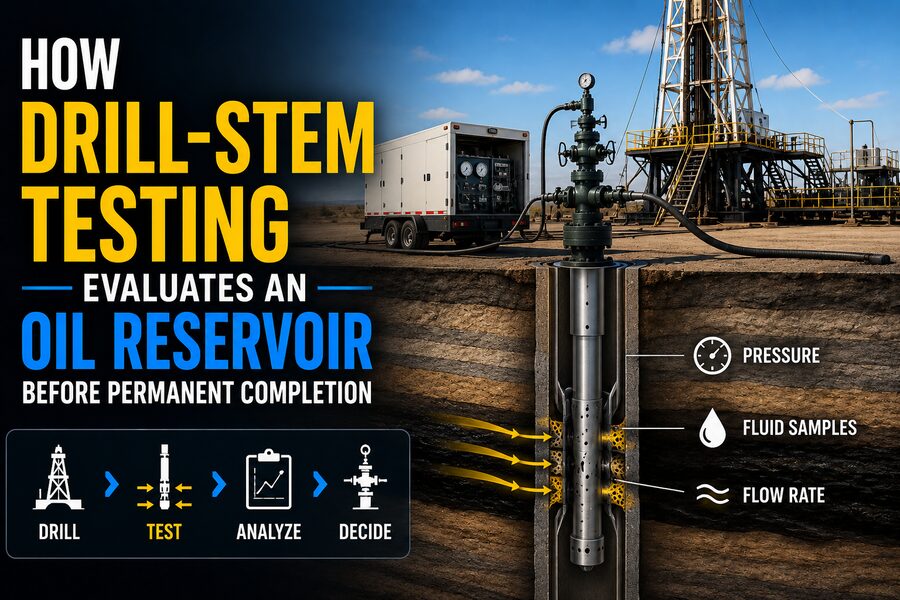

Before an oil or gas well is permanently completed for production, engineers need to answer a crucial question: Will the reservoir actually produce enough hydrocarbons, at useful pressure and flow rates, to justify the investment?
Drilling through a reservoir can reveal rock type, porosity, hydrocarbon shows, and formation thickness, but those observations do not fully reveal how the reservoir will behave when fluids are allowed to flow. A formation may contain oil or gas yet still produce poorly because of low permeability, formation damage, limited reservoir extent, or unfavorable pressure conditions.
That is where Drill-Stem Testing, commonly abbreviated as DST, becomes extremely valuable. 🧪⚙️
A drill-stem test temporarily allows formation fluids to flow into the well through a controlled downhole tool assembly. During the test, engineers measure pressure, flow behavior, fluid properties, and reservoir response. The information helps determine whether the formation is commercially promising and how the well should eventually be completed.
In simple terms, DST is like giving the reservoir a temporary production test before committing to a permanent production system.
🧭 1. Why Testing Is Needed Before Completion
Completing a well can be expensive.
Permanent completion may involve:
- Installing production tubing
- Setting packers
- Perforating casing
- Installing downhole safety equipment
- Adding artificial-lift systems
- Connecting the well to surface facilities
Before making those investments, operators want as much information as possible about the reservoir.
Well logs and core samples provide valuable indirect information, but DST reveals something different: dynamic reservoir behavior.
It shows how the formation responds when pressure in the well is reduced and fluids are allowed to move toward the borehole.
That makes DST one of the most direct ways to evaluate whether a newly drilled reservoir interval can actually deliver oil or gas. 🛢️📊
🧰 2. What Is a Drill-Stem Test?
A drill-stem test uses a temporary assembly of tools lowered into the well on drill pipe or tubing.
The assembly isolates the target reservoir interval and allows formation fluids to flow into the drill string under controlled conditions.
A typical DST system may include:
- Packers
- Test valves
- Pressure gauges
- Temperature gauges
- Sampling chambers
- Circulating valves
- Safety devices
- Flow-control equipment
The exact configuration depends on whether the well is open hole or cased, whether it is offshore or onshore, and what type of reservoir is being tested.
The goal is to create a controlled temporary flow period and record how pressure changes over time.
🔒 3. Packers Isolate the Reservoir Interval
One of the most important DST components is the packer.
A packer seals the annular space between the test string and the wellbore wall or casing.
This isolates the selected formation interval from the rest of the well.
Why is this necessary?
Without isolation, fluids from other formations could enter the well and interfere with the test.
By sealing around the test assembly, engineers can focus specifically on the reservoir zone of interest.
The isolated interval can then be opened to flow while the rest of the well remains separated. 🔧
🚪 4. Opening the Formation to Flow
Before the test begins, the test valve is closed.
When engineers are ready, the valve is opened.
The pressure inside the test string is usually lower than the reservoir pressure.
This creates a pressure difference known as drawdown.
Because reservoir fluids naturally move from higher pressure toward lower pressure, oil, gas, or formation water begins flowing from the rock into the well.
The fluids then move upward through the test string toward the surface or into designated test chambers.
The way flow develops provides important clues about reservoir productivity.
📉 5. Drawdown Reveals How Easily the Reservoir Produces
When the test valve opens, pressure near the wellbore decreases.
This reduction in pressure causes reservoir fluids to flow toward the well.
The resulting pressure decline is called pressure drawdown.
Engineers observe how much pressure reduction is required to produce a certain flow rate.
A productive reservoir with good permeability may deliver a substantial flow rate with relatively modest pressure drawdown.
A tight or damaged formation may require a much larger pressure reduction to produce only a small amount of fluid.
This relationship helps engineers estimate how easily hydrocarbons can move through the rock. 🪨➡️🛢️
🧱 6. Permeability Is a Key Reservoir Property
Porosity tells engineers how much fluid the rock can store.
Permeability tells them how easily that fluid can move.
A reservoir may have significant porosity but poor permeability.
That means it can contain hydrocarbons yet still produce slowly.
DST pressure data can be analyzed to estimate effective permeability around the well.
Higher permeability generally means fluids can move toward the well more easily.
This makes permeability one of the most important parameters when evaluating reservoir productivity.
⏸️ 7. Shut-In Periods Are Just as Important as Flow Periods
A drill-stem test does not simply let the reservoir flow continuously.
Engineers often alternate between flow periods and shut-in periods.
During a shut-in period, the test valve is closed and fluid flow into the well is stopped.
The pressure near the well then begins recovering toward the reservoir’s natural pressure.
This recovery is known as pressure buildup.
The shape and speed of the buildup curve contain valuable information about the formation.
Pressure buildup analysis can help estimate:
- Reservoir pressure
- Permeability
- Formation damage
- Reservoir boundaries
- Flow barriers
In many cases, the shut-in data can be even more informative than the flowing data. 📈
🧠 8. Reservoir Pressure Can Be Estimated
One of the major goals of DST is to determine the reservoir’s natural pressure.
Reservoir pressure provides insight into the energy available to move hydrocarbons toward the well.
A newly discovered reservoir may have high pressure, while a depleted or compartmentalized reservoir may show lower pressure.
By analyzing pressure recovery during shut-in periods, engineers can estimate the pressure that existed before the formation was disturbed by testing.
This helps with reserve calculations, production planning, and completion design.
⚙️ 9. Skin Factor Indicates Near-Wellbore Damage or Improvement
Drilling can alter the rock immediately surrounding the well.
Drilling mud may invade pore spaces.
Fine particles may block flow channels.
Mechanical damage can reduce permeability near the wellbore.
Engineers describe this additional resistance using a parameter called skin factor.
A positive skin factor often indicates extra flow resistance.
A negative skin factor may indicate that the well has been stimulated or has unusually favorable near-wellbore flow.
DST pressure data can help estimate skin.
This is important because a reservoir may be naturally productive but appear weak if drilling damage is restricting flow. 🧱
🧪 10. DST Can Recover Actual Reservoir Fluids
Pressure measurements are only part of the test.
Engineers also want to know exactly what fluid is present.
DST equipment can collect samples of:
- Crude oil
- Natural gas
- Formation water
- Condensate
These samples can later be analyzed in a laboratory.
Fluid analysis may determine:
- Oil density
- Gas composition
- Water salinity
- Gas-oil ratio
- Bubble-point pressure
- Formation volume factor
- Viscosity
Such information is essential for designing production equipment and estimating economic value.
🔥 11. Surface Flow Testing Provides Additional Information
When conditions allow, fluids produced during DST may be routed to surface test equipment.
Surface equipment can separate oil, gas, and water and measure their individual flow rates.
A typical test spread may include:
- Choke manifold
- Separator
- Flow meters
- Pressure gauges
- Sampling equipment
- Flare system
Gas may be safely burned in a flare when there is no pipeline connection available.
Oil may be stored temporarily in tanks.
This allows engineers to measure how much of each fluid the reservoir produces. 🛢️🔥
📏 12. Flow Rate Is Not the Only Measure of Success
A high initial flow rate can look impressive, but engineers do not judge a reservoir on flow rate alone.
They also consider:
- Pressure decline
- Stability of production
- Water production
- Gas-oil ratio
- Reservoir pressure recovery
- Duration of flow
- Evidence of boundaries
A well that flows strongly for a few minutes and then rapidly declines may be less attractive than a well that maintains a moderate but stable rate.
DST helps distinguish temporary effects from sustainable reservoir performance.
🧭 13. Pressure Transients Reveal Reservoir Geometry
When pressure changes at the well, that pressure disturbance travels outward through the reservoir.
The way it propagates depends on reservoir properties and boundaries.
If the pressure signal reaches a sealing fault, for example, the buildup response may change.
Similarly, a nearby constant-pressure boundary or connected aquifer may alter the pressure behavior.
By analyzing these pressure transients, engineers can sometimes infer:
- Faults
- Reservoir compartmentalization
- Limited drainage area
- Layered formations
- Nearby pressure support
This makes DST a powerful diagnostic tool for understanding reservoir structure. 🗺️
🌊 14. DST Can Reveal Water Production
Not every fluid entering the well is desirable.
A formation may produce large amounts of water along with oil or gas.
Water production can increase operating costs because the water must be separated, treated, transported, or reinjected.
During DST, engineers measure the proportion of water in the produced fluids.
If water production is unexpectedly high, it may indicate:
- Water-bearing layers
- Communication with an aquifer
- Poor interval selection
- Unfavorable fluid contacts
This information can influence whether the interval is completed at all.
💨 15. Gas-Oil Ratio Helps Characterize the Reservoir
For oil reservoirs, engineers often measure the gas-oil ratio, or GOR.
GOR describes how much gas is produced relative to oil.
A very high gas-oil ratio can indicate proximity to a gas cap or a volatile fluid system.
A lower ratio may characterize a different reservoir condition.
Combined with laboratory fluid analysis, GOR helps engineers understand the petroleum system and design suitable surface-processing equipment.
🛠️ 16. Open-Hole and Cased-Hole DSTs
DST can be conducted in different well configurations.
🪨 Open-Hole DST
In an open-hole test, the reservoir is tested before casing is installed across the formation.
Packers seal directly against the exposed wellbore.
This can provide early reservoir information, but open-hole testing can be mechanically more challenging because the borehole may be irregular or unstable.
🔩 Cased-Hole DST
In a cased-hole test, casing has already been installed.
The target formation is usually perforated so reservoir fluids can enter the well.
Cased-hole testing generally provides better mechanical control but requires additional completion-related operations.
🛡️ 17. Safety Is a Major Part of DST Design
A drill-stem test deliberately allows reservoir fluids to flow into the well.
That means it must be carefully controlled.
Unexpected pressure, gas flow, or formation fluid behavior can create serious hazards.
DST equipment therefore includes safety features such as:
- Downhole shut-in valves
- Surface pressure-control systems
- Blowout preventers
- Emergency shutdown equipment
- High-pressure test lines
Engineers carefully plan allowable pressures, flow rates, and contingency procedures before testing begins.
In high-pressure or high-temperature reservoirs, safety considerations become especially important. ⚠️
🌊 18. Offshore DST Can Be Especially Complex
Offshore drill-stem testing introduces additional challenges.
A floating drilling rig may be operating thousands of meters above the seabed.
Any produced hydrocarbons must be safely controlled on the rig.
Special subsea test trees and emergency disconnect systems may be used.
These systems allow the test string to be shut in and disconnected safely if the rig must move away from the well.
Offshore DST therefore combines reservoir evaluation with advanced well-control engineering.
📡 19. Downhole Gauges Record High-Resolution Data
Modern DST tools often contain electronic pressure and temperature gauges.
These devices record conditions throughout the test.
High-resolution pressure data is especially valuable because small changes in pressure behavior can reveal important reservoir characteristics.
After the test, engineers download and analyze the recorded data.
In some systems, information may also be transmitted toward the surface during the operation.
The quality of pressure data strongly influences the reliability of reservoir interpretation. 📊
🧮 20. Engineers Build Pressure-Time Curves
DST analysis often begins by plotting pressure against time.
These curves show what happened during:
- Initial shut-in
- Flow periods
- Pressure buildup
- Final shut-in
Engineers then use specialized well-test interpretation methods to extract reservoir properties.
Pressure derivatives may also be plotted because they can make certain flow regimes and reservoir boundaries easier to identify.
These plots help transform raw pressure measurements into a model of how the reservoir behaves underground.
🏗️ 21. DST Results Influence Completion Design
One of the most important reasons to perform DST is to decide how the well should be completed.
If the reservoir has strong natural productivity, a relatively simple completion may be sufficient.
If the formation has low permeability or high skin, engineers may consider:
- Hydraulic fracturing
- Acid stimulation
- Additional perforations
- Selective zone completion
If water production is excessive, certain intervals may be isolated.
If the reservoir appears uneconomic, the operator may decide not to complete the well at all.
DST therefore directly influences major investment decisions. 💰
📈 22. Productivity Index Can Be Estimated
Engineers often compare flow rate with the pressure difference driving production.
This can provide an estimate of productivity index.
In simplified form:
Productivity Index = Flow Rate ÷ Pressure Drawdown
A higher productivity index generally indicates that the well can produce more fluid for a given pressure reduction.
This helps compare different wells or reservoir intervals.
However, real reservoir behavior can be more complex, especially in multiphase flow or non-Darcy flow conditions.
🧠 23. DST Helps Distinguish Reservoir Quality From Well Damage
Suppose a well produces poorly.
There are at least two possible explanations:
- The reservoir itself has low permeability.
- The reservoir is good, but the near-wellbore region has been damaged.
These require very different decisions.
A naturally poor reservoir may not justify additional investment.
A damaged but otherwise strong reservoir might become highly productive after stimulation.
Pressure-transient analysis from DST helps engineers separate these effects.
That makes the test economically valuable, not just technically interesting.
💰 24. The Economic Question Behind Every DST
Ultimately, reservoir testing supports a business decision.
A reservoir may contain hydrocarbons, but development only makes sense if those hydrocarbons can be produced economically.
DST helps answer questions such as:
- How much can the well produce?
- At what pressure?
- For how long?
- How much water will accompany the hydrocarbons?
- Will stimulation be required?
- Are reservoir boundaries limiting?
- Is the interval commercially attractive?
The answers influence whether the operator completes, stimulates, sidetracks, suspends, or abandons the well.
⚠️ 25. DST Has Limitations
Drill-stem testing provides valuable information, but it is still a temporary test.
Its limitations may include:
- Short test duration
- Limited radius of investigation
- Wellbore storage effects
- Multiphasic flow complications
- Tool limitations
- Formation damage
- Interpretation uncertainty
A short test may not detect distant reservoir boundaries.
Similarly, pressure behavior can sometimes have multiple possible interpretations.
DST results are therefore combined with seismic data, well logs, core analysis, production forecasts, and geological models.
🛰️ 26. Modern Reservoir Evaluation Combines Many Data Sources
A DST does not operate in isolation.
Reservoir engineers may integrate its results with:
- Wireline logs
- Logging-while-drilling data
- Core measurements
- Seismic surveys
- Formation pressure tests
- Fluid samples
- Geological models
Each technique reveals a different part of the reservoir story.
Logs describe rock properties near the borehole.
Seismic data helps map larger structures.
DST reveals how fluids actually move under pressure.
Together, these data provide a more complete picture of the reservoir. 🧩
🏁 Conclusion
Drill-stem testing is one of the most important ways to evaluate an oil or gas reservoir before committing to permanent completion.
During a DST, a temporary downhole tool assembly isolates the target formation and allows reservoir fluids to flow under controlled conditions. Engineers monitor flow rate, pressure drawdown, pressure buildup, temperature, and fluid composition.
From this information, they can estimate critical reservoir properties such as:
Reservoir pressure
Permeability
Skin factor
Productivity
Fluid type and composition
Possible reservoir boundaries
The test also reveals whether the formation produces excessive water, whether near-wellbore damage is restricting flow, and whether the reservoir can sustain commercially meaningful production. 🛢️📈
Most importantly, DST reduces uncertainty before expensive completion decisions are made.
Instead of relying only on what the rock looks like in logs or cores, engineers temporarily allow the reservoir to behave like a producing well and observe its response.
That makes drill-stem testing a powerful bridge between discovering hydrocarbons underground and deciding whether they can be produced economically and safely. 🧪⚙️🏭