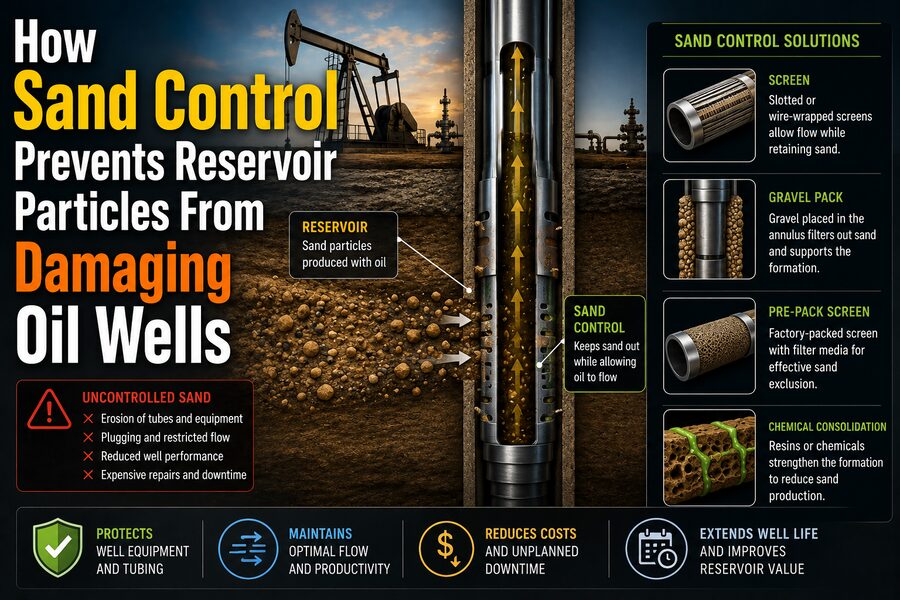

Oil and gas wells do not produce only hydrocarbons. In many reservoirs, fluids flowing toward the well can also carry tiny fragments of rock and loose mineral grains from the formation. These particles are commonly called formation sand. While a small amount of sand may seem harmless, uncontrolled sand production can create serious mechanical, operational, and economic problems throughout an oil well. ⚙️🌍
Sand can erode valves, damage pumps, plug tubing, fill separators, restrict production, and even destabilize the formation surrounding the wellbore. In severe cases, a well may become too difficult or expensive to operate safely.
To prevent these problems, petroleum engineers use a collection of techniques known as sand control.
Sand-control systems are designed to allow oil, gas, and water to flow into the well while preventing excessive quantities of reservoir particles from entering the production system. These techniques can range from carefully designed metal screens to gravel-packed completions and specialized chemical treatments.
The engineering challenge is surprisingly delicate: stop damaging solid particles without blocking the valuable fluids the well was drilled to produce. 🛢️🔧
🧠 Why Does Sand Enter an Oil Well?
Reservoir rock is made of mineral grains held together by natural cementation and stress.
Some formations are strongly consolidated, meaning their grains are firmly bonded together. Others are poorly consolidated or unconsolidated, meaning the grains can separate relatively easily.
When a well begins producing, reservoir fluids move toward the lower-pressure wellbore.
This fluid movement creates forces on the rock surrounding the completion.
If those forces exceed the strength holding mineral grains together, particles can become detached and travel into the well.
Sand production is particularly common in formations containing weakly cemented sandstone. 🪨
Several factors can contribute, including:
- High production rates
- Large pressure drawdown
- Weak formation strength
- Changes in reservoir pressure
- Water production
- Repeated well shutdowns and startups
- Poor completion design
- Changes in effective stress around the wellbore
As a reservoir becomes depleted, the mechanical conditions around the well can also change, potentially increasing the likelihood of sand production.
📉 What Is Pressure Drawdown?
One of the most important concepts in sand production is drawdown.
Reservoir pressure pushes fluids toward the well.
The pressure inside the producing well is deliberately kept lower than the surrounding reservoir pressure so oil or gas can flow inward.
The difference between reservoir pressure and flowing well pressure is called pressure drawdown.
A larger drawdown can increase production—but it also creates stronger forces around the wellbore.
If the formation is weak, excessive drawdown may destabilize the rock.
Grains can separate and enter the well.
This creates an important engineering tradeoff:
More drawdown → potentially more production 📈
but also:
More drawdown → potentially greater sand risk ⚠️
Sand-control design therefore often begins with understanding both reservoir mechanics and expected production conditions.
⚠️ Why Is Produced Sand Dangerous?
Formation sand can cause problems almost everywhere in the production system.
One of the most serious is erosion.
Sand grains moving at high velocity can behave like abrasive particles.
As they repeatedly strike equipment surfaces, they can gradually remove metal.
Components particularly vulnerable to erosion may include:
🔧 Chokes
🛢️ Tubing
⚙️ Pumps
🔄 Valves
📏 Flowlines
🧪 Separators
High-velocity gas wells can be especially sensitive because particles may travel extremely quickly.
Over time, erosion can reduce wall thickness or damage critical equipment.
That creates not only maintenance costs but potentially serious safety risks.
🧱 Sand Can Block the Well
Not every sand grain remains suspended in flowing fluid.
When velocity decreases, particles can settle.
Inside a well, accumulated sand may form a deposit known as a sand fill.
This material can cover producing intervals or restrict the inside of the well.
The result may be:
📉 Reduced production
🚫 Blocked perforations
⚙️ Pump interference
🛠️ Expensive cleanout operations
If enough sand accumulates, operators may need specialized tools or circulating fluids to remove it.
Preventing excessive sand from entering the well is usually preferable to repeatedly cleaning it out.
🏭 Sand Problems Continue at the Surface
Sand that successfully travels up the well does not disappear.
It enters surface production equipment.
Separators designed to divide oil, gas, and water may gradually accumulate solids.
Pipelines can experience erosion.
Control valves may wear rapidly.
Produced sand also needs to be collected, cleaned, transported, and disposed of appropriately.
Therefore, sand production affects the entire production chain:
Reservoir → wellbore → tubing → wellhead → flowline → processing equipment
Sand control is therefore not merely a downhole problem.
It can strongly affect the economics and reliability of the complete field. 💰
🛡️ What Is Sand Control?
Sand control refers to technologies and operating practices used to manage the movement of formation particles into a well.
The objective is usually not necessarily to stop every microscopic solid particle.
Instead, engineers aim to prevent harmful levels of sand production while preserving adequate fluid flow.
Common approaches include:
- Production-rate management
- Standalone screens
- Gravel packs
- Frac packs
- Expandable screens
- Chemical consolidation
- Specialized completion designs
The correct method depends on formation properties, well geometry, production rate, fluid characteristics, economics, and expected well life.
📏 Step 1: Engineers Study Formation Grain Size
Before choosing a sand-control system, engineers need to understand the reservoir material.
Formation samples may be collected through:
🪨 Core samples
🧪 Sidewall cores
🔬 Laboratory analysis
📊 Logging and geological interpretation
One important measurement is the particle-size distribution.
Reservoir sand does not consist of perfectly identical grains.
Instead, it contains a range of particle sizes.
Engineers may pass samples through progressively smaller sieves to determine how much material falls within each size range.
The resulting grain-size distribution helps determine appropriate screen openings or gravel sizes.
If openings are too large, excessive formation sand may pass through.
If they are too small, the completion may restrict flow or become plugged.
🕸️ Standalone Screens: A Physical Barrier
One of the simplest sand-control techniques is a standalone screen.
A screen is installed across the producing interval.
It contains carefully sized openings that allow fluids to enter while restricting larger formation particles.
Common designs include:
- Wire-wrapped screens
- Premium mesh screens
- Metal mesh assemblies
- Slotted liners in some applications
A screen might be imagined as an extremely robust downhole filter.
However, its job is more sophisticated than ordinary filtration.
The screen often encourages the formation itself to create a stable particle structure around the completion.
Larger grains become supported near the screen while smaller particles may initially pass through until a more stable arrangement develops.
🧵 How Wire-Wrapped Screens Work
A wire-wrapped screen typically consists of shaped wire wrapped around longitudinal support rods.
Small gaps between the wires create controlled flow openings.
Fluids pass through these gaps and enter the well.
Larger particles are retained.
Advantages can include:
✅ Simple construction
✅ Large flow area
✅ Good mechanical strength
✅ Relatively straightforward installation
However, standalone screens perform best only when reservoir conditions are suitable.
If the formation contains highly variable grain sizes or is extremely unstable, a screen alone may not provide sufficient protection.
🪨 Gravel Packing: Creating an Engineered Filter
One of the most widely recognized sand-control methods is gravel packing.
Despite the name, the material used is not ordinary construction gravel.
Engineers use carefully selected, highly uniform particles—often specially processed sand or ceramic materials.
These particles are placed in the annular space between the formation and a screen.
The arrangement becomes:
Formation sand → gravel pack → screen → production tubing
The gravel pack acts as an engineered filtration layer.
Its pore spaces are large enough to allow hydrocarbons to flow but small enough to restrict problematic formation grains.
🔄 How a Gravel Pack Is Installed
A simplified gravel-packing operation may involve:
- Running a screen assembly into the well
- Positioning it across the producing formation
- Pumping a slurry containing gravel particles
- Transporting the gravel into the desired annular space
- Allowing carrier fluid to return while gravel remains
- Packing the region around the screen
The goal is to create a continuous, densely packed barrier with minimal voids.
Installation quality is critical.
If sections are not properly packed, formation sand may find pathways into the well.
These unfilled areas are sometimes called voids or incomplete pack regions.
🧮 Why Gravel Size Matters
Gravel must be selected in relation to the reservoir’s grain-size distribution.
If the gravel particles are too large, pore openings between them may allow formation sand to migrate through.
If the gravel is too small, permeability can decrease and production may be unnecessarily restricted.
Engineers therefore use laboratory data and established design criteria to choose an appropriate gravel size.
This illustrates a recurring principle in sand control:
The goal is not simply to create the smallest possible openings—it is to create a stable, permeable filtration structure.
Oil and gas must still be able to reach the well efficiently. 🛢️➡️
💥 What Is a Frac Pack?
A frac pack combines elements of hydraulic fracturing and gravel packing.
During the operation, fluid is pumped at sufficient pressure to create or extend fractures in the formation.
Proppant is placed within those fractures to keep them conductive.
At the same time, material around the well provides sand-control functionality.
Frac packs can be particularly useful when engineers want both:
📈 Improved well productivity
and:
🛡️ Reliable sand control.
By creating a highly conductive flow path through damaged or low-permeability material near the wellbore, frac packs can sometimes reduce the pressure drop required to achieve a given production rate.
That can also help reduce destabilizing forces close to the well.
🌊 Open-Hole Gravel Packs
Not every well is completed through a steel casing that has been perforated.
Some reservoir sections are produced as open hole, meaning the formation is directly exposed along the wellbore.
In an open-hole gravel pack, a screen is placed within the uncased producing interval, and gravel is positioned around it.
This configuration can provide excellent inflow area.
However, installing a uniform gravel pack in a long horizontal open-hole section can be technically challenging.
Engineers must manage fluid flow, gravel transport, hole stability, and completion geometry carefully.
➡️ Horizontal Wells Create Special Challenges
Modern oil fields frequently use long horizontal wells.
A horizontal section may extend for thousands of meters through the reservoir.
Sand control becomes more complicated because gravel or other materials must be distributed along a long lateral interval.
Gravity, fluid leakoff, changing flow conditions, and irregular well geometry can make uniform placement difficult.
Technologies used to improve these completions include:
🔧 Alternate-path systems
🕸️ Specialized screens
🌊 Optimized carrier fluids
📊 Detailed placement simulations
The objective is to prevent sections of the lateral from being left inadequately protected.
🧪 Chemical Consolidation: Strengthening the Formation
Instead of physically filtering sand, some methods attempt to strengthen the reservoir rock itself.
This approach is known as chemical consolidation.
Special resin or chemical systems are injected into the formation near the wellbore.
The treatment bonds loose grains together.
Ideally, the resulting structure becomes strong enough to resist sand production while remaining sufficiently permeable for oil and gas to flow.
This balance is crucial.
Too little consolidation may not stop sand.
Too much chemical material can reduce permeability and damage production.
Chemical consolidation can be useful in specific circumstances but requires careful formation evaluation and treatment design.
🧱 Expandable Sand Screens
Another technology is the expandable sand screen.
The screen is run into the well at a smaller diameter and then expanded against or near the borehole wall.
Potential benefits include:
📐 Larger internal well diameter
🪨 Improved formation support
🌊 Reduced annular gaps
⚙️ Simplified completion geometry in some cases
By contacting the formation more closely, expandable screens may reduce the amount of unsupported rock around the wellbore.
However, like all sand-control technologies, their suitability depends on reservoir and mechanical conditions.
📉 Sometimes the Best Sand Control Is Production Management
Not every well requires a physical sand-control completion.
In some cases, engineers can manage sand risk by controlling how aggressively the well is produced.
If excessive drawdown triggers formation failure, operating the well at a lower production rate may keep stresses within acceptable limits.
This approach is sometimes referred to as sand management rather than complete sand exclusion.
Engineers may monitor:
📊 Sand production rate
📉 Flowing pressure
🛢️ Oil or gas rate
💧 Water production
⚙️ Equipment erosion risk
They then adjust operating conditions accordingly.
This strategy can avoid expensive downhole equipment, but only if the expected sand levels remain manageable.
🔬 Geomechanics Helps Predict Sand Failure
Modern sand-control design increasingly uses geomechanical modeling.
Engineers study the forces acting on the reservoir rock.
Important factors include:
- In-situ stresses
- Pore pressure
- Rock strength
- Well orientation
- Perforation direction
- Reservoir depletion
- Drawdown
When fluid pressure inside the rock decreases, the effective stresses carried by the rock framework can increase.
If these stresses exceed the strength of the formation, grains or chunks of rock may fail.
Geomechanical simulations help engineers estimate when sand production may begin and how it may evolve throughout the well’s life. 🧠📊
💧 Why Water Production Can Increase Sand Problems
Many oil wells eventually produce increasing quantities of water.
Water can affect sand production in several ways.
It may weaken natural cementing materials between grains.
Changing fluid saturation can alter capillary forces.
High water rates can also increase drag forces on particles.
Therefore, a well that originally produced sand-free oil may begin experiencing sand problems later as water breakthrough occurs.
Sand-control designs must often consider not only initial conditions but also how the reservoir will change over many years.
🕳️ Perforations Also Influence Sand Production
In cased-hole wells, fluids typically enter through perforations—small tunnels created through casing, cement, and into the formation.
The geometry and orientation of these perforations can influence mechanical stresses and fluid velocity around the well.
Poorly positioned or highly stressed perforations may be more prone to failure.
Engineers can consider:
🎯 Perforation orientation
📏 Shot density
🕳️ Perforation diameter
📐 Phasing
💥 Penetration depth
when designing a completion.
In some formations, better perforation strategy can contribute to improved sand stability.
🚨 What Happens When a Screen Fails?
Sand-control equipment operates in an extremely demanding environment.
Screens may experience:
- Mechanical loading
- Corrosion
- Erosion
- Scale buildup
- Plugging
- Installation damage
If a screen develops a damaged section, formation particles may suddenly enter the well through that opening.
This can create localized high-velocity flow and accelerate further erosion.
Diagnosing such failures can be difficult because the equipment may be thousands of meters underground.
Engineers may use production logging, sand monitoring, pressure data, and well-intervention tools to investigate the problem.
📡 How Operators Detect Sand Production
Modern wells can use several techniques to monitor produced solids.
Some facilities install acoustic sand detectors.
Particles striking sections of pipe create characteristic signals.
Sensors detect these impacts and estimate sand-production activity.
Other approaches may involve:
🧪 Sampling produced fluids
⚖️ Measuring collected solids
📊 Monitoring separator accumulation
🔍 Inspecting erosion patterns
🧠 Combining sensor data with production models
Early detection allows operators to reduce rates or modify operations before serious damage occurs.
⚙️ Sand Erosion Depends Strongly on Velocity
A relatively small quantity of sand can become dangerous when particle velocity is high.
Impact energy increases strongly with speed.
This means engineers pay close attention to areas where flow accelerates, such as:
🔧 Chokes
↪️ Pipe bends
🔄 Valves
📉 Restrictions
Changing geometry can concentrate particles against particular surfaces.
Computational fluid dynamics may be used to predict where particles are likely to strike equipment and where erosion rates could become highest.
Protective materials or replaceable components can then be placed in vulnerable areas.
💰 Sand Control Is an Economic Decision Too
Sand-control equipment adds cost to drilling and completion.
Screens, gravel, pumping equipment, completion tools, engineering studies, and installation time can be expensive.
However, uncontrolled sand can lead to even larger costs through:
🛠️ Frequent well interventions
📉 Lost production
⚙️ Equipment replacement
🏭 Separator cleaning
🚨 Safety risks
❌ Premature well abandonment
Engineers therefore evaluate the total life-cycle economics.
The cheapest initial completion is not always the least expensive solution over the life of the well.
🧩 Sand Control Must Preserve Productivity
A perfect particle barrier would be useless if it also stopped oil from entering the well.
Therefore, sand-control design must maintain high flow capacity.
Engineers consider pressure drop across:
- Formation
- Gravel pack
- Screen
- Perforations
- Near-wellbore damage
A poorly designed system can introduce excessive resistance.
The well may then require a larger drawdown to achieve the desired production rate—which can create additional mechanical problems.
Good sand control therefore aims for:
High particle retention + high permeability + mechanical reliability
Achieving all three simultaneously is the central challenge.
🧪 Laboratory Testing Helps Select the Right Completion
Before installing a sand-control system, engineers may conduct laboratory tests using representative formation material.
Tests can evaluate:
🔬 Particle retention
💧 Flow capacity
📉 Pressure buildup
🧱 Plugging behavior
🌊 Fluid compatibility
🪨 Gravel performance
For screens, engineers may test how much formation material passes through various slot or mesh sizes.
For gravel packs, they may examine how the pack behaves under expected fluid velocities.
These experiments reduce uncertainty before equipment is installed deep underground, where replacement can be extremely expensive.
🛠️ Maintaining Sand-Control Systems
Even a successful completion requires monitoring.
Over time, permeability around a screen or gravel pack can decrease because of:
- Scale
- Organic deposits
- Fine particles
- Corrosion products
- Chemical precipitation
This process can increase pressure drop and reduce production.
Engineers may use chemical treatments, stimulation, or well intervention to restore flow.
However, any treatment must be compatible with the sand-control equipment.
Aggressive procedures could damage screens or destabilize the formation.
🌍 Sand Control in Offshore Wells
Sand control is particularly important offshore.
An offshore well may be located beneath hundreds or thousands of meters of water.
Intervening in such wells can be extremely expensive.
Subsea equipment may also be difficult to repair.
Reliable sand exclusion becomes valuable because a failure could affect:
🛢️ Production availability
⚙️ Subsea valves
📏 Flowlines
🏭 Topside processing equipment
For this reason, many offshore developments invest heavily in detailed sand-control design during the original completion.
🤖 The Future of Sand-Control Engineering
New technologies are making sand management increasingly data-driven.
Engineers are combining:
📡 Downhole sensors
🔊 Acoustic sand monitoring
🧠 Machine-learning models
💻 Reservoir simulation
🪨 Geomechanical modeling
📊 Real-time production data
A future intelligent production system could detect increasing sand risk and automatically adjust well operating conditions before equipment is damaged.
Advanced materials may also improve screen resistance to erosion, corrosion, and plugging.
At the same time, better computational models are helping engineers design completions specifically for the changing mechanical behavior of individual reservoirs.
✅ Conclusion
Sand control is one of the most important completion challenges in wells drilled into weak or unconsolidated reservoirs.
When reservoir fluids flow toward a well, they can dislodge rock grains and carry them into the production system. If excessive sand is produced, the particles can erode valves, damage pumps, block tubing, accumulate in separators, reduce production, and shorten the useful life of expensive equipment. 🛢️⚠️
Engineers prevent these problems using several complementary approaches.
Screens physically restrict larger formation particles. Gravel packs create highly permeable engineered filters around the well. Frac packs combine sand control with stimulation. Chemical consolidation strengthens weak formation material, while careful management of production rate and drawdown can reduce the forces that initiate rock failure.
Successful sand control requires far more than choosing a small filter opening. Engineers must understand reservoir grain size, rock strength, fluid flow, pressure drawdown, completion geometry, erosion, long-term reservoir depletion, and the economics of the entire producing system.
The objective is a carefully balanced one:
Let hydrocarbons flow freely while keeping destructive reservoir particles where they belong. 🪨➡️🚫🛢️➡️✅
When this balance is achieved, sand-control technology helps wells produce more reliably, protects expensive equipment, reduces maintenance, and allows oil and gas reservoirs to remain productive for years longer than they otherwise might.