
A production engineer arrives for the morning review and sees a familiar problem: water handling has increased, oil rate has slipped, and the most recent well test is already several days old. The team must decide whether the cause is reservoir behavior, a changing choke setting, equipment deterioration, or an issue in the measurement system itself.
In a conventional field, answering that question can require separate spreadsheets, delayed surveillance data, and several rounds of discussion among reservoir, production, and operations teams. Meanwhile, the well continues to produce under conditions that may not be close to its best operating point.
Smart wells and digital twins aim to shorten this gap between what is happening underground and what engineers can see, interpret, and act on. They do not remove uncertainty from petroleum production, but they can make uncertainty more visible and manageable.
For students, these technologies connect reservoir engineering, completions, automation, data science, and field operations. For working professionals, they represent a practical shift: moving from periodic, reactive adjustments toward better-informed, closed-loop production decisions.
🔍 The Production Problem These Technologies Address
An oil or gas well is not a static pipe. Reservoir pressure declines, fluid contacts move, permeability varies between layers, and facilities impose operating constraints. A setting that worked well last month may encourage early water or gas breakthrough today.
Traditional surveillance remains valuable, but it often provides snapshots rather than a continuous picture. Smart completions and digital models help engineers observe changes sooner and evaluate possible responses before making an intervention.
🧠 What Makes a Well “Smart”?
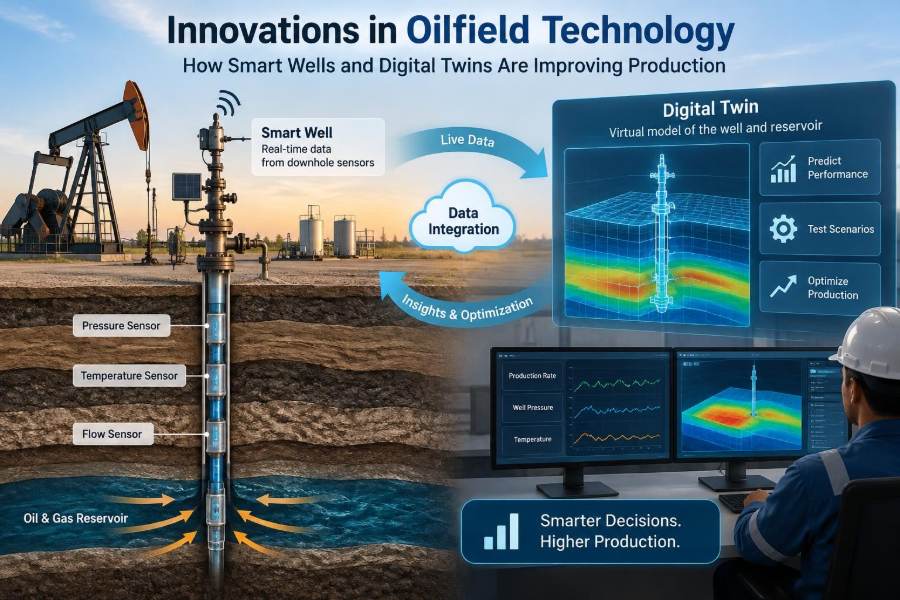
A smart well is a well equipped with downhole monitoring, controllable completion hardware, or both. Its defining feature is the ability to obtain useful information from the well and, in many cases, adjust flow from individual reservoir zones without a workover.
The term does not mean the well makes every decision by itself. In most applications, engineers still set operating limits, review recommendations, and approve meaningful changes. The intelligence comes from the combination of sensing, models, automation, and human judgment.
🧩 Core Components of a Smart Completion
Smart-well architecture varies with the reservoir and completion design, but several components recur. Their value depends on whether they answer a production question that matters for that particular well.
- Downhole gauges measure pressure and temperature at selected locations.
- Inflow control devices add resistance to balance inflow along a horizontal section.
- Interval control valves can open, close, or restrict communication with individual zones.
- Permanent monitoring systems transmit data to the surface over time.
- Surface controls and software allow operators to command and verify valve positions.
Not every completion needs every component. A complex design can be difficult to justify where zonal behavior is predictable or intervention access is easy.
📏 Sensors: Turning Downhole Conditions into Evidence
Pressure and temperature are among the most common downhole measurements because they can reveal changing drawdown, restrictions, crossflow, and fluid-entry behavior. A pressure trend becomes particularly useful when interpreted with choke changes, production rates, and facility conditions.
Other sensing methods may add depth. Distributed temperature sensing can identify thermal patterns along a wellbore, while distributed acoustic sensing can capture vibration and flow-related signals. These measurements require careful interpretation; a temperature anomaly is a clue, not automatically a diagnosis.
🚪 Interval Control Valves and Zonal Management
Many reservoirs contain layers with different permeability, pressure, fluid saturation, and water or gas risk. If all zones are commingled with no selective control, a highly productive but water-prone interval can dominate flow and reduce the useful contribution from other zones.
An interval control valve lets the operator restrict or isolate a troublesome interval while maintaining production from stronger zones. This is especially relevant in long horizontal wells and multilayer reservoirs where physical access to a specific source of unwanted fluid is otherwise difficult.
🌊 Inflow Control Is Not the Same as Active Control
Inflow control devices, often abbreviated ICDs, are generally passive: their geometry creates a pressure drop that helps distribute inflow. They are designed into the completion and do not normally change position after installation.
Autonomous inflow control devices may respond to fluid properties or flow conditions without a surface command. By contrast, actively controlled valves receive commands through a control system. Each approach has different reliability, cost, and flexibility implications.
| Approach | Main function | Operational flexibility | Typical consideration |
|---|---|---|---|
| Passive ICD | Balances inflow using fixed resistance | Low after installation | Requires sound upfront design |
| Autonomous device | Responds internally to flow or fluid behavior | Automatic but limited | Response must suit expected fluids |
| Active valve | Adjusts zonal flow on command | High | Needs controls, monitoring, and reliability planning |
🛢️ Why Horizontal Wells Create a Strong Use Case
Horizontal wells contact a large reservoir area, which can improve productivity. That same length also creates uneven inflow: heel-to-toe pressure differences, permeability variation, fractures, and changing fluid contacts can cause one part of the lateral to behave very differently from another.
Without zonal information, the total well rate may look acceptable while a damaging local trend develops. Selective completion hardware can help manage this unevenness, provided the team understands where fluids are entering and what restriction will do to total drawdown.
💧 Managing Water and Gas Breakthrough
Unwanted water can increase lifting, separation, treatment, disposal, and corrosion burdens. Gas breakthrough can alter lift performance, constrain facilities, or reduce oil production efficiency. Neither problem has a universal hardware-only solution.
Smart-well controls can provide an option to choke back a contributing zone, but the response depends on the mechanism. Water coning, a nearby high-permeability streak, behind-casing flow, and a rising water contact require different diagnoses and may respond differently to restriction.
⚖️ The Trade-Off Between Rate and Recovery
Restricting a zone may reduce today’s gross rate while protecting oil production later or postponing excessive water handling. Conversely, shutting a zone too aggressively can leave producible hydrocarbons behind or shift flow toward another undesirable path.
This is why a good decision should consider more than the latest oil rate. Engineers may compare liquid rate, water cut, gas-oil ratio, drawdown, facility capacity, expected recovery, and the uncertainty around the reservoir interpretation.
🪞 Defining a Digital Twin
A digital twin is a digital representation of a physical asset, process, or system that is connected to operational data and used to understand, predict, or improve behavior. In oilfield work, a twin may represent a single well, a completion, a gathering network, a production train, or an integrated reservoir-to-facility system.
A dashboard is not automatically a digital twin. Displaying live data is useful, but a twin generally adds a model, logic, or simulation capability that relates observations to physical behavior and supports decisions.
🏗️ A Twin Is Built in Layers
The useful level of detail depends on the decision. A well-performance twin may combine a wellbore hydraulics model, artificial-lift behavior, choke performance, and pressure measurements. An integrated twin can add reservoir inflow and surface-network constraints.
Building every possible detail is rarely wise. More complexity introduces more assumptions, longer maintenance effort, and more ways for the model to drift from reality. The right twin is fit for a defined operating question.
🔗 Connecting Reservoir, Wellbore, and Facilities
Production is a connected system. Increasing choke opening may lower wellhead pressure and improve a well’s rate, but it can also increase separator loading, alter flowline pressure, or affect neighboring wells sharing a constrained facility.
An integrated digital twin makes these dependencies explicit. It links reservoir deliverability, multiphase flow in the wellbore and network, and facility operating limits so that optimization does not simply move a bottleneck downstream.
📡 Data Pipelines Are Engineering Infrastructure
For a twin to remain useful, data must move reliably from sensors, control systems, tests, and maintenance records into governed engineering workflows. This includes timestamps, units, tag definitions, communication status, and clear ownership of data corrections.
A pressure value with the wrong datum or a rate assigned to the wrong allocation period can mislead a model even when its mathematical formulation is sound. Data engineering is therefore part of production engineering, not merely an information-technology task.
✅ Data Quality Before Sophisticated Analytics
Before applying advanced algorithms, teams should ask basic questions: Is the sensor calibrated? Was the well shut in? Did a choke position actually change? Is a missing value truly missing, or is communication interrupted?
Useful checks include range limits, rate-of-change tests, comparison against independent measurements, and flags for operating states. A model should preserve questionable data with quality labels rather than silently treating every value as equally trustworthy.
🧮 Physics Models and Data-Driven Models
Physics-based models use engineering relationships such as inflow performance, pressure-volume-temperature behavior, and multiphase-flow correlations. They are interpretable and can be applied where data are limited, though their assumptions may not capture every field-specific effect.
Data-driven models learn patterns from historical data. They can be valuable for anomaly detection or forecasting within conditions represented in their training data, but they may fail when operations shift into unfamiliar territory. Hybrid models often combine physical constraints with data-based adjustments.
🧪 Calibration Keeps the Twin Honest
Calibration aligns a model with observed behavior by checking whether it reproduces relevant pressures, rates, temperatures, and responses to known operating changes. It is not a one-time event completed at project handover.
Reservoir depletion, scale deposition, changing fluid composition, artificial-lift degradation, and sensor drift can all make a once-good twin less representative. Regular recalibration and documented assumptions keep the model credible.
🔄 Closed-Loop Production Optimization
Closed-loop optimization describes a repeating cycle: measure conditions, compare them with a model or objective, recommend or execute an adjustment, then observe the result. The loop may operate over minutes for some surface controls or over days and weeks for reservoir-management decisions.
Automation should match the consequence of the action. A low-risk control adjustment within approved limits may be automated, while a zonal shutoff with uncertain recovery consequences often deserves engineering review.
🎯 Choosing an Objective Function
“Maximize production” is too vague for a responsible optimization workflow. A field may need to maximize oil subject to water-handling capacity, minimize energy use while maintaining a delivery commitment, or preserve reservoir pressure for a broader development plan.
The objective should include constraints that operators actually face. Without them, an optimizer can recommend a technically attractive but operationally impossible setting.
🧭 A Hypothetical Decision Scenario
Consider a hypothetical two-zone horizontal producer. Downhole trends and production interpretation suggest that the toe interval is contributing a growing share of water, while the heel still supplies most of the oil. The facility is approaching its water-handling limit.
An engineer can use the twin to test several cases: leave both zones unchanged, partially restrict the toe, or isolate it. The preferred case is not automatically the one with the highest immediate liquid rate; it is the case that best meets the stated objective while staying within uncertainty and operating limits.
🚨 Detecting Problems Earlier
Digital twins can support anomaly detection by comparing measured behavior with expected behavior. Examples include an unexpected pressure drop across a valve, a temperature pattern inconsistent with normal flow, or a mismatch between predicted and measured wellhead pressure.
An alert is a prompt for investigation, not proof of failure. It may point to a sensor issue, an unrecorded operational change, changing fluid properties, or a genuine equipment or reservoir problem.
🔧 Reliability and Maintainability Matter
Downhole equipment operates in harsh conditions: high temperature, pressure, vibration, corrosive fluids, scale, and difficult access. A feature that appears valuable in a design review must be weighed against failure modes and the cost of recovering from them.
Design decisions should consider qualification history, control-line protection, redundancy where justified, intervention options, and the consequences if a valve fails open, closed, or in an unknown position. Complexity without a clear decision value is a reliability risk.
🔐 Cybersecurity Is Part of Well Integrity
When production equipment is connected to digital networks, cybersecurity becomes an operational concern. Unauthorized access, corrupted data, or loss of communications can affect visibility and, in some architectures, control capability.
Segmentation, access control, change management, backups, logging, and tested response procedures are practical safeguards. Control systems should also have safe operating states and clearly defined authority when communications fail.
👷 Human Roles Do Not Disappear
Smart technology changes work rather than eliminating the need for petroleum-engineering judgment. Engineers must assess reservoir uncertainty, operators must recognize abnormal conditions, and maintenance teams must understand how instrument health affects decisions.
The strongest workflows bring disciplines together. Reservoir engineers explain subsurface uncertainty, production engineers evaluate deliverability, completion specialists understand hardware limits, and operations teams contribute the reality of how the asset behaves day to day.
📚 Skills Students and Professionals Can Build
Useful preparation combines fundamentals with digital fluency. A practitioner does not need to become a specialist in every software platform, but should understand the physical system well enough to challenge a surprising output.
- Strengthen reservoir, well-test, production, and multiphase-flow fundamentals.
- Learn to clean, visualize, and validate time-series data.
- Understand control concepts such as feedback, constraints, alarms, and safe states.
- Practice communicating uncertainty and assumptions clearly.
- Use coding or analytics tools to automate repeatable checks, not to replace engineering reasoning.
💰 Where the Business Case Is Strongest
Smart completions can be most compelling where intervention is expensive or risky, zonal behavior is likely to diverge, and selective control can protect meaningful value. Offshore wells, long horizontals, multilayer reservoirs, and constrained water-handling systems are common candidates.
Digital twins create value when they improve recurring decisions, not merely when they provide an impressive visualization. A modest twin that helps teams identify avoidable deferment or avoid an unnecessary intervention can be more useful than an elaborate model nobody trusts.
⚠️ Common Implementation Mistakes
A frequent mistake is starting with technology instead of a decision. Teams may install sensors without agreeing on what action their data will enable, or build a twin without assigning ownership for calibration and maintenance.
- Assuming more data automatically means better decisions.
- Ignoring uncertainty in zonal allocation and reservoir interpretation.
- Allowing models to operate beyond their validated range.
- Separating digital projects from field operating procedures.
- Measuring success only by initial production rate instead of lifecycle performance.
🛠️ A Practical Deployment Path
Start with a high-value production question, such as whether selective choking can defer a water constraint or whether integrated network modeling can reduce unstable operating conditions. Define the decision, available data, physical constraints, and measure of success before choosing tools.
Then pilot the workflow on a manageable asset. Validate the model against known events, involve the people who will use it, document exceptions, and scale only after the process proves useful in normal operations.
🌱 Emissions and Energy Implications
Better production control can reduce avoidable energy use by avoiding unnecessary lifting, compression, pumping, or water processing. Earlier recognition of abnormal behavior may also support faster investigation of leaks or inefficient equipment operation.
These are potential operational benefits, not automatic outcomes. Digital infrastructure itself uses energy and equipment, while production optimization should remain consistent with environmental requirements, asset-integrity practices, and responsible emissions management.
🗺️ The Future Is Integrated, Not Fully Autonomous
As sensing improves and models become easier to connect, more assets will use near-real-time surveillance and scenario testing. The likely direction is deeper integration among reservoir models, well controls, facilities, maintenance systems, and emissions monitoring.
Fully autonomous production is not appropriate for every decision. Subsurface systems remain uncertain, rare events can be poorly represented in data, and high-consequence actions require governance. The practical goal is human-supervised automation with transparent limits.
🏁 The Core Principle: Better Decisions From Better Feedback
Smart wells provide selective visibility and, in some cases, selective control. Digital twins turn measurements and engineering relationships into a structured way to test choices. Together, they help teams see the production system as connected rather than as isolated equipment and datasets.
The technology delivers its strongest results when it is tied to a real operating decision, supported by reliable data, constrained by physical and safety limits, and maintained by people who understand both the model and the field.
Smart wells and digital twins improve production not by making petroleum engineering less rigorous, but by giving rigorous engineering faster, better feedback. Used with sound judgment, they can help operators manage complexity while protecting long-term asset value. 🛢️📈🔧