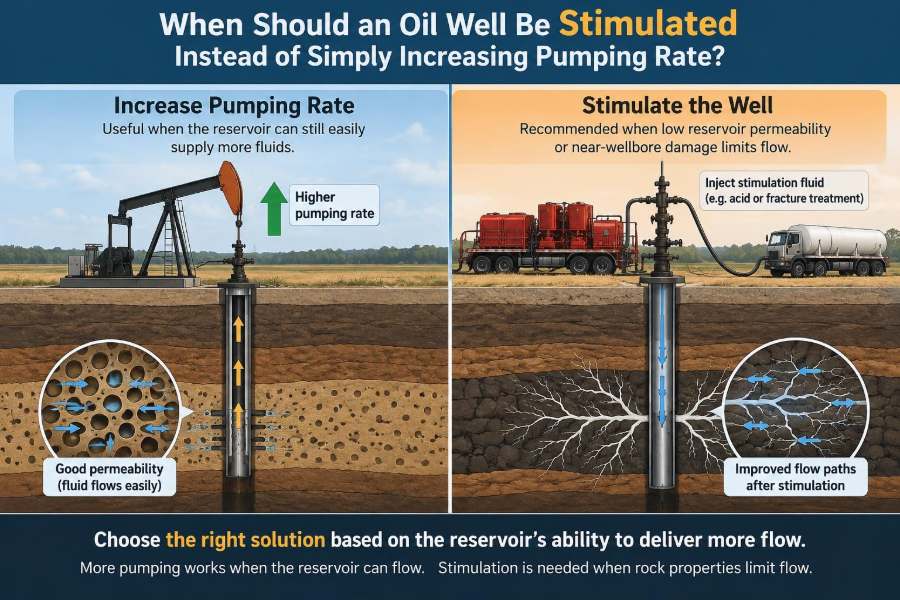

A producing well begins to disappoint. Fluid rate falls, pump intake pressure declines, and the daily report seems to offer an obvious remedy: speed up the pump.
Sometimes that is exactly the right move. A well may still have productive capacity, but the artificial-lift system is not drawing fluid efficiently. In that case, more lift can increase production without touching the reservoir.
But a faster pump cannot repair a damaged near-wellbore region, dissolve scale inside perforations, or create a flow path through very low-permeability rock. It can even make a constrained well perform worse by increasing drawdown, producing gas or solids, and lowering pump efficiency.
The practical question is not “Can the pump run faster?” It is “What is limiting the well right now?” Answering that question separates a sound stimulation candidate from a well that simply needs different artificial-lift settings.
🧭 Start With the Production Constraint
Every production decision should begin with a constraint diagnosis. A well’s liquid rate is governed by the reservoir’s ability to deliver fluids, the wellbore’s ability to transmit them, and the lift system’s ability to bring them to surface.
If the reservoir-to-wellbore path is restricted, stimulation may help. If the limitation lies above the perforations or at surface, increasing pump rate, repairing equipment, or changing operating conditions may be more appropriate.
This distinction sounds simple, yet it is easy to miss when teams focus only on the visible symptom: declining oil rate.
🔄 What Increasing Pumping Rate Actually Changes
Increasing pumping rate usually means changing the speed, stroke, frequency, or operating point of an artificial-lift system. Examples include increasing strokes per minute on a rod pump, raising electric submersible pump frequency, or adjusting gas-lift injection.
The intended effect is to lower flowing bottomhole pressure. That increases drawdown: the difference between average reservoir pressure and flowing pressure at the sandface. More drawdown can pull more fluid into the well if the reservoir and completion can supply it.
It does not, by itself, improve rock permeability or remove a restriction near the wellbore.
🪨 What Stimulation Changes Instead
Well stimulation is an intervention designed to improve flow from the reservoir into the well. The two broad categories are matrix treatments and hydraulic fracturing.
Matrix acidizing places reactive fluids below fracture pressure to dissolve acid-soluble damage or formation material. Hydraulic fracturing creates conductive fractures, commonly held open with proppant, to extend the well’s effective contact with the reservoir.
Both approaches target the inflow side of the production system. Pump changes target the lift side.
📉 Read the Inflow–Lift Relationship
Engineers often frame the decision through nodal analysis. The inflow performance relationship, or IPR, describes how much fluid the reservoir can deliver at different bottomhole pressures. The vertical lift performance relationship, or VLP, describes the pressure needed to move that fluid to surface.
The operating point is where those two relationships meet. Increasing pump capacity can shift the lift requirement and move the operating point to a higher rate. Stimulation improves inflow and shifts the IPR outward.
A useful mental image is a two-part system: a narrow drinking straw attached to a weak vacuum pump. A stronger pump helps only until the straw itself becomes the bottleneck.
🧪 Recognize Near-Wellbore Damage
Stimulation is most compelling when evidence indicates damage close to the wellbore. This damage may come from drilling mud invasion, completion fluids, fines migration, scale, wax, emulsions, corrosion products, or incompatibility between injected and formation water.
Damage reduces effective permeability around the well, often represented by positive skin. Skin is not merely a production label; it reflects additional pressure loss near the wellbore compared with an ideal completion.
A damaged well can show low productivity even when reservoir pressure and remaining hydrocarbons are still favorable.
📏 Use Productivity Index as a Clue
The productivity index, commonly abbreviated PI, relates liquid production rate to drawdown. In simplified form, it asks how many units of liquid rate the well delivers for each unit of pressure reduction.
A falling PI can suggest increasing near-wellbore resistance, although it is not proof by itself. Changes in water cut, gas liberation, relative permeability, fluid viscosity, and reservoir pressure can also change the apparent relationship.
Comparing current PI with early-life performance, offset wells, pressure data, and completion history is usually more useful than interpreting one value alone.
🧾 Compare Current Performance With the Well’s History
A well’s history often reveals whether the problem developed gradually or appeared after a specific event. A sharp decline after workover fluid exposure, scale treatment, water breakthrough, or shut-in may point toward a distinct mechanism.
Plot production rate, flowing pressures, pump settings, water cut, gas-oil ratio, chemical treatments, failures, and interventions on the same timeline. Patterns that are invisible in isolated daily reports can become clear.
For example, a hypothetical rod-pumped well that loses fluid rate while pump fillage declines may not need a faster unit; it may be short of inflow because of formation damage or depleted reservoir pressure.
🛠️ Confirm the Artificial-Lift System Is Healthy
Before proposing a reservoir treatment, confirm that the lift system is operating as intended. Mechanical and operating problems are common sources of lost production.
- Rod pumps can suffer from gas interference, fluid pound, worn valves, tubing leaks, or poor pump fillage.
- ESP systems may operate away from their efficient range, face gas locking, experience scale deposition, or approach motor and cable limits.
- Gas-lift wells can have valve, injection-pressure, allocation, or unloading problems.
- Flowing wells may be restricted by choke size, tubing scale, liquid loading, or surface backpressure.
Stimulation cannot compensate for a pump that is damaged, improperly sized, or starved because of an avoidable mechanical issue.
🌡️ Check Whether More Drawdown Is Safe
Even if a pump can run faster, the additional drawdown may be undesirable. Low bottomhole pressure can liberate gas from oil, reduce liquid-pump efficiency, and increase gas handling requirements at surface.
In unconsolidated formations, aggressive drawdown can mobilize formation sand. In some reservoirs, it can encourage fines movement or water and gas coning toward the perforations.
The operating limit is not simply the maximum equipment speed. It is the drawdown the reservoir, completion, and facilities can tolerate while producing economically and safely.
🌊 Watch for Water Coning and Gas Coning
When a well is close to a water contact or gas cap, increasing drawdown can distort fluid flow toward the wellbore. Water coning and gas coning occur when unwanted fluids are pulled into the completion more rapidly than the reservoir can maintain stable separation.
A higher pump rate may briefly raise total liquid production while reducing oil rate, increasing disposal volumes, or overloading separators and compressors. That is not necessarily a production improvement.
Stimulation is not automatically safer in these settings either. A fracture treatment can connect the well more effectively to water or gas if placement and geometry are poorly suited to the reservoir.
🧱 Distinguish Formation Damage From Scale in the Completion
Restrictions can occur in rock, perforations, casing, tubing, pumps, and surface equipment. The treatment must match the location.
Scale in tubing may call for mechanical cleanout, solvent, chelant, or inhibitor strategy. Scale or deposits in perforations may justify a targeted chemical treatment. Damage extending into the formation may require matrix acidizing or another formation-focused method.
Calling every decline “formation damage” leads to expensive treatments that miss the actual restriction.
🔬 Use Diagnostics Before Selecting a Treatment
Good stimulation decisions rely on converging evidence rather than one diagnostic. Pressure-transient testing can help estimate permeability, skin, boundaries, and wellbore-storage effects, though interpretation depends on data quality and model assumptions.
Other useful inputs may include flowing and static pressure surveys, fluid levels, dynamometer cards, pump intake pressure, production logging, temperature surveys, spinner data, tracer information, and samples of scale or produced solids.
No tool provides a complete answer in every well. The goal is to reduce uncertainty enough to choose the most likely and most controllable intervention.
🧫 Match Matrix Acidizing to the Mineralogy
Matrix acidizing is appropriate only when the formation and damage mechanism are chemically compatible with the proposed fluids. Carbonate reservoirs may respond to acid dissolution of the rock itself, while sandstone treatments require more careful chemistry to address clays, fines, and acid-sensitive minerals.
Acid can remove certain deposits and bypass some near-wellbore damage, but it can also create precipitates, mobilize fines, corrode equipment, or worsen damage if the design is poor.
“Pump acid” is not a diagnosis. A treatment design should consider mineralogy, fluid compatibility, temperature, pressure, placement, corrosion control, and return-fluid handling.
🪨 Choose Hydraulic Fracturing for a Conductivity Problem
Hydraulic fracturing is generally considered when the formation has low effective permeability, limited drainage connection, or a need for greater conductive flow area than matrix treatment can create. It is intended to create a flow path that reaches beyond the immediate wellbore region.
A fracture is not simply a larger hole. Its value depends on fracture geometry, proppant transport, retained conductivity, stress contrasts, fluid leakoff, completion design, and the reservoir’s response during production.
In a high-permeability formation with shallow damage, fracturing may be unnecessary or create excessive water production. In a tight reservoir, merely lowering bottomhole pressure with a larger pump may accomplish very little without added conductivity.
🕳️ Consider Perforation and Completion Limitations
Poor inflow can originate from the completion rather than the reservoir matrix. Limited perforation density, inadequate penetration, plugged perforations, unfavorable phasing, crushed zones, or incomplete interval coverage can all add pressure loss.
Perforation cleanout, reperforating, selective treatment, or a focused stimulation may be more rational than a broad treatment. The right action depends on whether the productive interval is present but poorly connected, or whether the reservoir itself lacks deliverability.
Production logs are especially valuable in multilayer reservoirs because they show which intervals are contributing fluid and which are taking water or gas.
🧯 Do Not Ignore Surface Backpressure
A well can appear inflow-limited when excessive downstream pressure is the real problem. Chokes, flowlines, separators, headers, compression constraints, emulsions, and high water-cut handling limits can all raise wellhead pressure.
Reducing surface backpressure may lower flowing bottomhole pressure without changing the pump or treating the formation. Depending on the system, this can be a lower-risk and lower-cost option.
Always include the full production system in the diagnosis, from reservoir to sales line.
⚖️ Compare the Two Levers Directly
| Question | Increasing pumping rate is more likely to help when… | Stimulation is more likely to help when… |
|---|---|---|
| Primary limitation | Lift capacity or operating point limits rate | Near-wellbore resistance or poor reservoir connectivity limits rate |
| Pressure behavior | Reservoir can deliver more fluid at modest additional drawdown | High skin or low inflow persists despite adequate lift |
| Equipment condition | Pump is healthy and has usable operating margin | Lift is adequate, but pump is starved by weak inflow |
| Likely risks | Gas interference, sand, coning, overload, facility constraints | Fluid incompatibility, poor placement, water or gas communication, cost |
| Typical first check | Pump diagnostics and nodal analysis | Pressure, completion, fluid, and damage diagnostics |
This comparison is not a decision rule by itself. Some wells need both improved inflow and a revised lift design after treatment.
🧮 Let Economics Follow the Technical Case
A stimulation that produces more oil is not automatically economic, and a pump-rate increase that costs little may still be poor value if it accelerates water handling or equipment failures.
Economic screening should include incremental oil and gas, water disposal, chemical use, power or fuel, workover exposure, treatment cost, expected decline behavior, facility capacity, and downtime. The uncertainty range matters as much as the central forecast.
A modest intervention with a high probability of success can be preferable to a large treatment with an attractive but uncertain upside.
🧩 Account for Reservoir Heterogeneity
Reservoirs are rarely uniform. Permeability, saturation, natural fractures, stress, pressure, and fluid properties can vary substantially across a field and even within one completed interval.
For this reason, a treatment that worked in an offset well may not transfer directly. Similar-looking wells can have different damage mechanisms, contacts, fracture barriers, or completion quality.
Offset performance is useful evidence, but it should inform the diagnosis rather than replace it.
💧 Treat Water-Handling Capacity as a Real Constraint
Water cut often changes the decision. A faster pump can increase liquid rate mainly by lifting more water, while a stimulation may redirect flow toward a water-bearing interval or fracture into it.
Before acting, confirm what the facilities can separate, treat, store, reinject, or dispose of. Water chemistry also affects scale risk and chemical compatibility.
In mature assets, the best production strategy may be selective isolation, profile control, or constrained drawdown rather than pursuing the highest possible gross fluid rate.
🧱 Protect Sand-Prone and Weak Formations
Sand production can erode equipment, fill the wellbore, damage pumps, and create handling concerns at surface. It may be triggered by depletion, high drawdown, water breakthrough, completion changes, or stimulation.
When formation strength is uncertain, evaluate sanding risk before raising pump rate or applying a treatment that changes pressure gradients. Sand-control completions, drawdown management, and monitoring may be part of the solution.
The desired result is sustained hydrocarbon production, not a short-lived rate increase followed by repeated cleanouts.
🧠 Design the Treatment Around Placement
A technically sound fluid is ineffective if it does not reach the intended interval. Diversion, coiled-tubing placement, staged pumping, mechanical isolation, and rate control may be needed to treat zones selectively.
This matters most in long, layered, or heterogeneous completions. Fluids naturally seek the path of least resistance, which can mean they enter an already high-permeability or water-producing interval instead of the damaged target zone.
Treatment placement is therefore a reservoir and completion problem, not only a chemical or pumping problem.
📊 Define Success Before the Job Begins
Set measurable success criteria before changing lift settings or stimulating the well. Criteria might include sustained oil-rate increase, improved PI, reduced skin estimate, stable pump fillage, lower water cut, or acceptable fluid-handling costs.
Also define the observation period and the data needed to judge the response. Immediate post-treatment rates can be distorted by cleanup fluids, flowback behavior, choke changes, or temporary operating conditions.
A clear success definition supports better learning across future candidates.
🔁 Plan for Post-Stimulation Artificial Lift
A successful stimulation can change the well’s lift requirements dramatically. Higher fluid influx may overload an existing pump, while gas production or solids can alter pump behavior and surface separation.
Before treatment, assess whether the current lift system can handle the expected range of post-job rates. The plan may include a pump change, different ESP operating frequency, revised gas-lift allocation, or a controlled ramp-up schedule.
Ignoring this step can make a good reservoir response look like a disappointing job because the well cannot efficiently lift what it can produce.
🚫 Avoid the “More Is Better” Pumping Mistake
Operators sometimes respond to declining rate by continually increasing speed until the pump reaches its limit. This can create gas interference, fluid pound, excess wear, high power demand, and unstable production without improving oil recovery.
For a rod-pumped well, a poorly filled pump is a warning that capacity may exceed inflow. For an ESP, movement far from the preferred operating range can reduce efficiency and reliability.
Use the lowest lift intensity that reliably meets the production objective and preserves equipment life.
🚫 Avoid the “Stimulation Will Fix It” Mistake
Stimulation is not a universal cure for low rate. It will not restore depleted reservoir pressure, repair a leaking tubing string, solve a failed pump, or make an economically marginal interval profitable by itself.
It also carries operational risks: chemical handling, pressure control, returns management, equipment mobilization, and uncertainty in reservoir response. These risks can be managed, but not eliminated.
A treatment should follow a defensible mechanism, not a desire for a quick production spike.
🧑🔧 Build a Cross-Disciplinary Decision
The strongest decisions combine reservoir engineering, production engineering, completion engineering, operations, chemistry, facilities, and economic input. Each discipline sees a different part of the system.
Reservoir staff may identify pressure depletion or coning risk. Production engineers can test lift capacity. Completion specialists can evaluate perforations and placement. Operations teams often know recurring field constraints that do not appear in a model.
Bringing those views together early reduces the chance of solving one bottleneck while worsening another.
🗺️ A Practical Screening Sequence
- Verify production measurements, allocation, pressures, and recent operating changes.
- Check pump, tubing, flowline, choke, and surface-facility performance.
- Build or update a nodal analysis using credible fluid and pressure data.
- Estimate whether additional drawdown can safely improve hydrocarbon rate.
- Investigate skin, deposits, completion restrictions, and reservoir connectivity.
- Match any proposed stimulation to mineralogy, interval, placement, and risks.
- Screen economics and facility capacity across realistic response cases.
- Plan surveillance and post-job lift adjustments before execution.
This sequence does not replace field-specific engineering procedures. It provides a disciplined way to prevent premature commitment to either a larger pump or a stimulation treatment.
🔍 A Simple Hypothetical Comparison
Consider two hypothetical wells with similar declining oil rates. Well A has a healthy reservoir inflow curve, high pump fillage, and an ESP operating below the rate needed to move available fluid. Increasing frequency may shift the operating point and recover rate, provided gas and power limits are acceptable.
Well B has an adequately sized lift system but poor pump fillage, rising pressure loss near the wellbore, and evidence of deposits after an incompatible-fluid event. Raising speed would likely deepen drawdown without supplying more liquid. A diagnostic-led cleanout or compatible matrix treatment may be the better route.
The same surface symptom—lower production—leads to different actions because the limiting mechanism differs.
✅ The Core Decision: Improve Inflow or Improve Lift?
Increase pumping rate when analysis shows that the well has unused inflow capacity, the artificial-lift system is the governing constraint, and added drawdown will not create unacceptable gas, sand, water, equipment, or facility problems.
Stimulate when credible evidence shows that formation damage, poor near-wellbore conductivity, restricted perforations, or limited reservoir connectivity is choking inflow—and when the selected treatment fits the rock, fluids, completion, and target interval.
In many cases, the answer is sequential: remove the inflow restriction first, then optimize artificial lift to handle the new operating point. The key is to diagnose the system before selecting the lever.
A faster pump is appropriate when the well can deliver more fluid; stimulation is appropriate when the well cannot deliver it because the reservoir-to-wellbore path is impaired. Treating that distinction as the starting point leads to safer interventions, more durable production, and better use of capital. 🛢️📈🔧