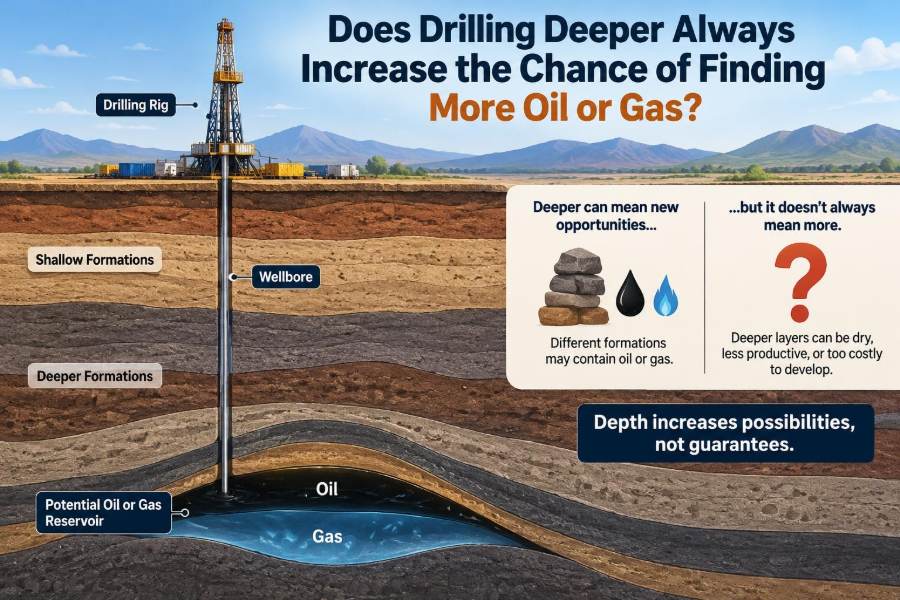

A drilling crew has reached its planned target, the logs look discouraging, and a familiar question arrives from the operations team: should the well keep going deeper? It can sound like a straightforward decision. More depth seems to mean more rock, more chances, and perhaps another reservoir below.
That intuition is understandable. Some of the world’s most productive oil and gas accumulations occur far below the surface, and deeper drilling has opened plays that were once technically unreachable. But depth by itself does not create petroleum.
A well is expensive, and every additional interval introduces new geological uncertainty and operational risk. Drilling deeper can be an excellent decision when the subsurface model supports it; it can also turn a promising well into a costly search through rocks that were never capable of holding commercial hydrocarbons.
The useful question is not “How deep can we drill?” It is “Does a deeper target have the complete geological conditions needed for a viable accumulation?”
🧭 The Short Answer: Depth Is Not the Main Predictor
No, drilling deeper does not automatically increase the probability of finding more oil or gas. Petroleum occurs where a working petroleum system has generated hydrocarbons, moved them into a reservoir, trapped them, and preserved them in commercial quantities.
Depth affects several parts of that system, especially temperature, pressure, rock compaction, and drilling difficulty. It is one variable among many, not a reliable shortcut to discovery.
🪨 Oil and Gas Need a Working Petroleum System
Before a prospect can contain recoverable hydrocarbons, several geological elements must work together over time. Geoscientists commonly describe this combination as a petroleum system.
- Source rock: organic-rich sediment capable of generating oil or gas.
- Reservoir rock: porous and permeable rock that can store and transmit fluids.
- Seal: low-permeability rock that prevents upward escape.
- Trap: a geometry that concentrates hydrocarbons rather than allowing migration away.
- Timing: generation and migration must occur when the trap and seal already exist.
A deeper layer lacking any one of these features may be less attractive than a shallower, well-understood reservoir.
🌡️ Burial Depth Controls Temperature, Not Guaranteed Richness
As rocks are buried, they usually become hotter because temperature rises with depth in most sedimentary basins. The rate of increase, called the geothermal gradient, varies substantially from basin to basin.
Heat is essential for converting organic matter in source rocks into hydrocarbons. Yet excessive heat can push a source rock beyond oil generation and eventually destroy much of its remaining gas-generating potential. Deeper is therefore not simply “better cooked”; it can be overmature.
🍳 The Oil Window Has a Limited Range
Organic matter first changes into kerogen, a solid precursor to petroleum. With progressive heating over geological time, kerogen can generate liquid hydrocarbons within a temperature range often called the oil window.
At greater thermal maturity, gas generation becomes more dominant. Beyond that, the remaining organic material may be too altered to generate useful volumes. Exact ranges depend on kerogen type, heating history, pressure, and other local factors, so depth alone cannot identify the window.
🔥 Deep Rocks May Favor Gas Rather Than Oil
A deep prospect may have a higher chance of containing gas than oil if its source rocks reached advanced maturity. That is not necessarily a disadvantage: gas can be a valuable target when there is a market, infrastructure, and a reservoir capable of producing it.
However, a gas-prone deep target is not the same opportunity as an oil target. Fluid properties, development design, processing requirements, transport options, and economics can all change.
🧱 Reservoir Quality Often Declines with Burial
Reservoirs need connected pore spaces to store and flow hydrocarbons. With increasing burial, the weight of overlying rock compacts grains together. Mineral cements can also grow in the pore space as hot fluids circulate through the formation.
Many deeply buried sandstones and carbonates therefore have lower porosity and permeability than their shallower equivalents. A source may have generated hydrocarbons at depth, but a tight reservoir can prevent them from being produced at an economic rate.
🔬 Why Some Deep Reservoirs Still Work
Depth does not automatically ruin reservoir quality. Some deep sands retain pores because of rigid grain frameworks, favorable mineral composition, unusually high pressure, or limited cementation. Fractures and dissolution can also create flow pathways, especially in some carbonate reservoirs.
The key is evidence. Core samples, wireline logs, pressure data, seismic interpretation, and nearby well results help determine whether a deep formation is merely porous on paper or actually capable of sustained flow.
💧 Porosity Is Not the Same as Permeability
Porosity is the fraction of rock volume made up of pores. Permeability is the ability of connected pores to transmit fluids. A rock may hold some hydrocarbons but still produce poorly if its pore throats are extremely small or disconnected.
This distinction matters more at depth, where compaction and cementation often reduce connectivity. A log-derived porosity value should never be interpreted as a production forecast by itself.
🪤 A Deep Reservoir Still Needs a Trap
Hydrocarbons are buoyant relative to formation water, so they tend to migrate upward unless stopped by a seal and trap. A structural closure, such as a folded anticline or fault-bounded block, can provide that geometry. Stratigraphic changes, such as a porous sandstone pinching out into shale, can also trap fluids.
Below an existing field, the structural closure may disappear, leak, or contain water-bearing rock. Continuing to drill beneath a known reservoir is therefore not a dependable way to find a second pool.
🧢 Seals Become More Critical at Depth
A seal is commonly shale, evaporite, or another tight formation that blocks hydrocarbon migration. At depth, seal performance must be considered alongside faults, fractures, and stress conditions.
A fault can seal in one location and leak in another, depending on clay content, displacement, pressure difference, and later deformation. A large deep structure without a reliable seal is not a valid prospect; it is simply a place hydrocarbons may have passed through.
⏳ Timing Can Make a Perfect-Looking Trap Empty
Imagine a trap forming after the main pulse of hydrocarbon migration. It may look excellent on seismic data but have missed the charge entirely. Conversely, a trap that formed early could later be breached by fault movement, uplift, or erosion.
Petroleum exploration is therefore a history problem as much as a geometry problem. Teams reconstruct burial, maturation, migration, trap formation, and preservation through basin modeling and geological interpretation.
🧪 Source Rock Presence Is Not Enough
An organic-rich shale is not automatically a successful source rock. Its organic matter must be of a type capable of generating oil or gas, present in sufficient volume, and mature at the right time.
It must also expel enough hydrocarbons to charge nearby traps. If generated fluids remain trapped in the source rock or migrate in the wrong direction, a deeper conventional reservoir may receive little or no charge.
🗺️ Basin Position Matters More Than a Depth Number
The same depth can mean very different things in different parts of a basin. A formation at 3,000 metres in a cool basin may be less mature than a formation at a shallower depth in a hot rift setting.
Depth must be interpreted with thermal history, burial rate, heat flow, erosion, and tectonic events. This is why exploration teams use maps and models rather than relying on a single depth contour.
📈 Pressure Can Help and Complicate the Opportunity
Deep formations often have high pressures, and some are overpressured, meaning their pore pressure is above the expected pressure for that depth. Overpressure can reduce effective stress and sometimes help preserve porosity.
It also makes drilling more complex. Incorrect pressure prediction can lead to kicks, losses, well-control hazards, stuck pipe, or formation damage. A potentially good reservoir is not automatically a good drilling target if pressure uncertainty is large.
⚙️ Higher Temperature Changes Well Design
High-temperature wells demand tools, fluids, elastomers, cement systems, electronics, and completion equipment that can survive the expected conditions. Logging tools may have operating limits, while cement and drilling-fluid behavior must be managed carefully.
These requirements increase planning effort and cost. They can also reduce the quality or availability of subsurface measurements precisely where uncertainty is already greatest.
🛠️ The Drilling Window Can Become Narrow
Safe drilling depends on maintaining mud weight between two limits: high enough to control formation pressure, but low enough to avoid fracturing the rock and losing fluid. The difference is often called the drilling window.
In deep, pressured, or mechanically weak formations, that window can be narrow. Engineers may need carefully managed casing points, real-time pressure monitoring, or specialized drilling practices to reach the target safely.
💰 A Discovery Must Be Commercial, Not Just Present
Finding hydrocarbons is not the same as finding a development. A deep accumulation may require expensive wells, high-specification equipment, stimulation, subsea infrastructure, or complex gas treatment.
Commerciality depends on expected recoverable volumes, flow rates, fluid composition, access to markets, project costs, fiscal terms, and operating constraints. The deeper target must offer enough incremental value to justify incremental risk.
📊 A Simple Comparison of Shallow and Deep Targets
| Factor | Shallower target | Deeper target |
|---|---|---|
| Thermal maturity | May be immature or oil-prone | May be mature, gas-prone, or overmature |
| Reservoir quality | Often better preserved, but variable | Often reduced by compaction and cementation |
| Pressure and temperature | Usually more manageable | Often higher and less forgiving |
| Well cost | Typically lower | Typically higher, with greater uncertainty |
| Chance of success | Depends on petroleum-system evidence | Also depends on evidence, not depth alone |
This comparison describes tendencies, not rules. A deep target can outperform a shallow one when its reservoir, seal, charge, and economics are stronger.
🎯 What “Deeper” Means in a Well Plan
Drillers may use “deeper” in several ways: extending below the planned total depth, testing a deeper mapped reservoir, or sidetracking toward a lower structural position. These are different decisions with different evidence requirements.
For example, extending a few tens of metres to evaluate a known sand is unlike committing to a much deeper unexplored interval beneath a casing shoe. The latter can require new pressure predictions, contingency materials, and regulatory or partner approval.
📡 Seismic Helps, but It Cannot Directly See Oil
Seismic surveys image contrasts in rock properties and help map faults, folds, reservoir geometries, and depth structure. They are central to prospect definition, especially before expensive deep drilling.
But seismic amplitudes and other attributes are not direct proof of hydrocarbons. Their meaning can be affected by lithology, tuning, processing choices, pressure, and data quality. A promising seismic feature must be integrated with well and geological evidence.
🧾 Well Logs Reduce Uncertainty While Drilling
Wireline and logging-while-drilling measurements can estimate lithology, porosity, fluid response, and formation pressure. Mud-gas observations, cuttings, cores, and formation tests add further evidence.
Each measurement has limitations. For instance, resistivity may be influenced by formation water salinity and invasion, while gas shows can reflect drilled cuttings, mud conditions, or connection gas. Sound interpretation combines multiple indicators rather than treating one signal as a discovery.
🧠 The Decision to Deepen Is a Risk Decision
Before deepening a well, teams update their view using actual drilling results. Did the planned reservoir arrive at the predicted depth? Did the pressure match expectations? Are shows, logs, cores, or seismic ties consistent with a deeper petroleum system?
A decision should compare the expected value of the deeper objective with added time, cost, operational exposure, and the chance of losing access to the existing opportunity. This is disciplined uncertainty management, not pessimism.
🚫 A Common Mistake: Chasing Shows Without Context
Hydrocarbon shows in mud logs can be encouraging, but they do not prove a producible accumulation. Small quantities of gas may come from source rock, residual hydrocarbons, contamination, or a tight interval with no practical deliverability.
Likewise, a faint oil stain in a core does not establish commercial saturation, permeability, or trap size. Good exploration practice asks what the observation means within the full reservoir and petroleum-system context.
🧱 Another Mistake: Assuming Every Layer Repeats
In layered sedimentary basins, it is tempting to assume that a productive sandstone will be repeated below. Depositional environments shift, faults displace units, and reservoir sands can thin, become shaly, or disappear laterally.
A deeper sequence may also belong to an entirely different geological setting. Correlation based only on depth can create false confidence; stratigraphy and structure must be established independently.
🧮 Volumetrics Need Realistic Inputs
Early estimates commonly combine mapped area, reservoir thickness, porosity, hydrocarbon saturation, and recovery assumptions. Every input becomes more uncertain when data are sparse, as is often true for deep targets.
Optimistic values can multiply into an impressive-looking resource estimate that has little practical meaning. Sensitivity ranges and conservative scenarios are more useful than a single precise-looking number unsupported by data.
🧯 Safety and Environmental Planning Cannot Be Deferred
Deep wells can involve higher pressures, temperatures, and hydrocarbon energies, which demand robust barriers and well-control preparation. Drilling programs need appropriate casing, cement evaluation, pressure-control equipment, emergency procedures, and trained personnel.
Environmental planning also matters. Fluid handling, emissions management, waste control, and spill prevention should be built into the design rather than treated as afterthoughts once a deeper target becomes attractive.
🔄 Appraisal Often Beats Blind Deepening
When a discovery is made, the best next well is not always deeper. An appraisal well may be placed to define fluid contacts, test lateral continuity, measure reservoir properties, or clarify compartmentalization across faults.
That information can improve development decisions more than an untested deep step-out. The right sequence depends on the largest uncertainty limiting value: volume, deliverability, seal integrity, pressure, or charge.
🌍 Unconventional Resources Change the Question
For shale gas, shale oil, tight oil, and some coalbed resources, the hydrocarbon-bearing rock may also be the source rock. Exploration then focuses less on a conventional trap and more on maturity, thickness, organic richness, brittleness, natural fractures, stress, and completion response.
Even here, depth is not a stand-alone advantage. Greater depth may improve maturity but can increase stress, temperature, cost, and stimulation complexity. The optimal interval is a balance, not the deepest available rock.
🏗️ Mature Fields Can Have Deeper Potential
In producing basins, deeper plays beneath established fields may be attractive because infrastructure, subsurface knowledge, and operational experience already exist. Existing wells can provide valuable calibration for seismic and pressure models.
Still, a proven shallow play does not prove a deeper one. The deeper interval needs its own evidence for reservoir quality, charge, trap, and commercial flow potential.
📚 A Practical Checklist Before Going Deeper
- Is there a defined deeper reservoir or merely an untested depth interval?
- Is there evidence of mature source rock and a plausible migration route?
- Can the reservoir retain sufficient porosity and permeability at expected conditions?
- Is the trap closed, sealed, and correctly timed relative to charge?
- Are pressure, temperature, and drilling hazards understood well enough to design the well?
- Would expected volumes and flow rates justify the added cost and complexity?
If several answers are uncertain, the appropriate response may be more data, a revised model, or a different well location—not automatically more footage.
🧩 Bringing the Evidence Together
The strongest deep prospects are supported by converging evidence: seismic structure, well correlations, basin modeling, petrophysical interpretation, pressure data, analog fields, and realistic engineering design. None is perfect, but together they narrow uncertainty.
Conversely, depth alone is weak evidence. It says something about burial conditions, but almost nothing by itself about whether hydrocarbons were generated, accumulated, preserved, and can be produced.
✅ The Core Principle: Drill for a Valid Target, Not for Depth
Drilling deeper can increase opportunity when it reaches a distinct, well-supported objective with a functioning petroleum system and credible economics. It can also increase the likelihood of tight, overmature, water-bearing, poorly sealed, or operationally difficult rock.
The most effective exploration strategy is target-led rather than depth-led. Define the geological chance of success, understand the engineering limits, and update the decision as new well data arrives.
More depth creates more possibility, but only a complete petroleum system and a producible reservoir create a meaningful oil or gas opportunity. 🛢️🧭