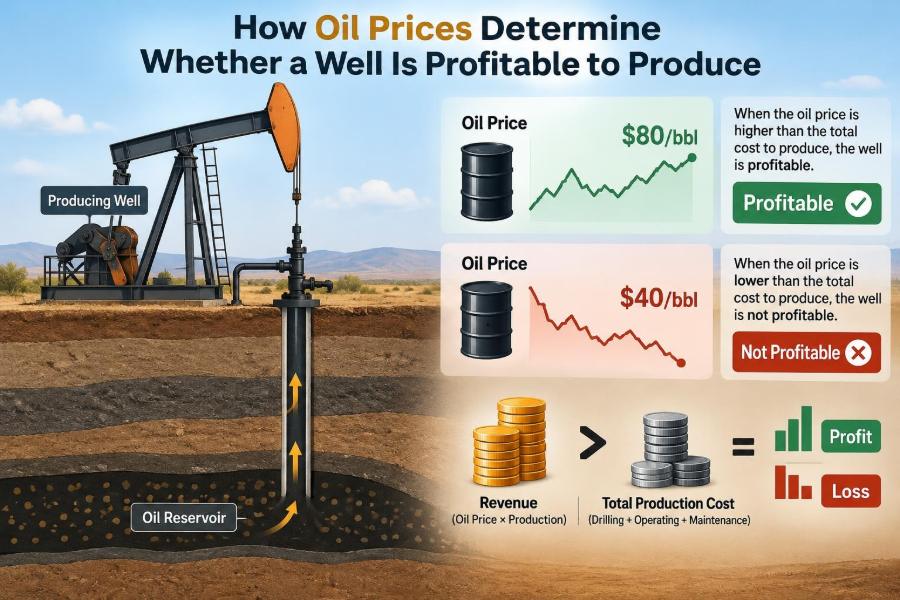

A well can be flowing thousands of barrels of fluid each day and still be a poor business decision. It can also produce only a modest amount of oil and remain worth operating for years. The difference often comes down to a deceptively simple question: what does each barrel earn after every relevant cost is paid?
Oil prices are the number most people see in the news, usually quoted as a benchmark such as West Texas Intermediate or Brent. For an operator, however, that headline price is only the starting point. The value received at the lease may be lower, while the costs of lifting, treating, transporting, and selling the oil can be substantial.
This matters to petroleum engineers because production decisions are not made on reservoir performance alone. Engineers help determine whether a well should keep flowing, be repaired, be choked back, temporarily shut in, or ultimately plugged and abandoned.
Understanding the connection between price and profitability turns an abstract market number into a practical operating decision. It also explains why the same well can be valuable in one price environment and uneconomic in another.
📊 Price Is a Signal, Not the Whole Answer
An oil price indicates what buyers are willing to pay for a specified grade of crude at a specified market location. It does not automatically equal the revenue received by every producer.
Profitability depends on the relationship between revenue and cost. In its simplest form, a well creates positive operating cash flow when the money received from its production exceeds the cash required to keep it operating.
A higher oil price improves the chance of profitability, but it does not guarantee it. A high-water-cut well with expensive disposal, for example, may still lose money even when benchmark prices are strong.
🛢️ Start With the Realized Oil Price
The realized price is the effective price an operator receives for its crude. It is commonly lower than a published benchmark because the crude may differ in quality or need to travel to a market.
A useful conceptual calculation is:
Realized price = benchmark price ± quality differential − transportation and marketing deductions
Some crude streams receive a premium if they are light, low in sulfur, or conveniently located near refinery demand. Others sell at a discount because they are heavier, more sulfurous, farther from pipelines, or produced in a congested region.
🚚 Location Changes the Value of a Barrel
A barrel at a producing field is not necessarily worth the same as a barrel at a major trading hub. The producer may need pipeline capacity, trucking, rail, marine transport, storage, or blending before a refinery can use it.
When takeaway capacity is limited, local prices can fall relative to the benchmark. A well may remain physically productive while its netback—the revenue left after getting the barrel to market—shrinks sharply.
For this reason, engineers and commercial teams must consider infrastructure alongside reservoir quality. A good well in an isolated area can face a weaker economic outcome than a comparable well connected to reliable pipelines.
⚗️ Crude Quality Creates Differentials
Crude oil is not a uniform product. Density, usually described through API gravity, and sulfur content are two major properties that influence refinery value and handling requirements.
Light, sweet crude is often easier for many refineries to process into valuable products. Heavy or sour crude can require more complex processing and may trade at a discount, although the exact relationship changes with refinery demand and market conditions.
Quality also affects field operations. A waxy crude may need heating or chemical treatment, while an emulsion-prone crude may require more separation effort. Those extra operating needs affect cost as well as sales value.
💰 Revenue Includes More Than Oil
Many wells produce oil, gas, and water together. Associated gas may provide meaningful revenue, particularly where gathering and sales infrastructure exists. In other locations, gas constraints can limit oil production or require costly handling.
Natural gas liquids, condensate, and electricity generated from field gas can also affect the economics of a producing asset. Conversely, a well with little marketable gas but large volumes of water may have a much less favorable revenue-to-cost balance.
Revenue must be calculated from the actual saleable streams, not simply from the oil rate shown on a daily production report.
🧾 Royalties Reduce the Producer’s Share
A royalty is the share of production revenue paid to the mineral owner or rights holder. The detailed calculation depends on the lease, jurisdiction, deductions allowed, and contract language.
For economic screening, the key point is straightforward: the operator does not retain all gross sales revenue. Taxes, production-related levies, and contractual interests can reduce the amount available to pay operating expenses and recover investment.
Engineers often work with a net revenue interest, which represents the fraction of production revenue attributable to the working interest after royalty burdens. Using gross barrels without recognizing this distinction can overstate project economics.
🏭 Operating Expense Is the Daily Cost of Keeping a Well Alive
Operating expense, often shortened to OPEX, covers the recurring costs of producing and maintaining a well. These costs occur after drilling and completion, and they matter greatly for mature wells with declining oil rates.
Typical categories include:
- Labor, field supervision, and routine inspections
- Electricity or fuel for artificial lift and surface equipment
- Chemicals for corrosion, scale, emulsion, or flow assurance control
- Maintenance of pumps, flowlines, tanks, separators, and instrumentation
- Produced-water treatment, transport, and disposal
- Insurance, site services, and allocated field overhead
Some costs are fixed or semi-fixed at the lease level. As production declines, those relatively stable costs are spread across fewer barrels, raising the cost per barrel.
💧 Water Can Decide the Economics
Most oil wells eventually produce increasing amounts of water as the reservoir depletes or water advances through the formation. The water cut is the percentage of the total liquid stream that is water.
A well producing 100 barrels of liquid per day at a 90% water cut produces only 10 barrels of oil. Yet the operator may still need to lift, separate, store, treat, and dispose of all 100 barrels of liquid.
Water handling can therefore become the dominant operating cost for mature wells. Disposal well fees, pumping energy, corrosion risk, and trucking can turn a seemingly acceptable oil rate into a negative-margin operation.
⚙️ Artificial Lift Has Both Benefits and Costs
As reservoir pressure declines, many wells require artificial lift to bring fluids to the surface. Rod pumps, electric submersible pumps, gas lift, progressive cavity pumps, and other systems can extend productive life.
Artificial lift is not free. Equipment consumes power, requires maintenance, and may fail under challenging conditions such as gas interference, solids production, scale, or high temperatures.
The engineering question is not simply whether a larger pump can increase fluid rate. It is whether the incremental oil produced is worth the incremental energy, maintenance, water handling, and failure risk.
🔧 Workovers Are Investment Decisions
A workover is a significant intervention performed after the well has been completed. It might replace failed downhole equipment, repair casing, isolate a water-producing interval, clean out fill, or recomplete the well in another zone.
Unlike routine OPEX, a workover often requires a concentrated upfront expenditure. The expected additional production must generate enough future net cash flow to justify that spending.
When prices are low, an operator may defer a marginal workover. When prices improve, the same intervention may become attractive. This is one way oil prices influence activity levels beyond the simple decision to keep a well on production.
🧮 Contribution Margin Is a Useful First Screen
For a producing well, a practical initial measure is the contribution margin: revenue from incremental production minus the incremental costs required to produce it.
Suppose a hypothetical well produces 20 barrels of oil per day. If the realized price is $60 per barrel, gross daily oil revenue is $1,200 before royalties and taxes. If its variable costs and production burdens are large, the cash available to cover fixed costs may be much smaller.
This calculation is a screening tool, not a complete valuation. It helps identify whether continued operation contributes cash or destroys cash in the near term.
📉 Break-Even Price Has More Than One Meaning
People often ask for “the break-even oil price” as though every well has one permanent answer. In practice, break-even depends on the decision being considered.
| Break-even type | Question it answers | Costs commonly included |
|---|---|---|
| Operating break-even | Should the well keep producing now? | Incremental operating costs, water disposal, production burdens |
| Workover break-even | Should the operator fund an intervention? | Workover cost plus future operating costs and revenue |
| Full-cycle break-even | Was drilling and developing the well economically justified? | Land, drilling, completion, facilities, OPEX, abandonment, financing assumptions |
A well can be below its full-cycle break-even price yet still produce positive operating cash flow. The drilling cost is already spent, so the immediate operating decision should not be confused with the original investment decision.
🕳️ Sunk Costs Can Mislead Decisions
Money already spent on drilling and completion is a sunk cost for a current operating decision. It cannot be recovered by continuing to operate a loss-making well.
That does not mean historical investment is irrelevant to the company’s overall performance. It matters for evaluating whether the original project created value. But the question “Should we produce tomorrow?” should focus primarily on future revenue and future costs.
Continuing production solely because “we have already spent so much” is a classic economic mistake. The rational comparison is between the future cash flow from operating and the future cash flow from shutting in, selling, or abandoning the well.
⏳ Decline Curves Shift the Economics Over Time
Most wells do not produce at a constant oil rate. Production commonly declines as pressure falls, fluid properties change, and the reservoir delivers hydrocarbons less efficiently.
Early in life, a well may generate strong revenue and rapidly repay a portion of its capital. Later, the same well may produce only a few barrels of oil per day while fixed lease costs, water handling, and equipment needs remain.
A forecast should therefore evaluate economics through time. A single price assumption paired with a realistic production decline is more informative than applying today’s oil rate indefinitely.
📈 Price Volatility Creates Planning Risk
Oil prices move for reasons that extend beyond an individual field: global supply and demand, inventories, refinery outages, transportation constraints, geopolitical events, currency movements, and market expectations all play a role.
Because prices are uncertain, a project that works only at one optimistic price is fragile. Engineers commonly test several price cases rather than treating a single forecast as a promise.
Economic resilience is often more valuable than a highly favorable result under one narrow set of assumptions. A robust well remains acceptable across a reasonable range of prices, operating costs, and production outcomes.
🧪 Sensitivity Analysis Shows What Actually Matters
Sensitivity analysis changes one input at a time, or several inputs together, to show how the economic result responds. It identifies the variables with the most influence on value.
For a mature oil well, the major drivers may be realized oil price, oil rate, water cut, water-disposal cost, pump run time, and workover frequency. For a new development, drilling and completion cost may dominate as well.
A simple sensitivity chart can prevent teams from spending effort on minor variables while overlooking a major constraint such as a rising disposal fee or an unfavorable differential.
🛡️ Hedging Can Stabilize Revenue, Not Reservoir Performance
Some producers use financial hedges, such as fixed-price swaps, collars, or options, to reduce exposure to price swings. A hedge can protect a portion of expected revenue when market prices fall.
However, hedging does not lower water cut, repair a failed pump, improve pipeline access, or make a poor well technically productive. It manages price risk rather than operational risk.
It can also limit upside when prices rise, depending on the instrument. For engineering decisions, hedged pricing may matter to the company’s cash planning, but physical well performance must still be evaluated honestly.
🚦Shut-In Is Not Always the Same as Abandonment
A shut-in well is temporarily not producing. It may be shut in because prices are weak, facilities are constrained, repairs are pending, regulatory conditions apply, or the operator is preserving the well for a later decision.
Plugging and abandonment is different. It is the permanent closure of a well using engineered barriers to isolate subsurface zones and protect groundwater and the environment.
Shutting in can avoid immediate operating losses, but it also has costs and risks. Restarting may require repairs, production may not return to the same level, and idle wells still require monitoring and eventual abandonment planning.
🌡️ Low Prices Change Field Priorities
When prices fall, operators often rank wells by cash contribution rather than keeping every well flowing at maximum rate. They may prioritize wells with low lifting costs, low water cuts, reliable equipment, and favorable crude differentials.
Maintenance programs can also be adjusted, but deferring work indiscriminately can create larger failures later. The best response is usually selective: preserve safety-critical and integrity-critical work while postponing projects with weak near-term returns.
Price downturns can expose operational inefficiencies that were less visible when margins were wide.
🚀 High Prices Do Not Justify Every Barrel
Higher prices can make repairs, optimization projects, and marginal wells more attractive. Yet chasing every possible barrel can still be unwise if it causes equipment overload, excessive water production, reservoir damage, or unsafe operating practices.
For example, aggressively increasing drawdown may raise short-term fluid production but accelerate water influx, sand production, coning, or artificial-lift problems in some settings. Reservoir and production engineers must weigh the recovery profile, not only the next month’s cash flow.
Good economics balances short-term margin with asset integrity and long-term recovery.
🧱 Fixed Costs Make Small Wells Vulnerable
Some expenses do not fall proportionally when oil rate declines. A lease may still need periodic inspections, tank gauging, electrical service, access-road maintenance, and compliance reporting whether it produces 100 barrels per day or 5.
This creates a practical threshold. Below a certain rate, each barrel must carry too much fixed cost, and the well becomes a candidate for optimization, shut-in, or abandonment.
Field-level economics can be more favorable than well-by-well economics when several wells share a battery, water system, crew, or power connection. Allocating shared costs thoughtfully is essential.
🏗️ Facilities and Gathering Systems Matter
A well does not operate alone. Separators, storage tanks, compressors, water-disposal systems, pipelines, and electrical infrastructure determine whether fluids can be handled safely and sold efficiently.
Adding a new well to an existing system may be comparatively economical because much of the infrastructure already exists. A remote standalone well can require new facilities that materially increase its full-cycle break-even price.
Capacity constraints also matter. If a separator or water system is near its limit, additional production may require capital upgrades before it creates meaningful net value.
🌍 Environmental and Regulatory Obligations Are Real Costs
Producing oil carries obligations related to emissions, spills, produced water, waste handling, well integrity, reporting, and eventual closure. Specific requirements differ by location, but they are not optional economic footnotes.
For instance, a well with persistent leaks, corroded equipment, or problematic water handling may require repairs that alter its economic ranking. Leaving a well in service without addressing integrity risks can create environmental harm and larger future liabilities.
A complete economic view includes the cost of responsible operations and eventual abandonment, not merely near-term production revenue.
📐 Net Present Value Looks Beyond This Month
Operating cash flow answers an immediate question: does the well contribute cash now? Net present value, or NPV, answers a broader question by estimating the value today of future cash flows after accounting for the time value of money.
Future revenue is discounted because a dollar received years from now is not equivalent to a dollar received today. NPV analysis is especially useful for new wells, recompletions, enhanced recovery projects, and major facility investments.
The result depends on assumptions about price, production decline, costs, taxes, timing, and discount rate. It is a decision model, not a crystal ball.
🧭 A Simple Hypothetical Well Screen
Consider a hypothetical mature well producing 12 barrels of oil per day and 180 barrels of water per day. Assume its realized oil price, after differential and transportation, is $55 per barrel. Its gross daily oil revenue is therefore about $660 before royalty and production burdens.
Now add water disposal, electricity, chemicals, routine field service, and a share of lease overhead. If these future operating costs approach or exceed the operator’s net revenue, continued production may not make economic sense without a change in price, cost, or performance.
If a low-cost repair could reduce water production or restore several barrels of oil per day, the decision changes. The key is to compare the repair cost with the expected incremental net cash flow, while recognizing that actual results may differ from forecasts.
🧠 Common Mistakes in Well Profitability Calculations
Economic models can look precise while hiding flawed assumptions. The most frequent errors are often conceptual rather than mathematical.
- Using benchmark price instead of the field’s realized price
- Counting fluid rate as oil rate and overlooking water cut
- Ignoring royalties, taxes, transportation, or marketing deductions
- Treating historical drilling cost as a reason to continue operating at a loss
- Assuming a workover delivers its forecast production with certainty
- Forgetting future abandonment and integrity obligations
- Applying field-average costs to a well with unusually high water or maintenance needs
Clear assumptions, current production data, and sensitivity cases are usually more useful than an elaborate spreadsheet built on unreliable inputs.
👷 The Engineer’s Role Is Both Technical and Economic
Petroleum engineers do not set global oil prices, but their choices influence how much value a well captures at any given price. Artificial-lift optimization, water management, surveillance, failure analysis, production allocation, and intervention design can all change costs or recoverable volumes.
The strongest decisions combine disciplines. Reservoir engineers assess subsurface behavior, production engineers evaluate lift and flow performance, facilities teams assess capacity, and commercial staff clarify realized pricing and contractual impacts.
Economic thinking is not separate from engineering. It is the framework that connects physical performance to an operating decision.
🔄 Review Economics as Conditions Change
A profitability assessment should be updated when material conditions change: oil price moves, differentials widen, water disposal costs rise, equipment reliability worsens, production declines faster than expected, or a new pipeline becomes available.
Regular review is particularly valuable for mature fields, where small changes in oil rate or water handling can have a large effect on margin. Automation and production surveillance can help identify deteriorating wells early, but data still require engineering interpretation.
Using stale assumptions is a quiet source of bad decisions. A well’s economics are dynamic because both its performance and its commercial environment change.
✅ The Core Principle: Produce When Future Value Exceeds Future Cost
The central decision rule is simple in concept: continue producing when expected future net revenue exceeds the relevant future costs and risks. The difficult part is estimating those inputs honestly.
Oil price affects the revenue side of the equation, but realized price, royalties, transport, water management, artificial lift, maintenance, capital needs, and abandonment obligations all shape the final answer. A well is not profitable merely because oil is expensive, nor automatically unprofitable because prices are weak.
Sound well economics requires matching market value to the actual barrel, the actual operating burden, and the specific decision being made.
For students and working professionals alike, the most useful habit is to look beyond the headline price and follow the cash flow all the way from the reservoir to the sales point—and through the costs required to operate responsibly. 🛢️📈🔧