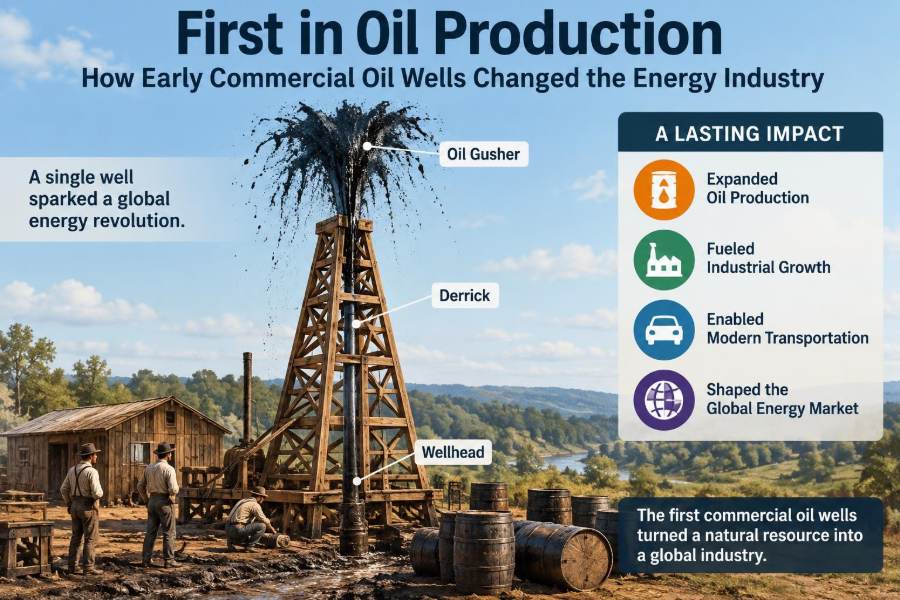

A student standing beside a historic wooden derrick may see an old machine, a few pipes, and a shallow well. It can be hard to connect that scene with a modern refinery, a jet crossing an ocean, or the plastics and medicines used every day.
Yet commercial oil production changed more than the fuel people bought. It changed how engineers searched for underground resources, managed pressure and fluids, moved bulky materials, measured risk, and organized large industrial systems.
The familiar story often begins with Edwin Drake’s 1859 well near Titusville, Pennsylvania. That well deserves attention, but it was not the first place people collected, refined, or sold petroleum. Oil seeped from the ground and was used in several regions for centuries.
The more useful question is not simply “who was first?” It is how early commercial wells turned a locally gathered substance into a dependable industrial commodity—and why that transformation still shapes petroleum engineering.
🧭 What “First in Oil Production” Actually Means
Claims about the first oil well can refer to very different milestones: the first oil collected from a seep, the first hand-dug shaft, the first drilled well, the first commercial sale, or the first sustained oil industry.
These categories matter because petroleum history developed in several places at once. A well can be technically early without creating a large market, while a later well can be commercially decisive because it proved a repeatable business model.
🌍 Petroleum Was Useful Long Before Modern Wells
Natural petroleum seepages were known in the ancient world. Bitumen—a thick, viscous form of petroleum—was used for waterproofing, construction, adhesives, and medicinal preparations in different societies.
These uses relied on oil that was visible or easily collected near the surface. The breakthrough of commercial production was not discovering that petroleum existed; it was learning to reach it more predictably beneath the ground.
🕳️ Early Extraction Was Often Digging, Not Drilling
Before cable-tool drilling became widespread, producers commonly used pits, shafts, or shallow hand-dug wells. In areas such as Bóbrka in present-day Poland, oil was collected from hand-dug wells in the mid-nineteenth century.
Such methods could work where oil occurred close to the surface, but they were hazardous and limited by groundwater inflow, unstable walls, toxic gases, and depth. A shaft is not easily extended or controlled when conditions become difficult.
🏞️ Oil Regions Developed on Different Timelines
The petroleum industry did not have one universal birthplace. Productive areas in what are now Azerbaijan, Romania, Poland, Canada, and the United States each contributed important early practices and markets.
Baku, for example, had long-known oil-bearing ground and later became a major producing center. Romanian production and refining also developed early. Treating one national story as the whole history hides the international character of petroleum technology.
🔨 Why the Drake Well Became a Turning Point
Edwin Drake’s well, completed in 1859 near Titusville, Pennsylvania, reached oil at a relatively shallow depth using a steam-powered cable-tool drilling system. Its output was modest by modern standards, but the result was commercially influential.
The well demonstrated that drilling could be used deliberately to obtain oil rather than waiting for a seep or excavating a shallow pit. Just as importantly, it was followed quickly by imitation, investment, and an expanding local supply chain.
⚙️ Cable-Tool Drilling Solved a Practical Problem
In cable-tool drilling, a heavy drilling tool is repeatedly lifted and dropped to crush rock. Workers periodically remove the broken rock, called cuttings, using a bailer or other cleaning tool.
The method was slow, but it transferred ideas already used in water-well drilling to petroleum. Early operators did not need a fully mature oilfield technology; they needed a workable method for making a borehole and keeping it open long enough to produce fluid.
🧱 Casing Was an Early Engineering Lesson
A borehole is not automatically stable. Loose formations can collapse, and water from shallow layers can enter the well and interfere with oil production. Drake used iron pipe to isolate troublesome water-bearing ground.
This was an early form of a problem that remains central today: wellbore integrity. Modern casing strings and cement are far more sophisticated, but their purpose is familiar—separate formations, support the hole, and protect people and groundwater.
💧 Water Was Both an Obstacle and a Clue
Early producers often treated water as an enemy because it filled pits, slowed drilling, and reduced the apparent value of the produced liquid. In a producing reservoir, however, water can also reveal how fluids are arranged underground.
Oil, gas, and water respond to density, pressure, rock properties, and structural traps. Modern engineers interpret water production carefully because it may indicate a nearby aquifer, coning, channeling, or a change in completion performance.
🪨 Reservoir Rock, Not an Underground Lake
A persistent misconception is that oil accumulates in large open caverns. Most petroleum is held in tiny connected pores within sedimentary rock, much like water held in a sponge, though the comparison is imperfect.
Porosity describes the amount of pore space, while permeability describes how easily fluids can move through connected pores. Early drillers did not use today’s reservoir vocabulary, but their successes depended on these properties.
🪤 Traps Made Some Wells Valuable
For oil to accumulate in economically useful quantities, it generally needs a reservoir, a seal, and a trapping geometry. A folded rock layer, a fault arrangement, or a change in rock type can help retain hydrocarbons.
Early drilling was often guided by surface signs and local experience. Over time, geology became less of a background description and more of a decision tool for choosing where to spend drilling capital.
🕯️ Kerosene Created the First Major Market
In the nineteenth century, kerosene became a valuable illuminating fuel. It offered an alternative to more expensive or less convenient lighting fuels, helping create demand that could absorb increasing volumes of crude oil.
Crude petroleum itself is a mixture, not a single finished product. Commercial success depended on refining it into products customers could use consistently and safely enough for their intended applications.
🏭 Refining Turned Crude into a Commodity
Refining separates and transforms crude oil into useful fractions based partly on differences in boiling behavior. Early refineries were much simpler than modern integrated facilities, but they made petroleum more standardized and marketable.
That standardization mattered. A household buying lamp fuel needed predictable burning behavior, not a container of variable fluid from an unfamiliar well. Quality control became part of the industry’s economic foundation.
🔥 Early Products Also Created Serious Hazards
Petroleum products can be flammable, and early refining and storage practices carried substantial fire risks. Volatile fractions, open flames, poor ventilation, and rudimentary equipment could turn small mistakes into major incidents.
The lesson remains current: hydrocarbon handling requires attention to ignition sources, vapor control, containment, procedures, and emergency response. Production growth without safety discipline merely moves risk from the ground to workers and nearby communities.
🚂 Transportation Determined What Was Profitable
A well can produce oil and still fail commercially if the fluid cannot reach a buyer. Early oil was commonly moved in barrels by wagon, river, and rail, with cost, leakage, and delays limiting the reach of many fields.
This is why petroleum engineering cannot be separated completely from midstream infrastructure. Gathering lines, storage, terminals, and pipelines convert a local flow of fluid into a dependable supply system.
🛢️ The Barrel Became More Than a Container
Wooden barrels were practical early transport containers, but they were not a precise scientific unit in the beginning. As trade expanded, common measurement conventions made it easier to price, report, and compare volumes.
Standard units do not eliminate uncertainty—temperature, sampling, and fluid composition still matter—but they allow operators, refiners, and buyers to coordinate. Measurement discipline is an often-overlooked part of industrial maturity.
📈 A Discovery Became an Industry Through Replication
One successful well may be luck. A commercial industry begins when others can reproduce useful results often enough to justify equipment purchases, leases, labor, and processing capacity.
In northwestern Pennsylvania, rapid follow-on drilling created a boom because knowledge, financing, and buyers converged. The crucial change was not that every well succeeded; it was that drilling became an organized, repeatable venture.
🎲 Early Oil Production Was a High-Risk Experiment
Early operators faced uncertain geology, variable production rates, unreliable equipment, and unstable prices. A nearby productive well did not guarantee success because reservoir quality can change sharply across short distances.
This uncertainty is recognizable to modern project teams. Better data reduce risk, but they do not remove it. Sound decisions compare possible outcomes, development costs, operational limits, and the consequences of being wrong.
📉 Boom-and-Bust Cycles Appeared Quickly
When discoveries attracted many new wells, supply could rise faster than available refining and transport capacity. Prices then fell, exposing producers who had planned on scarcity or borrowed heavily during the boom.
This pattern teaches a durable commercial lesson: production capacity has value only when matched with market access. Reservoir performance, logistics, processing, contracts, and demand must be considered together.
👷 Specialized Oilfield Work Began to Emerge
Early oil districts needed drillers, tool dressers, boiler operators, barrel makers, teamsters, lease agents, refiners, and merchants. The well site was only one part of a growing technical and commercial network.
Over time, work became more specialized. Petroleum engineering eventually brought together geology, drilling, production operations, reservoir analysis, facilities design, economics, and safety management into a distinct profession.
🧪 Chemistry Changed What Producers Could Sell
Crude oils differ in density, sulfur content, wax content, and the proportions of hydrocarbons they contain. These differences affect transport, refining yields, corrosion risk, and product value.
Early markets initially focused on a limited number of products. As chemical knowledge and processing technology advanced, petroleum became a feedstock for fuels, lubricants, solvents, and petrochemical materials rather than only lamp oil.
🌫️ Gas Was Once Often Treated as a Nuisance
Associated gas is natural gas produced with oil. In early fields, operators frequently lacked pipelines, processing equipment, or nearby customers able to use it, so gas could be vented or flared.
Modern operations generally seek to capture, use, reinject, or otherwise manage associated gas responsibly. The comparison shows how infrastructure and regulation can turn what was once viewed as waste into a valuable resource and emissions concern.
🌱 Environmental Consequences Were Not Fully Understood
Early production often occurred before modern environmental controls. Spills, leaking storage, waste disposal, land disturbance, and air emissions could affect soil, water, habitats, and communities.
It would be inaccurate to judge every nineteenth-century decision by standards that did not yet exist. But it would be equally mistaken to treat historic practices as acceptable models. Today’s engineering includes prevention, monitoring, remediation planning, and closure responsibilities.
🛡️ Safety Systems Grew from Hard Experience
Early oil work involved heavy tools, steam equipment, unstable structures, flammable fluids, and limited protective measures. Many hazards were visible only after incidents revealed their consequences.
Current safety practice is strongest when it is built into design and daily work: barrier management, permit systems, training, maintenance, clear communication, and the authority to stop unsafe work. Safety is not an add-on to production performance.
🧭 “First” Claims Need Careful Historical Language
When discussing early petroleum history, avoid declaring a single uncontested first unless the category is defined. “Often recognized as,” “among the earliest,” and “commercially influential” may be more accurate than a sweeping claim.
This is not needless caution. Precise language respects evidence and improves engineering thinking. The same habit helps professionals distinguish a measured result from an interpretation, a forecast, or an assumption.
📊 Comparing Milestones Prevents a Simplified Story
| Milestone | What it demonstrates | Why it differs from the others |
|---|---|---|
| Natural seep collection | Petroleum has long been known and used | Does not require a constructed well |
| Hand-dug oil well | Deliberate subsurface extraction | Usually limited by depth and ground stability |
| Drilled commercial well | Mechanical access to deeper targets | Can be replicated with tools and capital |
| Refining and distribution network | Reliable products can reach customers | Turns production into a durable industry |
The table does not rank one milestone as inherently superior. It shows why different regions may reasonably be associated with different “firsts.”
🔍 What Modern Engineers Can Learn from Early Wells
First, basic constraints still govern projects: subsurface uncertainty, fluid behavior, well integrity, surface handling, economics, and people. Modern software and sensors improve decisions, but they do not repeal those constraints.
Second, simple observations can be powerful when recorded well. Early operators watched seepages, water influx, production changes, and equipment behavior. Modern teams add logs, cores, pressure data, seismic interpretation, and surveillance—but must still ask disciplined questions of the evidence.
🧰 A Practical Framework for Studying a Historic Field
Students can analyze an early field without treating it as a museum curiosity. Start by separating the subsurface system from the business system, then identify how the two constrained each other.
- What rock and trap conditions likely allowed accumulation?
- How was the well drilled, supported, and cleaned?
- What fluid-handling problem limited production?
- Which product had a customer, and how did it reach that customer?
- What safety or environmental controls would be expected if the field were developed now?
This approach connects history with the practical decisions engineers make throughout a field’s life.
🧠 Common Mistake: Treating Technology as the Only Cause
The derrick and drill bit are visually memorable, so it is tempting to explain the oil industry as a story of machines alone. Technology mattered, but it worked alongside credit, land access, labor, transport, refining, and demand.
A useful analogy is a smartphone: a good device has limited value without networks, power, suppliers, software, and users. Likewise, a productive well needed an entire system around it before it could reshape energy use.
🏗️ From Local Wells to Integrated Energy Systems
Early commercial wells began a transition from scattered extraction to connected value chains. Production supplied refineries; refineries supplied transport and households; transport infrastructure expanded the accessible market.
That integration also created dependencies. A disruption at one point—such as a pipeline outage, refinery constraint, or storage shortage—can affect the value of production elsewhere. Understanding these links is essential for field development planning.
⚖️ The Legacy Is Powerful but Not Simple
Petroleum enabled major changes in lighting, mobility, industrial production, and chemical manufacturing. It also created safety hazards, pollution risks, geopolitical competition, and a large contribution to greenhouse-gas emissions when fuels are burned.
A technically honest view holds both realities. Learning the history of oil production should help professionals build more reliable systems while recognizing the environmental and social responsibilities attached to energy choices.
🎓 The Core Takeaway from the First Commercial Wells
Early wells changed the energy industry because they connected underground resources with repeatable drilling, useful refining, practical transportation, and expanding markets. No single well achieved that transformation alone.
The enduring principle is that petroleum production is a system problem. A reservoir discovery matters only when wells can be drilled safely, fluids can be managed responsibly, products can be delivered, and impacts can be addressed across the asset life cycle.
The first commercial oil wells mattered not simply because they found oil, but because they showed how geology, engineering, markets, and infrastructure could combine to change energy at scale. That lesson remains relevant wherever engineers turn subsurface resources into useful energy. 🛢️🔧🌍