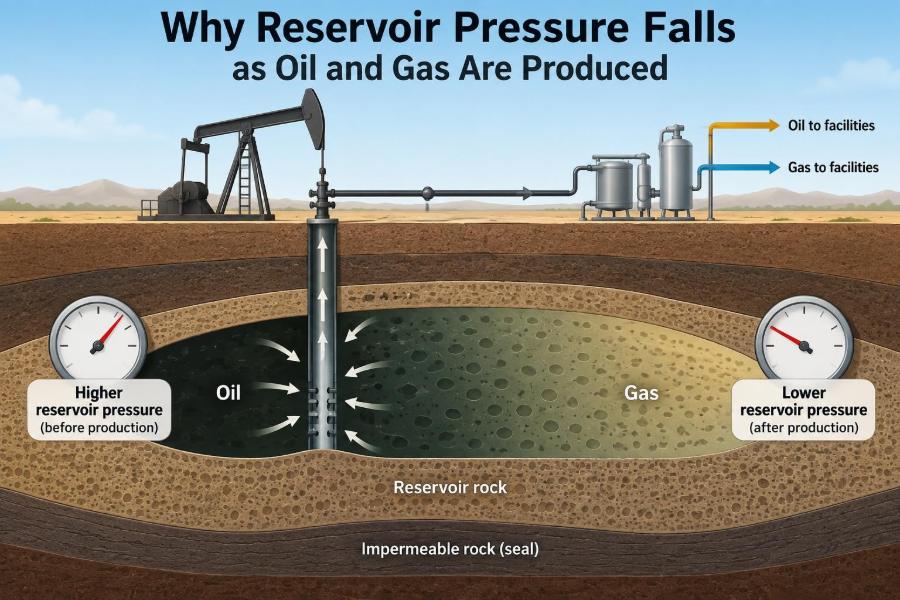

A well may begin its life flowing strongly, with oil, gas, and water moving to the surface under their own energy. Months or years later, the same well may need a choke adjustment, artificial lift, compression, or even a new recovery strategy. The visible change at the surface often begins with a less visible change deep underground: declining reservoir pressure.
For a student, pressure decline can seem like a simple rule—remove fluids and pressure goes down. For an engineer making daily production decisions, the real question is more demanding: which mechanism is supplying energy, where is the pressure being lost, and what does the decline mean for recovery?
The answer affects well rates, facility design, reserve estimates, waterflood timing, gas handling, and the risk of leaving movable hydrocarbons behind. It also explains why two reservoirs with similar initial pressure can behave very differently after production starts.
Reservoir pressure is not merely a number reported on a gauge. It is the result of fluids, rock, temperature, pore volume, connectivity, and operating choices interacting over time.
🧭 Start with the Reservoir, Not the Wellbore
A reservoir is a volume of porous rock containing fluids in connected pore spaces. Although a producing well provides the path to the surface, it does not contain most of the hydrocarbon inventory. Production changes conditions across the reservoir, beginning near the well and gradually extending farther away.
Reservoir pressure is the pressure exerted by fluids within those pores. It is commonly measured at a defined depth and referenced to a datum so that values from different wells can be compared meaningfully.
When fluids leave the pore system, the balance of forces that supported them changes. Pressure decline is the reservoir’s response to that changing material balance.
📦 Pore Space Holds a Limited Fluid Inventory
Imagine a rigid-looking sponge saturated with liquid. Its void spaces represent pores, while narrow connecting passages represent pore throats. A reservoir has a finite pore volume, even though that volume may be enormous on a field scale.
Oil, gas, and water occupy that pore volume in varying proportions. Producing one or more fluids removes mass from the system. Unless another fluid enters, or the rock and remaining fluids expand enough to compensate, the pressure must fall.
This does not mean every produced barrel creates the same pressure drop. The result depends on fluid compressibility, rock compressibility, reservoir size, communication with surrounding aquifers, and the rate and location of production.
⚖️ Pressure Is Part of the Reservoir Energy Balance
At the simplest level, a reservoir begins with stored energy. That energy can appear as compressed fluids, dissolved gas, free gas, water support, gravity segregation, or rock expansion. Production consumes or redistributes that energy.
A useful material-balance view is: fluids produced from the reservoir must be matched by expansion of fluids and rock, water influx, injected fluids, or some combination of these. If the replacement is incomplete, average reservoir pressure declines.
Pressure depletion is therefore not automatically a sign of poor operation. In many reservoirs it is an expected production mechanism. The engineering task is to determine whether depletion is occurring at an acceptable pace and with acceptable recovery consequences.
🪨 Rock Compaction Contributes Some Energy
Reservoir rock is not perfectly rigid. As pore pressure falls, the effective stress carried by the rock framework rises. The rock grains and pore structure may compact slightly, reducing pore volume and helping push fluids toward producing wells.
This rock and connate-water expansion is usually modest compared with gas expansion or strong aquifer support, but it can matter in low-compressibility oil reservoirs. Connate water is water held in the smallest pores and generally not mobile under normal production conditions.
Compaction can also create operational risks. In susceptible formations, substantial pressure reduction may contribute to subsidence, casing deformation, sand production, or changes in permeability. The energy benefit and geomechanical consequences must be considered together.
🛢️ Oil Expansion Helps, but Only Modestly
Above the bubble-point pressure, oil contains dissolved gas and behaves as a slightly compressible liquid. As pressure declines, the oil expands. This expansion displaces some oil toward wells and provides a portion of the producing energy.
Liquid expansion alone is often insufficient to sustain high production rates for long. Compared with gas, oil has relatively low compressibility. A reservoir depending mainly on oil expansion commonly experiences meaningful pressure depletion unless it receives water influx or pressure support through injection.
The extent of oil expansion depends on crude composition, temperature, and pressure. Engineers use pressure-volume-temperature, or PVT, laboratory data to represent these properties rather than assuming all oils respond alike.
🫧 Dissolved Gas Changes the Picture at Bubble Point
Bubble-point pressure is the pressure at which the first gas bubble comes out of solution from an oil at reservoir temperature. Above this pressure, the reservoir is undersaturated: all gas remains dissolved in the oil.
Once pressure falls below bubble point, dissolved gas evolves into a separate gas phase. This is a turning point in many oil reservoirs because the fluid system, flow behavior, and energy sources all change.
Early gas evolution does not always mean gas immediately flows freely to the well. Gas must build enough saturation to become connected through the pore network. Before that happens, much of it can remain trapped as disconnected bubbles.
🎈 Gas Expansion Can Be a Powerful Drive Mechanism
Gas is much more compressible than oil or water. As pressure falls, gas expands significantly, which can provide substantial energy to move fluids. In a solution-gas-drive reservoir, this expansion is often the dominant natural drive after bubble point is crossed.
That energy has a trade-off. Gas that comes out of solution may occupy pore space previously filled by oil and can reduce oil relative permeability—the oil’s ability to flow in the presence of other fluids. Gas may also reach the well preferentially, raising the gas-oil ratio.
A reservoir can therefore have strong gas expansion while still achieving only moderate oil recovery if pressure decline is rapid and gas mobility becomes unfavorable.
🌫️ Free Gas Is Not Always Helpful Gas
Engineers distinguish between gas that remains dispersed and trapped in the pores and gas that becomes mobile. Once gas saturation exceeds a critical threshold, connected gas pathways form and gas can flow toward the well.
Mobile gas may add energy, but it can also bypass oil because gas typically has lower viscosity and responds strongly to pressure gradients. Near the wellbore, high drawdown can encourage gas to move faster than oil, reducing the efficiency of oil displacement.
This is why managing bottomhole flowing pressure matters. Producing as hard as possible may accelerate cash flow in the short term while worsening gas liberation and oil recovery in some reservoirs.
💧 Water Influx Can Replace What Production Removes
Many reservoirs are connected hydraulically to an aquifer: a water-bearing rock volume that can supply water as reservoir pressure falls. The pressure difference between the reservoir and aquifer drives water influx into hydrocarbon-bearing pore space.
A strong aquifer can slow average pressure decline substantially. In effect, water replaces part of the produced fluid volume, maintaining pressure and supporting oil movement toward wells.
Water support is not automatically ideal. If water advances unevenly or reaches wells early, water production can rise before a large share of oil has been recovered. The value of aquifer support depends on its strength, geometry, rock heterogeneity, and well placement.
🌊 Aquifer Strength Creates Different Pressure Responses
Not all aquifers behave the same way. A large, well-connected aquifer may provide sustained support, while a small or poorly connected aquifer may respond slowly or contribute little. Boundaries, faults, permeability barriers, and aquifer shape all influence the response.
| Reservoir support condition | Typical pressure behavior | Common production implication |
|---|---|---|
| Weak or absent water support | Pressure may decline rapidly with cumulative production | Depletion and gas evolution can become dominant |
| Moderate water support | Pressure decline is moderated but still evident | Water-cut management becomes increasingly relevant |
| Strong water support | Pressure can remain relatively stable for a period | Early or uneven water breakthrough may limit sweep |
These are broad patterns, not fixed classifications. Reliable interpretation requires pressure data, production history, fluid samples, geological understanding, and usually a reservoir model.
📉 Production Rate Controls the Local Pressure Drawdown
Pressure is rarely uniform while wells are flowing. The pressure near a producing well is lower than pressure farther out in the reservoir because fluid must overcome flow resistance through the rock and completion.
This local reduction is called drawdown: the difference between reservoir pressure and flowing bottomhole pressure. Larger drawdown can increase rate, but it can also intensify near-well gas liberation, water coning, fines movement, or sand-production risk.
Shutting in a well allows nearby pressure to rebuild partially as fluids redistribute. That recovery does not mean the reservoir has regained all pressure lost to cumulative production; it mainly reveals pressure communication from the surrounding reservoir.
🧩 Permeability Determines How Easily Pressure Communicates
Permeability describes how readily fluids move through connected pore spaces. In high-permeability rock, pressure changes can spread relatively quickly. In tight rock, pressure disturbance may remain concentrated near the well for much longer.
Two wells in the same field may therefore report different pressures without either measurement being wrong. They may drain different compartments, be separated by low-permeability rock, or simply be measured under different flowing conditions.
Pressure data must always be interpreted with geology and well status in mind. A single pressure measurement is useful; a consistent pressure-surveillance program is much more informative.
🧱 Barriers and Compartments Change the Story
Faults, shale layers, cemented zones, pinch-outs, and permeability contrasts can restrict fluid flow. These features may divide what appears on a map to be one reservoir into pressure compartments with limited communication.
When one compartment is produced aggressively, its pressure can fall faster than pressure in an adjacent compartment. Untapped hydrocarbons may remain behind a barrier even while nearby wells show severe depletion.
Recognizing compartmentalization affects development planning. It can justify additional appraisal, altered well locations, separate pressure-management plans, or revised reserve estimates. Assuming full communication where it does not exist is a costly reservoir-management error.
🧪 Fluid Properties Shape the Depletion Path
Reservoir fluids are mixtures, not simple substances. Oil composition affects bubble point, formation volume factor, viscosity, and dissolved-gas content. Gas composition affects compressibility and phase behavior, especially at high pressure and temperature.
Viscosity matters because more viscous fluids require a larger pressure gradient to flow at the same rate. Heavy oil reservoirs can show substantial local drawdown even when average reservoir pressure remains comparatively high.
PVT experiments provide the property relationships used in material-balance calculations and simulation. Using representative samples is essential; a poor fluid description can make pressure forecasts look precise while being physically misleading.
🌡️ Temperature and Depth Set the Pressure Environment
Pressure in a reservoir is linked to depth because fluid columns have weight. A deeper datum generally has a higher pressure than a shallower one within the same connected fluid system. Engineers account for this using pressure gradients.
Temperature also affects fluid volume, gas solubility, and phase behavior. A pressure value without depth, temperature context, fluid type, and measurement condition is easy to misinterpret.
For this reason, teams commonly compare pressures at a common datum and distinguish static or shut-in measurements from flowing pressures. These details turn a number into usable reservoir information.
🔄 Depletion Drive Is a Natural but Finite Strategy
In a depletion-drive reservoir, production relies primarily on the expansion of oil, gas, connate water, and rock rather than on major water influx or intentional injection. Pressure falls as the fluids expand and the produced volume is not fully replaced.
Depletion can be an appropriate early-life strategy, particularly when the reservoir has adequate natural energy and facilities must be developed in stages. It may also be the only practical option in certain settings.
Its limitation is straightforward: once pressure and fluid mobility decline, production becomes harder. Decisions about pressure maintenance are most effective when considered before depletion has irreversibly altered the fluid distribution.
🚰 Waterflooding Adds Pressure Support and Displacement
Water injection places water into selected wells to replace produced reservoir volume and displace oil toward producers. Properly designed waterflooding can slow pressure decline and improve sweep of the reservoir.
Success depends on more than injecting water. Injection rate, water quality, fracture pressure, reservoir layering, well pattern, and mobility ratio all influence whether water contacts oil effectively or simply finds fast paths to production wells.
Injection water that is incompatible with formation minerals or resident brine can cause scaling, clay swelling, plugging, or souring concerns. Pressure maintenance is therefore a reservoir, wells, facilities, and chemistry problem—not just an injection-volume target.
💨 Gas Injection Can Serve Different Purposes
Gas may be injected to maintain pressure, recycle produced gas, reduce gas flaring or export constraints, or improve oil displacement under favorable phase behavior. Depending on the system, injected gas can be immiscible with oil or become miscible under sufficiently suitable pressure and composition.
Miscible displacement can reduce interfacial effects that trap oil, but it requires careful screening and often a sustained pressure above a minimum miscibility condition. It is not a universal solution.
Gas injection also brings operational questions: where will injected gas travel, will it override because of gravity, can it break through early, and is sufficient compression capacity available? A sound plan balances recovery potential with these constraints.
🧲 Gravity Separates Fluids and Influences Pressure
Oil, gas, and water have different densities. Over time, gravity tends to place gas above oil and water below oil where the reservoir structure and connectivity allow segregation. This creates gas caps, oil columns, water legs, and depth-dependent pressure gradients.
Producing near a gas cap can encourage gas movement downward toward a well. Producing near an oil-water contact can draw water upward. These effects are often described as gas coning and water coning when the movement becomes localized around a well.
Completion interval, production rate, and well orientation influence these risks. A horizontal well placed thoughtfully can sometimes reduce drawdown intensity and delay unwanted fluid entry, though it does not remove the underlying reservoir physics.
🕳️ Bottomhole Pressure Connects Reservoir Physics to Operations
Surface tubing pressure is useful for operations, but it is not the same as bottomhole flowing pressure. Friction, fluid density, gas fraction, and elevation change pressure between the reservoir and the wellhead.
Bottomhole pressure helps engineers assess drawdown, inflow performance, artificial-lift needs, and whether a well is being produced within an appropriate operating envelope. It also supports well-test interpretation and calibration of production models.
When direct downhole gauges are unavailable, estimates may be made from surface measurements and flow correlations. Those estimates carry uncertainty, particularly in multiphase flow, so their limitations should be recognized in decisions.
📏 Measuring Pressure Requires the Right Conditions
Static reservoir pressure is ideally measured after a well has been shut in long enough for nearby pressure to stabilize. In low-permeability or complex reservoirs, full stabilization may take a long time and may not be practical.
Pressure transient tests analyze how pressure changes during controlled flow and shut-in periods. They can provide insight into permeability, skin, boundaries, and communication—not only a pressure estimate.
Permanent downhole gauges provide high-frequency data, while periodic wireline surveys provide snapshots. Neither approach is automatically superior; the useful choice depends on well value, expected dynamics, data quality, and surveillance objectives.
📊 Average Pressure Is Different from a Single Well Reading
Engineers often need an estimate of average reservoir pressure for material balance, reserves, and field planning. A pressure measured in one well may not represent that average, especially if the well is near a boundary, has strong drawdown, or sits in a distinct compartment.
Multiple measurements across depths and locations can reveal gradients and communication. Production and injection histories add further context. Combining these sources is more reliable than treating one convenient measurement as the field answer.
Uncertainty should be stated openly. Reservoir decisions frequently must be made before every ambiguity is resolved, but uncertainty-aware decisions are better than false confidence.
🧮 Material Balance Checks Where the Volume Went
Material balance applies conservation of mass and volume to reservoir production. It compares produced oil, gas, and water with changes expected from fluid expansion, rock and water expansion, water influx, and injection.
If the observed pressure decline is much slower than expansion alone predicts, water influx or unrecognized injection may be contributing. If it declines faster than expected, the assumptions about connected volume, fluid properties, or measured production may need review.
Material balance is powerful because it connects field-scale performance to physical accounting. It is also sensitive to input quality, especially pressure data, PVT data, and estimates of original fluids in place.
🖥️ Reservoir Simulation Tests Competing Explanations
A reservoir simulator represents rock properties, fluid behavior, wells, boundaries, and operating constraints across a grid of cells. Teams use it to test whether observed pressure and production trends can be reproduced by a plausible geological and fluid-flow model.
Simulation is valuable for comparing scenarios: continued depletion, delayed waterflooding, different injection patterns, rate limits, or new well locations. It can show trade-offs that simple calculations cannot capture.
However, a simulator is not a crystal ball. Its forecasts inherit uncertainty from the geological model, relative-permeability data, aquifer description, and future operating assumptions. History matching should improve understanding, not disguise uncertainty with a visually good fit.
⚠️ Rapid Pressure Decline Can Create Production Problems
A steep pressure decline may reduce the natural ability of fluids to flow into the well. Oil viscosity may remain unchanged or change only modestly, but the available pressure difference driving flow becomes smaller.
Below bubble point, increasing gas saturation can lower oil relative permeability. At the same time, gas and water may occupy more of the produced stream, increasing separation, compression, disposal, and treatment demands at the surface.
- Lower flowing rates or more frequent well interventions
- Earlier need for artificial lift or gas compression
- Greater risk of coning and unwanted fluid breakthrough
- Potential compaction and well-integrity concerns in sensitive formations
These risks vary by reservoir; pressure decline alone does not diagnose their cause.
🏗️ Surface Facilities Feel the Effects of Reservoir Depletion
Reservoir pressure behavior reaches beyond subsurface engineering. Falling wellhead pressure can reduce pipeline capacity and may require compression to move gas to processing or sales systems. Rising gas-oil ratio can change separator loading and vapor-handling requirements.
Increasing water production can strain produced-water treatment, pumping, disposal, and corrosion-control systems. Conversely, injection projects require water sourcing, treatment, filtration, pumps, and surveillance infrastructure.
Planning subsurface strategy without facility limits can produce impractical forecasts. The best development plans connect reservoir performance, well deliverability, processing capacity, and operating reliability.
🔧 Artificial Lift Helps Wells, Not Reservoir Pressure
Artificial lift—such as rod pumping, electric submersible pumps, gas lift, or progressing cavity pumps—reduces flowing bottomhole pressure or lifts fluids more effectively to surface. It can increase production from wells when reservoir energy alone is no longer enough.
It does not restore average reservoir pressure. In fact, if increased well rates are not paired with pressure support, artificial lift may accelerate depletion of the reservoir volume being drained.
This distinction prevents a common misunderstanding: well productivity and reservoir pressure are related, but they are not interchangeable. A well can be mechanically capable of lifting fluid even while the reservoir needs a separate pressure-management plan.
🚫 Common Interpretation Mistakes to Avoid
Several shortcuts can lead to poor conclusions about pressure behavior:
- Comparing pressures at different depths without correcting to a common datum.
- Treating flowing pressure as static pressure without considering drawdown.
- Assuming all wells communicate because they produce from the same named formation.
- Blaming water production only on strong aquifer support when completion issues or high drawdown may contribute.
- Using a single pressure survey as a trend rather than integrating repeated, quality-controlled measurements.
Each mistake can distort forecasts of recovery, well performance, or injection requirements.
🧠 A Simple Hypothetical Reservoir Example
Consider a hypothetical oil reservoir initially above bubble point, with limited aquifer connection. Early production is strong because the pressure difference between reservoir and wellbore is large. As oil is removed, oil and rock expansion supply some volume replacement, but not enough to maintain pressure.
Eventually, average pressure reaches bubble point. Gas begins leaving solution, and the gas-oil ratio rises. If operators increase drawdown sharply to preserve oil rate, mobile gas may reach the wells more readily while oil relative permeability declines.
At this stage, a team might compare controlled depletion with water injection or gas reinjection. The preferred choice would depend on injectivity, fluid compatibility, gas value, reservoir layering, facilities, economics, and the uncertainty in the reservoir description.
🗺️ Pressure Surveillance Should Guide Decisions Early
Pressure-management options are generally easier to evaluate before the reservoir has undergone extensive depletion, widespread gas liberation, or uneven water encroachment. Early surveillance establishes the baseline needed to recognize change later.
A practical surveillance plan may combine representative pressure surveys, bottomhole gauge data, PVT updates when warranted, production allocation, water and gas trends, injection accounting, and periodic model review. The frequency should reflect how rapidly the reservoir changes and how costly a wrong decision would be.
Data collection has a cost, but operating blindly also has a cost. The aim is not to measure everything; it is to measure the variables that resolve the most consequential uncertainty.
🤝 Pressure Management Is a Multidisciplinary Job
Reservoir engineers interpret connected volume and drive mechanisms. Production engineers manage drawdown and well performance. Geoscientists refine structure and compartment boundaries. Facilities engineers assess compression, water handling, and injection capacity. Geomechanics and integrity specialists evaluate compaction-related risks where relevant.
Strong decisions emerge when these perspectives are considered together. For example, a reservoir model may support higher drawdown, while completion integrity or water-handling limits may argue for a more controlled operating plan.
Clear communication matters because “maintain pressure” can mean different things: preserve average pressure, reduce local drawdown, support displacement, protect well integrity, or maintain export deliverability.
🎯 The Core Principle: Produced Volume Must Be Replaced or Pressure Falls
The central reason reservoir pressure falls is conservation: production removes fluids from pore space. Pressure can be sustained only to the extent that expansion, natural water influx, or injected fluids replace the produced volume and preserve the reservoir’s energy balance.
The details determine the outcome. Gas expansion may provide strong energy but impair oil mobility. Aquifer influx may maintain pressure but bring early water. Injection can improve displacement but requires sound design and reliable operations. Drawdown can increase a well’s rate while creating near-well flow problems.
Understanding pressure decline means connecting these mechanisms rather than looking for one universal explanation. That connection is the foundation of practical reservoir management.
Reservoir pressure falls because production changes the fluid-volume balance underground, and the best response depends on how rock, fluids, aquifers, wells, and operations share the task of replacing lost energy. Reading that balance correctly helps teams protect recovery, manage risk, and make better decisions throughout field life. 🛢️📉🔍