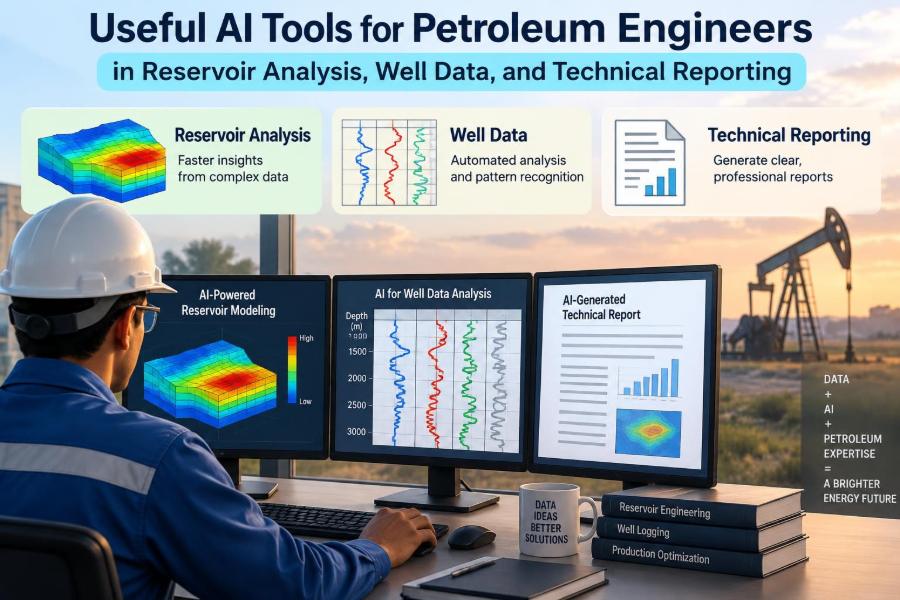

A reservoir engineer receives a spreadsheet with years of production history, a folder of pressure surveys, several well logs, and a request for “quick insights” before tomorrow’s review. The difficult part is rarely opening the files. It is deciding which data can be trusted, what the decline actually means, and whether a model result is physically plausible.
AI tools can make parts of this work faster: searching a large document set, cleaning repeated data patterns, flagging unusual measurements, drafting code, or turning a rough outline into a readable report. They can also make errors travel faster when assumptions, units, dates, and well identities are not checked.
For petroleum engineers, the useful question is not whether AI will replace reservoir analysis. It is where a tool can reduce routine effort while engineering judgment remains responsible for the result.
This distinction matters because subsurface decisions connect uncertain measurements to costly operational choices. A polished chart or fluent summary is not evidence by itself. The workflow still needs traceable data, sound physics, and review by people who understand the asset.
🧭 Start with the Engineering Decision
Choose an AI tool only after defining the decision it is meant to support. “Analyze the reservoir” is too broad; “identify wells whose water-cut trend needs surveillance review” is a workable task.
A useful task statement names the asset, decision, time horizon, input data, expected output, and acceptance check. This prevents teams from treating a chatbot response or machine-learning score as a substitute for an engineering workflow.
- Decision: prioritize candidates for pressure buildup analysis.
- Inputs: rate history, shut-in periods, pressure records, completion changes.
- Output: a ranked, explained candidate list.
- Check: an engineer verifies event history and measurement quality.
🧠 Understand the Main Families of AI Tools
“AI” covers tools with very different strengths. A large language model works with language and code; a predictive model estimates a target from historical patterns; computer vision interprets images; and optimization searches combinations under stated constraints.
These categories should not be confused. A language model may explain material balance concepts clearly but cannot create a reliable pressure-volume-temperature relationship from prose alone. A predictive model may rank candidate wells, but it does not establish a causal mechanism.
| Tool family | Useful petroleum task | Primary caution |
|---|---|---|
| Language model | Search, drafting, code assistance, document extraction | Can produce convincing but incorrect statements |
| Machine learning | Forecasting, classification, anomaly detection | Performance may fail outside training conditions |
| Computer vision | Core image or document-image interpretation | Image quality and labels strongly control results |
| Optimization | Constrained planning and allocation | Finds the best answer only for the stated model |
🗂️ Build a Trusted Data Foundation First
AI cannot repair an undefined datum, a duplicated production record, or a well name that refers to two different completions. Before modeling, establish a master well identifier, a time convention, unit rules, source locations, and ownership for each dataset.
For reservoir work, retain both the raw source and a curated analysis layer. The raw file supports audit and reprocessing; the curated layer records the transformations used for calculations and plots.
🔗 Resolve Well Names, Dates, and Units
Entity resolution is one of the most practical uses of assisted pattern matching. A tool can suggest that “A-17,” “A17H,” and “Alpha 17” might refer to the same well, but an engineer or data steward must confirm the match.
Unit normalization deserves equal attention. Mixing stock-tank barrels with cubic metres, gauge pressure with absolute pressure, or different gas volume bases can invalidate an otherwise elegant analysis. Store original values and units alongside converted values whenever feasible.
📊 Use AI for Data Quality Triage
Large production databases often contain issues that are simple individually but difficult to locate at scale: negative volumes, repeated dates, impossible uptime, abrupt step changes, and missing allocation periods. Rules and anomaly-detection models can flag these records for review.
A flag is not a correction. A sudden rate jump may be a data entry error, but it may also follow a choke change, workover, facility reroute, or reporting change. Good triage preserves the reason for accepting, correcting, or excluding a point.
📈 Make Time-Series Data Fit for Analysis
Production surveillance depends on consistent time handling. Monthly oil, gas, water, injection, pressure, uptime, and intervention records should be aligned to a clear reporting period before any model sees them.
AI-assisted scripts are valuable here because they can automate repeatable checks: identify gaps, calculate elapsed days, separate zero production from missing data, and produce standardized plots. The script should be reviewed, version-controlled, and tested against a small known dataset.
📉 Apply Decline-Curve Analysis with Restraint
Decline-curve analysis extrapolates production behavior from historical rates. It is useful for forecasting and reserves discussions, especially when combined with operational context, but it is not a direct measurement of remaining hydrocarbons.
AI can fit multiple decline forms quickly and compare residual errors. The engineer still selects the valid history window, recognizes curtailment or artificial-lift effects, and decides whether the assumed decline behavior is reasonable for the well’s flow regime.
🧮 Keep Material Balance Physics in the Loop
Material balance links production and pressure behavior to infer reservoir support and hydrocarbons initially in place under appropriate assumptions. It is often more informative than a purely statistical forecast because it expresses a physical accounting relationship.
AI can help organize inputs, calculate repeated scenarios, and explain sensitivity cases. It should not silently choose fluid properties, pressure averaging methods, or drive mechanisms. Those choices determine whether the calculation means anything.
🌐 Speed Up Reservoir Simulation Workflows
Reservoir simulation remains a physics-based representation of flow through a reservoir model. AI is most useful around the simulator: preparing cases, checking input files, summarizing run outcomes, screening uncertainty cases, and building fast proxy models.
A proxy model, sometimes called a surrogate, approximates simulator outputs after training on completed runs. It can accelerate screening, but it must be validated against withheld simulation cases and periodically checked when the model domain changes.
🎲 Treat Uncertainty as an Output, Not an Inconvenience
Reservoir properties, contacts, relative permeability, aquifer strength, and operational constraints are uncertain. A single “best” forecast can hide the fact that several plausible assumptions lead to very different outcomes.
AI can help generate and organize many cases, identify influential parameters, or cluster similar outcomes. It cannot decide the probability distribution of an uncertain input without defensible geological, laboratory, field, or expert basis.
🧱 Interpret Logs with Geological Context
Machine-learning models can assist with log facies classification, curve reconstruction, and recognition of repeated patterns across wells. These are useful aids when logs have consistent quality and reliable training labels.
Logs are not direct pictures of lithology or fluids. Borehole conditions, invasion, tool response, shale effects, and local calibration all matter. A predicted facies should be checked against core, cuttings, image logs, test data, and the broader depositional framework where available.
🪨 Use Core Images Carefully
Computer vision can accelerate the cataloging of core photographs, detect fractures or bedding features, and support consistent image annotation. It is particularly useful for sorting large image libraries before detailed specialist review.
Lighting, scale, slab orientation, drilling damage, and image resolution can mislead a vision model. A system trained on one core photography setup may perform poorly on another, so evaluation must include images representative of the intended field use.
🧪 Connect PVT Data to Engineering Decisions
Pressure-volume-temperature data define fluid behavior needed for material balance, nodal analysis, reserves calculations, and simulation. AI tools can extract tables from laboratory reports, compare correlations, and help write quality-control routines.
They should not infer a complete fluid model from sparse descriptions. Verify sample representativeness, separator conditions, recombination method, saturation pressure, and consistency between lab data and field observations before using derived properties.
🛢️ Improve Well-Test Data Preparation
Well-test interpretation is sensitive to rate history, gauge depth, fluid level effects, shut-in quality, and pressure measurement reliability. Automated routines can identify candidate shut-ins, standardize plot preparation, and flag periods with unstable rates.
The interpretation itself requires diagnosis. A straight line on a semilog plot is not automatically radial flow, and a derivative feature is not automatically a boundary. AI-generated explanations should be treated as prompts for investigation, not final interpretations.
🔧 Support Production Optimization Without Over-Automating
Predictive tools can combine operating variables and production history to identify patterns associated with improved or degraded performance. For example, they may help rank wells for artificial-lift review or detect unusual response after a choke change.
Correlation does not prove that the suggested control caused the outcome. Before changing a setting, consider facility limits, sand production, water handling, gas constraints, drawdown effects, integrity risks, and the possibility that the model learned a scheduling pattern rather than a physical relationship.
💧 Detect Water and Gas Breakthrough Signals
Surveillance models can flag wells whose water cut, gas-oil ratio, pressure, or rate behavior departs from their own historical trend or from comparable wells. This can focus attention in fields where manual plot review is time-consuming.
Breakthrough diagnosis still needs reservoir context. Rising water cut could reflect coning, channeling, behind-pipe communication, changing completion contribution, allocation uncertainty, or an operational measurement issue. The best workflow pairs a flag with the plots and metadata needed to investigate it.
🚨 Design Anomaly Detection for Actionability
An anomaly system is useful only if people know what happens after an alert. Too many vague alerts create alarm fatigue; too few alerts can miss emerging issues.
Define alert tiers, ownership, response time, and evidence requirements. A high-priority alert might require simultaneous deviations in rate, tubing pressure, and pump indicators, while a lower-tier alert simply creates a surveillance task for the next review cycle.
💻 Use Language Models as Coding Assistants
Language models can draft Python, SQL, spreadsheet formulas, or plotting routines from a clear engineering description. They are especially helpful for repetitive data preparation, documentation, and converting a manual calculation into a reusable template.
Never run generated code blindly on operational or production databases. Review the logic, test it on a copy, inspect unit handling, check edge cases, and compare results with a hand-calculated example. A syntactically valid script can still implement the wrong equation.
🔍 Search Technical Documents More Effectively
Retrieval tools can index reports, daily operations notes, completion summaries, laboratory reports, and meeting records so engineers can locate relevant passages quickly. This is often more useful than asking a general chatbot to answer from its broad training.
A strong setup returns the underlying excerpt, document name, revision, and location so the user can inspect the source. Search results should distinguish approved final documents from drafts, obsolete procedures, and informal notes.
📝 Draft Technical Reports Faster, Then Verify Them
AI can help transform structured inputs into a first draft of a surveillance note, simulation summary, or well performance review. It can improve clarity, produce a consistent outline, and identify missing sections such as assumptions or limitations.
Do not let the tool invent observations to make a report sound complete. Give it verified tables, selected figures, and explicit findings; then check every number, unit, well name, date, conclusion, and recommendation against source data.
📚 Separate Summaries from Evidence
A summary is a navigation aid, not the evidence base for an engineering decision. When a tool condenses a 100-page report, nuance can disappear: a qualification may be omitted, a tested interval may be confused with a completed interval, or a preliminary result may sound final.
For consequential decisions, retain a concise evidence trail: source documents, data version, calculation or model version, assumptions, reviewer, and date. This makes later challenge and learning possible.
🔐 Protect Confidential and Sensitive Information
Well data, reserves information, partner documents, commercial terms, and operational details may be confidential. Before entering information into an AI service, understand the organization’s approved tools, retention settings, access controls, and data-use terms.
Remove unnecessary identifiers when prototyping, use secure enterprise environments where required, and follow contractual and regulatory obligations. Convenience does not override data governance.
⚖️ Watch for Bias and Domain Drift
A model trained mostly on one basin, completion style, or operating strategy may not transfer to another. This loss of reliability when conditions differ from training data is often called domain drift.
Check performance by field, formation, well type, operating period, and data completeness rather than relying on one aggregate score. If the new use case is outside the training domain, treat the output as exploratory until it has been independently evaluated.
✅ Validate Models Against Meaningful Baselines
A model should outperform something useful, not merely produce a favorable metric. Depending on the task, a baseline might be the previous value, a conventional decline model, a simple rule, or an experienced engineer’s existing screening method.
Use a time-aware validation split for time-series work so future data does not leak into training. Inspect errors in engineering units and operational terms: a small average error can still conceal unacceptable failures on shut-in wells or high-rate producers.
👥 Keep Humans Accountable for Decisions
Human-in-the-loop does not mean adding a signature after automation has made an opaque recommendation. It means defining where professional judgment is required: input approval, assumption selection, interpretation, operational authorization, and post-action review.
Clear accountability also helps improve the tool. When an engineer overrides a recommendation, capture why: bad data, missing event context, out-of-domain behavior, or a legitimate engineering constraint. Those reasons are valuable feedback.
🧰 Build a Practical Tool Stack
A sensible stack usually combines established engineering software with data storage, scripting, visualization, and controlled AI assistance. There is no need to force every task into one platform.
- Data layer: governed databases, source files, and well identifiers.
- Analysis layer: engineering applications, notebooks, SQL, and tested scripts.
- AI layer: document retrieval, code assistance, anomaly screening, or proxies.
- Review layer: plots, assumptions, peer review, and decision records.
This arrangement keeps critical calculations transparent while allowing automation to remove routine friction.
🧪 Begin with Small, Measurable Pilots
Start with a repetitive task that has accessible data and a clear quality measure. Examples include extracting well-test metadata from approved reports, checking production files for unit inconsistencies, or generating a first-draft monthly surveillance summary.
Measure more than time saved. Track correction rate, missed exceptions, user trust, data-security fit, maintainability, and whether the output leads to better review conversations. A pilot that saves minutes but creates untraceable errors is not a successful deployment.
📋 Create Reusable Prompts and Checklists
For language-model tasks, a reusable prompt acts like a work instruction. It should specify the role, available source material, expected format, prohibited assumptions, unit convention, and required uncertainty statement.
For example, a report-drafting instruction can require the model to use only supplied values, label unknown items as “not provided,” list assumptions separately, and return a table of statements needing human verification. This reduces the temptation to fill gaps with plausible language.
⚠️ Recognize Common Failure Modes
Failures are often ordinary rather than dramatic: wrong date parsing, a rate reported at an unclear basis, training data that includes future information, a model that mistakes shut-ins for low productivity, or a summary that omits a key caveat.
- Do not accept polished prose as proof of a calculation.
- Do not merge data sources without confirming identifiers and measurement bases.
- Do not deploy a model without a response process for its output.
- Do not hide uncertainty because a dashboard needs one number.
- Do not treat vendor claims or benchmark scores as a substitute for local validation.
🧭 Make Explainability Proportionate to Risk
Not every automation requires the same level of explanation. A tool that sorts documents can tolerate more opacity than one that influences injection allocation, production constraints, reserves reporting, or well intervention priorities.
For higher-risk applications, users should be able to identify inputs, model version, training scope, key drivers, known limitations, and the person responsible for approval. Explainability is not only a technical feature; it is a discipline of documented reasoning.
🌱 Develop AI Literacy Alongside Reservoir Judgment
Petroleum engineers do not need to become full-time data scientists to use AI responsibly. They do need enough literacy to ask practical questions: What is the target? What data was used? What is missing? How was performance checked? Where can this fail?
Likewise, data specialists working on subsurface problems need exposure to fluid behavior, well operations, measurement limitations, and field workflows. Better results come from collaboration rather than handing a complex reservoir question to either group alone.
🏁 The Core Principle: Accelerate Work, Not Judgment
The strongest uses of AI in petroleum engineering remove friction around data organization, repetitive analysis, information retrieval, coding, and first-draft communication. They give engineers more time to examine assumptions, reconcile conflicting evidence, and discuss decisions with operations and subsurface teams.
The weaker uses ask a tool to provide certainty where the field data is incomplete or the physics is uncertain. Reservoir analysis remains an exercise in constrained interpretation, not a contest to produce the quickest forecast.
Use AI to make engineering work more traceable, testable, and efficient—while keeping physical reasoning, data stewardship, and accountable human review at the center.
That balance turns AI from a source of impressive-looking output into a practical part of reliable reservoir and well-performance decisions. 🛢️📊🤝