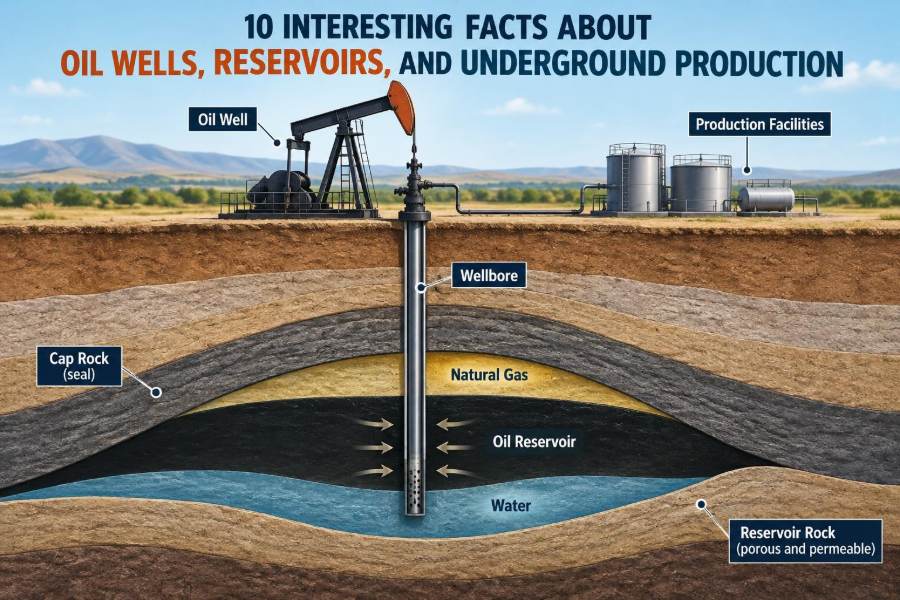

A driver passes a pumpjack beside a highway and sees its steady nodding motion. It is easy to picture that machine simply lifting oil from a giant underground lake.
The real picture is more interesting. Most petroleum is held inside tiny spaces between grains of rock, often kilometers below ground, mixed with water and gas, and moving only when pressure, permeability, and well design work together.
That difference matters to anyone studying or working in petroleum engineering. It explains why a well can be highly productive, why it can decline quickly, why water can arrive unexpectedly, and why a reservoir team may spend years interpreting data that nobody can see directly.
These facts connect the visible equipment at the surface with the physics, geology, and operational decisions that govern underground production.
🪨 Fact 1: Oil reservoirs are rocks, not underground lakes
An oil reservoir is usually a volume of porous rock containing petroleum fluids. Sandstone and carbonate formations are common reservoir rocks because they can contain interconnected pores, much like a sponge contains small openings.
The word reservoir refers to the rock-and-fluid system, not merely the oil. A large oil-filled cave is a memorable image, but it is not the usual geological setting for commercial oil production.
This matters because engineers must move fluids through a rock framework. The size, shape, and connectivity of pore spaces strongly influence what a well can produce.
🔬 Pores are tiny, but their total volume can be large
Porosity is the fraction of a rock’s bulk volume made up of pore space. Some pores contain oil, some contain water, and some may contain gas; their proportions vary throughout a reservoir.
A hand specimen may look solid, yet its microscopic pore network can store a significant fluid volume across a thick formation extending over a large area. Storage alone is not enough, however. The pores must also connect well enough for fluids to flow toward a well.
🌊 Fact 2: Water is usually present with the oil
Most oil reservoirs contain formation water, often called connate water or brine. This water may have been trapped in the rock when sediments were deposited, altered over geological time, or moved into the reservoir from connected aquifers.
At a broad scale, denser water tends to lie below oil, while gas tends to collect above it. But real reservoirs have tilted contacts, capillary effects, faults, thin layers, and local variations that make the arrangement more complex.
Producing water is therefore not automatically a sign of failure. The operational question is whether the water rate is manageable, expected, and economically sensible to separate, treat, and dispose of or reuse.
🧪 Fluid contacts are transition zones, not always sharp lines
Textbook diagrams show a clean gas-oil contact and oil-water contact. In the subsurface, these boundaries may instead be transition intervals because capillary pressure holds wetting water in smaller pores.
Capillary pressure arises from the interaction among rock, water, oil, and interfacial tension. In a fine-grained rock, water can occupy small pores while oil occupies larger ones, producing a gradual change in water saturation with depth.
Engineers use pressure data, well logs, core analysis, and fluid samples together to estimate contacts. Treating a single measurement as the exact boundary can lead to incorrect volumetric estimates.
🧱 Fact 3: A seal is as important as a reservoir rock
For petroleum to accumulate, it needs a trapping system. A seal is a low-permeability rock, commonly shale, salt, or dense carbonate, that restricts upward fluid migration.
A reservoir rock without a seal may still contain hydrocarbons, but it may not retain them in a concentrated, producible accumulation. The seal is part of the reason oil and gas can remain underground for geologic time.
Exploration teams assess both reservoir quality and seal integrity. A porous interval is not automatically a viable target if hydrocarbons have leaked away or if no effective trap exists.
🗺️ Traps come in structural and stratigraphic forms
A structural trap results from deformation, such as a folded anticline or a fault configuration that creates closure. A stratigraphic trap develops from changes in rock type, depositional geometry, or permeability, such as a sandstone pinching out into shale.
Many fields involve both mechanisms. A fault may shape the trap while a shale layer provides the seal, or a channel sandstone may hold hydrocarbons where its quality changes laterally.
- Structural traps are often easier to visualize on seismic maps.
- Stratigraphic traps can be subtle and depend heavily on geological interpretation.
- Faults can seal, leak, or compartmentalize a reservoir depending on their properties.
📏 Fact 4: Permeability controls flow more directly than porosity
A rock can have substantial pore volume and still produce poorly. Permeability measures how readily fluids can move through connected pore pathways.
Imagine two sponges with similar empty volume. One has open, connected channels; the other has isolated pockets and narrow throats. Their porosity may be comparable, but the first allows far easier flow. Reservoir rocks behave similarly.
Clay minerals, cementation, pore-throat size, fractures, and stress can all affect permeability. That is why estimating production potential requires more than an estimate of hydrocarbon volume in place.
🧭 Permeability is often directional
Many sedimentary rocks contain thin beds, laminations, or aligned fractures. Fluid may therefore flow more easily horizontally than vertically, a property called permeability anisotropy.
Directional behavior affects well placement and completion design. A horizontal well placed parallel to the direction of better permeability may contact more productive rock than one oriented unfavorably.
Vertical communication also matters. If layers do not communicate well, injecting water into one interval may provide little pressure support to another, even though both are included in the same mapped reservoir.
🧯 Fact 5: Reservoir pressure is a source of production energy
At the start of production, underground fluids are commonly under pressures greater than atmospheric pressure. This energy can drive oil, gas, or water toward the wellbore and lift fluids partway or all the way to the surface.
Pressure is not a fixed property that a well simply “uses up.” It changes as fluids are withdrawn, gas evolves from oil, water moves, and pressure-support systems operate. The pattern depends on the reservoir’s boundaries and drive mechanism.
Careful pressure surveillance helps teams distinguish a healthy pressure response from depletion, communication problems, or unexpected influxes.
💨 Dissolved gas can help move oil
Some crude oils contain gas dissolved under reservoir conditions. As pressure falls below the bubble-point pressure, gas begins to come out of solution and forms free gas within the reservoir.
This gas expansion can contribute energy, but it also introduces challenges. Free gas may reduce oil relative permeability, alter fluid properties, and complicate well flow if it accumulates near the wellbore.
Producing below bubble point is not inherently wrong; many reservoirs do so. The key is to understand the trade-off between recovery mechanisms, production rate, and long-term reservoir behavior.
🛞 Fact 6: Many wells do not flow naturally forever
A newly completed well may flow because reservoir pressure is sufficient to overcome gravity and friction losses. As pressure declines or water production rises, it may need artificial lift to bring fluids to the surface.
Artificial lift does not create oil underground. It reduces the flowing pressure at the wellbore or supplies lifting energy, allowing reservoir fluids to enter the well more effectively.
The familiar beam pump and pumpjack are only one example. Other systems are selected according to depth, fluid rate, gas content, solids, well geometry, power availability, and operating cost.
⚙️ Artificial lift is a matching problem
| Method | Basic function | Common consideration |
|---|---|---|
| Rod pump | Uses surface-driven rods and a downhole pump | Often recognizable at the surface; depth and rod loading matter |
| Electric submersible pump | Uses a downhole electric pump | Can handle high liquid rates but needs suitable power and operating conditions |
| Gas lift | Injects gas to lighten the fluid column | Requires an available gas source and injection system |
| Progressing cavity pump | Moves fluid using a rotating helical pumping system | Can suit viscous fluids; solids and elastomer compatibility matter |
No lift method is universally best. A design that performs well in a deep, high-rate well may be unsuitable for a shallow well producing viscous oil and sand.
🪛 Fact 7: The wellbore is engineered in stages
An oil well is not just an open hole drilled to a target. It is constructed in sections with steel casing and cement placed around the casing to provide structural support and isolate formations.
Isolation is essential because different intervals can have different pressures, fluids, and environmental risks. Casing and cement help prevent unintended flow paths between zones and support safe drilling and production operations.
After drilling, the production interval is completed so reservoir fluids can enter the well under controlled conditions.
🎯 Perforations connect the well to the reservoir
In a cased-hole completion, shaped charges create small tunnels through casing, cement, and a short distance into the formation. These openings are called perforations.
Perforation design affects inflow. The selected depth, shot density, phasing, and interaction with formation damage can influence how uniformly the reservoir contributes fluid.
A completion is therefore not a passive final step. It is an engineered interface between the rock and the production system, and poor communication at that interface can limit an otherwise promising well.
🧱 Fact 8: Drilling can damage the near-wellbore region
During drilling and completion, fine solids, filtrate, clays, scale, or incompatible fluids can reduce permeability close to the well. This is commonly described as formation damage or positive skin.
Because fluid flow converges sharply near the wellbore, even a thin damaged zone can cause a meaningful pressure drop. The reservoir farther away may be capable of supplying fluid, while the near-wellbore region acts like a clogged filter.
Damage prevention starts with compatible fluids, solids control, sound cleanup practices, and an understanding of rock-fluid sensitivity.
💥 Stimulation changes the flow path, not the amount of oil created
Acidizing can dissolve certain materials or bypass damage in compatible formations. Hydraulic fracturing creates conductive fractures by injecting fluid at pressures high enough to open rock and placing proppant to help keep fracture pathways open.
These methods can increase well productivity by improving connection to the reservoir. They do not guarantee commercial success, and their outcome depends on geology, stress, fluid design, containment, operational execution, and economics.
In a tight formation, stimulation may be fundamental to viable flow. In a naturally permeable reservoir, a simpler completion may be sufficient and less complex.
📉 Fact 9: Production decline is normal
Many wells produce their highest rates early and decline over time. This can happen because pressure falls, fluid mobility changes, water encroaches, gas behavior changes, or the well’s near-wellbore condition deteriorates.
A decline curve is useful for describing production behavior, but it is not a crystal ball. Changes in choke settings, workovers, artificial lift performance, shut-ins, new offset wells, or facility constraints can alter the trend.
Good forecasting combines production history with reservoir understanding rather than extrapolating a line without considering physical causes.
📊 Rate and recovery are not the same thing
A high initial production rate can be commercially attractive, but it does not by itself prove high ultimate recovery. Conversely, a modest-rate well may produce steadily for years and recover a useful volume.
Recovery factor is the share of original hydrocarbons in place that is ultimately produced. It depends on reservoir drive, fluid properties, heterogeneity, displacement efficiency, operating strategy, and economic limits.
Engineers must distinguish the question “How fast can this well produce?” from “How much of the resource can the field recover responsibly and economically?”
💧 Fact 10: Waterflooding can improve recovery
Water injection is often used to maintain pressure and displace oil toward producing wells. This process, commonly called waterflooding, can extend productive life beyond what primary depletion alone might achieve.
Injected water follows the easiest pathways. If the reservoir is layered, fractured, or highly variable, water can bypass some oil and reach producing wells early. This is called poor sweep efficiency.
The objective is not simply to inject the most water. Teams seek an injection pattern, rate, pressure, and surveillance plan that improve sweep while staying within safe operating limits.
🧩 Heterogeneity leaves oil behind
Reservoirs are rarely uniform blocks of rock. Thin shales, low-permeability streaks, barriers, channels, fractures, and changes in pore structure can redirect flow in ways that simple maps do not show.
During waterflooding, water may preferentially travel through high-permeability zones while lower-permeability zones retain oil. This is why an average permeability value can be misleading when used alone.
Core, logs, seismic interpretation, tracer information, pressure data, and production response all help build a more realistic model of internal reservoir architecture.
🧫 Enhanced recovery is not one single technique
After primary production and, in some cases, waterflooding, operators may evaluate enhanced oil recovery (EOR). Broad categories include thermal methods, gas injection, and chemical methods.
Steam can reduce the viscosity of certain heavy oils. Miscible or near-miscible gas injection can improve displacement under suitable pressure and fluid conditions. Polymer or surfactant systems may alter mobility or interfacial behavior, but their suitability is highly reservoir-specific.
EOR projects require careful screening. Chemical compatibility, facilities, injectivity, containment, energy use, monitoring, and economics can determine whether an attractive laboratory concept works at field scale.
🧭 Horizontal wells can contact more reservoir
A vertical well intersects a reservoir over its thickness. A horizontal well can remain within a target layer for a much longer distance, increasing contact with productive rock.
This can be especially valuable in thin reservoirs, low-permeability formations, or layers where avoiding water or gas is critical. It may also reduce the number of surface locations needed in some developments.
Longer reach brings its own difficulties: directional control, hole cleaning, completion placement, friction, uneven inflow, and intervention complexity all require attention.
🛰️ Engineers infer the reservoir from indirect evidence
No one can observe a reservoir directly at field scale. Instead, teams combine measurements with different strengths and uncertainties: seismic data can show large-scale structure; well logs describe conditions near a borehole; cores provide physical samples; pressure tests and production history reveal flow behavior.
A reservoir model is therefore an organized interpretation, not a perfect underground photograph. It is updated as new wells, tests, and operating results supply additional evidence.
Recognizing uncertainty is good engineering. It helps teams design flexible development plans rather than committing too early to a single geological story.
🧮 Reserves depend on more than oil in place
Hydrocarbons in the ground are not all automatically recoverable reserves. Technical recoverability, project maturity, facilities, operating constraints, economics, and applicable reporting rules all influence reserve classification.
This distinction prevents a common misunderstanding: a large estimate of oil in place does not mean an equal amount can be produced. Some oil remains trapped by capillary forces, bypassed by displacement, inaccessible to wells, or uneconomic under prevailing conditions.
For students, the practical lesson is to keep volume terms precise. “In place,” “recoverable,” “resources,” and “reserves” do not mean the same thing.
🧷 Well integrity protects people, aquifers, and assets
Production depends on barriers that remain effective over time. Casing, cement, tubing, wellheads, valves, and pressure-control equipment must be designed, tested, monitored, and maintained for the conditions they face.
Corrosion, mechanical loading, temperature changes, cement defects, and pressure cycling can challenge those barriers. Integrity management includes inspections, pressure monitoring, diagnostics, and repair or abandonment work where needed.
Safe production is not separate from reservoir engineering. A plan to increase injection or production must consider the pressure limits and integrity of wells and connected infrastructure.
🌿 Produced water requires deliberate management
As fields mature, water can become the dominant produced fluid volume. This water may contain dissolved salts, hydrocarbons, treatment chemicals, or naturally occurring constituents that require controlled handling.
At the surface, oil, gas, water, and solids are separated and managed through facilities designed for the field. Options for water may include treatment, reinjection, reuse where appropriate, or disposal in authorized systems.
Water management affects costs, emissions, corrosion, scaling, facility capacity, and environmental performance. It should be considered early, not treated as a late-life inconvenience.
🧯 Pressure control is central to safe operations
A well connects high-pressure formations to surface equipment. Well control is the practice of maintaining appropriate pressure barriers so formation fluids do not flow into the well unexpectedly during drilling, completion, intervention, or abandonment.
Equipment and procedures differ by operation, but the principle is consistent: understand pressures, maintain barriers, verify their condition, and respond promptly to abnormal indicators.
Operational discipline matters as much as hardware. Clear procedures, competent crews, communication, and conservative decision-making reduce the chance that a manageable condition becomes an incident.
🔄 A field is managed as a connected system
A producing well affects and is affected by neighboring wells, injection patterns, pipelines, separators, compressors, water-handling capacity, and sales constraints. Optimizing one well in isolation can harm field-level performance.
For example, opening a well aggressively may raise short-term rate but can create excessive drawdown, sand production, gas coning, water coning, or facility bottlenecks. The appropriate operating point depends on the whole system.
Reservoir, production, drilling, facilities, geoscience, and integrity disciplines must share data and constraints. Integrated asset management is a practical necessity, not merely an organizational slogan.
🧠 Common misconceptions to leave behind
- “Oil is stored in a giant empty cavern.” Usually it occupies pore spaces in rock.
- “A pumpjack pulls oil out of the ground by itself.” It is one artificial-lift system within a much larger well and reservoir system.
- “More pressure always means better production.” Pressure is useful, but fluid mobility, well condition, and safe operating limits also control performance.
- “Water production means the well is finished.” It can be expected, manageable, or a sign of a problem depending on the reservoir and facilities.
- “A successful well proves the whole field is uniform.” One well provides local evidence; reservoirs often vary substantially across short distances.
🎓 The core takeaway: production is controlled connection
Oil and gas production is best understood as managing a controlled connection between a complex rock-fluid system underground and facilities at the surface. Geology determines where fluids accumulated; rock properties determine how they move; wells and completions determine how they enter the borehole; and operations determine whether production remains safe and sustainable.
The most useful habit for petroleum engineers is to ask connected questions: What is the reservoir doing? What is the well seeing? What are the facilities limiting? What uncertainty remains? That mindset turns isolated measurements into better decisions.
Oil wells succeed not because they reach a hidden pool, but because engineers learn to work with the rock, fluids, pressure, equipment, and risks as one integrated system. 🛢️🪨⚙️