
The drilling rig has reached its target depth, the drill pipe is coming out of the hole, and the location looks ready for the next crew. From a distance, it is tempting to think the well is finished.
It is not. A drilled wellbore is only a pathway into the subsurface. Before it can safely produce oil or gas, engineers must turn that open, drilled interval into a controlled flow system that can withstand pressure, protect groundwater, and be monitored over years of operation.
This transition is called well completion. It combines reservoir understanding, mechanical design, pressure control, fluids, tools, and testing. A good completion helps the reservoir deliver fluids efficiently; a poor one can restrict production, admit unwanted water or sand, or create integrity problems that are costly to repair.
For students, completion explains what happens between drilling and first production. For working professionals, it is a reminder that every decision—from cement evaluation to choke setting—affects safety, recoverable hydrocarbons, and the well’s operating life.
🧭 Completion Begins Where Drilling Ends
Drilling creates the hole; completion prepares that hole to produce or inject fluids in a controlled manner. The work may begin immediately after drilling, or the well may be temporarily suspended until a completion rig, workover rig, or specialized service spread is available.
The exact sequence depends on well type, reservoir properties, pressure, location, and economics. A simple vertical oil well may need a modest completion, while a long horizontal shale well can require many stimulation stages and extensive surface equipment.
🧱 The Well Is Built as a Barrier System
A producing well is not simply a pipe into a reservoir. It is a system of nested tubulars, cement, valves, seals, and fluids designed to isolate formations and contain pressure.
Barrier integrity matters throughout the well life. Hydrocarbon-bearing zones must be separated from shallow aquifers and from other subsurface intervals that may contain water, gas, or different pressures.
🧪 Reviewing Drilling Data Before Completing
Before equipment is selected, the team reviews logs, cores where available, drilling records, mud data, cuttings descriptions, pressure observations, and wellbore surveys. These data help identify the productive interval and potential hazards.
For example, a zone interpreted as gas-bearing may also show a narrow margin between pore pressure and fracture pressure. That finding changes fluid design and pressure-control planning during completion.
📏 Confirming Depth and Wellbore Position
Depth is more complicated than it appears. Measurements may be referenced to the rig floor, ground level, mean sea level, measured depth along the well path, or true vertical depth. Completion components must be placed using the correct reference.
In deviated and horizontal wells, measured depth can be much longer than vertical depth. Accurate correlation between logs, perforating depth, and the actual reservoir interval prevents costly placement errors.
🧼 Conditioning the Wellbore
Drilling mud is designed to carry cuttings and control formation pressure, but it is not always compatible with production. Before completion, the wellbore is commonly circulated and cleaned to remove debris, excess solids, and fluids that could damage the formation.
Completion fluids are selected for density, cleanliness, corrosion control, and compatibility with reservoir rock and produced fluids. The aim is to maintain control without leaving residues that block pore throats near the wellbore.
🪨 Casing Gives the Hole Permanent Structure
Casing is steel pipe run into the well and cemented in place. Different casing strings are installed as depth increases: surface casing protects shallow formations, intermediate casing isolates difficult intervals, and production casing or a production liner provides the final conduit near the reservoir.
Its diameter, steel grade, connection type, and collapse, burst, and tension ratings must suit expected loads. Completion design cannot be separated from casing design because the completion hardware must fit and function inside it.
🧱 Cement Is More Than a Filler
Cement is pumped into the annulus—the space outside casing—to support the pipe and isolate formations. In production wells, cement behind the production casing is especially significant because it can prevent fluid movement between zones.
Good cement placement requires appropriate slurry design, displacement efficiency, and centralization of the casing. A cement sheath with channels or gaps may allow unwanted communication, even when the casing itself is sound.
🔍 Evaluating Cement and Mechanical Integrity
Where the decision is consequential, operators may use pressure tests, cement evaluation logs, temperature surveys, or other diagnostics to assess barriers. No single measurement provides a perfect picture; interpretation combines tool response with the well’s construction history.
If isolation is uncertain, remedial cementing may be needed before perforating or stimulating. Fixing a barrier issue early is generally less disruptive than trying to correct it after the well is flowing.
🧯 Installing Wellhead and Pressure-Control Equipment
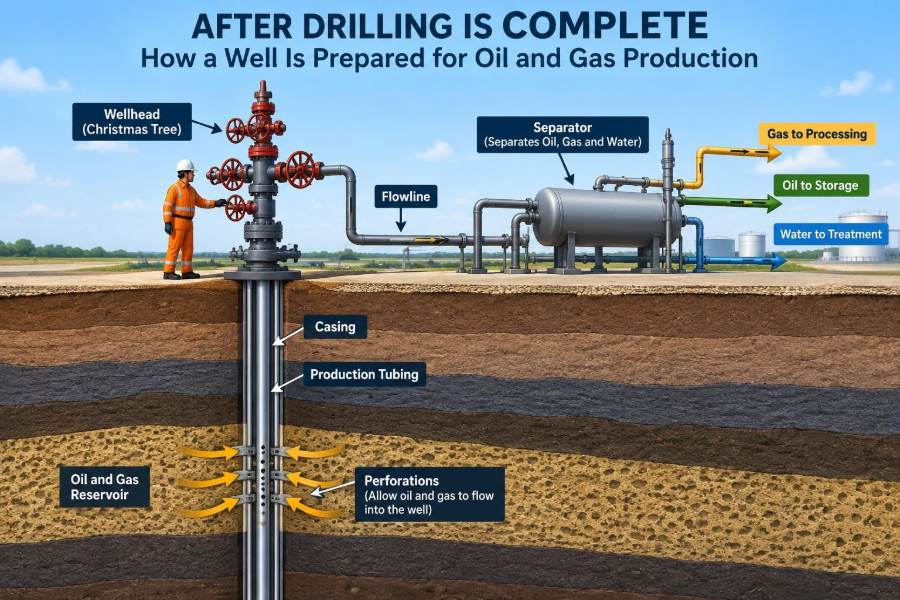
Once the required casing strings are installed, the wellhead supports and seals them at the surface. It provides pressure-containing connections between the subsurface well and the equipment above ground.
During completion operations, a blowout preventer stack or other appropriate pressure-control equipment is used. Its purpose is to close in, seal, and control the well if fluids or gas enter the wellbore unexpectedly.
🛑 Well Control Remains Active After the Rig Leaves
Well control is not only a drilling concern. Perforating, running tubing, flowing back a stimulated well, and testing can all expose personnel to pressure and hydrocarbons.
Planning considers the hydrostatic pressure of the well fluid, expected reservoir pressure, equipment ratings, flow paths, ignition control, emergency response, and the status of primary and secondary barriers. A completion is only ready to proceed when those barriers are verified for the planned operation.
🎯 Choosing the Completion Architecture
The completion architecture determines how the reservoir connects to the surface. The choice should reflect reservoir behavior rather than habit or the apparent simplicity of a familiar design.
| Completion type | Typical use | Main consideration |
|---|---|---|
| Open hole | Competent formations with suitable stability | Limited zonal selectivity |
| Cased-hole perforated | Many conventional reservoirs | Allows targeted intervals and isolation |
| Slotted liner | Some unconsolidated or open-hole settings | Can provide basic sand exclusion |
| Multistage horizontal | Long lateral reservoirs, including tight rock | Requires reliable stage access and isolation |
These categories overlap in practice. The right answer depends on formation strength, sand production risk, water or gas breakthrough risk, intervention needs, and project objectives.
🕳️ Open-Hole Completions Leave the Reservoir Exposed
In an open-hole completion, the productive formation is left without cemented casing across the producing interval. The reservoir can flow directly into the wellbore, sometimes through a liner or screen.
This can reduce perforation damage and simplify the flow path. However, it offers less control over individual zones and may be unsuitable where the borehole is unstable or fluid entry must be precisely managed.
🔫 Perforating Connects Cased Wells to the Formation
In a cased-hole completion, shaped charges create tunnels through casing, cement, and a short distance into the reservoir. These perforations provide flow paths between the formation and the wellbore.
Shot density, phasing, penetration, orientation, and underbalance or overbalance conditions affect performance. Perforating is not merely making holes in pipe: it is a designed connection between a damaged near-wellbore region and the reservoir beyond it.
🧭 Selecting Intervals Requires Reservoir Judgment
Not every hydrocarbon-bearing layer should necessarily be opened. A thin zone may have poor permeability, high water saturation, or a pressure relationship that makes it likely to produce unwanted water or gas.
Engineers combine petrophysical interpretation with pressure data, fluid contacts, production strategy, and uncertainty. In a layered reservoir, opening only the most favorable interval may initially reduce total rate but improve fluid quality and long-term control.
🧰 Tubing Creates a Serviceable Flow Path
Production tubing is smaller-diameter pipe run inside the casing. It carries produced fluids to the surface and allows the annulus outside the tubing to remain a separately managed space.
Using tubing makes many interventions easier than producing through casing. It also permits installation of safety valves, flow-control devices, and artificial-lift equipment, while protecting casing from some production-related exposure.
🔒 Packers Isolate the Tubing Annulus
A packer seals the annular space between tubing and casing, usually near the producing interval. It directs produced fluids into the tubing and can isolate pressure below from the upper annulus.
Packers must tolerate temperature, pressure, fluid chemistry, and mechanical loads. A seal that leaks can complicate pressure monitoring and may undermine the intended completion function.
🪨 Managing Sand Before It Manages the Well
Weak or unconsolidated formations can release sand grains as fluids flow into the well. Small amounts may be manageable; sustained sand production can erode valves and chokes, fill the wellbore, damage pumps, and threaten completion integrity.
Options include controlling drawdown, using screens or slotted liners, installing gravel packs, or applying chemical consolidation in selected situations. Each method trades cost and complexity against the risk of solids entering the well.
💧 Controlling Water and Gas Entry
Reservoir fluids rarely enter evenly along an interval. High-permeability streaks, fractures, or zones near a water contact may dominate flow. This can lead to early water production even when substantial oil remains elsewhere.
Mechanical isolation, selective perforation, inflow-control devices, and surveillance can help manage uneven inflow. They do not eliminate reservoir uncertainty; they give the operator more ways to respond to it.
💥 Stimulation Restores or Creates Conductivity
Some wells need stimulation because the rock near the wellbore has low permeability or was damaged by drilling and completion fluids. Matrix acidizing aims to dissolve compatible materials near the wellbore, while hydraulic fracturing creates conductive fractures held open with proppant.
Stimulation design is formation-specific. Acid can be ineffective or harmful in incompatible mineral systems, and a fracture treatment must consider stress, fluid loss, nearby intervals, and the ability to contain and produce the created fracture network.
🧩 Multistage Fracturing Opens Long Horizontal Intervals
In many tight reservoirs, a horizontal section is divided into stages. Isolation tools separate sections so each stage can be perforated and stimulated in sequence.
Stage count alone does not define quality. Cluster efficiency, fracture placement, fluid distribution, proppant transport, pressure response, and interaction with natural fractures all influence whether the treatment creates useful drainage paths.
🌊 Flowback Cleans Up the Well Carefully
After stimulation, the well is flowed back to recover some treatment fluid and allow reservoir fluids to enter. Rates and choke settings are managed to balance cleanup, pressure control, sand risk, and surface handling limits.
A rapid drawdown may help mobilize fluids but can destabilize weak formations or carry proppant and sand. A very cautious flowback may protect the completion but prolong cleanup. The appropriate plan is reservoir- and completion-dependent.
🧫 Sampling Reveals What the Well Is Actually Producing
Early samples help characterize oil, gas, water, and solids. Fluid composition affects corrosion management, separator operation, emissions handling, hydrate risk, scaling tendency, and sales specifications.
Samples must be collected and handled properly. Contamination, flashing of volatile components, or poor chain-of-custody practices can produce misleading laboratory results and flawed facility decisions.
📈 Well Testing Measures More Than Rate
A production test measures rates of oil, gas, and water under defined conditions, but pressure behavior often provides the deeper reservoir insight. Flow and shut-in data can help estimate productivity, identify boundaries, and reveal possible near-wellbore restrictions.
Test interpretation is model-based and contains uncertainty. Changing rates, multiphase flow, wellbore storage, and incomplete cleanup can obscure the reservoir response, so results should be integrated with geology and completion data.
⚙️ Artificial Lift May Be Needed Early or Later
Natural reservoir pressure does not always provide enough energy to lift fluids to surface at commercial rates. Artificial lift reduces the flowing bottomhole pressure or adds lifting energy.
- Rod pumps are common in many onshore oil wells.
- Electric submersible pumps can handle high liquid volumes when conditions are suitable.
- Gas lift injects gas to lighten the fluid column.
- Progressing cavity pumps can suit certain viscous-fluid and solids-tolerant applications.
Selection depends on depth, rate, gas content, solids, power access, deviation, temperature, and intervention strategy. No lift method is best for every well.
🏭 Surface Facilities Must Match the Well
The completion is not complete in a practical sense until produced fluids can be safely received, separated, measured, treated, stored or transported, and disposed of or reused as required.
Separators split gas from liquids; tanks or pipelines handle oil and water; gas treatment may remove water or contaminants; and produced-water systems manage a stream that can become a major operating constraint. Facility capacity can limit how aggressively a well is brought online.
📊 Establishing a Production Baseline
Once the well reaches a reasonably stable operating condition, the team establishes a baseline for rate, pressure, fluid ratio, choke setting, pump performance where applicable, and equipment condition. That baseline makes later changes easier to interpret.
A falling oil rate, rising water cut, abnormal annulus pressure, or increasing solids may have several causes. Without reliable initial data, distinguishing normal decline from a developing problem becomes much harder.
🛰️ Surveillance Turns a Completion into an Operating Asset
Routine surveillance can include wellhead and annulus pressure readings, production allocation, fluid samples, corrosion monitoring, pump diagnostics, temperature or noise logs, and periodic integrity tests. The scope should be risk-based rather than indiscriminate.
Data are valuable when they lead to decisions. For instance, a changing pressure relationship may prompt an integrity review, while an unexpected water trend may justify production logging or selective shutoff analysis.
⚠️ Common Completion Mistakes and Their Consequences
Many failures begin with assumptions that were never tested. Typical avoidable problems include:
- Opening intervals based only on a log response without considering pressure and fluid-contact uncertainty.
- Using fluids that are not adequately filtered or compatible with the formation.
- Ignoring sand risk until erosion or fill restricts production.
- Setting production targets without confirming separator, water-handling, or gas-handling capacity.
- Treating pressure anomalies as routine operating noise rather than investigating barrier integrity.
These are not guarantees of failure, and field conditions differ. They are reminders that completion performance depends on the interaction of reservoir, wellbore, equipment, and operations.
🔧 Workovers Keep the Well Adaptable
A well may later need a workover: an intervention to repair equipment, replace artificial lift, isolate water-producing intervals, clean scale, recomplete another zone, or restore access. Designing for future intervention can reduce downtime and expense.
For example, leaving an accessible flow path and selecting retrievable equipment where justified may provide flexibility. That flexibility has a cost, so it should be evaluated against the likelihood and value of future intervention.
🌱 Environmental Protection Is Designed Into Completion
Environmental performance is closely tied to sound engineering. Effective casing and cement barriers protect groundwater, closed handling systems reduce spills and vapors, and appropriate gas capture or routing reduces unnecessary releases.
Produced water, chemicals, drilling and completion wastes, and emissions all require site-specific management. Requirements vary by jurisdiction and operation, but the basic engineering principle is consistent: know the streams, contain them, measure them, and maintain the equipment that controls them.
👷 Coordination Makes Complex Operations Safer
Completion work involves operators, drilling and completion engineers, geoscientists, service companies, rig crews, production teams, and health, safety, and environmental personnel. Interfaces between teams are frequent sources of risk if responsibilities are unclear.
Clear procedures, pre-job discussions, equipment checks, permit systems, and disciplined handovers are practical controls. The most technically elegant completion can still perform poorly if the operating plan is not communicated and executed consistently.
🧠 The Core Principle: Create a Controlled Connection
Every completion decision serves one central objective: create a productive connection to the reservoir while maintaining control of pressure, fluids, and flow paths. Casing and cement isolate; perforations or open hole provide access; tubing, packers, valves, and surface facilities manage the flow.
The optimal completion is not necessarily the one with the most hardware or the highest initial rate. It is the design that fits the reservoir, maintains well integrity, supports safe operations, and leaves practical options for monitoring and intervention over the well’s life.
After drilling ends, completion is the engineering work that turns a hole in the ground into a controllable, monitorable, and productive well. Understanding that transition helps explain why successful production depends on far more than reaching the reservoir. 🛢️⚙️🌍