
An aging oil well rarely announces its next move clearly. Production may slide gradually for years, water may take a larger share of the fluid stream, and operating costs may rise just as revenue becomes less predictable. Yet a low-rate well is not automatically a dead well.
For an operator, the question is practical: should the well be reworked to restore or capture additional production, or should capital be directed to another opportunity? For engineers, the answer requires more than looking at the latest production rate.
A workover can remove a mechanical restriction, isolate an unwanted water-producing interval, change the lift system, or reconnect bypassed pay. It can also spend substantial money without changing the underlying reservoir problem.
The best decisions come from treating rework as a disciplined diagnosis-and-investment problem. The well must have a plausible technical opportunity, a safe execution path, and enough expected value to justify the uncertainty.
🧭 What “Reworking” an Oil Well Actually Means
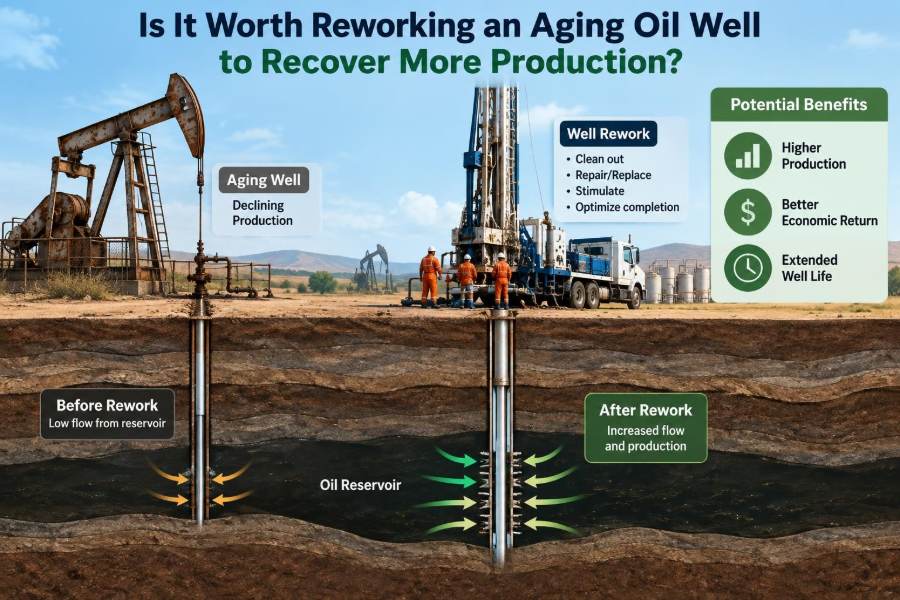
A well rework, often called a workover, is an intervention that changes the well’s completion, equipment, flow path, or access to the reservoir. It is more substantial than routine maintenance, although the boundary can vary between organizations.
Typical workovers include pulling and replacing downhole equipment, repairing tubing, reperforating an existing zone, isolating water entry, converting artificial lift, cleaning fill from the wellbore, or recompleting the well in another reservoir interval.
The aim is not simply to make the well flow harder. The aim is to remove a specific constraint between the reservoir and the sales line.
📉 Why Aging Wells Lose Production
Production decline is expected as reservoir pressure depletes and the easiest-to-produce fluids are removed. But the observed decline at the surface often combines reservoir behavior with wellbore, completion, and facility limitations.
Oil may still be present near the well, yet its movement can be restricted by scale, fines migration, damaged perforations, liquid loading, failing lift equipment, or excessive backpressure. Conversely, the well may be technically healthy while the reservoir has simply become less capable of delivering oil.
That distinction determines whether a rework can help. A workover can repair a well problem; it cannot create reservoir energy or movable oil where neither remains.
🔍 The Central Question: Is There Recoverable Value?
The right question is not “Can we perform a workover?” Nearly every mature field offers possible interventions. The better question is whether the intervention has a credible path to recovering incremental economic barrels or reducing enough operating cost to improve value.
Incremental production means output above what the well would have produced without the project. A temporary spike after restarting a shut-in well is not necessarily incremental recovery; some of that volume may merely be deferred production.
Engineers therefore compare a base-case forecast with one or more post-workover forecasts. The difference, adjusted for costs, royalties, taxes, downtime, and risk, is the project’s real contribution.
🧩 Start with a Failure Diagnosis, Not a Favorite Treatment
Many unsuccessful workovers begin with a familiar treatment chosen before the problem is defined. Acidizing a well with mechanical leakage, or installing a bigger pump in a water-flooded interval, may increase cost without fixing the limiting mechanism.
A useful diagnosis asks four linked questions:
- Is the reservoir able to deliver additional oil at the current location?
- Can fluids enter the wellbore efficiently through the completion?
- Can the wellbore lift and transport those fluids reliably?
- Can surface facilities handle the changed fluid rate and composition?
Each “no” suggests a different remedy. Several may be true at once, which is why mature-well diagnosis benefits from integrated reservoir, production, and completion expertise.
🗂️ Build a Reliable Well History
Old wells often have incomplete records, changing measurement practices, and multiple ownership periods. Before approving a major intervention, assemble the best available timeline of production, pressure, water cut, gas-oil ratio, workovers, stimulation treatments, artificial-lift changes, integrity tests, and nearby drilling activity.
Plotting these events against oil, water, and gas rates can reveal patterns that a single recent test hides. For example, a sharp water-rate increase immediately after a neighboring injector change suggests a different investigation than a slow, field-wide decline.
Missing data do not automatically stop a project, but they should widen the uncertainty range and reduce confidence in precise forecasts.
📊 Read Production Trends as Clues, Not Verdicts
Production data are among the cheapest diagnostic tools, but they need context. A falling oil rate paired with stable fluid rate may point toward rising water cut. Falling oil and total fluid rates can suggest declining inflow, inadequate lift, plugging, or restrictions.
Sudden changes deserve special attention. An abrupt loss after a pump failure, a tubing workover, or a pressure upset may identify a discrete problem that is more repairable than gradual reservoir depletion.
Test quality matters. Infrequent allocation-based rates, unstable wells, and changing choke settings can make apparent trends misleading, especially in commingled production systems.
💧 Understand Water Cut Before Chasing More Fluid
Water cut is the fraction of produced liquid that is water. High water cut does not automatically make a well uneconomic, but it raises lifting, separation, treatment, and disposal requirements while reducing the oil fraction of every barrel handled.
The source matters. Water can enter through a watered-out perforated layer, behind damaged casing, through fractures or high-permeability streaks, or through broader reservoir encroachment. A localized entry may be isolatable; pervasive reservoir water movement often is not.
A rework that raises total fluid production without controlling water can worsen operating economics. The desirable outcome is often more oil at manageable water volume, not simply a larger pump rate.
🧪 Use Fluid and Water Chemistry Carefully
Produced-water chemistry, oil properties, scale samples, and solids analysis can support diagnosis. Changes in salinity or ion composition may indicate that water is arriving from a different source, while scale deposits can explain declining tubing performance or plugged perforations.
These observations are supporting evidence rather than proof on their own. Sampling conditions, contamination, and natural reservoir variation can complicate interpretation.
Still, a representative sample can help engineers choose compatible chemicals, anticipate scaling risk after a pressure change, and distinguish a likely flow-assurance issue from a purely reservoir-driven decline.
🧱 Check Well Integrity Before Adding Energy
Mechanical integrity is fundamental. Corroded tubing, leaks, failed packers, casing damage, or poor cement isolation can create production losses and environmental or safety risks. Increasing drawdown or changing injection conditions before resolving integrity concerns can aggravate the problem.
Pressure tests, tubing and casing evaluations, temperature surveys, noise logs, and other diagnostic tools may help locate unwanted communication or leaks. The appropriate program depends on the well design and suspected failure mode.
If a repair restores containment and isolates the intended flow path, it can have value beyond added production: it may reduce produced-water handling, protect groundwater, and preserve the well’s future operating options.
🕳️ Evaluate the Completion and Perforations
Perforations form the connection between casing and reservoir rock. They can become impaired by scale, debris, fines, completion damage, or poor cleanup. Their placement also matters: opening a productive layer and opening a water-prone layer are not equivalent decisions.
Reperforating can add access to bypassed pay, but it is irreversible in the sense that it changes the well’s communication with the formation. Engineers review logs, core or offset information where available, pressure behavior, and nearby well performance before opening additional intervals.
In mature reservoirs, the “best-looking” log interval may have already depleted or watered out. Static petrophysical quality must be checked against current dynamic reservoir conditions.
🧯 Remove Near-Wellbore Damage Only When It Exists
Skin is a production-engineering concept describing extra resistance to flow near the wellbore. Positive skin may arise from drilling or completion damage, scale, fines, emulsions, or partial penetration effects. Removing genuine damage can improve productivity.
Mechanical cleanouts, solvent treatments, scale removal, acid treatments, and other stimulation approaches are selected according to the restriction and rock-fluid system. They are not interchangeable.
For example, an acid treatment may dissolve certain mineral scale or improve flow in suitable carbonate rock, but it can be ineffective against a mechanical obstruction and may require careful compatibility testing. Treatment design should follow evidence, not habit.
⚙️ Match Artificial Lift to Today’s Well Conditions
As reservoir pressure declines, many wells need artificial lift: equipment that helps bring fluids to surface. Common options include rod pumping, electric submersible pumps, gas lift, progressive cavity pumps, and hydraulic systems.
An aging well’s original lift design may no longer match its fluid rate, gas content, depth, deviation, solids tendency, or water cut. A pump that is oversized, gas-interfered, worn, or operating outside its efficient range can make a productive reservoir appear weak.
Lift optimization may be less intrusive than a full workover, but it still needs nodal analysis and realistic inflow assumptions. A larger pump cannot deliver fluid the reservoir cannot supply.
📐 Use Nodal Analysis to Locate the Bottleneck
Nodal analysis models the well as connected pressure-loss components: reservoir inflow, completion, tubing, lift equipment, choke, flowline, and separator. The operating point occurs where the reservoir’s inflow ability matches the system’s outflow requirement.
This framework helps test alternatives before mobilizing a rig. Lowering wellhead pressure, replacing tubing, changing pump speed, or reducing skin may each shift the operating point differently.
Models are only as credible as their inputs. Validate them against pressure surveys, fluid properties, recent well tests, and actual equipment performance whenever possible.
🌊 Separate Reservoir Opportunity from Wellbore Opportunity
This distinction prevents costly confusion. A wellbore opportunity exists when the reservoir can likely produce more but the completion, lift system, or flow path blocks it. A reservoir opportunity exists when untapped movable hydrocarbons remain accessible from the well.
Some projects have both. A recompletion into an undrained interval may require new perforations and a lift upgrade. Others have neither: the current interval may be depleted and no feasible mechanical change can alter that reality.
Reservoir surveillance, pressure data, maps, simulation models, and offset-well behavior are useful for judging whether the target volume is truly present.
🗺️ Look for Bypassed Pay and Untapped Intervals
Older wells may have passed through intervals that were not completed because of economics, technology, completion constraints, or limited knowledge at the time. Re-evaluating logs and integrating newer field data can reveal potential bypassed pay.
Recompletion is attractive when the target has sufficient thickness, permeability, hydrocarbon saturation, pressure support, and isolation from problematic zones. It is less attractive when uncertainty around fluid contacts or compartmentalization is high.
A hypothetical example: a well producing a watered-out lower sand may be recompleted to an upper interval identified on logs and supported by nearby production. The opportunity depends not on the log alone, but on whether the upper interval remains connected to recoverable oil and can be isolated properly.
🚰 Diagnose Unwanted Water Entry
Water-control workovers require a clear theory of where water enters and why. Production logging, temperature and noise data, pressure behavior, and completion history may help distinguish water entering through a specific perforated zone from channeling behind pipe.
Possible remedies include plugs, cement squeezes, mechanical isolation, selective reperforation, or relative-permeability modification treatments. Their suitability depends strongly on geometry and the mechanism of water movement.
Water coning or cresting, where water moves toward the well because of drawdown, may respond better to operating changes than to a permanent shutoff. If water is broadly sweeping the reservoir, local treatment may provide only limited or temporary benefit.
🔧 Common Rework Options and Their Best Fit
The following comparison is a planning aid, not a substitute for detailed design. Actual outcomes depend on reservoir conditions, well integrity, materials, and execution quality.
| Intervention | Problem it can address | Key limitation |
|---|---|---|
| Tubing or packer repair | Leaks, failed isolation, restricted flow path | Does not restore depleted reservoir pressure |
| Scale or fill cleanout | Mechanical restriction and reduced tubing capacity | Benefit can fade if the underlying deposition cause remains |
| Lift conversion or optimization | Inadequate fluid lifting or gas interference | Requires enough reservoir inflow and facility capacity |
| Reperforation or recompletion | Access to bypassed or poorly connected pay | May introduce water, gas, or crossflow risk |
| Water shutoff | Localized unwanted-water entry | Limited when water movement is reservoir-wide |
| Stimulation | Near-wellbore damage or suitable formation restriction | Can fail if damage diagnosis is wrong |
💰 Estimate the Full Cost, Not Just the Rig Invoice
Workover economics include more than the service invoice. Include planning, diagnostics, rig or intervention unit time, materials, chemicals, disposal, artificial-lift equipment, facility modifications, production downtime, contingency, and eventual abandonment implications.
Water handling is especially easy to underestimate. Additional fluid production can require pumping energy, chemical treatment, separation capacity, trucking or pipelines, and disposal or reinjection capacity.
Costs also change with logistics. Remote locations, difficult well access, sour-service requirements, and limited equipment availability can materially affect both schedule and total expenditure.
📈 Forecast Incremental Production with Ranges
A single production forecast implies more certainty than mature-well workovers deserve. A better practice is to develop low, central, and high cases based on distinct technical assumptions: repair success, post-job productivity, water behavior, decline rate, and equipment uptime.
For a pump replacement, the uncertainty may center on actual inflow and gas handling. For a recompletion, it may center on target saturation, pressure, and formation connectivity. Name the uncertainty explicitly rather than burying it in an optimistic average.
Forecasts should account for the decline that would have happened without intervention. This prevents the project from claiming ordinary base production as a workover benefit.
🧮 Apply Economic Screens Consistently
Common decision metrics include payout time, net present value, internal rate of return, and unit technical cost. The preferred metric varies by company, but each should use consistent assumptions for price, operating costs, fiscal terms, capital timing, and discounting.
A small workover can be attractive even if its peak rate is modest, particularly when it uses existing infrastructure and has short downtime. A high-rate opportunity can still disappoint if it produces mostly costly water or requires major facility upgrades.
Price assumptions should be treated as scenarios, not promises. The technical case must remain understandable even when commercial conditions change.
🎲 Make Uncertainty Visible in the Decision
Workovers involve subsurface uncertainty and operational uncertainty. The target may underperform, tools may encounter unexpected downhole conditions, or a repair may expose another failure. Ignoring these possibilities does not remove them from the economics.
Decision trees, probability-weighted cases, and sensitivity analysis can show which assumptions drive value. If the project only works at the most optimistic oil rate and lowest possible cost, it is fragile.
Risk analysis does not require false precision. Even qualitative rankings can improve decisions when teams identify the largest uncertainties, define triggers, and plan how to respond.
🦺 Put Well Control and Safety at the Center
A workover changes barriers and can expose personnel to pressure, hydrocarbons, chemicals, lifting operations, electrical equipment, and confined operational spaces. Mature wells may add complications such as degraded tubulars, unknown completion details, or sour fluids.
Barrier planning, pressure-control equipment, verified procedures, competent crews, and clear responsibilities are core project requirements. They are not paperwork to complete after the economic decision is made.
If conditions differ materially from the plan, stopping to reassess can be the safest and most economical action. A rushed response to an unexpected downhole condition can turn a marginal project into a serious incident.
🌱 Include Environmental and Closure Obligations
Reworking a well can extend productive life and make use of existing surface infrastructure, but it also carries environmental responsibilities. Produced-water volumes, chemical handling, emissions, spill prevention, waste management, and integrity protection all need consideration.
For some wells, plugging and abandonment may be the better long-term choice when integrity risks are high and no credible economic or operational role remains. Delaying closure without maintaining barriers can increase future liability.
The comparison should be fair: evaluate both the potential value of rework and the costs, risks, and timing of eventual abandonment.
🏭 Confirm Surface Facilities Can Accept the Result
A successful downhole intervention can create a surface problem if separators, water-treatment systems, pumps, flowlines, tanks, or disposal capacity cannot accommodate the new conditions. Gas handling constraints can also limit production after a lift or stimulation change.
Facility engineers should review expected peak and sustained rates, fluid properties, solids, pressure, corrosion risk, and chemical demand. The surface system may dictate a controlled ramp-up rather than an immediate full-rate restart.
Integrating facilities early avoids a common disappointment: proving more production at the wellhead but being unable to deliver it safely or economically to sale.
🛠️ Plan the Job Around Decision Gates
A good workover program includes points where new information changes the next action. For example, after pulling tubing, inspection may confirm whether a suspected leak exists; after a production log, the team may decide whether isolation is justified.
Predefined decision gates reduce improvisation while retaining flexibility. They should specify the observation, the acceptable range, the responsible decision-maker, and the action for both favorable and unfavorable outcomes.
This approach is particularly valuable in aging wells because the actual downhole condition can differ from historical records.
🧾 Set Clear Post-Job Success Criteria
“The well is flowing” is not a complete success measure. Define the expected oil rate, water-rate limit, drawdown, pump operating range, stable test duration, integrity outcome, and acceptable operating cost before the intervention begins.
Early production can be distorted by cleanup fluids, restart effects, or temporary pressure changes. A meaningful evaluation period should match the well and intervention type rather than relying on the first encouraging test.
Compare actual results with the forecast ranges, then document why differences occurred. That learning improves the next candidate selection.
📚 Learn from Both Successful and Failed Workovers
Workover portfolios improve when results are categorized by mechanism, not merely by whether the project made money. A scale-cleanout campaign may show strong results in wells with a particular water chemistry and weak results elsewhere. That pattern is actionable.
Capture diagnostic evidence, final equipment condition, treatment volumes, pressures, production response, water behavior, downtime, and deviations from plan. Standardized post-job reviews turn individual interventions into field knowledge.
Failure is not always poor execution. Sometimes it reveals that the reservoir model or completion understanding was incomplete, which is valuable if the lesson is retained.
⚠️ Common Mistakes That Destroy Workover Value
Several recurring errors make marginal projects worse:
- Treating a rate decline as proof of damage: depletion may be the true cause.
- Using old production data without quality checks: allocation errors can misidentify the candidate.
- Focusing on gross fluid rate: higher water handling can erase oil-value gains.
- Ignoring integrity: a lift upgrade cannot solve a leaking completion.
- Forecasting only a best case: this hides the downside that management must understand.
- Skipping facility review: bottlenecks may prevent realization of the forecast.
The common thread is a weak connection between diagnosis, design, and economics.
🔄 Compare Rework with Alternatives
A workover competes for capital and attention. Alternatives may include optimization of existing lift, chemical treatment without a rig, flowline debottlenecking, a sidetrack, drilling a new well, converting the well for injection or monitoring, or plugging it.
Rework is often attractive because it uses an existing wellbore and established infrastructure. But existing wells also bring uncertain integrity and constrained geometry. A new well may offer better reservoir placement, while a sidetrack may access reserves that a vertical recompletion cannot reach.
The right comparison is not “workover versus doing nothing.” It is “which available action creates the best risk-adjusted outcome for the asset?”
👥 Make Candidate Selection a Cross-Disciplinary Review
Reservoir engineers assess remaining opportunity and pressure support. Production engineers evaluate inflow, lift, and system constraints. Completion and well-integrity specialists assess mechanical feasibility, while operations and facility teams identify execution and handling limits.
Commercial, environmental, and safety input should enter early enough to change the plan, not merely approve it at the end. A short, focused candidate review can expose conflicting assumptions before they become expensive field surprises.
For students, this is an important lesson: workover decisions are a practical example of petroleum engineering as a team discipline.
✅ A Practical Decision Framework for Aging Wells
A disciplined sequence keeps the analysis proportional to project size:
- Verify production data, well status, and integrity history.
- Define the likely limiting mechanism and competing explanations.
- Gather the minimum diagnostics needed to discriminate among them.
- Design technically feasible intervention options.
- Forecast incremental oil, water, gas, downtime, and operating cost in ranges.
- Screen economics under transparent commercial assumptions.
- Review safety, environmental, facilities, and abandonment implications.
- Execute with decision gates and measure the actual response.
This sequence does not guarantee a successful well. It ensures that the decision is based on evidence and that the organization learns from the result.
🏁 The Core Principle: Rework the Constraint, Not the Symptom
An aging oil well is worth reworking when there is a technically credible, safely executable way to remove a constraint or reach recoverable hydrocarbons, and when the expected risk-adjusted value exceeds the alternatives. Low production alone is not enough.
The strongest candidates have a coherent story: reliable data indicate a specific failure or bypassed opportunity; diagnostics support that interpretation; the selected treatment directly addresses it; facilities can handle the outcome; and economics remain reasonable across more than one scenario.
Equally, choosing not to rework can be sound engineering. When depletion, broad water encroachment, integrity risk, or weak economics dominate, capital may be better spent elsewhere or directed toward responsible closure.
A workover earns its place when it solves the real bottleneck and creates durable value—not when it merely creates a brief increase in activity. 🛢️🔧📈