
A discovery well can make headlines, but finding oil or gas is only the beginning. A reservoir may contain hydrocarbons and still never become a producing field. The fluids may be too viscous, the rock too tight, the water too aggressive, the location too remote, or the project economics too weak.
That gap between “we found something” and “we are producing safely and reliably” is where petroleum engineers spend much of their working lives. Their job is not simply to make a well flow. It is to make disciplined decisions about a complex underground resource over years or decades.
They work with geoscientists, drilling teams, facilities engineers, economists, environmental specialists, operators, regulators, and service companies. Much of the work happens through data, models, designs, meetings, and operating decisions rather than beside a dramatic oil rig.
Understanding what happens after discovery helps students see the profession more clearly and helps working professionals place their own specialty in the larger field-development picture.
🧭 From Discovery to Development Decision
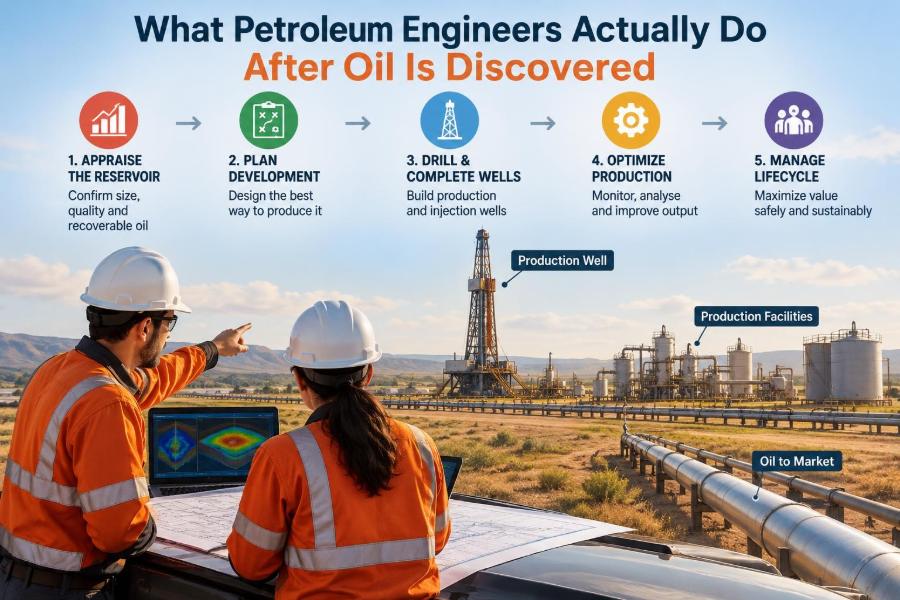
A discovery confirms that a well encountered hydrocarbons, but it does not fully define the reservoir. Engineers first ask whether the accumulation can produce at commercial rates and whether the expected value justifies the capital, operating cost, and risk.
This early stage is called appraisal. Additional wells, pressure measurements, fluid samples, seismic interpretation, and production tests may be used to reduce uncertainty before a company commits to full development.
🪨 Understanding the Rock That Holds the Fluids
Oil and gas are stored in pore spaces within rock, not in large underground caverns. Petroleum engineers need to understand porosity, which is the amount of pore space, and permeability, which describes how easily fluids can move through connected pores.
A reservoir with high porosity can hold a substantial fluid volume but still produce poorly if permeability is low. Natural fractures, thin layers, faults, and changes in rock quality can further complicate flow.
🧪 Defining the Reservoir Fluids
Hydrocarbons behave differently depending on pressure, temperature, and composition. Engineers analyze whether a reservoir contains dry gas, gas condensate, volatile oil, conventional black oil, heavy oil, or a mixture with challenging impurities.
They also examine produced water and gases such as carbon dioxide or hydrogen sulfide. These fluids affect safety systems, corrosion control, separation equipment, pipeline design, and the eventual method selected to recover hydrocarbons.
📊 Estimating What Can Actually Be Recovered
Oil in place is not the same as recoverable oil. Some hydrocarbon remains trapped by capillary forces, bypassed in low-permeability zones, or becomes uneconomic to produce as water handling and operating costs rise.
Engineers estimate recoverable volumes using geological models, well data, laboratory measurements, material-balance calculations, and reservoir simulation. These estimates are ranges, not promises, because the subsurface cannot be observed directly everywhere.
🔍 Reducing the Biggest Uncertainties First
Good appraisal programs target decisions, not data collection for its own sake. If a fault may divide the reservoir into separate pressure compartments, a strategically placed appraisal well can be more useful than another well near the discovery.
Typical uncertainties include reservoir boundaries, fluid contacts, rock continuity, productivity, pressure support, and the performance of completion methods. Engineers rank these uncertainties by their potential effect on value and choose the most useful way to reduce them.
🧠 Building a Reservoir Model
A reservoir model combines geological interpretation with engineering data. It represents rock layers, faults, fluid regions, pressure behavior, and flow properties in a form that can be analyzed and updated.
Models are useful because they force assumptions into the open. They are not exact underground replicas. A strong engineering team compares model predictions against new pressure, production, and surveillance data, then revises the model when reality disagrees.
💻 Simulating Years of Production
Reservoir simulation uses numerical calculations to estimate how fluids may move as wells produce and inject. Engineers test alternative well locations, production rates, injection strategies, facility constraints, and abandonment timing.
For example, a simulated waterflood may show that an injector placed too close to a producer causes early water breakthrough. Moving the well pattern could improve sweep, but it may also require more drilling and surface infrastructure. Simulation helps expose these trade-offs before money is spent.
🧱 Choosing a Development Concept
Once an opportunity looks viable, engineers help select the broad development concept. An onshore field might use a central processing facility and flowlines; an offshore field might need a fixed platform, floating production system, subsea wells, or a tieback to existing facilities.
The best concept depends on water depth, reservoir size, export routes, weather, available power, drilling access, emissions requirements, and future expansion options. A technically elegant plan can still fail if it cannot be built, operated, or maintained realistically.
📍 Deciding Where Wells Should Go
Well placement is a reservoir-management decision as much as a geological one. Engineers seek locations that contact productive rock, drain hydrocarbons efficiently, avoid unwanted water or gas, and fit the available drilling geometry.
Horizontal wells can expose far more reservoir length than vertical wells, which can be valuable in thin formations or low-permeability rock. Yet longer wells also bring drilling, completion, cleanup, and intervention challenges. More reservoir contact is not automatically better.
🛠️ Designing the Well Completion
Drilling creates a borehole; completion makes that borehole ready to produce or inject. The design may include casing, cement, perforations, sand-control equipment, valves, packers, and production tubing.
Completion choices must match the reservoir and expected operating conditions. A weak formation may produce sand, while a long horizontal well may need tools that distribute flow or allow selective control along the wellbore.
🌊 Managing Water From the Start
Most oil and gas fields produce water at some stage, and many produce large water volumes later in life. Water may come from the reservoir, from injected water, or from nearby aquifers connected to the producing interval.
Engineers plan for separation, treatment, reuse, reinjection, or disposal. Water can limit production because pumps, separators, pipelines, and disposal systems all have finite capacity. Ignoring water handling during design can turn a productive reservoir into a constrained asset.
💨 Using Natural Reservoir Energy Wisely
At first, a reservoir may produce because natural pressure pushes fluids toward wells. This pressure can come from dissolved gas, a gas cap, water influx, rock expansion, or combinations of these mechanisms.
Production rate matters. Pulling fluids too aggressively can cause pressure to decline rapidly, release gas in ways that reduce oil mobility, draw water toward wells, or damage near-well flow capacity. Engineers set operating strategies to balance early output with longer-term recovery.
🔄 Planning Pressure Maintenance and Injection
When natural energy is insufficient, engineers may inject water or gas to maintain pressure and displace hydrocarbons. Water injection, often called a waterflood, is common but requires compatible water, reliable injection wells, surveillance, and careful management of breakthrough.
Injection is not a simple act of “pushing oil out.” Fluids follow paths of least resistance. Reservoir layering, fractures, and mobility differences can cause injected fluid to bypass oil, so patterns and rates must be monitored and adjusted.
🧬 Considering Enhanced Oil Recovery
Enhanced oil recovery, or EOR, aims to change conditions that leave oil behind after primary production or conventional waterflooding. Depending on the reservoir, options can include thermal methods, gas injection, chemical flooding, or other specialized approaches.
These methods can be technically demanding and are not universal solutions. They depend on fluid properties, rock behavior, available injectants, facilities, energy use, economics, and operational capability. A pilot test may be needed before a full-field decision.
🏭 Connecting Wells to Surface Facilities
Reservoir performance and facilities performance are tightly linked. Produced fluids reach separators, where oil, gas, water, and solids are handled differently before sale, treatment, reinjection, storage, or export.
Petroleum engineers work with process and facilities teams to define expected rates, pressure, fluid composition, water cut, and operating envelopes. If a facility cannot handle gas or water at the anticipated rate, the wells may have to be choked back even when the reservoir could produce more.
📈 Forecasting Production Without Pretending Certainty
Production forecasts support budgets, equipment sizing, reserves reporting, commercial agreements, and field plans. They combine reservoir behavior with well performance, downtime expectations, operating constraints, and planned interventions.
Responsible forecasts show uncertainty. A low, central, and high case can be more useful than one polished curve because it reveals what decisions are sensitive to reservoir quality, well productivity, commodity conditions, or project execution.
💰 Testing Economics and Value
Engineering recommendations must work economically as well as technically. Teams compare expected revenue with drilling, completion, facilities, transport, operating, abandonment, and risk-management costs.
A larger development is not always the better one. Extra wells may accelerate production but add capital; a smaller initial project may preserve flexibility but lose scale advantages. Economic evaluation helps teams understand the consequences of these choices rather than treating them as purely technical preferences.
🦺 Designing for Process and Well Safety
Petroleum engineering decisions have safety consequences. High pressures, flammable hydrocarbons, toxic gases, rotating equipment, lifting operations, and remote worksites require robust barriers and disciplined operating procedures.
Engineers help define safe pressure limits, well-control requirements, emergency shutdown logic, isolation needs, and operating envelopes. They also participate in hazard reviews, where teams identify credible failure scenarios and consider prevention, detection, and response measures.
🌱 Managing Environmental Responsibilities
Field development can affect land, water, air, ecosystems, and nearby communities. The specific risks vary by location and project design, but they may include spills, emissions, water use, waste, noise, habitat disturbance, and eventual decommissioning.
Petroleum engineers contribute by reducing unnecessary flaring, designing containment and monitoring systems, minimizing well pads or flowlines where practical, managing produced water responsibly, and planning closure obligations early rather than leaving them for the end.
📏 Working Within Regulations and Permits
Projects operate under laws, permits, technical requirements, and reporting obligations that differ across jurisdictions. These may govern well construction, emissions, water management, worker protection, land access, production allocation, and abandonment.
Engineers do not replace legal or regulatory specialists, but their designs must be feasible within the applicable framework. A technically sound plan that overlooks permit timing or compliance conditions can face costly delay or redesign.
🛰️ Watching the Field Through Surveillance
After start-up, engineers do not simply wait for monthly production reports. They use surveillance: pressure surveys, production tests, fluid samples, well logs, temperature data, injection records, and other measurements that reveal reservoir and well behavior.
Think of surveillance as checking a patient’s vital signs rather than judging health from one symptom. A falling oil rate may reflect reservoir depletion, water encroachment, scale buildup, a failing pump, a facility restriction, or inaccurate allocation data. Diagnosis comes before treatment.
🧰 Diagnosing Underperforming Wells
When a well misses expectations, the cause may lie in the reservoir, completion, wellbore, artificial-lift equipment, flowline, or surface facility. Engineers combine pressure behavior, production trends, mechanical information, and comparison with nearby wells to narrow the possibilities.
Possible interventions include cleaning deposits, changing a pump, isolating a water-producing interval, reperforating a better zone, stimulating the formation, or modifying the choke. Every intervention has cost, safety, and downside risk, so the expected gain must justify the operation.
⚙️ Keeping Wells Flowing With Artificial Lift
As reservoir pressure falls, many wells need help lifting fluids to the surface. Common artificial-lift systems include rod pumps, electric submersible pumps, gas lift, progressive cavity pumps, and hydraulic systems.
Selection depends on fluid viscosity, gas content, depth, deviation, solids, power availability, expected rate, and maintenance access. A pump that looks ideal on a spreadsheet may be a poor choice if it cannot tolerate the field’s gas, sand, or frequent power interruptions.
🧱 Protecting Equipment From Corrosion and Scale
Produced fluids can corrode steel or deposit minerals known as scale. These problems can restrict flow, damage tubing and pipelines, impair valves, and increase the frequency of costly interventions.
Engineers and integrity specialists assess fluid chemistry and operating conditions, then may use material selection, chemical treatment, coatings, corrosion monitoring, scale inhibitors, or cleaning programs. Prevention is usually easier than recovering production after a restriction becomes severe.
🤝 Coordinating a Multidisciplinary Team
Petroleum engineers rarely work alone. Reservoir engineers may estimate flow and recovery; production engineers focus on wells and operations; drilling and completion engineers deliver wellbores; facilities engineers handle processing and transport; geoscientists refine the subsurface interpretation.
Useful collaboration means translating assumptions across disciplines. A reservoir plan may require injector rates that facilities cannot deliver, or a drilling plan may miss the intended reservoir target. Regular technical alignment prevents isolated optimizations from harming the full project.
🗓️ Managing the Field Across Its Life Cycle
A field changes from appraisal to development, ramp-up, plateau, decline, late-life operations, and abandonment. The best decision at one stage may not be best later. Early on, flexibility and learning may matter most; late in life, reliability, water handling, and cost discipline often become dominant.
Engineers update plans as new evidence arrives. This is called reservoir management: continuously comparing what was expected with what is observed, then changing wells, rates, injection, facilities, or investment priorities accordingly.
♻️ Planning Decommissioning Before the End
Wells eventually reach the end of their useful life. Plugging and abandonment isolates underground zones, while surface equipment, pipelines, and sites may be removed, repurposed, or monitored according to applicable requirements and project plans.
Late-life decisions should consider abandonment early. Deferring integrity work or leaving unclear ownership of old infrastructure can increase future risk and cost. Responsible engineering includes planning the full life cycle, not only the production phase.
📚 Skills Students Should Build
Students entering petroleum engineering benefit from strong foundations in fluid flow, thermodynamics, geology, drilling, production systems, statistics, economics, and safety. Just as valuable are communication skills: engineers must explain uncertainty, defend assumptions, and listen to operators who understand daily equipment behavior.
- Learn to work with imperfect data rather than waiting for complete certainty.
- Practice spreadsheet, coding, visualization, and data-quality skills.
- Understand the difference between a model result and a verified field observation.
- Build the habit of asking what could fail, what evidence is missing, and who will operate the design.
⚠️ Common Misunderstandings About the Job
One misconception is that petroleum engineers only maximize production. In practice, they balance recovery, safety, equipment limits, environmental performance, cost, and long-term reservoir value. Producing faster can sometimes reduce total value or create avoidable operating problems.
Another is that software supplies the answer. Software accelerates calculations, but every model rests on inputs and assumptions. The engineer’s judgment is needed to check data quality, challenge unrealistic outputs, and decide what uncertainty means for action.
🧩 The Core Principle After Discovery
After oil or gas is discovered, petroleum engineering becomes a long process of converting uncertain subsurface information into safe, practical, and economically defensible decisions. The work connects the reservoir, the well, the facility, the environment, and the people who operate the asset.
The central question is not merely “Can this well produce?” It is “How can this resource be developed and managed responsibly over time, given what is known, what remains uncertain, and what constraints the project must respect?”
Petroleum engineers turn a discovery into a managed energy project by continually learning from the reservoir and making better decisions as the field evolves. That is the real work after the announcement fades. 🛢️📈🌍