
A production engineer notices that water cut has risen in one well, while a nearby producer is delivering less oil than expected. The first instinct may be to choke back the wet well, adjust lift gas, or schedule an intervention. Each option costs time, money, and potentially recoverable reserves.
The difficult part is that the reservoir cannot be seen directly. Engineers infer its behavior from pressure readings, rates, fluid samples, well tests, seismic interpretation, and many incomplete measurements. A decision that looks sensible at the wellhead can unintentionally accelerate water breakthrough, reduce sweep efficiency, or shift problems to another part of the field.
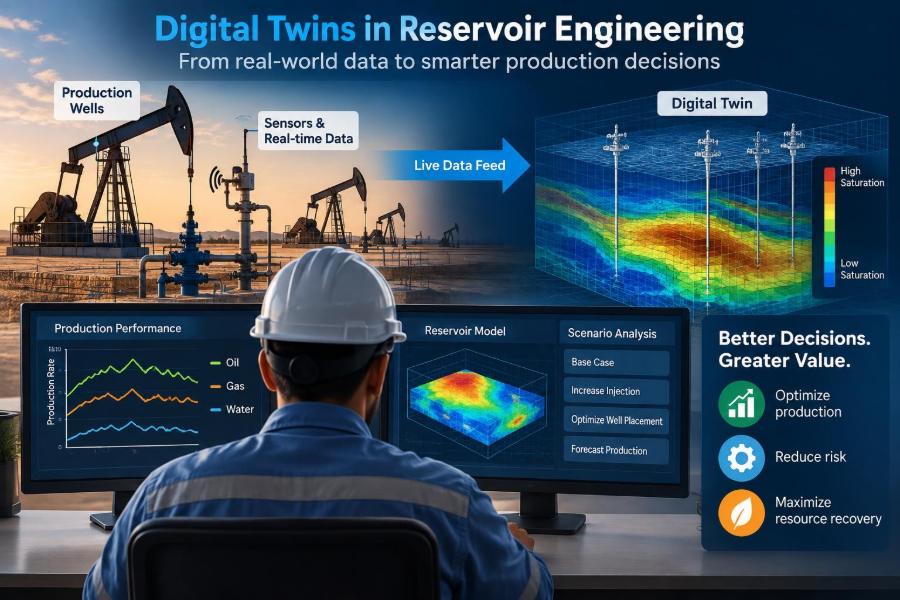
Digital twins are changing how teams approach this uncertainty. Rather than treating subsurface models, well surveillance, and facility data as separate sources of information, a digital twin connects them into a living decision environment.
For reservoir engineering, the promise is not a machine that “knows” the future. It is a disciplined way to update understanding, test choices before deploying them, and make production decisions with clearer assumptions and faster feedback.
🧭 What a Reservoir Digital Twin Actually Is
A reservoir digital twin is a digital representation of a reservoir and its production system that is regularly updated with operational and surveillance data. It combines geological interpretation, petrophysical properties, fluid behavior, dynamic reservoir simulation, wells, and often surface-network constraints.
The word “twin” can be misleading. It is not a perfect copy of the underground field. It is a set of connected models and workflows designed to represent the decisions that matter, along with the uncertainty around them.
🧩 More Than a Static Reservoir Model
A conventional reservoir model may be updated during a formal history-matching cycle or before a development plan. A digital twin aims for a more continuous loop: observe field behavior, compare it with model behavior, investigate the difference, update the model or assumptions, and evaluate actions.
This distinction matters because reservoirs evolve. Pressure depletes, contacts move, injectors influence producers, completion performance changes, and facilities impose new limits. A useful twin keeps pace with those changes rather than becoming an archived study.
📚 The Layers Inside the Twin
Most field twins contain multiple linked layers, each answering a different question. The value comes from preserving the connections between them.
- Static model: structure, faults, facies, porosity, permeability, saturation, and net-to-gross distribution.
- Dynamic model: pressure, fluid flow, relative permeability, aquifer support, and recovery mechanisms over time.
- Well model: completion intervals, inflow performance, artificial lift, tubing, chokes, and intervention status.
- Surface model: gathering lines, separators, compression, water handling, and operating constraints.
- Data layer: production rates, pressures, logs, well tests, tracer results, and maintenance records.
Not every asset needs all layers at high fidelity. The right scope depends on the decision being supported.
🔄 The Closed-Loop Decision Cycle
A practical twin follows a closed loop. Measurements from the field are checked, interpreted, and assimilated into models. The updated models generate forecasts or scenarios, which support an operating choice. Subsequent data then reveal whether the expected response occurred.
This is closer to navigation than to drafting a map once. A map is useful, but a navigator also needs current position, traffic conditions, route options, and an ability to revise the route when reality disagrees.
📡 Why Real-Time Data Alone Is Not a Twin
Dashboards can display live production rates, pressures, alarms, and facility status. They are valuable, but they do not automatically explain why behavior is changing or what a different operating strategy will do next.
A twin adds physics and context. It relates a falling oil rate to possible causes such as drawdown, increasing water saturation, scale, gas interference, changing lift performance, or pressure communication. Data visibility is the starting point; decision-grade interpretation is the harder task.
🧪 Data Quality Sets the Ceiling
Models cannot recover information that was never measured reliably. Allocation errors, inconsistent well status codes, drifting gauges, incorrect fluid properties, and missing shut-in pressures can produce a highly polished but misleading twin.
Before sophisticated analytics, teams need basic data discipline: clear ownership, timestamps, units, measurement provenance, validation rules, and documented changes to wells and facilities. A suspicious value should be flagged rather than silently treated as truth.
🗺️ Reconciling Static and Dynamic Uncertainty
Geological uncertainty concerns what is in the ground: fault sealing, channel continuity, permeability distribution, contacts, and compartmentalization. Dynamic uncertainty concerns how that system behaves under production: connectivity, aquifer strength, relative permeability, and well productivity.
A digital twin should not hide these uncertainties behind one “best” model. It should retain plausible alternatives where they would lead to different decisions. For example, whether an injector is connected to a producer may determine whether additional injection improves sweep or simply raises early water-production risk.
⚙️ History Matching as Learning, Not Curve Fitting
History matching adjusts model inputs so simulated pressures, rates, water cuts, gas-oil ratios, and other observations resemble historical field behavior. A good match builds confidence that the model captures influential mechanisms.
A bad match can still look impressive on a chart. If an engineer changes permeability, skin, aquifer size, and relative permeability freely until every line overlays the data, the model may lose geological credibility and predictive value. The goal is a defensible explanation, not a visually perfect fit.
🧠 Combining Physics With Analytics
Machine-learning methods can find patterns in large operational datasets, detect anomalies, estimate soft sensors, or accelerate repetitive calculations. Physics-based models describe mass balance, flow through porous media, pressure losses, and thermodynamic constraints.
The strongest workflows often combine both. Analytics may identify wells whose behavior departs from peers, while reservoir and production models test physically plausible explanations. This hybrid approach reduces the risk of treating correlation as a reservoir mechanism.
🛢️ Improving Well and Choke Decisions
Choke changes alter drawdown, fluid velocity, bottomhole pressure, and interactions with the surface network. Increasing a choke may raise short-term oil rate, but in a weakly supported reservoir it can also increase gas liberation, promote water or gas coning, or reduce long-term recovery.
A twin lets engineers compare operating cases before changing a set point. It can assess not only one well’s response but also effects on separator capacity, neighboring wells, injection balance, and cumulative production.
💧 Managing Waterflood Performance
Water injection is intended to maintain pressure and displace oil, but injection efficiency depends on connectivity and heterogeneity. High-permeability streaks, fractures, thief zones, and poorly aligned patterns can send water quickly to producers while bypassing oil.
By integrating injector pressures, rates, falloff tests, produced-water trends, tracers where available, and production history, a twin helps teams identify where water is likely moving. That supports decisions on rate redistribution, conformance work, pattern balancing, or surveillance priorities.
🌊 Understanding Water Breakthrough
Water breakthrough is not one diagnosis. It may arise from edge-water encroachment, bottom-water coning, fracture-assisted flow, channeling between injector and producer, behind-casing communication, or a completion problem.
A twin is useful because it forces competing explanations to be tested against several observations. A sudden rise in water cut with little reservoir pressure change may point to a different mechanism than a gradual water increase across several wells near a moving contact.
🔥 Managing Gas and GOR Changes
Rising gas-oil ratio can indicate gas-cap encroachment, gas coning, pressure falling below bubble point, changing separator conditions, or a wellbore and artificial-lift issue. The operational response differs in each case.
Connecting reservoir fluid behavior with well and facility models helps avoid simplistic answers. Restricting a well may be appropriate in one setting, while restoring pressure support or revisiting completion strategy may be more relevant in another.
🏭 Linking Reservoir and Surface Constraints
Reservoir optimization is incomplete if it ignores the production system. A well with strong subsurface potential may be limited by flowline pressure, compressor availability, separator capacity, water disposal, wax risk, or gas-handling restrictions.
Integrated asset models connect the reservoir to wells and surface facilities. They allow teams to ask a more useful question: which combination of well settings and facility conditions maximizes value while remaining operable and within constraints?
🔍 Surveillance Becomes More Targeted
Surveillance budgets are finite. Pressure surveys, production logs, interference tests, fluid sampling, and repeat logging should be selected because they reduce a decision-critical uncertainty, not simply because they are customary.
For example, if two reservoir interpretations recommend opposite injector actions, an interference or pressure-transient test may be worth more than another routine data collection campaign. The twin helps rank measurements by their potential to change a decision.
📈 Forecasts Should Include Ranges
A single production forecast can encourage false confidence. Reservoir forecasts depend on uncertain rock properties, fluid models, operating conditions, uptime, facility capacity, and future interventions.
Better twin workflows use scenarios or ensembles of plausible models. Decision makers can then see whether an option performs well across many outcomes, only under optimistic assumptions, or mainly as protection against a downside case.
🎯 Decision Metrics Must Match the Question
“Maximize oil rate” is not always the right objective. A mature field may prioritize water-handling limits, pressure maintenance, stable facilities operation, emissions intensity, cumulative recovery, or cash-efficient intervention sequencing.
Define the metric before optimizing. If the actual constraint is produced-water capacity, a recommendation based only on gross liquid rate can send the field in the wrong direction.
🧱 A Hypothetical Mature-Field Example
Consider a hypothetical waterflood with three producers showing rising water cut. A rate-only dashboard suggests choking back the wettest producer. The twin indicates that this well is receiving strong injector support and that reducing it would redirect injected water toward a nearby producer with limited water-handling capacity.
Scenario testing instead suggests a modest injector-rate redistribution, a controlled choke adjustment on a different well, and pressure surveillance to confirm the assumed connectivity. This is not a guarantee of outcome; it illustrates how integrated reasoning can reveal trade-offs hidden in isolated data.
⏱️ Faster Decisions Do Not Mean Instant Decisions
Automation can shorten the time between data arrival and model update, especially for routine screening. But speed should not remove engineering review. Unusual behavior may reflect a sensor fault, a change in allocation, a workover, or a physical event outside the model’s assumptions.
The practical aim is to automate repetitive checks and preserve human attention for interpretation, exceptions, and high-consequence decisions.
👥 Collaboration Is a Technical Requirement
Reservoir engineers, production engineers, geoscientists, petrophysicists, flow-assurance specialists, facility engineers, and data professionals each hold part of the explanation. A twin fails when it becomes a tool owned by one discipline and treated as a black box by others.
Shared review sessions are often more valuable than an elaborate interface. They expose assumption conflicts early: whether a water increase is subsurface channeling or a mechanical issue, whether a constraint is real, and which measurement can resolve the disagreement.
🧰 Choosing the Right Model Fidelity
Higher resolution is not automatically better. A fine-grid full-field simulation can represent complex geology, but it may be slow to update or difficult to use for frequent optimization. A simpler proxy or sector model may answer an operational question faster.
| Decision need | Often suitable approach | Main caution |
|---|---|---|
| Daily operating screen | Data checks, well and network models | Do not infer reservoir causality from rates alone |
| Injection redistribution | Calibrated sector or full-field dynamic model | Test connectivity uncertainty |
| Development planning | Full-field ensemble forecasts | Include facility and execution limits |
Fit-for-purpose modeling is a core engineering judgment, not a compromise.
⚠️ Common Failure: Treating the Twin as a Product
Software implementation alone does not create a digital twin. A field can have dashboards, cloud storage, automated workflows, and advanced visualization without a reliable decision process.
The twin is better understood as a capability: governed data, connected models, agreed workflows, calibration, uncertainty management, and people who use the output to make and review decisions.
🚫 Common Failure: Automating Bad Assumptions
Automation makes an assumption repeatable; it does not make it correct. A workflow can quickly distribute production, calculate a forecast, and recommend an action based on outdated PVT data, an invalid well model, or a static connectivity assumption.
Teams should make assumptions visible, version models, retain change logs, and define triggers for revalidation. When the field departs materially from expected behavior, the response should be investigation rather than blind continuation.
🔐 Data Governance and Cybersecurity
Because twins connect operational technology, engineering databases, and business systems, access control matters. Incorrect inputs, accidental configuration changes, or unauthorized access can affect both decisions and operations.
Good practice includes role-based access, validated data pipelines, audit trails, backup procedures, and separation between advisory analytics and direct control systems. Recommendations should be reviewed through established operating and safety processes.
🦺 Safety and Operating Limits Remain Outside Optimization
A model may identify a high-rate operating case, but it cannot override well-integrity limits, pressure ratings, sand-production risk, chemical constraints, permit conditions, or safe operating envelopes. These are hard constraints, not optimization inconveniences.
Engineers should encode known limits where possible and ensure that recommendations pass normal management-of-change and operational review. A twin improves decisions only when it is embedded in responsible field practice.
📏 How to Measure Whether It Is Helping
The success of a twin should be assessed by decision quality, not by the number of connected tags or screens. Useful indicators include shorter time to investigate deviations, fewer unexplained forecast misses, better prioritization of surveillance, more traceable assumptions, and clearer post-action learning.
Production improvements may occur, but they must be interpreted carefully. Commodity conditions, workovers, facility outages, and reservoir variation can affect results. The clearest evidence is often a documented chain from uncertainty, to test, to decision, to observed response.
🎓 Skills Engineers Need to Build
Reservoir fundamentals remain central: material balance, multiphase flow, PVT behavior, relative permeability, pressure-transient interpretation, uncertainty, and simulation. Digital tools increase the reach of those fundamentals; they do not replace them.
Engineers also benefit from data literacy: understanding data lineage, basic scripting or automation logic, visualization, model versioning, and the limits of machine-learning outputs. Most importantly, they need to communicate assumptions in language that operations teams can act on.
🪜 A Sensible Implementation Path
Start with a decision that recurs and has measurable consequences, such as injector allocation, well-choke management, artificial-lift optimization, or water-handling prioritization. Define the current workflow, data needed, responsible roles, and decision cadence.
- Clean and validate the minimum necessary data.
- Connect existing models before building unnecessary new ones.
- Calibrate against historical behavior and document uncertainty.
- Run the twin alongside current practice and compare recommendations.
- Expand only after users trust the outputs and feedback loop.
A narrow, adopted workflow is more valuable than a grand system that no one uses.
🌐 Where Digital Twins Are Heading
Future field twins will likely become more connected, faster to update, and more capable of combining subsurface, wells, facilities, emissions, and maintenance information. Proxy models may make scenario screening quicker, while improved sensors can reduce blind spots in selected applications.
Yet reservoirs will remain uncertain and partially observable. The enduring role of the engineer is to decide which discrepancies matter, what evidence is credible, and when an apparently optimal recommendation conflicts with physical judgment or operational reality.
✅ The Core Principle for Better Production Decisions
Digital twins improve reservoir engineering when they create a reliable conversation between field measurements, physical understanding, and operational choices. Their purpose is not to eliminate uncertainty; it is to make uncertainty explicit and manageable.
The strongest twin is therefore not the most visually impressive model. It is the one that helps a multidisciplinary team ask better questions, test realistic alternatives, respect constraints, and learn promptly from what the reservoir does next.
A digital twin earns its value when it turns scattered field data into transparent, testable production decisions—not when it merely makes complexity look sophisticated. 🛢️📊⚙️