
A drilling team may begin at a single well pad onshore, yet the reservoir target could sit several kilometres away beneath a town, a wetland, or an offshore platform. Drilling straight down would miss the target entirely—or require a new surface location that is impractical, expensive, or restricted.
That is where directional drilling changes the development plan. By deliberately steering the wellbore away from vertical, engineers can reach subsurface locations that cannot be accessed efficiently from directly above.
The technique is central to modern petroleum engineering, but it is not simply a matter of “turning the bit.” The well must be designed around geology, pressure, torque, fluid flow, completion requirements, and the limits of drilling equipment.
In complex reservoirs and offshore fields, directional drilling often determines whether hydrocarbons can be reached safely and economically—or whether valuable resources remain inaccessible.
🧭 What directional drilling actually means
Directional drilling is the intentional control of a wellbore’s trajectory in three dimensions. Instead of remaining vertical, the well can build inclination, change azimuth, hold a planned angle, or enter a near-horizontal section through the reservoir.
Inclination is the angle measured from vertical. Azimuth describes compass direction. Together with measured depth and position surveys, these variables define where the bit is underground, not merely how far it has travelled from the rig floor.
A directional well may be gently deviated, highly inclined, horizontal, or extended-reach. The correct profile depends on the target, rock properties, drilling risks, and surface constraints.
📐 Why a vertical well is not always enough
A vertical well intersects only a limited thickness of reservoir. In a thin, laterally extensive sandstone or carbonate layer, that intersection can be short. A horizontal well can remain within the productive interval for a much longer distance.
Vertical access also assumes the rig can stand above the target. This is often false in offshore developments, environmentally sensitive locations, congested facilities, and reservoirs beneath cities, coastlines, or water bodies.
Directional drilling therefore solves two different problems: it creates surface-to-target separation, and it can increase contact between the wellbore and a productive formation.
🗺️ The basic language of well trajectory
Engineers describe directional paths using a planned trajectory and frequent surveys. A common profile includes a vertical section, a kickoff point where deviation starts, a build section, and a tangent or lateral section.
Two measures are especially useful:
- Build rate: how quickly inclination increases over a specified drilled interval.
- Dogleg severity: the combined rate of directional change, including both inclination and azimuth changes.
A high dogleg may be needed to reach a target, but it also increases mechanical difficulty. The best trajectory is not necessarily the shortest geometric line; it is the line that can be drilled, cased, completed, and produced reliably.
🎯 Reaching targets beneath inaccessible surface areas
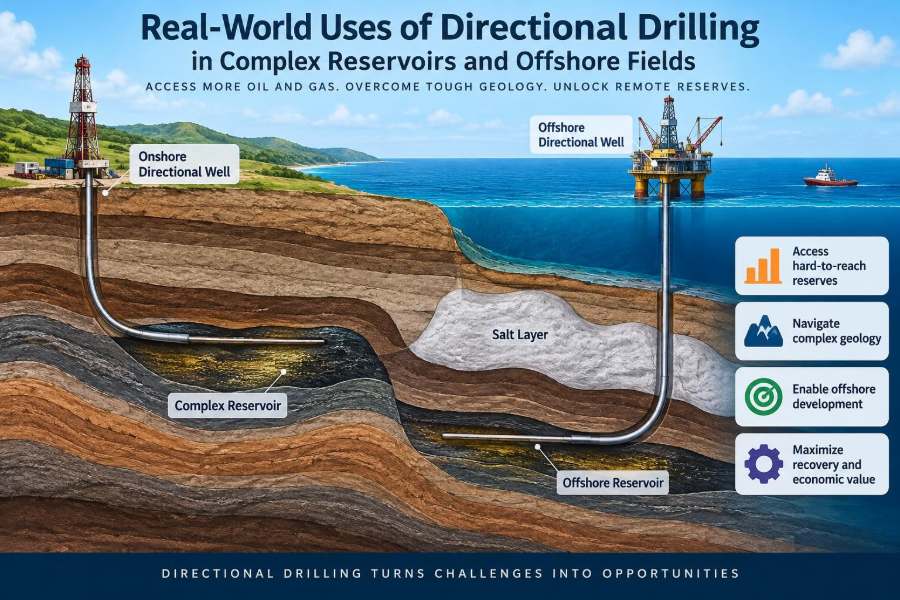
One of the clearest real-world uses is drilling beneath places where a rig cannot or should not be positioned. A pad set back from a coastline, for example, may access offshore reservoir compartments through deviated wells.
Similarly, onshore operators may drill from outside protected areas, populated zones, or difficult terrain. This does not remove the need for environmental assessment and operational controls, but it can reduce the surface footprint compared with scattering individual vertical locations across the area.
The subsurface target still requires accurate placement. A small positional error can put the well outside a narrow reservoir body or too close to a fault.
🌊 Offshore platform slot drilling
Offshore platforms have a limited number of well slots, yet a single fixed platform may need to drain several reservoir areas. Directional wells fan outward from the platform, allowing one facility to access targets in different directions.
This arrangement avoids building a separate platform for every reservoir block. It can reduce new offshore infrastructure, although the trade-off is longer and more technically demanding wellbores.
Platform drilling also introduces practical constraints. Wells must be spaced safely below the platform, conductor and casing programs must fit the slot arrangement, and anti-collision management becomes essential as the field fills with wells.
🏝️ Extended-reach drilling from shore
Extended-reach drilling applies directional methods to wells with large horizontal displacement from the surface location. A shore-based rig may reach a reservoir that lies beneath shallow water, an island margin, or a remote offshore area.
This approach can be attractive where offshore construction is difficult or where a land facility already provides processing, power, and logistics. It is not automatically simpler. Long reach increases drillstring friction, torque, hydraulics demands, and the challenge of transferring weight to the bit.
Success depends on integrated design rather than directional tools alone. Torque-and-drag modelling, casing design, mud properties, hole-cleaning plans, and contingency options must agree with the intended reach.
🪨 Staying inside thin reservoir layers
Many valuable reservoirs are thin relative to their lateral extent. A vertical well may cross only a few metres of pay, while a horizontal well can travel along the layer and expose a far greater length of reservoir to the wellbore.
This is especially useful when the productive interval lies between water-bearing rock below and gas-bearing rock above. Leaving the target can cause early unwanted fluid production or reduce hydrocarbon recovery.
The goal is commonly called geosteering: adjusting the trajectory while drilling to keep the well within the desired rock. It resembles driving through a narrow tunnel when the roof and floor cannot be seen directly—except the “view” comes from measured data rather than windows.
📡 Geosteering with real-time formation data
Geosteering combines directional measurements with formation evaluation data collected near the drill bit. Logging-while-drilling tools can provide information such as gamma ray response, resistivity, inclination, and azimuth while drilling continues.
These measurements are interpreted alongside seismic data, offset-well records, cuttings, and the geological model. The team may then revise the plan: build angle, drop angle, turn, or hold course.
Real-time data reduces uncertainty but does not eliminate it. Rock boundaries can be more irregular than expected, and signals may be ambiguous. Good geosteering decisions state the uncertainty clearly rather than treating every interpretation as exact.
🧱 Navigating faulted and compartmentalized reservoirs
Faults can divide a reservoir into pressure-separated or poorly connected compartments. A well that lands in the correct formation but on the wrong side of a sealing fault may deliver much less value than planned.
Directional drilling lets engineers target specific blocks from a common location. It can also allow separate laterals to investigate different compartments, subject to spacing and completion limitations.
Faults create drilling hazards as well as reservoir opportunities. They may bring unstable rock, abrupt pressure changes, lost circulation zones, or uncertainty in formation depth. A trajectory must account for both the reservoir map and the drilling behavior expected near the fault.
🧩 Developing stacked reservoirs from one location
Some fields contain multiple productive formations at different depths. Rather than installing separate surface locations for each zone, directional wells can be planned to access selected targets from a shared pad or platform.
This is particularly valuable offshore, where every new well slot and facility addition carries logistical consequences. It can also help onshore developments concentrate equipment, pipelines, and access roads.
However, stacked targets require disciplined well planning. The upper formations must be drilled and cased safely before the well continues to deeper objectives, and the final trajectory cannot compromise casing integrity or future completion options.
🛢️ Improving reservoir contact in horizontal wells
Horizontal drilling is often used to increase reservoir contact, meaning the length of wellbore exposed to productive rock. More contact can improve inflow potential, particularly in formations with limited vertical thickness or low permeability.
But a longer lateral does not guarantee a proportionally better well. Formation quality may vary along the lateral, pressure losses can reduce inflow near the heel or toe, and completion design strongly affects which intervals contribute fluids.
Engineers therefore pair directional design with reservoir simulation, petrophysical interpretation, and completion planning. The productive value of a lateral depends on where it goes, not only how long it is.
💧 Managing water and gas coning risks
In some reservoirs, water lies below oil and gas lies above it. Producing too aggressively or placing the well too near a fluid contact can pull unwanted fluids toward the wellbore. This process is often described as coning.
A horizontal well positioned within the oil column may delay unwanted water or gas compared with a poorly placed vertical completion, because drawdown can be distributed over a longer interval. Yet this benefit depends on reservoir properties, production rates, barriers, and completion behavior.
Directional placement is therefore a reservoir-management tool, not a substitute for sound production control. Water and gas movement must be monitored, and production strategy may need adjustment over the life of the well.
🧪 Accessing naturally fractured reservoirs
In naturally fractured carbonates and tight formations, fractures may provide much of the flow capacity. The direction of a horizontal well relative to the dominant fracture system can influence how many conductive fractures it intersects.
A trajectory designed to cross fractures may increase connectivity, while a poorly oriented well may encounter fewer effective flow paths. The best orientation is site-specific and should be based on image logs, cores, seismic interpretation, production history, and geomechanical understanding where available.
Fractures can also complicate drilling by causing fluid losses or wellbore instability. The same geological feature that improves production can challenge pressure management.
🧯 Drilling around hazardous zones
Directional wells can avoid known hazards such as unstable shale intervals, salt structures, depleted zones, shallow gas pockets, or regions with difficult pressure behavior. The planned path may bend around a problem zone before approaching the target.
Avoidance is not always possible. In some cases, the target lies beneath the hazard and the well must pass through it. Engineers then use trajectory selection, casing points, mud-weight windows, and operational procedures to reduce exposure.
The key lesson is that directional drilling expands the set of possible paths. It does not make the subsurface predictable, and it cannot override physical constraints such as narrow pressure margins.
🧂 Salt and complex overburden challenges
Salt can deform over geological time and distort seismic images beneath it. Wells drilled near salt may encounter changing stresses, difficult hole conditions, and uncertainty in the depth or shape of the target below.
Directional drilling may be needed to approach the reservoir from a more favorable location or angle. But steering beneath complex overburden requires frequent updating of the geological model as new data arrive.
In these settings, the drilling plan should include decision points rather than pretending the pre-drill model is final. A flexible design helps the team respond when actual formation tops differ from predictions.
🧰 The tools that steer the well
Two common directional drilling approaches are mud motors with bent housings and rotary steerable systems (RSS). A mud motor can slide drill by stopping drillstring rotation while the motor turns the bit in a chosen direction. During rotary drilling, the whole string rotates.
An RSS steers while the drillstring continues rotating. Continuous rotation can improve hole cleaning and reduce some friction-related issues, although tool selection depends on the well objective, formation, cost, and operational conditions.
Measurement-while-drilling tools provide inclination and azimuth data. Without reliable surveys, steering would be guesswork rather than controlled navigation.
⚙️ Torque, drag, and friction in long laterals
As a well becomes more inclined and extended, drillpipe rubs against the borehole over a greater distance. This produces torque when rotating and drag when moving pipe in or out of the hole.
Excessive friction can prevent sufficient weight from reaching the bit, make casing difficult to run, and increase the risk of stuck pipe. A trajectory with unnecessary turns or sharp doglegs may look acceptable on a map but become mechanically unworkable.
Torque-and-drag models help predict these loads. They are estimates, not guarantees, because actual hole conditions, cuttings beds, and friction factors can differ from assumptions.
🌀 Hole cleaning is critical in high-angle wells
In vertical wells, drilled cuttings tend to fall toward the bottom and can be transported upward by circulating fluid. In high-angle and horizontal sections, cuttings can settle on the low side of the hole and form beds.
If these beds grow, they increase drag, restrict circulation, damage tools, and may contribute to stuck-pipe events. Effective hole cleaning depends on annular velocity, fluid properties, pipe rotation, sweeps, penetration rate, and regular wiper trips where appropriate.
It is a common mistake to treat circulation as a routine background task. In a long lateral, cuttings transport is a primary design and execution concern.
🌡️ Pressure management in complex trajectories
Every well must maintain a safe pressure balance. Too little wellbore pressure may allow formation fluids to enter the well; too much can fracture the formation and cause losses. The workable range is often called the drilling margin or pressure window.
Directional wells complicate this because frictional pressure losses, equivalent circulating density, and true vertical depth all affect the pressure seen by the formation. Long, narrow annuli and high flow rates can make the margin tighter.
Managed pressure drilling may be considered when conventional methods provide insufficient control. It is a specialized approach requiring suitable equipment, procedures, and trained personnel—not a universal fix.
🧱 Casing and cementing in deviated wells
Casing stabilizes the well and isolates formations. In a deviated borehole, casing experiences additional friction while running, and cement placement can be more difficult because gravity causes solids and fluids to segregate around the pipe.
Centralizers, displacement design, spacer systems, and careful operational execution help improve cement coverage. The objective is competent zonal isolation, which is essential for well integrity and for preventing unwanted fluid communication between formations.
Sharp changes in trajectory can make casing deployment harder. This is why directional design must consider the entire well life cycle, not just the moment the bit reaches target depth.
🔩 Completion design must match the trajectory
A completion is the equipment and arrangement that allows the well to produce or inject fluids. Horizontal and multilateral wells may use open-hole completions, liners, screens, staged stimulation systems, inflow-control devices, or other configurations suited to reservoir conditions.
The directional profile affects whether tools can be conveyed, where they can be placed, and how fluids enter the well. A very tortuous well may restrict intervention tools later in its life.
For this reason, drilling and completion engineers should not work from separate assumptions. A trajectory that reaches the target but prevents the planned completion from being installed has not solved the development problem.
🌿 Reducing surface disturbance from multiwell pads
Onshore pad drilling allows multiple directional wells to originate from one prepared location. Roads, power systems, tanks, and support equipment can be concentrated rather than replicated at many separate sites.
This can reduce the area directly disturbed by surface infrastructure. It does not remove impacts such as traffic, noise, emissions, water handling, or the need to manage produced fluids and waste responsibly.
Directional drilling should therefore be viewed as one element of a broader environmental and operational plan. Its footprint advantage is meaningful only when planning, containment, monitoring, and restoration practices are also effective.
🚢 Offshore logistics and facility constraints
At sea, directional drilling is shaped by space, weather, marine transport, lifting limits, and platform capacity. A fixed platform, jack-up, or floating rig has different capabilities and restrictions.
Longer-reach wells may reduce the number of offshore structures, but they can demand more specialized tools, longer drilling time, and careful management of consumables such as drilling fluid and casing. A small planning oversight becomes harder to correct when supply vessels and weather windows are involved.
Field development decisions must compare the whole system: wells, facilities, subsea infrastructure, processing capacity, intervention access, and eventual abandonment obligations.
📏 Well spacing and collision avoidance
As more wells are drilled from a pad or platform, their paths occupy the same subsurface neighbourhood. Anti-collision planning compares planned and actual well positions, survey uncertainty, and separation requirements.
The aim is to avoid unintended intersection with another wellbore. Such an event can create serious safety, integrity, and operational consequences, especially if the offset well contains pressure or hydrocarbons.
Reliable survey practices matter. Magnetic interference, tool errors, and uncertain reference data can affect positional confidence. Teams use appropriate survey management processes and update separation assessments as drilling progresses.
🧭 Multilateral wells and branch access
A multilateral well has one main bore with one or more branches. It can access separate reservoir compartments, increase drainage area, or reach multiple targets from a single main wellbore.
The concept is attractive where surface access is constrained, but junctions between the main bore and laterals introduce complexity. Isolation, re-entry, stimulation, production allocation, and future intervention may all be more difficult than in a single-lateral well.
Multilaterals are therefore selected when their reservoir value justifies their added completion and operational challenges.
📊 A practical comparison of common well profiles
| Well profile | Typical real-world use | Main advantage | Key challenge |
|---|---|---|---|
| Vertical | Thick, accessible reservoir targets | Relatively simple geometry | Limited lateral reservoir contact |
| Deviated | Targets offset from the surface location | Reaches inaccessible subsurface areas | Trajectory control and collision management |
| Horizontal | Thin or laterally extensive pay zones | Extended reservoir contact | Geosteering and hole cleaning |
| Extended-reach | Offshore targets reached from shore or a central platform | Potentially fewer surface or offshore facilities | High torque, drag, and hydraulic demands |
| Multilateral | Multiple compartments or branches from one main bore | Broad access from one well | Complex junctions and interventions |
⚠️ Common planning mistakes
Many directional drilling failures begin before the rig starts. The technical challenge is often not one dramatic error but a set of disconnected assumptions.
- Designing the trajectory without checking casing-running and completion constraints.
- Using a geological model as though it has no uncertainty.
- Choosing aggressive doglegs without evaluating torque, drag, and fatigue.
- Underestimating cuttings transport in long high-angle intervals.
- Leaving anti-collision planning until the well is already close to an offset path.
- Optimizing drilling cost while ignoring later production, intervention, or abandonment needs.
A stronger plan identifies these interactions early and includes operational limits that tell the team when to pause, reassess, or change course.
🤝 Integrated teamwork makes directional drilling work
Directional drilling connects disciplines that are sometimes treated separately: geologists define the target, reservoir engineers estimate value and drainage, drilling engineers design the path, service teams execute measurements and steering, and completion engineers prepare the producing well.
Offshore developments add facilities, subsea, logistics, and marine specialists. Each group sees a different failure mode, which is why integrated reviews are more valuable than isolated technical approvals.
During operations, rapid communication is equally important. A changed formation top, rising torque, unexpected pressure behavior, or poor log response may require a decision that balances multiple objectives in real time.
🔍 Learning from actual well performance
Post-well review turns drilling experience into better future designs. Teams compare planned and actual trajectory, rate of penetration, nonproductive time, torque and drag, fluid losses, cement results, completion installation, and early production behavior.
A well that reached total depth is not automatically a complete success. The review should ask whether the lateral stayed in the intended rock, whether the completion functioned as planned, and whether operational limits were realistic.
These lessons are especially useful in pad and platform campaigns, where early wells provide data that can improve the next sequence of trajectories.
🧠 The core principle: access the reservoir, protect the well
Directional drilling is valuable because it gives engineers options: reach an offset target, remain in thin pay, drain several compartments from one facility, avoid selected hazards, and reduce the need for new surface locations.
Its value is limited by the realities of mechanics, pressure control, geology, well integrity, and future operations. A trajectory is successful only when it supports safe drilling and a workable producing well.
The central engineering question is not simply, “Can the bit reach that point?” It is, “Can the entire well be drilled, completed, produced, monitored, and eventually managed responsibly along this path?”
Directional drilling delivers its greatest value when reservoir access, drilling practicality, and long-term well integrity are designed as one connected system. That systems mindset is what turns a curved well path into a durable field-development solution. 🧭🛢️🌊