
An aging oil well can look deceptively simple at the surface: declining daily production, more water in the test separator, and a growing list of operating concerns. The instinctive response is often to focus on the wellbore—clean it out, change the pump, stimulate the formation, or reduce backpressure.
Those actions can be valuable, but they do not automatically address the reason the well is underperforming. A mature well is connected to a reservoir that has been changing for years or decades. Pressure has declined, fluids have redistributed, and the paths that once carried oil easily may now favor water or gas.
Better reservoir management asks a more useful question: what is still in the ground, where is it located, and what is preventing it from reaching the well efficiently? The answer may lead to a workover—but it may also show that a workover would spend capital without recovering meaningful incremental oil.
For students, this topic connects reservoir engineering theory to field decisions. For working professionals, it is a reminder that extending an asset’s productive life depends on disciplined diagnosis, not simply doing more to every declining well.
🧭 Start With the Right Definition of an Aging Well
An aging well is not merely a well with a low production rate. It is a well whose performance has been shaped by depletion, fluid movement, mechanical wear, operating changes, or some combination of these factors over time.
A low-rate well may still have access to a large volume of movable oil and deserve intervention. Conversely, a well producing at a respectable rate may be nearing an uneconomic water cut or suffering from rapid reservoir damage. Calendar age alone is therefore a poor management criterion.
📉 Separate Natural Decline From Avoidable Underperformance
Most oil wells decline as reservoir pressure falls and the easiest-to-produce oil is removed. This natural decline is expected and should be estimated using production history, reservoir behavior, and decline-curve analysis.
Avoidable underperformance appears when actual production falls below what the reservoir and completion should reasonably deliver. Possible causes include scale, tubing leaks, excessive drawdown, near-wellbore damage, liquid loading, poor artificial-lift settings, or unwanted fluid breakthrough.
The practical objective is not to eliminate decline. It is to identify the portion of lost production that can be recovered safely and economically.
🗺️ Rebuild the Reservoir Picture Before Choosing a Fix
Every intervention should begin with an updated conceptual model. In a mature field, the original development model may no longer describe current saturation, pressure communication, or flow paths.
Review structure maps, stratigraphy, fault interpretation, core data, well logs, completion intervals, pressure data, and production trends together. A reservoir model is useful only when it can explain observed behavior, such as why adjacent wells have very different water cuts or why one zone responds to injection while another does not.
Uncertainty is normal. The goal is not a perfect model; it is a model accurate enough to rank decisions and reveal the most consequential unknowns.
📊 Treat Production Data as a Diagnostic Signal
Production data are often the most continuous record available in a mature asset. Plot oil, water, gas, flowing pressure, choke settings, pump speed, downtime, and interventions on the same time scale whenever possible.
A sudden water-rate increase after a nearby injector change tells a different story from a slow, steady rise over several years. Likewise, a sharp oil decline accompanied by a stable water rate may suggest mechanical restriction or artificial-lift trouble rather than reservoir depletion.
- Look for breaks in trend after workovers, chemical treatments, shut-ins, or facility changes.
- Compare rates with operating conditions, not production volumes alone.
- Flag data gaps, estimated allocations, and inconsistent test quality before drawing conclusions.
🧪 Measure What the Well Is Actually Producing
Allocated production can be adequate for accounting, but it is often inadequate for diagnosis. Periodic well tests help establish oil rate, water rate, gas-oil ratio, flowing pressures, and sometimes flowing temperature under known operating conditions.
For commingled completions, production logging can identify which intervals contribute oil, water, or gas. This matters because a single high-water zone can mask productive intervals behind it. Without zonal information, an operator may treat the entire well as “watered out” when only one interval is the problem.
🧠 Understand Pressure as the Reservoir’s Driving Energy
Oil flows toward a well because of a pressure difference. Reservoir pressure provides the upstream energy, while bottomhole flowing pressure is the pressure near the producing well. The difference between them is drawdown.
As pressure declines, the same wellbore conditions may deliver less oil. Yet aggressively lowering bottomhole pressure is not always the answer. Excessive drawdown can pull water or gas toward the well faster, mobilize fines, increase sanding risk, and reduce long-term oil recovery.
Good management seeks an appropriate drawdown for the rock, fluids, completion, and recovery mechanism—not the lowest possible flowing pressure.
🔍 Use Pressure-Transient Testing With a Clear Question
Pressure-transient tests, including buildup tests, can indicate permeability, skin, boundaries, and pressure communication when designed and interpreted carefully. “Skin” is a dimensionless indicator of additional flow resistance near the wellbore; positive skin often suggests damage or restriction, while negative skin may reflect stimulation.
These tests are not automatic answers. Poor rate history, inadequate shut-in time, multiphase flow, wellbore storage, and changing operating conditions can complicate interpretation. Define the decision first: are you testing for damage, compartmentalization, injector communication, or a completion restriction?
🪨 Distinguish Reservoir Damage From Wellbore Problems
A falling rate can originate in the reservoir, near the wellbore, the completion, the tubing, or the surface system. These causes may look similar in a daily production report but require very different remedies.
| Observed clue | Possible interpretation | Potential response |
|---|---|---|
| Rate falls while pump load changes | Artificial-lift or mechanical issue | Inspect equipment and operating envelope |
| High positive skin with intact equipment | Near-wellbore damage or restricted perforations | Diagnose damage mechanism before treatment |
| Oil drops as water rises sharply | Water breakthrough or coning | Identify water source and contributing interval |
| Several wells decline together | Field-scale pressure or facility constraint | Review reservoir and network behavior |
The key is to avoid treating a subsurface issue as a pump problem, or a tubing problem as an expensive reservoir-stimulation opportunity.
🧱 Protect Productive Pay From Near-Wellbore Damage
Near-wellbore damage can reduce permeability around the well through fines migration, scale, clay swelling, incompatible fluids, emulsion blocks, drilling or completion residue, and precipitated solids. Even a thin damaged zone can materially reduce flow because all produced fluid must pass through it.
The appropriate treatment depends on the mechanism. Acid may help dissolve certain mineral scales or damage in compatible formations, but it can be ineffective or harmful if the restriction is organic, mechanical, or caused by incompatible chemistry. Laboratory compatibility work and field evidence should guide chemical selection.
💧 Diagnose Water Production Before Trying to Shut It Off
Water production is one of the defining challenges of mature oil fields, but “high water cut” is a symptom rather than a diagnosis. Water may arrive through a bottom-water drive, an advancing aquifer, a high-permeability streak, fractures, a channel from injection, casing leaks, or flow behind pipe.
Each mechanism has a different scale and remedy. Mechanical isolation may help a discrete watered-out interval, while it will not stop a broad regional aquifer from supporting the reservoir. Water-control treatments should therefore be based on logs, pressure behavior, completion history, and evidence of the water source.
🌊 Manage Coning and Cresting With Drawdown Control
Water coning occurs when water beneath an oil zone rises toward a producing well. Gas coning, often called gas cresting, occurs when gas from above moves downward. Both can be accelerated by high drawdown near the well.
Reducing rate or changing artificial-lift settings may delay coning, but it also lowers immediate production. The trade-off is asset-specific: sacrificing some short-term rate can preserve oil productivity and postpone costly fluid handling. Horizontal wells and selective completions may reduce localized drawdown, although they introduce their own placement and completion risks.
🧩 Identify and Isolate Unwanted Zonal Contribution
Many mature wells are completed across multiple layers. Over time, the balance of contribution changes: one interval may water out while another retains oil potential. Production logging, temperature surveys, noise logs, and selective pressure measurements can help locate the problem.
Possible responses include bridge plugs, cement squeezes, straddle systems, selective reperforation, or recompletion above or below the unwanted zone. Isolation is most likely to work when the source is localized and the barrier can be placed reliably. It is less persuasive when water is entering through widespread fractures or multiple poorly defined paths.
⚙️ Match Artificial Lift to Current Inflow
Artificial lift should evolve as reservoir inflow changes. A pump sized for early-life production may become inefficient, gas locked, worn, or unable to handle increasing water volumes later in the well’s life.
Common options—rod pumps, electric submersible pumps, gas lift, progressing cavity pumps, and hydraulic systems—have different strengths in depth, gas handling, solids tolerance, deviation, rate range, and maintenance requirements. Selection should consider the full operating envelope, not only today’s rate.
A larger pump is not automatically better. If inflow is limited, oversizing can create excessive drawdown, intermittent operation, gas interference, or premature equipment wear.
🛠️ Find Surface Constraints That Mimic Reservoir Decline
Aging wells can lose production because the surface network cannot move fluids efficiently. Restrictions may include undersized flowlines, rising separator pressure, fouled chokes, wax deposition, scale, emulsion problems, or a bottleneck in water handling.
Review flowing wellhead pressure alongside separator pressure and line pressure. If a lower downstream pressure restores production without changing reservoir conditions, the constraint may be at the surface. Network modeling can help distinguish deliverability limits from reservoir inflow limits.
🧴 Control Scale, Wax, and Corrosion as Flow-Assurance Problems
Scale, wax, asphaltenes, and corrosion products can gradually restrict perforations, tubing, valves, and flowlines. These are not merely maintenance annoyances; they alter pressure losses and can make a healthy reservoir appear weak.
An effective program combines monitoring with prevention and removal. Chemical treatment, mechanical scraping, hot-oil operations, solvent use, and inhibitor programs must suit the fluid system and operating conditions. Repeating a cleanout at fixed intervals without understanding deposition location and cause can waste money and expose equipment to unnecessary risk.
🧱 Revisit Completion Strategy as Conditions Change
Completion design determines how the reservoir communicates with the well. In mature wells, original perforations may be damaged, partially plugged, poorly placed relative to remaining oil, or open to increasingly water-prone intervals.
Reperforating can access bypassed pay, but only if logs and reservoir interpretation support remaining movable hydrocarbons. Perforating additional footage simply to increase contact can worsen water or gas production. Selective access is often more valuable than maximum access.
🔥 Evaluate Stimulation as a Targeted Tool
Matrix acidizing and hydraulic fracturing can improve productivity when flow restriction or limited reservoir contact is the true constraint. Matrix acidizing is intended to improve flow near the wellbore without fracturing the rock, while hydraulic fracturing creates conductive fractures that extend farther into the formation.
Both approaches carry risks in mature reservoirs. A fracture may connect a well to water-bearing rock, an injector, or an unwanted natural fracture network. Acid can preferentially enter the highest-permeability paths instead of the oil-bearing zones. Candidate selection, diversion design, geomechanics, and offset-well behavior deserve careful attention.
💉 Optimize Waterflooding Instead of Assuming More Injection Helps
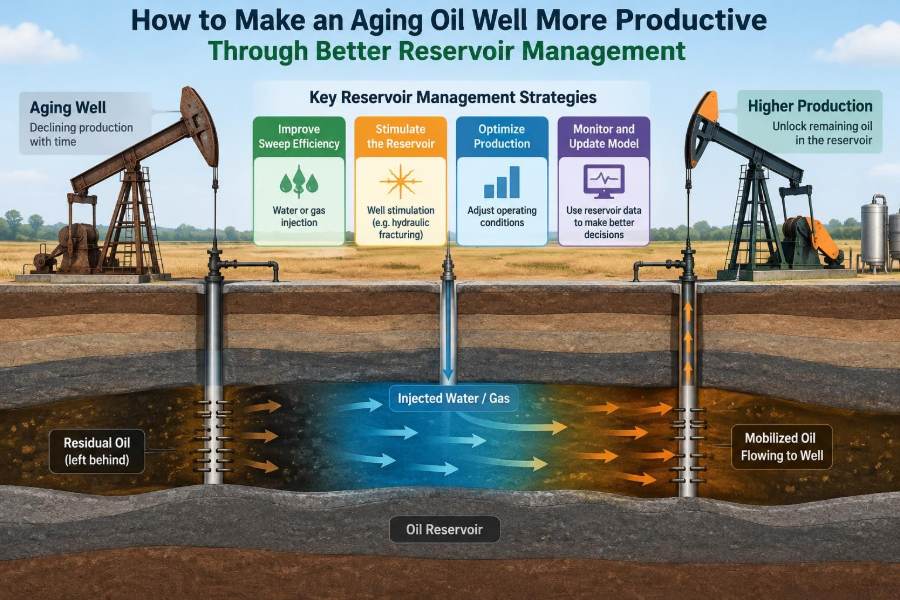
Water injection can maintain pressure and displace oil toward producers, but mature waterfloods often become less uniform over time. High-permeability channels may accept most injected water, causing early breakthrough while lower-permeability oil-bearing rock remains under-swept.
Injection allocation should be reviewed against pressure response, injection profiles, producer behavior, and voidage replacement. Voidage replacement compares produced reservoir volumes with injected volumes and is a useful surveillance indicator, but it does not by itself prove that injection is reaching the desired rock.
🔄 Improve Sweep Efficiency, Not Just Injection Volume
Sweep efficiency describes how effectively a displacement process contacts and moves oil through the reservoir. A field can inject large volumes of water while leaving substantial oil behind if flow is channeled through a small fraction of the reservoir.
Potential actions include profile modification, selective injection, pattern balancing, conformance treatments, and injector conversion. These measures should be judged by their ability to alter flow distribution, not by injection rate alone. Tracer programs and interwell pressure responses can help test whether a suspected fast path is real.
🧫 Consider EOR Only When the Reservoir and Operations Fit
Enhanced oil recovery, or EOR, uses methods beyond conventional waterflooding to mobilize or displace additional oil. Thermal processes, gas injection, chemical flooding, and miscible or near-miscible displacement are examples, but each has strict screening requirements.
Oil viscosity, temperature, depth, pressure, salinity, rock mineralogy, fluid availability, containment, facilities, and economics all matter. An EOR concept can be technically attractive yet impractical where produced-water handling, corrosion control, gas supply, or pattern containment cannot be managed. Pilot testing is often needed before broader deployment.
🧭 Use Infill Drilling to Reach Bypassed Oil, Not to Chase Rates
Infill wells can access compartments or unswept regions between existing wells. Their value depends on whether they recover oil that existing wells cannot efficiently drain, rather than simply accelerating production that would have occurred anyway.
Before drilling, assess well spacing, pressure depletion, saturation distribution, faults, injector-producer communication, and interference risk. A hypothetical infill location may look attractive on a structure map but disappoint if it sits inside a depleted drainage area or immediately connects to a water channel.
📐 Let Surveillance Close the Loop
Reservoir management is a repeating cycle: measure, interpret, act, and measure again. Surveillance may include pressure surveys, fluid samples, injection profiles, production logs, well tests, interference tests, and repeated saturation monitoring where feasible.
Every data acquisition activity should have a decision use. For example, a production log may decide whether to isolate an interval; an interference test may influence injector allocation; a fluid sample may determine whether a scaling tendency has changed. Data with no intended decision path often become expensive archives.
🧮 Rank Opportunities With Incremental Value and Uncertainty
Mature-field portfolios commonly contain more possible interventions than available capital or rig time. Ranking should compare expected incremental oil, duration of benefit, operating-cost changes, intervention cost, risk, and confidence in the diagnosis.
Use ranges rather than a single precise forecast when uncertainty is material. A low-cost optimization with modest upside and high confidence may rank ahead of a larger but poorly understood stimulation. Economic screening should also include water disposal, power, chemical use, emissions, and future abandonment implications.
🛡️ Integrate Well Integrity Into Productivity Planning
A productive response is not a successful response if it compromises well integrity. Aging wells may have corroded tubulars, degraded cement, casing deformation, sustained annulus pressure, or barriers weakened by repeated interventions.
Integrity assessment should precede changes that increase pressure, rate, temperature, or mechanical loading. For example, higher injection pressure may improve injectivity temporarily while increasing the risk of out-of-zone flow if barriers are inadequate. Productivity and containment must be managed together.
🌱 Account for Water, Energy, and Emissions
Late-life production often requires more energy per barrel of oil because water lift, treatment, and disposal increase as water cut rises. This affects operating cost and the environmental footprint of the asset.
Practical improvements can include reducing unnecessary recirculation, optimizing pump efficiency, minimizing leaks and venting, improving produced-water handling, and shutting in wells that consume resources without a credible path to economic recovery. Responsible reservoir management considers these trade-offs alongside oil volumes.
👥 Make Decisions Across Disciplines, Not in Silos
A reservoir engineer may recognize pressure depletion, a production engineer may see pump inefficiency, a geologist may identify a barrier, and an operations team may know that a line has been repeatedly restricted. The best diagnosis often emerges when these perspectives are combined.
Regular integrated reviews should connect subsurface interpretation with actual field constraints: rig availability, chemical logistics, facility capacity, safety procedures, and downtime. A technically sound plan that cannot be executed reliably is not yet a complete plan.
🚫 Avoid the Common “Quick Fix” Mistakes
Several habits repeatedly weaken mature-well performance programs:
- Treating every decline as formation damage: this leads to unnecessary acidizing or fracturing.
- Increasing drawdown without diagnosing water or gas behavior: short-term rate gains can accelerate unwanted-fluid production.
- Using average field behavior to judge individual wells: heterogeneity makes local behavior matter.
- Ignoring data quality: faulty tests and allocation errors can create convincing but incorrect stories.
- Measuring success only by initial rate: sustained incremental oil and total cost are more meaningful.
The corrective principle is straightforward: make the simplest intervention that is consistent with the evidence, then verify the response.
🧪 Learn From Controlled Field Trials
Where uncertainty is high, a carefully selected pilot or trial can be more valuable than a field-wide rollout. Choose wells with comparable conditions, document baseline performance, define operating changes, and specify success criteria before the work begins.
For example, a selective water-control treatment should be evaluated using oil rate, water rate, pressure behavior, duration, and nearby-well effects—not just the first few days after restart. Operational changes and market conditions can obscure results, so interpretation should acknowledge confounding factors.
📈 Use Digital Tools Carefully, Not Blindly
Production dashboards, automated surveillance alerts, physics-based models, and machine-learning tools can help engineers notice anomalies and prioritize work. They are especially useful when a field contains many wells and large data streams.
However, a model trained on historical patterns cannot automatically recognize a new tubing failure, changing allocation method, or unrecorded operating event. Digital tools should support engineering judgment, data validation, and field observation rather than replace them.
🗓️ Build a Repeatable Mature-Well Management Routine
A practical routine prevents wells from receiving attention only after a large decline. The frequency depends on asset complexity, but the sequence is broadly applicable:
- Validate production and operating data.
- Classify the likely constraint: reservoir, completion, lift, wellbore, or surface.
- Gather the minimum additional surveillance needed to reduce uncertainty.
- Rank intervention options by expected value, risk, and execution feasibility.
- Implement with clear operating limits and integrity controls.
- Measure the response and update the reservoir model.
Documenting why a decision was made is as useful as documenting the result. It builds a field-specific learning base for later candidates.
🏁 The Core Principle: Manage the Reservoir, Not Just the Symptom
The most productive aging wells are rarely the result of one universal treatment. They are the result of matching the intervention to the actual limiting mechanism: protecting pressure where it remains useful, improving sweep where oil is bypassed, restoring flow where damage exists, and controlling unwanted fluids where they threaten economics.
Better reservoir management also means knowing when not to intervene. If remaining oil is poorly connected, water handling dominates the cost, or integrity uncertainty is unacceptable, a technically aggressive option may not be the responsible choice. The aim is durable value from the whole reservoir-well-facility system, not a brief increase on a production chart.
An aging oil well becomes more productive when decisions are driven by an updated understanding of fluids, pressure, flow paths, and operating constraints—not by a one-size-fits-all remedy. That mindset turns late-life field management from reactive maintenance into purposeful resource stewardship. 🛢️📈🌍