
A production engineer begins the morning with an alert: tubing-head pressure at one well has drifted outside its usual pattern. The well is still flowing, no alarm has tripped, and a field visit would take several hours. Is this the beginning of a restriction, a sensor fault, an artificial-lift problem, or simply a normal response to changing separator conditions?
For decades, answering that question relied heavily on periodic readings, trend charts, operator experience, and physical inspection. Those remain essential. But modern production systems generate far more continuous information than any person can comfortably watch well by well.
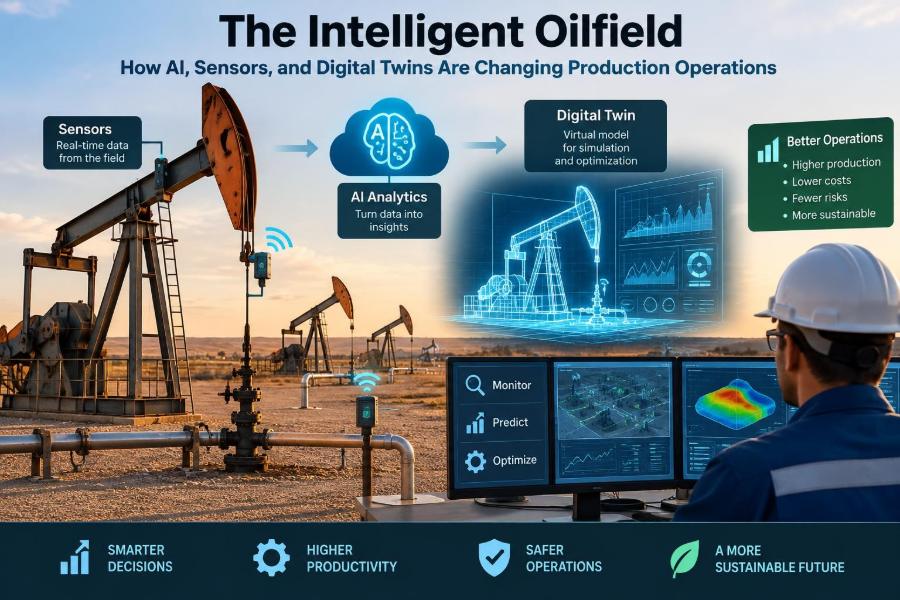
The intelligent oilfield is an attempt to turn that information into better operational decisions. It combines field instrumentation, communications, data systems, physics, analytics, and human judgment to detect changes earlier and act with clearer evidence.
This matters because production operations are a constant balancing act: protect people and equipment, meet constraints, manage water and gas, reduce avoidable downtime, and recover hydrocarbons efficiently. Digital tools can help—but only when they are built on reliable measurements and used with engineering discipline.
🧭 What an Intelligent Oilfield Actually Means
An intelligent oilfield is not a single product or control room full of screens. It is an operating approach in which data from wells, facilities, and equipment are connected to workflows that support monitoring, prediction, optimization, and decision-making.
Its building blocks usually include sensors, supervisory control systems, historian databases, engineering models, analytics, and people who can interpret the results. The objective is practical: make the next operating decision more informed and more timely.
In a mature field, that may mean recognizing a gradual rise in water cut before it becomes a facility bottleneck. In a new development, it may mean testing choke settings virtually before changing several wells in the field.
📡 The Data Starts at the Physical Asset
Every useful digital workflow begins with a physical measurement. Common field signals include wellhead pressure and temperature, choke position, flow rate, tank level, vibration, motor current, valve status, and separator pressure.
Downhole gauges may add flowing pressure, temperature, and sometimes other completion-specific measurements. In artificial-lift systems, surface and downhole signals can reveal changes in pump loading, gas interference, or operating envelope.
A sensor does not measure “production performance.” It measures a specific physical quantity with a particular range, accuracy, location, sampling rate, and failure mode. Understanding those limits is the first defense against misleading conclusions.
🔌 From Sensor to Screen: The Data Path
A measurement must travel through several layers before an engineer sees it: transmitter, local controller or remote terminal unit, communications network, data platform, and visualization or application layer. A weakness anywhere in that chain can distort operational awareness.
Field communications may use fiber, radio, cellular, satellite, or a combination. Remote locations often face intermittent connectivity, limited power, harsh weather, and cybersecurity constraints, so system design must account for lost or delayed data.
Timestamp quality matters. A pressure trend is far less useful if it cannot be aligned confidently with a choke movement, pump start, shutdown, or separator upset.
🧹 Why Data Quality Comes Before Artificial Intelligence
Artificial intelligence cannot repair a fundamentally unreliable data foundation by itself. A flatlined transmitter, swapped engineering units, uncalibrated meter, or copied manual value can look like a meaningful operating event unless quality checks are in place.
Useful checks include range limits, rate-of-change tests, missing-data flags, comparison with redundant instruments, and reconciliation against mass-balance expectations. For example, a sudden, sustained zero flow reading may indicate either a shut-in well or a communications problem; contextual signals help distinguish them.
Data governance also assigns ownership. Someone must know who validates a tag, what its units mean, when it was calibrated, and whether its value is suitable for a particular calculation.
🧠 Where AI Fits in Production Operations
In this setting, AI usually refers to algorithms that find patterns, classify conditions, forecast variables, or recommend actions from historical and current data. Machine learning is one branch of AI that learns relationships from examples rather than relying only on manually written rules.
AI is especially useful where systems produce many interacting signals and where past labeled events exist. It can help rank wells for review, identify behavior that differs from a well’s normal baseline, or estimate a difficult-to-measure variable from related measurements.
It is not a substitute for conservation laws, equipment limits, or operational accountability. A model may detect an unusual pattern, but the engineer still needs to ask whether the pattern is physically plausible and operationally actionable.
🔎 Pattern Recognition and Anomaly Detection
Anomaly detection identifies observations that depart from expected behavior. The expectation may come from engineering limits, a statistical baseline, a machine-learning model, or a combination of all three.
Consider a hypothetical gas-lift well. If casing pressure, injection-gas rate, and tubing pressure normally move together, a different relationship may signal valve behavior, a restriction, changing reservoir inflow, or bad instrumentation. The alert should prompt investigation, not declare a diagnosis.
A good anomaly system ranks significance and explains which signals contributed. Sending operators a large stream of unexplained alerts creates alarm fatigue rather than insight.
📈 Forecasting Is Useful, but Not a Crystal Ball
Forecasting models can estimate near-term production rates, water handling demand, compressor load, or the likelihood of equipment conditions changing. These forecasts help planning teams prepare for credible operating scenarios.
However, wells are not static consumer devices. Workovers, choke changes, offset activity, facility constraints, and reservoir depletion can change the relationship between inputs and outputs. A model trained on last year’s conditions may degrade quietly after operations change.
Forecasts should therefore include uncertainty where feasible and be monitored against actual outcomes. A prediction is most valuable when it supports a decision with enough lead time to matter.
⚖️ Physics-Based Models Still Matter
Production engineering already uses physical models: inflow performance relationships, vertical-lift performance, nodal analysis, material balance, heat transfer, and network hydraulics. These models express known mechanisms and remain central to sound decisions.
Data-driven methods can complement them. For example, a machine-learning model may estimate a parameter that is hard to observe continuously, while a hydraulic model tests whether the estimate is compatible with pressures, rates, and fluid behavior.
This hybrid approach is often stronger than treating either physics or data science as sufficient alone. Physics provides guardrails; data may capture field-specific behavior that simplified models miss.
🪞 Digital Twins: More Than a Dashboard
A digital twin is a digital representation of a physical asset or process that is connected, to some degree, with operational data. A production-system twin might represent wells, flowlines, separators, compressors, constraints, and operating logic.
A dashboard mainly displays what has happened or is happening. A useful twin goes further: it represents relationships between components and can evaluate what may happen when conditions or settings change.
The term is sometimes used loosely. A static engineering model is valuable, but it becomes more twin-like when it is maintained, contextualized, and refreshed with field data in a controlled way.
🧩 Levels of Digital-Twin Capability
Not every asset needs the same sophistication. A practical maturity path prevents teams from spending heavily on complex models before basic measurement and workflow problems are solved.
| Level | Typical capability | Operational use |
|---|---|---|
| Descriptive | Asset status and validated trends | See current condition |
| Diagnostic | Relationships, balances, and event context | Investigate deviations |
| Predictive | Scenario modeling and forecasts | Anticipate constraints |
| Prescriptive | Ranked options within defined limits | Support approved actions |
A prescriptive twin should not automatically control a process merely because it can calculate an optimum. The consequence of error, quality of measurements, and ability to supervise the action determine how much automation is appropriate.
🛢️ The Well as a Connected Production System
A well’s delivered rate reflects a chain of interacting elements: reservoir inflow, completion performance, tubing lift, choke behavior, flowline backpressure, and facility constraints. Optimizing one element in isolation can shift a problem somewhere else.
For instance, opening a choke may initially increase rate, but it can also raise water handling, alter sand-production risk, increase slugging, or create separator constraints. A connected model makes these trade-offs more visible.
This is why intelligent operations should be organized around the production system, not only around individual data tags or equipment packages.
🚰 Managing Water with Better Visibility
Water is often one of the dominant operational variables in producing fields. Rising water cut changes lifting requirements, separation duty, chemical needs, produced-water treatment, disposal or reinjection demand, and corrosion exposure.
Frequent and trustworthy water measurements can support allocation, identify wells whose behavior has shifted, and improve facility planning. Yet water-cut readings can be uncertain, especially with changing flow regimes or challenging emulsions.
A digital workflow should preserve that uncertainty. Treating every inferred water-rate change as an exact fact can lead to poor optimization decisions.
🔥 Gas Handling and Compression Constraints
Gas is both a valuable product and a major operating constraint. Associated gas may require separation, compression, fuel use, reinjection, export, or other managed handling routes, each with pressure and capacity limits.
Compressor performance monitoring can combine suction and discharge conditions, vibration, temperatures, anti-surge status, and power-related signals. Analytics may reveal gradual efficiency loss or operating conditions that deserve inspection.
Production optimization must respect the gas system. A recommended choke change that increases gas beyond compression or export capacity is not an optimum for the asset as a whole.
⚙️ Artificial Lift Benefits from Continuous Context
Artificial-lift equipment operates near changing limits as fluid level, gas fraction, inflow, and surface conditions evolve. Continuous data can help engineers see when an electric submersible pump, rod-pump system, gas-lift well, or progressive cavity pump is moving away from its preferred operating range.
For an ESP, trends in intake conditions, motor behavior, frequency, and production response may provide clues about gas handling or changing head requirements. For rod pumping, dynamometer cards and motor data can support diagnosis when interpreted with well history.
The aim is not to eliminate field expertise. It is to focus attention on wells where an intervention, test, or operating adjustment is most justified.
🔧 Predictive Maintenance Has Practical Boundaries
Predictive maintenance uses condition data to estimate when equipment may require attention. Vibration, temperature, electrical signatures, run hours, and operating context can all contribute to a maintenance decision.
It works best when failure modes are understood and historical records distinguish genuine failures from planned shutdowns, sensor issues, and normal operating variations. Rare, catastrophic, or poorly labeled failures are harder to predict reliably.
A useful output may be a prioritized inspection list rather than a precise failure date. Maintenance teams still need to consider spares, access, process criticality, safety requirements, and the cost of a false alarm.
🏭 Facility Optimization Requires Mass Balance
Separators, heaters, pumps, compressors, tanks, and treatment units are coupled through flows, pressures, temperatures, and inventories. A facility digital model helps operators test whether a bottleneck lies in inlet conditions, separation capacity, gas handling, liquid transfer, or downstream handling.
Mass balance is a powerful reality check: over a defined boundary and time period, measured inflows, outflows, inventory changes, and expected losses should broadly reconcile. Persistent mismatches can reveal meter bias, allocation issues, unaccounted inventory movement, or model assumptions that need review.
Reconciliation does not prove every value is correct. It identifies where the measurement and model story does not yet fit together.
🚨 Closed-Loop Control Is Not the Same as Automation Hype
Closed-loop control means a system measures a process variable, compares it with a target, and adjusts a control element to reduce the difference. Basic examples already exist throughout production facilities: pressure-control valves, level controllers, and speed control.
Advanced control can coordinate multiple variables and constraints, but it must be engineered, tested, and managed like any safety-relevant operational change. Controllers require defined operating envelopes, fallback modes, alarms, and clear authority boundaries.
Safety instrumented functions should remain independent where required. Optimization software must never be treated as a replacement for process safety design or emergency response procedures.
👷 The Human Operator Remains Central
An intelligent oilfield changes roles; it does not remove the need for competent people. Operators understand sounds, local conditions, maintenance history, and practical constraints that may not be represented in a dataset.
The best systems provide context: what changed, when it changed, which related signals moved, and what checks are recommended. They should fit the operator’s workflow rather than demand constant attention to a separate analytics screen.
Trust grows when systems are transparent, when feedback improves the model, and when users can see why a recommendation was made.
🧑🔬 Production Engineers Need New Working Habits
Engineers do not need to become full-time programmers to work effectively with digital tools. They do need to formulate questions precisely, understand data limitations, and test recommendations against fluid behavior, equipment constraints, and operating history.
Helpful habits include documenting assumptions, comparing calculated values with field tests, retaining event context, and distinguishing correlation from causation. A rate increase after a choke change does not automatically prove the choke caused it if separator pressure also changed.
Cross-functional conversations are increasingly valuable. Reservoir, production, facilities, automation, maintenance, and data teams often hold different pieces of the same operational explanation.
🗂️ Contextual Data Is Often the Missing Ingredient
Numbers alone rarely explain an event. A production dip becomes easier to interpret when the dataset also records chemical changes, maintenance work, well tests, shut-ins, choke moves, power interruptions, and process trips.
This is called contextualization: linking time-series data to asset hierarchy, engineering meaning, and operational events. Without it, an algorithm may treat planned maintenance and unexpected failure as similar patterns.
Simple, disciplined event logging can be more valuable than a sophisticated model trained on ambiguous histories.
🔐 Cybersecurity Is an Operations Issue
Connecting field assets creates pathways that must be protected. Operational technology includes the systems that monitor or control physical processes, and its cybersecurity priorities include availability and safe operation as well as confidentiality.
Practical measures include network segmentation, controlled remote access, identity management, patching procedures suited to operational systems, backups, monitoring, and incident response planning. Exact measures depend on the architecture and risk assessment.
Security should be designed in from the start. Adding connectivity first and controls later can create difficult and expensive weaknesses.
🧯 Safety, Environmental Performance, and Assurance
Digital monitoring can strengthen assurance by improving visibility of pressures, inventories, emissions-related equipment status, flare conditions, leaks, and abnormal operations. It may also reduce unnecessary travel when reliable remote diagnosis is possible.
But remote visibility can create false confidence. A site still needs inspection, maintenance, emergency readiness, and competent verification. Sensors can fail, models can be wrong, and a process can change faster than an analytics workflow recognizes.
Use digital tools to improve the quality and timeliness of decisions, not to lower the standard of process safety or environmental control.
💸 Build the Business Case Around Decisions
“Collect more data” is not a business case. A stronger case starts with a repeated decision that is costly, slow, uncertain, or prone to missed opportunities: which wells to test, where to dispatch a technician, how to allocate constrained gas capacity, or when to schedule maintenance.
Define the baseline workflow, the information gap, the proposed intervention, and how performance will be evaluated. Benefits may come from reduced downtime, fewer unnecessary visits, better constraint management, improved production stability, or lower operational risk.
Not every digital initiative delivers equal value. Prioritizing high-frequency decisions and high-consequence assets usually produces clearer learning than attempting to digitize everything at once.
🧪 Start with a Focused Pilot
A pilot should be narrow enough to learn quickly but real enough to expose operational complexity. Choose an asset set with available data, engaged users, a known pain point, and a measurable decision workflow.
Before deployment, agree on what success looks like and how to separate the tool’s contribution from changing field conditions. Keep a record of alerts, actions taken, rejected recommendations, and reasons for rejection.
A pilot that reveals poor data quality or an unusable workflow is still valuable if the team acts on the lesson. Scaling an unproven workflow only spreads its weaknesses.
📏 Measure Performance Without Fooling Yourself
Performance measures should reflect the purpose of the system. An anomaly model may be judged by whether it identifies actionable conditions with manageable false alarms; a facility optimizer may be judged by constraint compliance and stable operating outcomes.
Be cautious with simple before-and-after comparisons. Production can change because of reservoir behavior, weather, outages, interventions, or commercial constraints. Where possible, evaluate performance over appropriate operating conditions and review individual cases.
Also measure adoption. A technically accurate recommendation has little operational value if users cannot understand it, cannot act on it, or do not trust the underlying data.
🚧 Common Failure Modes in Digital Projects
Many initiatives struggle for ordinary, preventable reasons rather than because the mathematics is weak. Typical problems include unclear ownership, unreliable tags, disconnected systems, insufficient user involvement, and trying to automate a poorly understood workflow.
- Starting with technology: define the operational decision first.
- Ignoring maintenance of sensors: data quality is an ongoing operating task.
- Overpromising autonomy: keep human review where consequences are significant.
- Training only analysts: operators and engineers need practical system training.
- Leaving models unmanaged: monitor drift and update assumptions after changes.
The durable solution is usually less glamorous than a major software launch: clear roles, disciplined data practices, and an iterative improvement cycle.
🗺️ A Practical Implementation Sequence
- Identify a decision that matters operationally and define its constraints.
- Map the physical process, available measurements, missing context, and current workflow.
- Validate critical tags, units, timestamps, and event records before modeling.
- Select the simplest model or analytics method that can improve the decision.
- Test it alongside existing practice, with engineers and operators reviewing outputs.
- Document action limits, escalation paths, maintenance responsibilities, and cybersecurity controls.
- Measure results, learn from exceptions, then expand only where the workflow is repeatable.
This sequence respects a basic engineering truth: a system is useful only when it performs reliably in the conditions where people must use it.
🌐 Interoperability Prevents Digital Islands
Production assets often contain equipment from different vendors and generations. Data may sit in separate control systems, historians, maintenance tools, laboratory systems, and engineering applications. If those systems cannot exchange meaningful context, users spend time manually reconciling information.
Interoperability is not merely moving data from one database to another. It requires consistent asset names, units, timestamps, data definitions, and access rules. A tag called “PWH” is not useful to an enterprise workflow unless its location, meaning, units, and quality status are clear.
Open, well-governed interfaces can reduce dependence on one application, but they still require architecture choices and lifecycle support.
🎓 Skills for the Next Production Team
The intelligent oilfield needs a blended workforce. Domain specialists bring understanding of reservoir behavior, multiphase flow, lifting, facilities, and safe operations. Digital specialists contribute data engineering, controls, visualization, and model-development skills.
Students can prepare by becoming comfortable with time-series data, uncertainty, basic statistics, automation concepts, and clear technical communication. Working professionals can deepen capability by learning how their operational data are created, stored, and validated.
The shared skill is problem framing: translating “this well is behaving strangely” into observable variables, plausible mechanisms, tests, and decisions.
🔭 What the Intelligent Oilfield Will Not Change
Reservoirs will remain uncertain, fluids will remain complex, and equipment will continue to age. No model eliminates the need for well tests, surveillance, inspection, sound operating procedures, or engineering judgment.
Digital systems are most credible when they acknowledge those realities. They should reveal uncertainty, preserve traceability, and make it easier to challenge a result rather than presenting a black-box answer as certainty.
The future is not a field run entirely by algorithms. It is a field where people can spend less time searching for signals and more time understanding the production system behind them.
✅ The Core Principle: Better Decisions, Not More Screens
AI, sensors, and digital twins create value when they connect reliable field information to a specific decision and a workable action. The technology is only one part of the system; measurement quality, physical understanding, operating discipline, and human trust are equally important.
Start with the problem, respect the physics, validate the data, and introduce automation in proportion to the risk. That approach turns digital capability from an attractive demonstration into a dependable part of production operations.
The intelligent oilfield succeeds when it helps people make safer, faster, and better-grounded decisions about real physical assets. 🛢️📡⚙️