
A petroleum engineering student may see a salary figure online and assume it answers the big career question: “What will I earn?” A working engineer may see a job posting in another basin and wonder whether the higher number truly offsets the move, longer schedule, and field exposure.
The answer is rarely a single number. Petroleum engineering compensation is shaped by where the work is done, what stage of the asset life cycle needs support, how much decision-making responsibility an engineer carries, and whether the role requires time at the wellsite or in remote operations.
That makes salary discussions more nuanced than a simple comparison between job titles. Two production engineers with similar degrees can have meaningfully different total compensation because one supports a mature urban-area asset from an office while another rotates to a remote drilling campaign.
Understanding those differences helps students choose early-career opportunities more realistically and helps experienced professionals assess offers beyond the base salary. The goal is not to chase the largest headline figure, but to understand what the figure is paying for.
🧭 Why Petroleum Engineering Pay Varies So Widely
Petroleum engineering sits close to high-value, capital-intensive decisions. A drilling program, completion design, artificial-lift change, or reservoir management plan can affect safety, production, operating cost, and project economics simultaneously.
Employers therefore pay for technical judgment, operational reliability, and the ability to work under changing conditions. Compensation varies because those demands are not evenly distributed across companies, regions, and roles.
💵 Base Salary Is Only One Part of Compensation
Base salary is the fixed annual pay stated in an offer. It is useful for comparing roles, but it does not fully describe what an engineer receives or what the job requires.
Total compensation can also include performance incentives, annual or project bonuses, overtime or day-rate arrangements where applicable, housing or travel support, retirement contributions, health coverage, and allowances for remote assignments. The mix differs substantially by employer and country.
A role with a lower base may still be competitive if it includes reliable benefits and a predictable schedule. Conversely, a high base can look less attractive when it comes with costly relocation, extended travel, or unstable project-based employment.
📍 Location Changes Both Pay and Purchasing Power
Location affects salary because oil and gas activity is geographically concentrated. Employers compete for people in producing basins, offshore hubs, remote facilities, and areas where several operators and service companies need similar skills at the same time.
But nominal pay is not purchasing power. A larger salary in a high-cost city may be consumed by housing, transportation, taxes, childcare, or travel home. A smaller salary in a lower-cost operating center may provide more financial flexibility.
When comparing offers, estimate the full personal budget rather than relying on a percentage difference in salary.
🏜️ Producing Basins Create Their Own Labor Markets
Active basins need engineers who understand local geology, fluid behavior, infrastructure constraints, regulatory expectations, and operating practices. Those requirements can increase demand for people with directly relevant experience.
In a mature basin, the challenge may be reducing decline, managing water, optimizing artificial lift, or extending asset life. In a newer development area, the emphasis may be drilling efficiency, completion execution, facility commissioning, or rapid production surveillance.
Neither setting automatically pays more. The local balance of activity, talent supply, logistics, and employer competition matters more than a basin’s reputation alone.
🌊 Offshore and Remote Work Carry Different Demands
Offshore and remote positions may offer additional compensation because travel, isolation, weather exposure, rotational schedules, and emergency-response readiness place practical demands on employees and families.
These roles are not simply “office jobs at sea” or in a distant field. They may involve formal handovers, strict permit systems, limited specialist availability, and decisions that must be made with incomplete information.
Additional pay is best viewed as compensation for constraints and accountability, not a bonus that comes without trade-offs.
🏙️ Headquarters, Technical Centers, and Field Offices
Headquarters roles often place engineers near planning, finance, commercial teams, senior technical authorities, and corporate leadership. They can provide exposure to portfolio decisions and long-term career visibility.
Field offices put engineers closer to daily production, drilling, completions, and facility issues. The work can be faster paced and more operationally visible, especially when a decision must be implemented within hours rather than reviewed over several meetings.
Neither path is inherently better. Early field experience often builds practical judgment, while office exposure can strengthen economic and strategic thinking.
🧳 Relocation Packages Need Careful Reading
Relocation assistance can materially improve an offer, but its terms matter. Some packages cover moving costs, temporary housing, immigration support, or periodic travel; others are limited or must be repaid if the employee leaves within a stated period.
Ask for the terms in writing and separate one-time assistance from recurring income. A generous first-year package does not necessarily indicate a higher long-term compensation level.
- Confirm which expenses are reimbursed and whether there is a cap.
- Check repayment obligations and time limits.
- Estimate housing, commuting, and family-transition costs after temporary support ends.
🎓 The Degree Opens the Door, Not Every Pay Band
A petroleum engineering degree demonstrates a foundation in reservoir behavior, drilling, production, fluids, economics, and related disciplines. It can qualify a graduate for roles that are difficult to enter from unrelated backgrounds.
However, the degree alone does not determine compensation. Employers also evaluate internships, field readiness, communication, software familiarity, problem-solving habits, and whether a candidate can contribute safely within a multidisciplinary team.
For graduates, a role with strong mentoring and genuine operational exposure may be more valuable than a slightly higher starting salary without development support.
🌱 Early-Career Pay Reflects Learning Capacity
Entry-level engineers are paid partly for technical potential. They usually work under supervision while learning company procedures, data quality limitations, safety systems, and the practical difference between a textbook design and a workable field solution.
Early progression depends on whether an engineer becomes dependable with routine work and then demonstrates sound judgment on more ambiguous problems. A well-kept production surveillance workbook, a clear incident review, or a disciplined well-performance analysis can build credibility quickly.
📈 Experience Raises the Value of Judgment
As experience grows, engineers are trusted with larger decisions and more uncertainty. They learn which warning signs matter, when operating data are misleading, which assumptions need testing, and when a small intervention is preferable to a costly redesign.
That accumulated judgment is one reason experience influences salary. It is not simply years served; it is the ability to reduce risk, explain trade-offs, and move work forward responsibly.
🧠 Technical Depth and Breadth Both Matter
A specialist may develop deep capability in areas such as reservoir simulation, well integrity, drilling hydraulics, formation evaluation, or production chemistry. Specialized expertise can command strong demand when it solves a recurring operational problem.
Generalists also add value, particularly in smaller teams or asset roles, by connecting subsurface, wells, facilities, economics, and operations. The strongest compensation opportunities often appear when a person has a clear technical strength plus enough breadth to work across interfaces.
🛠️ Field Roles Pay for Operational Accountability
Field assignments may involve daily coordination with operators, contractors, service providers, and supervisors. An engineer may need to interpret real-time data, respond to equipment limitations, and ensure technical choices align with safety and operating procedures.
The higher pay sometimes associated with field work reflects this responsibility, as well as schedule disruption and local conditions. It should never be treated as payment for accepting unsafe practices; safety expectations remain fundamental.
⛏️ Drilling Engineers Face Time-Critical Decisions
Drilling is expensive, sequential, and sensitive to delays. Drilling engineers plan well trajectories, casing programs, mud systems, hydraulics, and contingencies while coordinating with a wide range of specialists.
During operations, choices can be time-critical. The work may include rig-site rotations, extended hours, and detailed post-well learning. These factors can influence compensation, especially for engineers with demonstrated execution experience.
💧 Production Engineers Work Where Revenue Meets Operations
Production engineers focus on keeping wells productive, safe, and economical. Their work can include well surveillance, nodal analysis, artificial lift, water management, workover planning, flow assurance coordination, and production optimization.
Because small changes across many wells can accumulate into significant operational value, production roles reward engineers who can prioritize effectively. The best intervention is not always the most technically elaborate one; it is often the one that delivers dependable value within operational constraints.
🧪 Reservoir Engineers Influence Long-Term Value
Reservoir engineers estimate recoverable volumes, model reservoir behavior, forecast production, assess uncertainty, and support depletion or injection strategies. Their work informs development planning and investment decisions that can extend over many years.
Compensation may rise with the ability to integrate geology, pressure data, production history, and economic assumptions into clear recommendations. Models are valuable, but a model is not a crystal ball; uncertainty communication is a core professional skill.
🔧 Completions and Intervention Expertise Can Be Scarce
Completion and intervention engineers work on the link between the reservoir and the wellbore. Their responsibilities may include stimulation, perforating, sand control, equipment selection, diagnostic work, and plans to restore or improve well performance.
These roles can be operationally demanding and highly asset-specific. Engineers who understand both design intent and execution realities are particularly useful when wells behave differently than predicted.
🧱 Facility and Flow Assurance Interfaces Matter
Petroleum engineers rarely work in isolation. A production increase may be limited by separator capacity, water handling, compression, pipeline pressure, corrosion risk, or hydrate management.
Engineers who can identify these interfaces avoid proposing “solutions” that merely shift a problem downstream. This systems perspective can broaden career options into integrated operations, projects, and asset management.
🔄 The Industry Cycle Affects Hiring and Negotiation
Oil and gas employment tends to respond to activity levels, capital budgets, project sanctions, commodity prices, and service capacity. When activity expands, companies may compete more actively for experienced personnel. When investment slows, openings can narrow quickly.
Cycles do not erase the value of sound skills, but they affect timing. A strong offer in a busy market should still be assessed for role quality, employer stability, and transferable experience.
🏢 Operator, Service Company, and Consulting Paths Differ
Operators own or manage producing assets and may offer long-term exposure to field development, reserves, and asset economics. Service companies often provide intense technical and operational learning across multiple clients, tools, or basins.
Consulting, software, data, and advisory roles can offer another route, especially for engineers with strong analytical or communication skills. Compensation structures, travel requirements, and advancement patterns differ, so job title alone is a weak comparison.
| Career setting | Typical value proposition | Common trade-off |
|---|---|---|
| Operator | Asset ownership perspective and long-term planning | Openings may be selective |
| Service company | Fast operational learning and broad client exposure | Travel and project intensity can be high |
| Consulting or technology | Specialized analysis and cross-asset work | Less direct field ownership in some roles |
🤝 Leadership Expands Compensation Potential
Senior compensation often reflects leadership as much as technical expertise. Leading means setting priorities, developing younger engineers, resolving conflicts between disciplines, and making decisions that others can execute.
A manager is not automatically more valuable than a technical specialist. Many organizations need both paths. The key is whether the role increases the scale, complexity, and consequence of decisions the person can handle.
🗣️ Communication Is an Economic Skill
An engineer may identify an excellent optimization opportunity, but it will not create value if the case is unclear to operations, finance, leadership, or partners. Clear communication turns analysis into action.
Useful communication explains the decision, assumptions, uncertainty, cost, safety implications, expected outcome, and trigger for reassessment. This is especially important when recommending a workover, a drilling change, or a production curtailment.
📊 Compare Offers on a Like-for-Like Basis
Build a simple comparison sheet before accepting or rejecting an offer. Separate guaranteed pay from variable pay, one-time benefits, and costs that you will personally absorb.
- Base salary and review process
- Bonus eligibility and how performance is assessed
- Work schedule, travel frequency, and on-call expectations
- Location, housing, tax, and commuting implications
- Training, mentorship, and likely first assignments
- Job security, contract terms, and mobility requirements
This exercise makes trade-offs visible. A difference in salary can be real, but so can a difference in time away from home or access to career-building work.
🧾 Ask Precise Questions During Interviews
Thoughtful questions signal professional maturity and help prevent mismatched expectations. Ask what a successful first year looks like, who reviews technical work, how much time is spent in the field, and what decisions the role can actually influence.
You can also ask whether the position is tied to a specific project, what happens after project completion, and how engineers move between field and office assignments. These questions are more informative than asking only for a salary range.
⚠️ Do Not Confuse High Pay With a Better Fit
A high-paying field role can be an excellent choice for someone who enjoys operations, can manage the schedule, and wants rapid exposure to execution. It can be a poor fit for someone who needs geographic stability or prefers long-cycle analytical work.
Similarly, a lower-paid development role may provide exceptional mentoring and a clear route toward reservoir, projects, or leadership work. Career satisfaction depends on more than the first offer.
🧮 Avoid Comparing Salaries Across Countries Too Literally
International compensation comparisons are complicated by taxes, currency movements, local benefits, housing arrangements, visa status, schooling, healthcare, and legal employment conditions. A figure quoted in one country cannot be cleanly converted into another currency and treated as equivalent.
For international roles, seek qualified local advice on tax and employment matters. An employer’s package summary is useful, but it may not capture every personal consequence of a move.
📚 Skills That Improve Long-Term Mobility
Technical software can help, but durable mobility comes from skills that transfer between assets and market conditions. These include production-data interpretation, uncertainty analysis, economics, well and facility interfaces, project execution, and disciplined safety leadership.
Digital tools, automation, and data workflows are increasingly part of operations, yet they do not replace engineering judgment. Engineers who understand the physical system and can validate data outputs remain valuable.
🧑🏫 Mentorship Can Outweigh a Small Pay Difference
A capable mentor can shorten the path from theoretical knowledge to independent contribution. Good mentorship includes review of assumptions, exposure to site decisions, candid feedback, and increasing responsibility rather than simple task delegation.
When offers are reasonably close, consider the quality of the team. A role that teaches you how decisions are made can produce compounding career value that is difficult to see in the first-year salary.
🛡️ Safety Performance Is Part of Professional Value
Petroleum operations involve pressures, hydrocarbons, heavy equipment, chemicals, confined spaces, marine environments, and process hazards. Technical success without safe execution is not success.
Engineers should be wary of workplaces that frame safety as a barrier to speed or compensation. Strong employers expect people to stop, question, and escalate work when controls are inadequate.
🧭 Build a Career Narrative, Not Just a Pay History
Each role should add a meaningful capability: executing wells, optimizing production, building forecasts, managing integrity risk, leading a project, or integrating a development plan. This narrative helps you explain why you are ready for the next level.
Keep records of problems solved, decisions supported, lessons learned, and measurable operational contributions where appropriate and permitted. A clear professional story is more persuasive than a list of job titles.
🎯 The Core Principle: Pay Follows Context and Responsibility
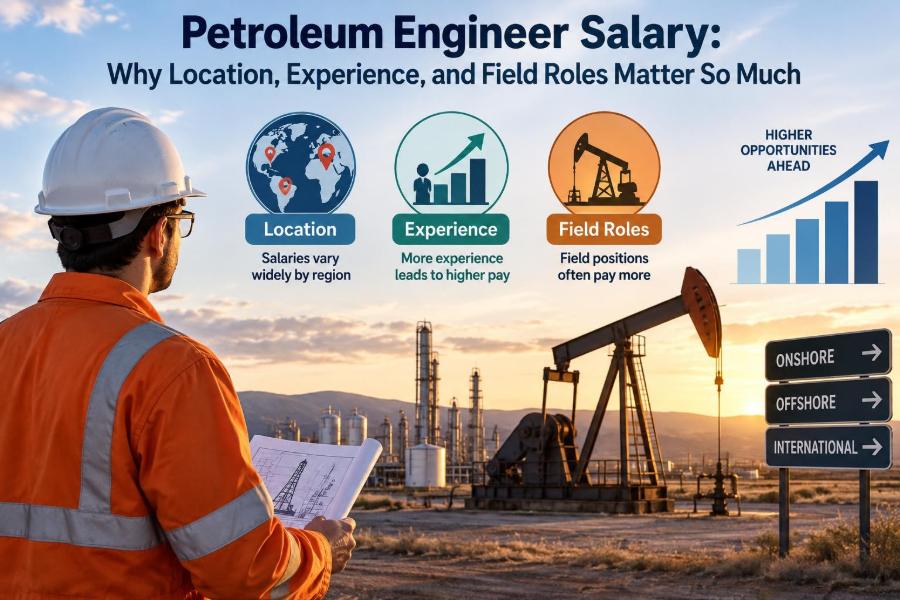
Petroleum engineer salary reflects far more than academic qualification. Location affects labor demand and living costs; experience affects judgment; field roles affect schedule, risk exposure, and operational accountability; and the employer’s business model shapes the entire package.
The most useful question is not “Which petroleum engineering job pays the most?” It is “What responsibilities, conditions, learning opportunities, and trade-offs are attached to this compensation?” That question leads to better comparisons and more durable career decisions.
The strongest petroleum engineering career choices balance compensation with transferable experience, safe working conditions, sustainable personal demands, and responsibility that helps you grow. A salary matters, but the work behind it shapes its real value. 🛢️📍📈