
A production engineer begins the morning by sorting through dozens of alarms from wells, separators, compressors, and water-handling equipment. Some alarms signal a genuine process upset. Others are stale, duplicated, or caused by an instrument that needs attention. The difficult part is not simply seeing the data; it is knowing which signal deserves action first.
At the same time, a field operator may drive hours to inspect a remote well whose behavior could have been reviewed from a control room. A reservoir engineer may update a forecast using production figures that arrived late or were stored in separate systems. These are familiar operational realities, not signs that people are failing at their jobs.
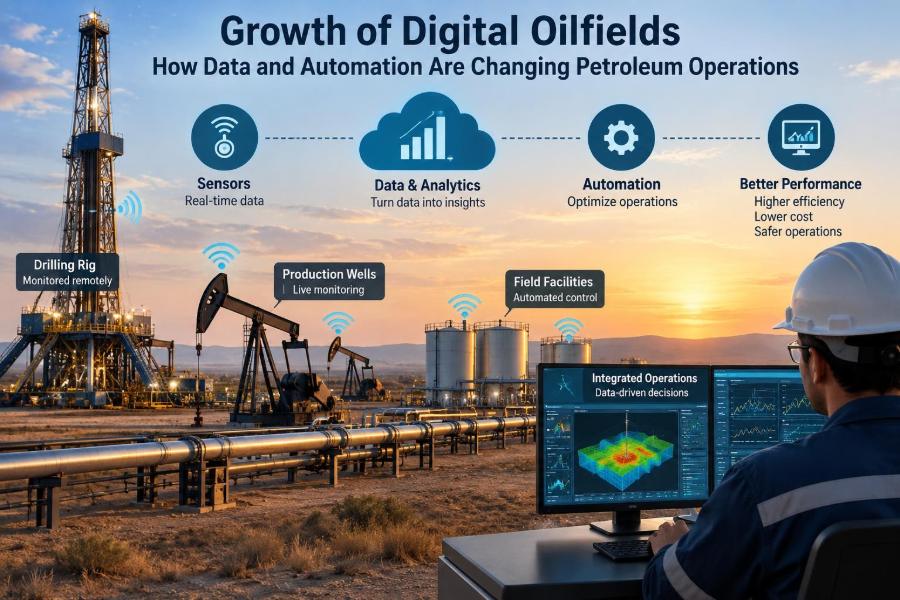
Digital oilfields aim to reduce these gaps by connecting measurements, engineering models, workflows, and decisions. The objective is not to replace petroleum professionals with screens or algorithms. It is to give them a more timely, consistent view of what is happening underground and at the surface.
For students, this shift changes the skills that complement core petroleum engineering. For working professionals, it changes how surveillance, optimization, maintenance, safety, and collaboration are organized. Understanding the limits of digital tools is just as essential as understanding their promise.
🛢️ What a Digital Oilfield Actually Means
A digital oilfield is an operating approach that uses connected data, digital models, analytics, automation, and redesigned workflows to improve petroleum decisions. It can apply to an individual well, a producing field, a pipeline network, or an integrated asset that includes facilities and export systems.
The term does not describe one software package or a fully unmanned installation. A field can become more digital in stages: adding reliable remote measurements, standardizing data, improving surveillance dashboards, or automating a narrow control task.
The defining feature is the connection between information and action. Data must reach the right people or systems in time to support a decision, while the result of that decision should be visible for learning and adjustment.
📈 Why Petroleum Operations Are Becoming More Data-Driven
Petroleum operations have always generated data: well tests, pressure surveys, mud logs, laboratory reports, production allocations, and operator observations. What has changed is the volume, speed, and accessibility of measurements from sensors, control systems, inspections, and connected equipment.
Many assets are also mature, geographically dispersed, or operationally complex. Small losses in uptime, inefficient lift-gas allocation, excess water production, or delayed intervention planning can accumulate over long periods. Better visibility helps teams focus scarce engineering and field resources where they matter most.
Lower-cost computing and improved connectivity have made continuous surveillance more feasible. But the business case still depends on an operational problem being solved, not on collecting more data for its own sake.
🧩 The Difference Between Digitization, Digitalization, and Automation
These related terms are often used interchangeably, yet they describe different changes. Separating them prevents unrealistic expectations and helps teams choose suitable projects.
| Term | Meaning in petroleum work | Example |
|---|---|---|
| Digitization | Converting information into digital form | Scanning completion reports into a searchable repository |
| Digitalization | Using digital information to improve a workflow | Combining well data and test results in a surveillance workflow |
| Automation | Allowing a system to execute a defined task under set conditions | Adjusting a valve position within approved operating limits |
A scanned report is useful, but it does not automatically improve a decision. Likewise, an automated controller may execute commands quickly, but it still needs sound operating constraints, dependable instruments, and clear human accountability.
📡 Sensors: The Field’s Digital Senses
Sensors supply the measurements that make digital operations possible. Common examples include pressure, temperature, flow rate, vibration, level, valve position, electrical load, and chemical injection rate. In wells, permanent downhole gauges may provide pressure and temperature information that supplements surface data.
Every measurement has limits. A flow meter may be accurate only within a certain range; a pressure transmitter may drift; a level reading can be distorted by foam or fluid properties. Engineering interpretation remains necessary because a displayed value is an estimate of a physical condition, not the condition itself.
Good sensor selection starts with a decision question: What action will this measurement support? Installing instruments without defining that answer often creates maintenance burden and unused data.
🌐 Connecting Remote Wells and Facilities
Remote terminal units, programmable logic controllers, supervisory control and data acquisition systems, and communication networks move information between field equipment and operating centers. The exact architecture varies with asset age, location, power availability, communication coverage, and regulatory requirements.
Reliable connection is especially valuable where travel is difficult or operating conditions change rapidly. It can allow operators to see tank levels, shutdown status, wellhead pressure, or compressor performance before dispatching a crew.
Connectivity is not the same as control. A site may send data outward while retaining local safeguards and manual operating capability. This separation can be prudent where communications are intermittent or where an automatic remote response could introduce risk.
🗂️ Data Architecture: Making Information Usable
Production, drilling, maintenance, laboratory, and reservoir data often originate in different systems. A digital oilfield needs an agreed structure for identifying assets, wells, equipment, measurement points, units, timestamps, and data ownership.
Without common naming and context, a dashboard can show conflicting values that are all technically “available.” For example, a well name used by the production database may not match the name in the maintenance system, making it difficult to connect repeated failures with operating conditions.
A practical data architecture does not require placing every file in one giant database. It requires enough governance and integration for users to understand where a value came from, when it was measured, and how it should be used.
✅ Data Quality Before Advanced Analytics
Analytics built on poor data can produce confident but misleading recommendations. Before deploying complex models, teams should examine missing values, impossible readings, duplicated records, incorrect units, inconsistent timestamps, and signals frozen at an old value.
Data quality is an operating responsibility, not only an information technology task. Field teams may identify a faulty instrument first, while engineers recognize an implausible production trend and data specialists maintain validation rules.
- Define acceptable ranges and rate-of-change checks for key tags.
- Preserve flags that distinguish measured, estimated, and manually entered values.
- Record calibration, maintenance, and sensor replacement events.
- Make the source and timing of each important calculation visible.
Cleaning historical data is valuable, but real-time workflows also need a way to identify bad values before they trigger a misleading alarm or recommendation.
⏱️ Real-Time Surveillance and Its Practical Value
Real-time surveillance means reviewing operational data soon enough to influence the next decision. Its useful time scale depends on the problem. Detecting a pressure excursion may require seconds or minutes, while identifying gradual water breakthrough may depend on trends over weeks or months.
For production surveillance, engineers commonly compare rates, pressures, water cut, gas-oil ratio, choke position, and operating status. The goal is to recognize deviations from expected behavior and determine whether they arise from the reservoir, wellbore, artificial-lift system, facility constraints, or data error.
A dashboard alone does not create surveillance. A working process assigns who reviews exceptions, how observations are checked, when action is taken, and how outcomes are documented.
🚨 Alarm Management: Reducing Noise Without Missing Hazards
Alarm floods can overwhelm operators, especially during process disturbances. When too many alarms arrive without priority or context, important warnings may be acknowledged late or treated as routine noise.
Effective alarm management distinguishes between an informational notification, an engineering alert, and an alarm requiring an operator response. Set points should have a defensible purpose, and alarms should be reviewed after incidents, equipment changes, and recurring nuisance events.
Digital tools can group related alerts and show likely equipment context, but they should not suppress warnings casually. Safety-critical alarms require disciplined design, testing, and formal management of change.
🧠 Physics-Based Models Still Matter
Petroleum engineering relies on physical relationships: fluid flow through porous media, pressure losses in tubing, phase behavior, heat transfer, equipment performance, and material balances. These models remain essential in a digital oilfield because they provide interpretable boundaries for decisions.
A well-performance model, for instance, can combine inflow performance with tubing and choke behavior to examine possible operating points. It does not guarantee what the well will do tomorrow, but it helps engineers test whether a proposed choke adjustment is physically plausible.
Models should be calibrated against field data and updated when conditions change. A detailed model built from outdated fluid properties, completion details, or equipment settings can be less useful than a simpler model maintained carefully.
🤖 Machine Learning: Useful Pattern Recognition, Not Magic
Machine learning finds relationships in data that can support classification, prediction, anomaly detection, or recommendation. In petroleum operations, possible applications include identifying unusual pump behavior, estimating missing measurements, screening well candidates, or forecasting equipment condition.
Its strength is pattern recognition across many variables. Its weakness is that a model may learn historical habits, including bad operating practices or misleading correlations. If a model has rarely seen a particular failure mode, it may not recognize it reliably.
For that reason, machine learning is often most effective when paired with engineering constraints and expert review. The question is not whether the algorithm is advanced; it is whether its output changes a decision safely and usefully.
🔍 Hybrid Models Combine Data and Engineering Knowledge
Hybrid models combine physical understanding with data-driven methods. They can use first-principles calculations to impose realistic limits while allowing data-based components to represent relationships that are difficult to model precisely.
Consider a compressor-monitoring workflow. Equipment curves and operating envelopes provide physical context, while historical sensor patterns may help detect early deviations. Together, they can be more interpretable than a black-box prediction alone.
Hybrid approaches are not automatically simpler to implement. They require teams that understand both the process and the available data, plus a clear method for validating recommendations under changing conditions.
🛠️ Predictive Maintenance and Equipment Reliability
Traditional maintenance strategies range from reactive repair after failure to preventive work at scheduled intervals. Predictive maintenance uses condition indicators to estimate when an asset may need attention, allowing work to be planned before a disruption becomes severe.
Vibration, temperature, motor current, pressure differential, run time, starts and stops, and lubricant condition can all provide clues. A rising trend may signal wear, blockage, imbalance, or changing process conditions, but it is not a diagnosis by itself.
A successful program connects the alert to a maintenance action. If a technician cannot inspect the equipment, verify the condition, and feed the result back into the workflow, predictive maintenance becomes another stream of unclosed notifications.
⚙️ Automating Routine Control Tasks
Automation can hold variables near a target more consistently than manual adjustment for repetitive, well-understood tasks. Examples may include maintaining separator level, controlling compressor speed, regulating injection pressure, or sequencing equipment startup under defined conditions.
In production systems, automated control must account for interactions. Increasing a choke opening might raise a well’s rate while affecting separator capacity, sand-production risk, drawdown, or lift-gas availability. Local optimization can damage overall asset performance if constraints are ignored.
Automation should therefore be introduced with clear operating envelopes, tested fallback behavior, and the ability for authorized personnel to understand and intervene when conditions fall outside the design basis.
🎛️ Closed-Loop Optimization Needs Guardrails
Closed-loop optimization goes beyond displaying a recommendation. It uses measurements and a decision logic to adjust operating settings automatically, then observes the response. This can be valuable in stable, repetitive processes with good instrumentation and well-defined constraints.
Guardrails are the non-negotiable boundaries: maximum pressure, minimum flow, temperature limits, equipment operating envelopes, safety-system states, environmental constraints, and approved production strategies. The optimizer must not treat these boundaries as tradeable targets.
Many assets begin with advisory mode, where software recommends a setpoint and an engineer or operator approves it. This provides an opportunity to compare predictions with reality before granting more autonomy.
🛢️ Artificial Lift Optimization
Artificial lift systems offer a practical digital-oilfield use case because they generate measurable operating signals and require continual adjustment. Gas lift, electrical submersible pumps, rod pumps, and other systems each have distinct failure modes and optimization variables.
For gas lift, allocation of limited lift gas across multiple wells can be evaluated against production response curves and facility limits. For an electrical submersible pump, intake pressure, motor load, frequency, fluid conditions, and well behavior can help identify an unsuitable operating region.
Optimization does not mean maximizing every individual well. The best field-level decision may allocate energy, gas, or intervention effort to wells that produce the highest total value while respecting facility and reservoir constraints.
🌊 Water Management Requires an Integrated View
Water production can affect lifting costs, separation capacity, chemical demand, corrosion exposure, disposal or reinjection systems, and environmental risk. The source may be formation water, injected-water breakthrough, completion leakage, or a measurement and allocation issue.
Digital surveillance can connect water cut trends with pressures, injection patterns, zonal information, and facility performance. That broader view helps teams distinguish between a sudden equipment or sampling problem and a gradual reservoir-related change.
There is no universal automated response to rising water. Reducing drawdown, modifying injection, isolating a zone, changing lift conditions, or accepting the water may each be appropriate under different reservoir and facility conditions.
🧪 Digital Support for Drilling and Completions
Digital workflows also affect drilling and completions, where measurements can arrive rapidly and decisions may have immediate operational consequences. Real-time data may include mud properties, flow in and out, torque and drag, vibration, rate of penetration, pressure indicators, and tool status.
These streams can support early recognition of trends such as hole-cleaning deterioration, abnormal pressure indicators, or equipment dysfunction. They do not eliminate uncertainty: subsurface interpretation remains incomplete, and sensors can be affected by conditions or telemetry limitations.
For completions, structured records of perforations, stimulation stages, treatments, and post-job behavior improve later production surveillance. A digital record is especially useful when teams need to interpret well behavior years after the original operation.
🧱 Digital Twins: A Useful but Often Misused Term
A digital twin is a digital representation of a physical asset that is connected, to some degree, with current data and used to understand or predict its behavior. It may represent a pump, well, separator, pipeline segment, or wider facility.
Not every visualization is a twin. A static three-dimensional model may help planning and training, but it becomes a stronger operational twin only when it reflects asset configuration, receives relevant data, and supports a defined decision.
The useful question is simple: what operational decision will the twin improve? If no answer exists, a complex virtual replica may consume effort without creating meaningful operational value.
👥 The Control Room and Field Team Must Work as One System
Remote operations centers can bring production, reservoir, facilities, reliability, and data specialists into a shared view of the asset. This may reduce delays in diagnosing problems and make cross-disciplinary decisions easier.
However, centralization should not disconnect decisions from field reality. Operators and technicians understand access limitations, equipment behavior, weather impacts, and practical work sequencing that may not appear in a dashboard.
The strongest model is collaborative: the control room supplies context and analysis, while field teams verify conditions and execute safely. Clear handovers, escalation paths, and respect for local knowledge are essential.
🧑🏫 Changing Roles for Petroleum Professionals
Digital operations increase the value of professionals who can translate between disciplines. A reservoir engineer who understands data provenance, a production engineer who can frame an optimization problem, and a data specialist who understands operating constraints can all improve outcomes.
Core petroleum knowledge remains central. Decline analysis, nodal analysis, well integrity, phase behavior, reservoir drive mechanisms, and process safety are what allow teams to judge whether a digital output makes engineering sense.
Useful complementary skills include basic programming or query logic, visualization, statistics, time-series interpretation, version control, and clear communication of uncertainty. Professionals do not need to become specialists in every tool, but they should understand how tools affect decisions.
🔐 Cybersecurity Is Part of Process Safety
Connecting operational technology creates potential pathways for cyber incidents. Operational technology includes control systems and devices that interact with physical processes, unlike ordinary office systems that primarily manage information.
A cyber event can affect availability, data integrity, or control. The response is not simply to isolate every system; it is to design layered protections, control access, manage patches carefully, segment networks, monitor unusual activity, and prepare recovery procedures.
Changes to industrial control environments must be assessed with operational safety in mind. A security update or new connection can have consequences for availability, so cybersecurity, engineering, operations, and maintenance teams need coordinated governance.
🦺 Functional Safety Cannot Be Delegated to Software
Safety instrumented functions, emergency shutdown systems, relief systems, and operating procedures exist to prevent or mitigate hazardous events. Digital analytics may provide additional awareness, but they do not replace independent protective layers.
Any change that influences process control should go through the organization’s management-of-change process. Teams need to assess failure modes, loss of communication, bad sensor inputs, incorrect model assumptions, and human-machine interface behavior.
Automation should make safe work easier, never make safety assumptions invisible. Operators must know what an automated system can do, when it has been bypassed, and how to place equipment in a safe state.
🌍 Emissions, Energy Use, and Environmental Monitoring
Digital tools can help identify inefficient operation that contributes to energy use or emissions, such as unnecessary compressor loading, recurring flaring conditions, leaking equipment, or unstable process control. Continuous monitoring can also improve the speed with which abnormal conditions are investigated.
Measurement quality and coverage remain limiting factors. An emissions estimate derived from operating data is not equivalent to a direct measurement, and its uncertainty should be understood before it is used for reporting or major decisions.
Environmental value comes from combining monitoring with accountable action: repairing leaks, improving maintenance, changing operating practice, or redesigning equipment where justified. A dashboard that does not lead to follow-through has limited impact.
💰 Building a Business Case Around Decisions
Digital projects are stronger when they begin with a specific operating decision and a measurable pain point. Examples include reducing unplanned downtime, shortening time to diagnose production losses, improving test allocation, avoiding unnecessary field visits, or improving maintenance planning.
Costs include instruments, communications, integration, licenses or cloud services, cybersecurity, training, process redesign, and ongoing support. Benefits may be financial, safety-related, environmental, or operational, and some will be harder to quantify than others.
A pilot should test the full workflow, not merely prove that data can be displayed. Ask whether users trusted the output, whether it changed actions, and whether the observed result can reasonably be attributed to the new process.
🚧 Common Reasons Digital Projects Disappoint
One common failure is technology-first thinking: selecting a platform or algorithm before defining the operational problem. Another is treating a prototype as a finished product, without funding the maintenance, ownership, cybersecurity, and user support required for long-term use.
Projects also falter when they ignore how work is actually done. A dashboard may be technically sound but unused if it does not fit shift routines, approval authority, field connectivity, or the time available to review alerts.
- Trying to integrate every data source before delivering a useful first capability.
- Using historical data without checking whether operating conditions have changed.
- Hiding uncertainty behind a single recommendation or score.
- Failing to assign ownership for models, alarm rules, and data corrections.
- Measuring project success by number of screens rather than decision quality.
These problems are solvable, but they require operational leadership as well as technical skill.
🧭 A Sensible Implementation Path
Start with a narrow, high-frequency decision where delay, inconsistency, or poor visibility causes a real cost or risk. Map the current workflow from measurement to action, including handoffs, assumptions, approvals, and exceptions.
- Define the decision, user, timing, and operating constraints.
- Check that essential measurements are reliable and contextualized.
- Build a simple workflow or advisory tool before pursuing full automation.
- Validate outputs against engineering knowledge and field observations.
- Train users, capture feedback, and establish support ownership.
- Scale only after the process demonstrates repeatable value.
This sequence helps organizations learn cheaply. It also makes it easier to stop or redesign a project that does not deliver useful results.
📚 Skills Students Can Develop Now
Students preparing for digital petroleum work should first build strong fundamentals in reservoir engineering, production systems, drilling, facilities, and safety. Digital tools are most valuable when applied by someone who understands the physical system and its uncertainties.
Then practice working with real-looking data sets: plot time series, check units, identify outliers, calculate simple balances, and explain what a trend may and may not mean. Learn enough statistics to distinguish correlation from causation and enough coding or spreadsheet automation to make repetitive analysis transparent.
Communication is equally valuable. A useful engineer can explain a technical recommendation to an operator, manager, data scientist, or maintenance planner without hiding uncertainty or overwhelming the audience with jargon.
🔮 What Will Remain Human-Centered
As automation expands, people will still define objectives, weigh trade-offs, investigate unusual conditions, approve consequential changes, and take responsibility for safe operations. Reservoir behavior, equipment condition, market context, and field realities often contain uncertainty that cannot be reduced to a single automated answer.
The most productive question is not “Will software replace engineers?” It is “Which decisions can be made more consistent, timely, and transparent when engineers use better information?” That framing directs attention toward work design rather than fear or hype.
Digital oilfields will likely continue to develop unevenly across assets. Older infrastructure, remote locations, data gaps, and varying organizational capability mean that the right level of automation will differ from one operation to another.
🧠 The Core Principle: Better Decisions, Not More Screens
The growth of digital oilfields is fundamentally about linking reliable information to disciplined action. Sensors, models, analytics, remote operations, and automated controls can help petroleum teams see problems earlier and manage complex systems more consistently.
Yet every layer depends on the ones beneath it: trustworthy measurements, sound engineering, safe operating limits, cybersecurity, clear ownership, and workers who understand both the process and the tool. Sophisticated analytics cannot compensate for missing context or weak operating discipline.
The best digital programs begin with a real field or facility problem, preserve human judgment where uncertainty is high, and automate only where the process is understood and guardrails are strong.
Digital oilfields succeed when data helps people make safer, clearer, and more timely petroleum decisions—not when technology is treated as the decision-maker. 🛢️📊⚙️