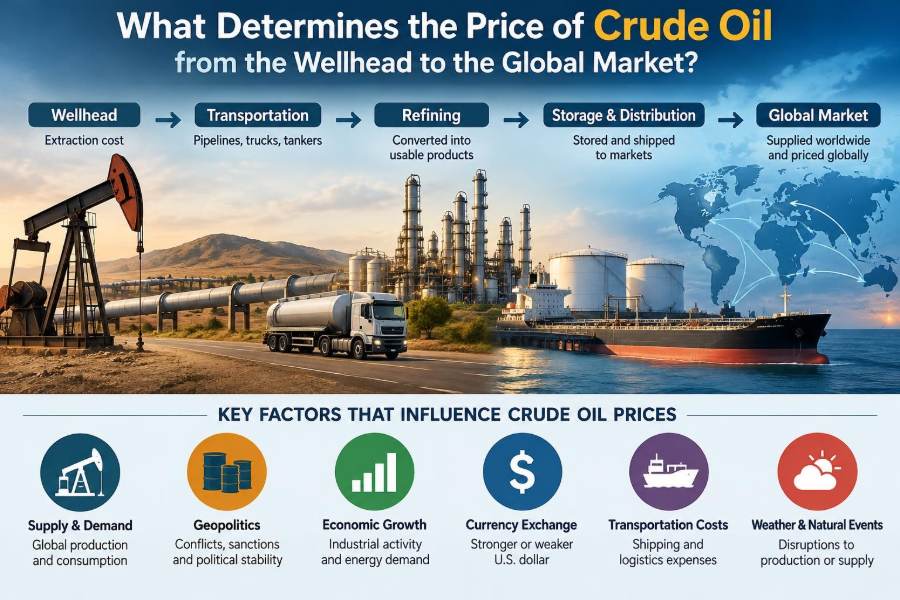

A producer may watch a benchmark crude price rise on a market screen and still receive a disappointing price for a barrel leaving a remote field. Meanwhile, a refinery may pay a premium for a crude stream that looks, at first glance, similar to another one selling at a discount.
That apparent contradiction is central to petroleum economics. “Oil price” is not one universal number. It is a chain of prices, deductions, quality adjustments, transport costs, contractual terms, and market signals that change as crude moves from a reservoir to a refinery.
For students, this explains why production decisions cannot be based on headline prices alone. For working professionals, it connects reservoir performance, facilities reliability, marketing, logistics, and commercial strategy to the revenue ultimately received.
Understanding the path from the wellhead to the global market turns a vague question—“What is oil selling for?”—into a more useful one: which barrel, delivered where, at what quality, under which commercial conditions?
🛢️ There Is No Single “Price of Oil”
News reports often quote a price for a benchmark such as Brent or West Texas Intermediate (WTI). These are valuable reference points, but they are not automatically the cash price received by every producer.
A barrel has different economic values at different locations. Its value can be described at the lease, at a pipeline delivery point, at an export terminal, or when delivered to a refinery. Each point includes a different set of costs and risks.
In practical terms, the crude price a producer receives is usually a netback: the realized sales value after applicable price differentials, transport charges, quality adjustments, and other deductions.
📍 The Wellhead Is the Starting Commercial Point
The wellhead is where produced fluids first leave the well and enter surface equipment. It is a physical and commercial starting point, but the material flowing there is rarely ready-to-sell crude oil.
Early production may contain oil, natural gas, produced water, sand, and chemical-treatment residues. The operator must separate and condition these streams before oil can meet a buyer’s specification.
A wellhead price, where it is used in a contract or regulation, therefore does not simply mean “the market price minus nothing.” It reflects the agreed transfer point and the condition of the hydrocarbons at that point.
🧪 Crude Quality Begins with API Gravity
API gravity expresses how dense a petroleum liquid is relative to water. Higher API gravity generally indicates a lighter crude; lower API gravity indicates a heavier crude.
Density matters because refineries are designed to process particular crude slates. Lighter crudes often yield more light products through simpler processing, while heavier crudes may require equipment such as cokers or hydrocrackers to convert their heavier fractions efficiently.
Light crude is not always worth more in every location. A refinery optimized for heavier feedstock may value a suitable heavy crude, particularly if it can capture a favorable discount while using its conversion capacity well.
🌡️ Sulfur Content Shapes Refining Value
Crude is commonly described as sweet when it has relatively low sulfur content and sour when sulfur content is higher. Sulfur must be managed because fuel-product specifications and refinery equipment constraints limit how much sulfur can remain in finished products.
Processing sour crude generally requires more sulfur-removal capacity and creates hydrogen demand, operating complexity, and sulfur-handling obligations. For that reason, sour crude often trades below a comparable sweet crude.
The discount is not fixed. It expands or narrows with refinery utilization, hydrogen economics, available sour-crude supply, product demand, and the ability of regional refiners to process the grade.
🧫 Other Assay Properties Matter Too
API gravity and sulfur are useful shorthand, but they do not fully define a barrel. A refinery evaluates a crude assay: a detailed description of its physical properties and expected product yields.
Relevant properties can include acidity, metals, salt, pour point, viscosity, wax content, distillation profile, and carbon residue. Some properties affect corrosion; others influence fouling, transportation, storage, or the amount of valuable product produced.
Two crudes with similar API gravity and sulfur can therefore have meaningfully different values. The refinery does not buy labels alone; it buys an expected processing outcome.
🏭 Refinery Configuration Creates Different Buyers
A simple refinery mainly separates crude into fractions. A complex refinery has additional conversion and treating units that can upgrade heavier or sourer feedstocks into higher-value products.
This difference explains why the same grade can have different demand in different regions. A complex coastal refinery may compete strongly for a discounted heavy sour crude, while a simpler refinery may avoid it.
Crude valuation is therefore linked to the marginal refinery—the buyer whose processing economics help determine what the next available barrel is worth in that market.
📊 Benchmarks Provide a Common Pricing Language
Benchmarks allow buyers and sellers to price many different crude streams without renegotiating an entirely new price every day. A contract may describe a grade as a premium or discount to a recognized benchmark.
Brent-related pricing is widely associated with seaborne crude trade, while WTI-related pricing is influential in North American markets. Other regional markers and assessed grades also support local trading.
A benchmark should be treated as a pricing reference, not as a universal quality ranking. Its usefulness comes from liquidity, transparent market participation, delivery arrangements, and its connection to real physical barrels.
➕ Differentials Turn Benchmarks into Grade Prices
The differential is the amount added to or subtracted from a benchmark to price a specific crude. It captures the gap between the benchmark barrel and the actual barrel being sold.
A simplified formula is:
Grade price = Benchmark price + or − Quality and location differentialFor example, a hypothetical crude may be sold at a discount to a benchmark because it is heavier, more sour, or farther from the buyer. If a supply disruption makes that particular grade scarce, its discount may shrink even if the benchmark itself barely moves.
🚛 Location Can Be as Valuable as Quality
A high-quality crude stranded far from a refinery or export terminal can realize less than a lower-quality crude located on a well-connected coast. Markets reward barrels that can reach buyers reliably and at low marginal cost.
Location value is shaped by pipelines, storage, ports, waterways, rail access, local refinery demand, and border or export arrangements. It is also shaped by congestion: a route has little value if capacity is already fully committed.
This is why a price gap between regions may persist. Arbitrage closes the gap only when someone can physically move the barrel and still earn a margin after costs and timing risks.
🛤️ Pipeline Capacity Influences Local Prices
Pipelines are usually the lowest-cost way to move large, sustained volumes onshore, but they require available capacity and compatible quality specifications. When a producing basin adds supply faster than takeaway infrastructure, local crude can trade at a larger discount.
Conversely, new pipeline access to a refinery hub or export terminal can improve a producer’s netback. The effect is not automatic: tariffs, nomination rules, committed capacity, and downstream constraints still matter.
Operational outages can have the opposite effect. A temporary restriction may leave producers competing for limited transport, weakening the local price even while the broader market remains firm.
🚢 Seaborne Freight Connects Regional Markets
Once crude reaches an export terminal, tanker freight becomes a major part of delivered cost. Freight depends on vessel availability, voyage distance, port delays, fuel costs, insurance, canal routes, and geopolitical conditions.
A refinery deciding between two imported grades compares their delivered cost, not merely their loading-port price. A cheap cargo can lose its advantage if freight rises sharply or the voyage becomes longer and riskier.
Freight also affects who can compete for a cargo. A crude that is economical for a nearby refinery may be uneconomic for a distant buyer during a period of tight vessel availability.
🧮 Incoterms and Delivery Points Change the Comparison
Commercial terms specify who is responsible for freight, insurance, and delivery at each stage. A crude offered free on board at a terminal is not directly comparable with one offered on a delivered basis without accounting for those obligations.
The transfer point affects who bears logistical uncertainty. If the seller’s obligation ends at loading, the buyer manages the voyage. If the seller commits to delivery at a destination, the seller takes on more freight and timing exposure.
When comparing reported prices, always ask: where is title transferred, and which costs are included? A price label without that context can lead to poor commercial conclusions.
🧱 Gathering, Treatment, and Blending Add Costs
Before pipeline transport or sale, oil commonly passes through gathering lines, separators, heaters, tanks, dehydration units, and custody-transfer measurement systems. These facilities make crude marketable, but they consume energy, chemicals, labor, and maintenance spending.
Blending may also be necessary. A producer might combine streams to achieve a target density, viscosity, or sulfur level, or dilute very heavy crude so it can flow through a pipeline.
Blending can create value when it meets a desirable specification. It can also reduce value if a premium stream is mixed into a lower-value pool without a commercial benefit that justifies the loss.
💧 Water, Sediment, and Salt Affect Saleability
Crude buyers specify limits for basic sediment and water, often abbreviated as BS&W, as well as salt and other contaminants. Excess water increases the volume being transported without adding oil value, while salt can contribute to corrosion and fouling in refinery equipment.
Off-spec crude may require reprocessing, blending, a price deduction, or rejection. These outcomes can be expensive because they disrupt tank management and planned cargo schedules.
Strong production operations protect value by monitoring separation performance, tank quality, sampling practices, and chemical treatment—not merely by maximizing gross liquid volume.
🧾 Custody Transfer Makes Volume and Quality Bankable
Custody transfer is the point where ownership changes and measurements become the basis for payment. Metering, tank gauging, sampling, laboratory analysis, temperature correction, and density determination all affect the final invoice.
A small measurement discrepancy can matter when volumes are large. Clear procedures, calibrated equipment, representative samples, and agreed dispute-resolution methods are therefore commercial necessities, not paperwork afterthoughts.
Contracts often define the measurement standard, acceptable tolerances, testing frequency, and what happens when a result falls outside specification. Engineers involved in facilities design should understand these requirements early.
📦 Storage Creates Timing Flexibility
Storage allows producers, traders, and refiners to manage timing mismatches. A tank can hold crude while a pipeline slot, vessel, refinery intake window, or more attractive sales opportunity is arranged.
But storage is not free. Tank capacity, evaporation and handling losses, financing, insurance, and inventory risk all have costs. Some crudes also require circulation, heating, or careful segregation to maintain quality.
When storage is scarce, sellers may have less ability to wait for better market conditions. This can pressure local prices, especially when production continues but transport outlets are constrained.
📈 Supply and Demand Set the Broad Market Direction
Physical characteristics and logistics shape individual grade prices, but global supply and demand establish the wider price environment. If available supply is tight relative to refinery demand and inventory needs, benchmark prices tend to receive support.
Demand comes largely from refinery runs, which respond to fuel consumption, petrochemical feedstock needs, seasonal patterns, refinery maintenance, and product margins. A refinery does not process crude simply because crude is cheap; it must expect a viable return from products.
Supply includes producing capacity, actual output, declines in mature fields, unplanned outages, inventory releases, and the speed at which additional barrels can reach the market.
🔄 Inventories Reveal Pressure but Not the Whole Story
Commercial and strategic inventories can cushion short-term disruptions or absorb excess supply. Falling inventories may indicate that demand exceeds current supply, while rising inventories can signal the reverse.
However, inventory interpretation requires care. Stocks may shift between regions, be held in transit, be unavailable because of quality mismatch, or rise temporarily during refinery maintenance.
The useful question is not just whether inventories changed, but which grades changed, where they are located, and whether they are accessible to the relevant refinery system.
⏳ Time Spreads Influence Decisions to Store or Sell
Oil markets trade barrels for different delivery months. The relationship between near-term and later prices is called the time spread or forward curve.
When future prices are sufficiently higher than prompt prices, storage may become more attractive if the spread covers storage, financing, and operational costs. When prompt barrels command a premium, holders may prefer to sell sooner.
These relationships influence trading behavior and inventory movement, but they should not be read as certain forecasts. Forward prices reflect current market expectations and risk pricing, not guaranteed future outcomes.
💱 Currency and Financing Affect International Trade
Crude is commonly priced in U.S. dollars in international markets, so currency movements can alter the local-currency cost faced by buyers and the local-currency revenue received by producers.
Financing also matters because cargoes tie up capital from purchase through transport and delivery. Interest rates, payment terms, credit quality, and letters of credit can affect the economics of holding or moving physical crude.
These factors are usually secondary to supply, demand, and quality in the short run, but they can influence margins and purchasing behavior, particularly for import-dependent refiners.
⚠️ Geopolitical Risk Changes More Than Supply Volumes
Conflict, sanctions, trade restrictions, piracy risk, and political instability can affect crude markets by disrupting output, redirecting trade routes, raising insurance costs, or making particular barrels difficult to finance or accept.
The market response is often about uncertainty as much as immediate lost supply. Buyers may seek alternative grades before an outage occurs, while sellers may offer discounts to attract buyers willing and able to manage additional constraints.
It is risky to assume every geopolitical headline produces a lasting price move. The impact depends on the credibility, duration, scale, and substitutability of the threatened supply.
🌪️ Weather and Operational Reliability Matter Locally
Storms, extreme cold, flooding, drought, and other weather conditions can disrupt production, power supply, port operations, pipelines, or refinery runs. Their price effect depends on which part of the system is interrupted.
A production shut-in may reduce local supply. A port closure may trap barrels inland. A refinery outage may weaken demand for nearby crude. The same weather event can therefore support one price point while depressing another.
Reliability engineering has a direct commercial dimension. Redundant power, maintained pumps, emergency inventory, and clear shutdown procedures can reduce lost production and protect a producer’s ability to meet sales commitments.
🏛️ Regulations Shape Costs and Market Access
Environmental rules, pipeline approvals, flaring limits, marine standards, taxes, royalties, export controls, and reporting obligations can all alter the economics of crude production and movement.
These rules are not merely “costs.” Some reduce environmental harm, improve safety, or create clearer operating expectations. Yet compliance requirements can change the attractiveness of a field, route, or export option.
Because regulations vary by jurisdiction and can change, commercial teams should avoid treating a historical netback as permanently representative of future value.
🤝 Contracts Allocate Price Risk
Physical crude can be sold through spot transactions, term contracts, producer marketing arrangements, or integrated-company transfers. Each approach allocates price, volume, quality, and delivery risk differently.
A term agreement may provide a dependable outlet for production, which is valuable for a field with limited transport alternatives. A spot sale may offer flexibility and capture a favorable market window, but it can expose the seller to weaker demand when barrels become available.
Contract clauses covering nomination, tolerances, force majeure, quality claims, payment, and pricing dates are as consequential as the headline differential.
🛡️ Hedging Manages Exposure, Not Physical Value
Producers and consumers may use futures, swaps, or options to reduce exposure to benchmark price movements. Hedging can help stabilize cash flows and support investment planning.
It does not eliminate basis risk: the risk that the producer’s local grade price moves differently from the benchmark used in the hedge. A producer can hedge benchmark prices successfully yet still suffer from a widening local transport differential.
Hedging also has financial, accounting, collateral, and governance implications. It should be aligned with physical production volumes and risk tolerance rather than treated as a substitute for strong marketing and logistics.
🧠 A Simple Netback Calculation
A netback calculation connects market value to field economics. The exact formula varies by contract and accounting practice, but the logic is straightforward: begin with the price achieved at a recognized sales point and subtract the costs necessary to reach it.
| Illustrative component | Effect on producer value |
|---|---|
| Benchmark price | Starting market reference |
| Grade differential | Adds or subtracts for quality and local supply-demand conditions |
| Pipeline, terminal, and freight charges | Reduces net revenue unless paid by the buyer |
| Quality deductions and losses | Reduces value for off-spec material, water, or handling losses |
| Royalties and applicable fiscal charges | Further reduce revenue available to the producer |
For a hypothetical example, a field may be linked to a strong benchmark but still have a modest netback because its heavy crude requires diluent and travels through a congested route. The benchmark is only the first line of the calculation.
🔧 Production Costs Are Different from Market Price
Market price determines revenue, while production cost determines how much of that revenue remains after operating, transport, and capital obligations. Confusing the two can distort investment decisions.
A mature field may have low incremental operating cost but high maintenance needs. A new offshore development may have substantial upfront capital requirements yet low operating cost once it is producing. Neither profile can be judged using a single headline oil price.
Decision-makers also distinguish between short-run shut-in choices, development sanction decisions, and long-term abandonment decisions. Each uses a different relevant cost and risk horizon.
🧭 Why the Same Field Can Realize Different Prices Over Time
A field’s geology may not change much, but its realized price can move substantially. Pipeline availability, local production growth, refinery outages, export capacity, blending needs, and buyer competition all evolve.
Quality can change too. Water cut may rise as a reservoir matures, treatment performance may shift, or produced fluids from new wells may alter the blended stream. These changes can affect both saleable volume and grade value.
Regularly updating price assumptions is essential in reserves economics, development planning, and operating budgets. Static differentials are convenient, but they can conceal a real commercial risk.
🔍 Common Mistakes When Reading Oil Prices
Several shortcuts produce misleading conclusions:
- Assuming a benchmark quote equals the producer’s revenue.
- Comparing prices quoted at different locations or under different delivery terms.
- Using API gravity and sulfur as the entire definition of quality.
- Ignoring transport capacity, not just transport distance.
- Confusing a temporary disruption with a permanent change in market balance.
- Assuming a hedge removes all price exposure.
A better habit is to identify the grade, quality specification, pricing basis, delivery location, timing, and deductions before making a comparison.
🎓 Practical Questions for Petroleum Engineers
Engineers do not need to become traders to improve commercial outcomes. They do need to recognize how technical choices affect barrel value.
- Will the produced crude meet pipeline and refinery specifications?
- Does the facility have enough separation, dehydration, heating, and storage capacity?
- Could a change in blending improve flow assurance but reduce net value?
- What is the revenue consequence of downtime during a constrained transport period?
- Does the development plan depend on an export route that is not yet available?
These questions help connect reservoir and facilities decisions with the commercial system that pays for them.
🌍 The Core Principle: A Barrel Is Valued in Context
Crude oil pricing is best understood as a series of adjustments rather than a single market number. Global supply and demand establish the broad environment, but quality, refinery fit, location, logistics, contract terms, and risk determine what a particular barrel earns.
A useful mental model is to picture every barrel competing for a place in a refinery. The winning value is not based only on what is inside the barrel; it also depends on how reliably, safely, and economically that barrel can reach the refinery that can use it.
For petroleum professionals, the commercial objective is not simply to produce more liquid. It is to deliver saleable, specification-compliant crude to the best accessible market at a cost and risk level that preserves value.
The price of crude oil is ultimately the value of a specific quality of barrel, at a specific place and time, after the real costs of getting it to a willing buyer are recognized. That is why wellhead operations and global markets are connected more closely than they first appear. 🛢️📈🌍