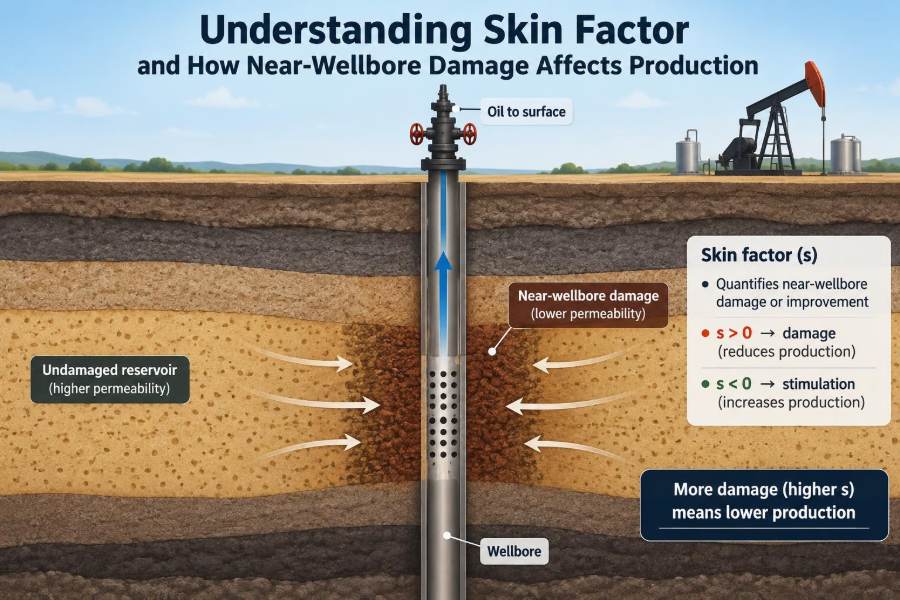

A well can have a productive reservoir, adequate pressure, and a sound completion design yet still deliver less oil or gas than expected. When that happens, attention often turns to the short interval of rock immediately surrounding the wellbore.
This region is small compared with the full drainage area, but it is where all produced fluids must converge before entering the well. A modest restriction there can create a disproportionate pressure loss and make an otherwise capable well look disappointing.
Skin factor is the engineering term used to describe this extra flow resistance near the wellbore. It gives reservoir and production engineers a practical way to quantify whether the near-wellbore region is helping production, harming it, or behaving close to ideal.
Understanding skin is useful far beyond well-test interpretation. It affects completion choices, stimulation design, production forecasting, diagnosis of declining wells, and decisions about whether an intervention is likely to pay off.
🧭 The Basic Meaning of Skin Factor
Skin factor, usually written as s, is a dimensionless measure of additional pressure drop caused by altered flow conditions close to a wellbore. In its simplest interpretation, it compares the real near-wellbore flow path with the flow path expected in undamaged reservoir rock.
A positive skin indicates extra resistance. A negative skin indicates reduced resistance, commonly because a stimulation treatment has improved the connection between the well and the reservoir.
Skin is not a direct measurement of permeability, porosity, or damage thickness. It is a convenient summary of how the near-wellbore condition changes the pressure required to produce a given rate.
🚪 Why a Small Zone Can Control Production
Reservoir flow toward a vertical well is approximately radial: fluid moves from a broad outer area toward an increasingly smaller circumference near the wellbore. As the flow converges, velocity increases close to the well.
That convergence makes the near-wellbore region unusually sensitive. If permeability is reduced only a short distance from the well, every barrel of liquid or volume of gas must pass through that restricted zone.
A useful analogy is a wide highway feeding into a single narrowed tunnel. The highway may be clear, but the tunnel still controls throughput. In a well, the damaged zone acts as that bottleneck.
📐 The Pressure-Drop View of Skin
For radial Darcy flow, engineers often express the additional near-wellbore pressure drop as:
Δp_skin = (q μ B / 2πkh) sIn field-unit forms of the equation, the numerical constant changes, but the physical message does not: higher rate, fluid viscosity, and formation volume factor increase the pressure penalty, while greater permeability and completed thickness reduce it.
Here, q is flow rate, μ is viscosity, B is formation volume factor, k is permeability, and h is net completed thickness. The equation is an idealized representation, so multiphase flow, non-Darcy effects, and complex completions require more careful interpretation.
➕ Positive, Zero, and Negative Skin
| Skin condition | General meaning | Common interpretation |
|---|---|---|
| Positive skin | Extra near-wellbore pressure loss | Damage, restricted perforations, partial penetration, or other flow restriction |
| Near-zero skin | Little additional resistance beyond the idealized model | Reasonably effective well-reservoir connection |
| Negative skin | Less resistance than the ideal radial-flow reference | Successful acidizing, fracturing, or highly conductive near-wellbore flow paths |
Zero skin should not be treated as a universal “perfect well” target. A real well may have geometrical or completion effects that are represented as skin even when no formation has been chemically or mechanically damaged.
🪨 What Near-Wellbore Damage Actually Means
Near-wellbore damage is an impairment of fluid flow in the formation immediately around the well. It may involve reduced effective permeability, blocked pore throats, altered wettability, trapped fluids, fines movement, or a combination of mechanisms.
The word “damage” can be misleading if used casually. Some restrictions are created during drilling or completion, while others develop later during production, injection, pressure depletion, or changes in fluid chemistry.
Engineers therefore distinguish between the observed skin value and the physical mechanism causing it. The same positive skin can arise from very different problems.
🛠️ Damage Introduced During Drilling
Drilling exposes the formation to mud filtrate, solids, pressure differences, and mechanical disturbance. If the well is drilled overbalanced, mud pressure exceeds formation pressure and can drive filtrate and fine solids into the rock.
Solids may form an external filter cake on the borehole wall, while finer particles and filtrate can invade deeper. In a susceptible formation, this can lower permeability around the wellbore.
Drilling fluid design aims to balance well control with formation protection. A fluid that is effective for borehole stability may still create productivity challenges if its solids, filtrate, or chemistry are poorly matched to the reservoir.
🧪 Completion Fluids and Chemical Incompatibility
Completion brines, kill fluids, spacer fluids, and stimulation additives can cause problems when they react unfavorably with formation minerals or reservoir fluids. Scale precipitation, clay swelling, emulsions, and insoluble residues can all reduce flow capacity.
For example, mixing waters with incompatible ionic compositions may promote mineral precipitation. In clay-bearing rocks, changes in salinity or pH can sometimes destabilize clay minerals and encourage pore-throat restriction.
Laboratory compatibility testing helps reduce these risks, but it cannot reproduce every reservoir condition. Temperature, pressure, fluid residence time, and local mineral variation all matter.
🧱 Solids Invasion and Pore-Throat Plugging
Many reservoirs contain pore throats far smaller than the visible grains in a core sample. Fine drilling solids, corrosion products, scale particles, and formation fines can lodge at these narrow passages.
The key issue is not merely whether particles enter the formation; it is whether they bridge, accumulate, or migrate into a location where they restrict flow. A thin layer with severe plugging can matter more than a thicker zone with only mild permeability reduction.
Clean-fluid practices, filtration, and careful displacement procedures are practical controls. Their value is greatest before damage occurs, because restoring original permeability is not always straightforward.
💧 Water Blocking and Relative Permeability
A well may show positive skin even when the rock’s absolute permeability has changed little. If water invades a gas-bearing or oil-bearing zone near the well, it can raise water saturation enough to reduce the relative permeability to the desired hydrocarbon phase.
Relative permeability describes how easily one fluid flows when other fluids occupy part of the pore space. Water blocking is particularly troublesome in low-permeability gas reservoirs, where capillary forces can retain water near the wellbore.
Because the problem is phase behavior and saturation distribution, a treatment designed only to dissolve mineral deposits may not solve it. Diagnosis must precede treatment selection.
🧲 Fines Migration and Clay Sensitivity
Formation fines are small mineral particles that may remain stable under original reservoir conditions but move when velocity, salinity, pH, or stress conditions change. Once mobilized, they can plug smaller pore throats downstream.
Clay-rich formations deserve particular attention because some clays can swell or disperse when contacted by incompatible water. Yet clay sensitivity varies widely by mineral type and rock fabric; assumptions based only on a formation name are risky.
Fluid design, controlled drawdown, and appropriate brine salinity may reduce the likelihood of fines-related impairment. Core and fluid testing can clarify whether fines migration is a credible mechanism.
⚗️ Scale, Wax, Asphaltenes, and Organic Deposits
Restrictions close to the well are not always inside the rock. Mineral scale can accumulate in perforations, tubulars, and pore spaces when pressure, temperature, or water chemistry changes. Common scale-forming systems depend on the produced-water composition and operating conditions.
Wax deposition and asphaltene precipitation can also reduce flow area. Wax is often associated with cooling below conditions favorable for its deposition, while asphaltene behavior is influenced by fluid composition and pressure changes.
These mechanisms may produce symptoms resembling formation damage, but the remedy can differ greatly. A solvent, scale dissolver, inhibitor, or mechanical cleanout may be more suitable than an acid treatment.
🔩 Perforations Can Create Apparent Skin
In cased-hole completions, fluids must pass through perforation tunnels before entering the well. Limited perforation density, short tunnels, crushed zones around perforations, debris, poor phasing, or inadequate penetration can all add pressure loss.
This contribution is often called perforation skin. It is a completion-related restriction rather than necessarily a damaged formation matrix.
Perforating design depends on rock strength, expected flow rate, casing geometry, anisotropy, and cleanup behavior. More shots are not automatically better if they create undesirable communication with water or gas intervals.
📏 Partial Penetration and Geometric Skin
If a well is completed through only part of the productive interval, fluid must converge vertically as well as radially to enter the open section. That extra convergence increases pressure loss and is commonly represented as partial-penetration skin.
The effect can be significant in thick formations, anisotropic reservoirs, or wells completed over a limited pay interval. It may be intentional when operators are avoiding water, gas, weak rock, or unwanted zones.
This is a reminder that positive skin is not automatically a failure. Sometimes it is the production cost of managing another reservoir risk.
🌪️ Turbulence and Rate-Dependent Skin
At high velocities, especially in gas wells and near perforations or fractures, flow may depart from the simple linear Darcy relationship. The pressure drop can rise more rapidly than rate alone would predict.
This behavior is often represented by a rate-dependent or non-Darcy skin component. A well may appear acceptable at modest rates but show a sharp productivity loss when drawdown increases.
Reducing this problem may involve larger flow areas, improved perforation design, fracture conductivity, or operating at a rate where the additional pressure loss is economically acceptable. It is not always evidence of conventional formation damage.
📊 Skin in Well-Test Analysis
Pressure-transient testing uses pressure and rate behavior to infer reservoir and well properties. During suitable flow periods, analysts can estimate permeability-thickness, pressure boundaries, wellbore storage, and skin.
The reported skin is model-dependent. It reflects the assumptions used for well geometry, boundaries, fluid behavior, multiphase effects, and the chosen interpretation interval.
A single test result should therefore be treated as evidence to integrate with completion records, production history, logs, fluid samples, and operating conditions—not as a complete diagnosis by itself.
⏱️ The Role of Buildup and Drawdown Tests
In a pressure buildup test, a producing well is shut in and pressure recovery is measured. In a drawdown test, pressure response is observed as production begins or changes. Both can reveal near-wellbore behavior when quality pressure and rate data are available.
Early-time data are often strongly affected by wellbore storage, meaning the measured response initially reflects fluid expansion or movement in the well rather than the reservoir. Misidentifying this period can distort a skin estimate.
Practical testing requires stable gauges, reliable rate history, and a test duration long enough to see useful flow regimes. Operational constraints often limit the ideal test design.
🧮 Productivity Index and Production Consequences
For a liquid-producing well, productivity index (PI) is commonly defined as production rate divided by drawdown. Higher skin raises the drawdown needed to achieve a given rate, reducing PI when other conditions remain comparable.
Suppose a hypothetical oil well has sufficient reservoir pressure but cannot meet its target rate without pulling flowing bottomhole pressure too low. Positive skin may be consuming part of the available pressure drawdown that should be driving flow through the larger reservoir.
The production impact depends on reservoir permeability, fluid properties, completion thickness, and artificial-lift limits. The same skin value is generally more consequential in a low-permeability reservoir than in a highly permeable one.
📉 Skin Can Change Over a Well’s Life
Skin is not necessarily fixed after completion. Cleanup may lower skin during early production, while scale deposition, fines migration, increasing water cut, changing stress, or damage from workover fluids can increase it later.
A sudden rate decline does not automatically mean skin has increased. Reservoir pressure depletion, rising gas-oil ratio, water breakthrough, equipment constraints, and changing choke settings can create similar surface symptoms.
Trend analysis is valuable when it combines production rates, pressures, water chemistry, intervention history, and well operating conditions. Looking at only one variable can produce an attractive but incorrect story.
🧠 Separating Damage from Depletion
A declining rate is often blamed on near-wellbore damage because skin is a familiar explanation. Yet depletion reduces reservoir pressure and can lower deliverability even with unchanged skin.
One useful question is whether the well’s required drawdown has changed relative to its rate. If a similar rate now requires much more drawdown, a near-wellbore restriction may be involved. If pressure support has simply declined, the diagnosis may point elsewhere.
Bottomhole-pressure data are especially helpful, though they must be interpreted with awareness of gauge quality, multiphase gradients, and changing flowing conditions.
🔍 A Practical Diagnostic Workflow
Before choosing an intervention, engineers typically develop a ranked list of plausible mechanisms. The objective is not to find a treatment quickly; it is to identify the restriction that is actually limiting value.
- Review production, pressure, choke, and artificial-lift history.
- Check drilling, completion, workover, and chemical-treatment records.
- Assess fluid samples, water chemistry, solids, and deposit evidence where available.
- Evaluate pressure-transient data or other diagnostic measurements.
- Compare candidate mechanisms with the well’s geology, completion, and timing.
- Estimate expected gain, treatment risk, and uncertainty before acting.
This workflow does not eliminate uncertainty, but it prevents a common mistake: treating every positive skin with the same service.
🧫 What Core and Laboratory Tests Can Tell You
Special core analysis, return-permeability tests, mineralogical work, and fluid-compatibility tests can help identify damage sensitivity. For example, a laboratory program may examine how a core plug responds to a proposed completion brine or acid system.
Laboratory results are most useful when sample quality, stress conditions, temperature, and fluid sequence resemble the field situation. Small plugs cannot fully represent fractures, heterogeneity, large-scale flow paths, or all operational variables.
Use laboratory work to narrow uncertainty and screen fluid systems, not to promise a precise production outcome.
🧴 Matrix Acidizing as a Skin-Reduction Tool
Matrix acidizing places reactive fluid into the formation below the pressure that would intentionally fracture it. In carbonate rocks, acid may dissolve parts of the rock and create conductive channels. In sandstones, treatment designs often aim to remove specific damage while protecting the formation from harmful reactions.
Acidizing can be effective when mineral scale, drilling-fluid damage, or acid-soluble material is truly responsible for the restriction. It can be ineffective or harmful if the main issue is water blocking, mechanical blockage, inappropriate fluid placement, or an unsuitable mineral system.
Placement is critical. A treatment that enters only the easiest-flowing interval may bypass the damaged zone or worsen nonuniform inflow.
🪓 Hydraulic Fracturing and Negative Skin
Hydraulic fracturing creates a conductive pathway extending away from the wellbore. In pressure-transient terms, an effective fracture can appear as substantial negative skin because it reduces the near-wellbore pressure loss compared with radial flow into an unstimulated well.
Fracturing is not simply a stronger form of cleanup. It changes the flow geometry and may be selected for low-permeability rock, bypassed damage, or a need for greater reservoir contact.
Its suitability depends on geomechanics, containment, fluid system, proppant transport, nearby wells, water or gas risks, and economics. A fracture can improve deliverability while also introducing operational complexity.
🧰 Mechanical and Chemical Cleanup Options
When restriction lies in the wellbore or perforations, mechanical approaches may be appropriate. These can include cleanout operations, milling, jetting, or tools designed to restore access through obstructed completion components.
Chemical approaches may target scale, wax, asphaltenes, emulsions, or corrosion products. Their effectiveness depends on contact time, temperature, fluid compatibility, and the ability to reach the deposit.
A useful treatment program defines both the target and the verification method. If no pre-job hypothesis exists, post-job results are difficult to interpret.
⚖️ Treatment Benefits Must Be Balanced Against Risks
Every intervention has potential downsides. Acid may react with unintended materials, mobilize fines, damage tubular components, or enter high-permeability streaks. Aggressive drawdown after cleanup can destabilize weak formations or encourage sand production.
Stimulation can also alter fluid movement. Opening communication to a water-bearing interval, for example, may increase total fluid rate while reducing the economic oil or gas fraction.
The best decision is usually not “maximize rate at any cost.” It is to improve economically valuable production while maintaining well integrity and manageable operating conditions.
🚫 Common Mistake: Treating Every Low-Rate Well
Low rate alone is not a diagnosis. A well may be constrained by surface equipment, liquid loading, artificial-lift performance, pressure depletion, multiphase flow, or a closed choke rather than a positive skin.
Unnecessary stimulation consumes capital and can make future diagnosis harder by changing the near-wellbore condition without addressing the original constraint. It may also create water-handling or solids-management problems.
Start by confirming what is limiting the well. The most effective intervention is often the one that removes the dominant restriction, not the most familiar one.
🚫 Common Mistake: Treating Skin as a Single Physical Property
Skin is an interpretation parameter, not a rock sample measurement. It can combine formation damage, perforation effects, partial penetration, turbulence, completion geometry, and model simplifications.
Calling the entire value “damage” can lead to the wrong treatment. For instance, acid may not correct a partial-penetration effect, and a perforation cleanout may not solve water blocking deeper in the formation.
When reporting skin, state the likely components and uncertainty. That improves communication between reservoir, production, completions, and operations teams.
🧾 Common Mistake: Ignoring Data Quality
Skin estimates are only as reliable as the data and assumptions behind them. Inaccurate rate history, drifting pressure gauges, unknown shut-in conditions, and poorly documented completion changes can create misleading interpretations.
Multiphase wells add another layer of uncertainty because bottomhole pressure and flow behavior may not follow simple single-phase assumptions. Gas evolving from oil or changing water fraction can affect the apparent response.
Documenting data limitations is not a weakness. It helps decision-makers understand whether a treatment should proceed, be redesigned, or wait for better evidence.
🌍 Different Reservoirs, Different Skin Behavior
In conventional sandstone reservoirs, drilling-fluid invasion, clay sensitivity, fines movement, and perforation effects may be prominent concerns. In carbonates, acid response, natural fractures, and strong heterogeneity often complicate the picture.
In tight oil and shale developments, fracture conductivity and multiphase cleanup can dominate deliverability, while the traditional radial-flow skin concept may be less direct. In gas wells, non-Darcy flow and liquid blocking can become especially relevant.
The underlying principle remains the same: identify the pressure loss between the reservoir and the well, then determine whether it is controllable and worth reducing.
🛡️ Preventing Damage Before It Needs Repair
Prevention begins with integrating reservoir properties into drilling and completion planning. Formation sensitivity, mineralogy, fluid compatibility, expected drawdown, and completion geometry should influence fluid and operational choices.
- Use appropriately designed and filtered drilling and completion fluids.
- Minimize unnecessary exposure time and solids invasion where feasible.
- Confirm compatibility among reservoir fluids, brines, additives, and treatment chemicals.
- Plan perforating and cleanup with the target interval and flow regime in mind.
- Monitor pressure, rate, water chemistry, and deposits for early warning signs.
Prevention has limits because field operations involve trade-offs. Still, avoiding a restriction is usually less uncertain than trying to remove it after production has been impaired.
💼 Turning Skin into an Economic Decision
A proposed skin-reduction treatment should be evaluated in terms of incremental recoverable value, not only the predicted initial rate increase. Expected duration of benefit, additional water handling, chemical costs, downtime, and intervention risk all affect the outcome.
Forecasts should include uncertainty ranges because the actual skin mechanism, treatment placement, and reservoir response are rarely known perfectly. A modest but high-confidence gain can be preferable to an ambitious prediction with weak diagnostic support.
Post-job surveillance is part of the economic evaluation. Comparing actual pressure and production behavior with the pre-job hypothesis improves future decisions across a field.
🎯 The Core Principle Behind Skin Factor
Skin factor translates a complex near-wellbore condition into a pressure-loss concept that engineers can analyze, compare, and act upon. Positive skin signals that the well needs extra drawdown to deliver fluids; negative skin signals that the flow path has been improved relative to the reference case.
The number alone does not identify the cause. Effective production management comes from separating damage from geometry, completion restrictions, rate-dependent effects, reservoir depletion, and surface constraints.
Use skin as a diagnostic clue, then connect it to physical evidence before selecting a treatment. That approach protects capital, improves intervention design, and keeps attention on the restriction that truly controls production.
A productive well is not defined only by reservoir quality; it is defined by how efficiently the reservoir can communicate with the wellbore. Understanding and managing that connection is the practical value of skin factor. 🛢️🔍📈