
A well can be drilled on target, completed as designed, and connected to capable surface facilities—yet deliver far less oil or gas than the reservoir model predicted. The first instinct is often to blame a tight formation, depleted pressure, or a mechanical restriction in the wellbore.
Sometimes the problem is much closer to the well. The rock immediately surrounding the well may have lost part of its ability to transmit fluids after contact with drilling mud, completion brine, treatment chemicals, or produced fluids. This loss is known as formation damage.
The challenge is that reservoirs are naturally heterogeneous. A falling production rate does not automatically prove damage, and not every permeability reduction can be repaired. Still, formation damage is a central practical issue because the near-wellbore region controls the narrow gateway through which a large reservoir must feed a well.
Understanding what enters that gateway, how rock and fluids react, and how to diagnose the resulting restriction helps engineers protect productivity before a costly intervention is needed.
🧭 What Formation Damage Means
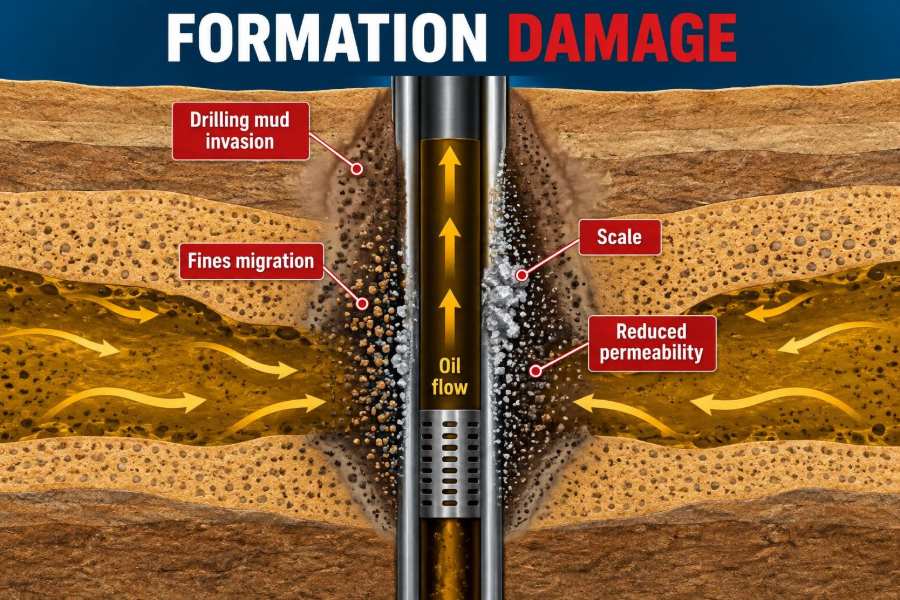
Formation damage is an undesirable reduction in reservoir permeability or effective flow capacity caused by physical, chemical, biological, or thermal processes. It commonly occurs in the pore space close to the wellbore, though some mechanisms can extend farther into the formation.
Permeability is the rock’s ability to allow fluid movement through connected pores. Damage may block pores, narrow pore throats, alter wettability, create stable emulsions, or reduce the permeability available to oil, gas, or water at the prevailing saturation.
🚪 Why the Near-Wellbore Zone Matters So Much
Fluid velocity rises sharply as reservoir fluids converge on the wellbore. A relatively thin damaged ring can therefore create a disproportionate pressure drop, much like a partially clogged filter limits flow through an otherwise open pipe.
This extra resistance is often represented by skin, a dimensionless term used in well-test interpretation. Positive skin indicates additional near-wellbore resistance; negative skin may indicate stimulation or highly conductive flow paths. Skin is evidence to investigate, not a unique diagnosis by itself.
🪨 Reservoir Rock Is Not an Empty Container
Reservoir rock contains mineral grains, pore throats, clays, natural water, hydrocarbons, and sometimes fines that are only loosely held in place. Introducing a new fluid can disturb this system even when the rock initially appears clean and stable.
Sandstones may contain quartz, feldspars, clay minerals, and cementing material. Carbonates can contain calcite, dolomite, anhydrite, and complex pore systems. Their damage sensitivities differ, so a fluid that performs acceptably in one formation may be harmful in another.
🧪 Permeability, Porosity, and Flow Capacity
Porosity measures storage volume, while permeability measures ease of flow. A rock can retain significant porosity but have poor permeability if its pore throats are small or disconnected.
Formation damage often affects permeability more than porosity. Depositing a small amount of material at pore throats may barely change total void space while substantially reducing the routes available for flow.
💧 Relative Permeability Adds Another Layer
Most producing reservoirs contain more than one fluid phase. Relative permeability describes how easily each phase flows when other phases share the pores.
A water block, altered wettability, or increased water saturation near the well can reduce the relative permeability to oil or gas without completely plugging the rock. This is particularly relevant in gas wells, where liquid accumulation can sharply impair gas flow.
🛢️ Drilling Mud Invasion and Filter Cake
During overbalanced drilling, wellbore pressure exceeds formation pressure. The resulting pressure difference can push mud filtrate and fine solids toward the formation. Ideally, solids form a thin, low-permeability filter cake on the wellbore wall and limit deeper invasion.
Problems arise when the cake is thick, poorly removable, or unable to control filtrate loss. Fine particles can invade pore throats, while filtrate may initiate clay swelling, scale precipitation, emulsions, or phase trapping deeper in the rock.
⚖️ Overbalance, Underbalance, and Managed Pressure
Overbalanced drilling supports well control and wellbore stability, but it creates a driving force for invasion. The operational aim is not simply to minimize pressure at all costs; it is to maintain a safe pressure window while limiting unnecessary differential pressure and exposure time.
Underbalanced drilling can reduce invasion by allowing formation fluids to flow toward the well. However, it introduces operational complexity, including produced-fluid handling, potential instability, and more demanding safety controls. Managed-pressure drilling can help keep pressure closer to the desired range where conditions justify it.
🧂 Completion Brines Can Be Incompatible
Clear brines are often selected to avoid solids invasion, but “solids-free” does not mean “damage-free.” A brine may be incompatible with formation water, connate water, or minerals exposed in the rock.
For example, mixing waters with incompatible dissolved ions can precipitate scale. The risk depends on temperature, pressure, ionic composition, mixing ratio, and changes that occur as fluids enter the formation. Compatibility testing is therefore a design input, not a paperwork exercise.
🧱 Solids Plugging and External Filter Cake
Drilled cuttings, weighting material, polymers, corrosion products, and improperly filtered treatment fluids can introduce solids. Larger particles may bridge at the face, while smaller particles can enter and plug pore throats internally.
Particle size distribution matters as much as total solids concentration. A low concentration of poorly sized particles may be more damaging than a larger amount of material that remains outside the formation and can be removed effectively.
🌿 Fines Migration Inside the Pores
Fines are small mineral particles, often clays or silt-sized material, that can detach from pore walls when fluid chemistry or flow forces change. Once mobilized, they travel until they lodge at narrower pore throats.
Low-salinity water, changes in pH, rapid flow-rate changes, and incompatible fluids can all contribute under certain mineralogical conditions. The resulting restriction may be internal and difficult to remove because the particles are no longer only at the wellbore face.
🧲 Clay Swelling and Dispersion
Some clay minerals react strongly with fresh or low-salinity water. Water entering the clay structure can cause swelling, while other clays may disperse into mobile particles.
These mechanisms are often grouped together, but they are not identical. Swelling narrows available pore space; dispersion releases particles that can migrate and plug throats. Mineralogy tests and fluid-sensitivity tests help determine whether a proposed fluid poses a meaningful risk.
🧪 Scale Deposition Near the Well
Scale is an inorganic mineral deposit that forms when water chemistry changes enough for dissolved ions to precipitate. Pressure reduction, temperature change, mixing incompatible waters, and gas evolution can all shift chemical equilibrium.
Scale may accumulate in tubing, perforations, and pore space. Near-wellbore scale is especially problematic because mechanical removal becomes less effective once deposits extend beyond the perforation tunnel.
🧫 Organic Deposits: Wax, Asphaltenes, and Sludge
Crude oil composition can change as pressure and temperature fall during production. Wax may crystallize when temperature drops below conditions that keep it dissolved, while asphaltenes can precipitate when pressure or fluid composition changes.
Some chemical mixtures can also form persistent sludge or deposits. These risks should be evaluated using representative fluid samples where possible, particularly before major pressure drawdown, gas injection, or solvent-based treatments.
🫧 Emulsions and Interfacial Problems
An emulsion is a dispersion of one liquid in another, such as water droplets suspended in oil. Stable emulsions can be highly viscous and can restrict flow through pores and perforations.
Surfactants, fine solids, crude characteristics, and mixing energy influence emulsion stability. A treatment fluid must therefore be judged not only by its individual properties but by how it interacts with reservoir oil, water, and existing additives.
🧽 Wettability Alteration and Water Blocking
Wettability describes which fluid preferentially contacts the rock surface. Many reservoirs have mixed-wet behavior, and changing that balance can alter capillary forces and phase mobility.
In a water block, aqueous fluid enters the near-wellbore zone and remains trapped by capillary forces. This is especially damaging in tight gas formations because the retained water occupies flow paths that gas needs. Cleanup may be slow unless drawdown, fluid design, and rock properties support fluid recovery.
🔥 Thermal and Mechanical Damage
Rapid temperature changes can affect fluid viscosity, precipitation behavior, cement integrity, and stresses around the well. Mechanical effects include compaction, sanding, perforation crushing, or stress-sensitive fracture conductivity loss.
These are not always classified as chemical formation damage, but they can produce the same operational symptom: reduced flow capacity. A useful diagnosis considers rock mechanics alongside fluid chemistry.
🔩 Perforations Are Part of the Flow System
In cased-hole completions, fluids do not enter the well uniformly through the entire formation face. They must pass through perforation tunnels, which can contain crushed rock, debris, residual gun material, or compacted filter cake.
Perforation damage may be localized but severe. Perforation strategy, underbalance conditions, cleanup practices, and subsequent treatment placement all influence whether the well accesses the intended interval efficiently.
📉 How Damage Appears in Field Performance
Common warning signs include lower-than-expected productivity index, higher drawdown needed to sustain a rate, poor cleanup after completion, or an unexplained decline following a workover or fluid exposure.
None of these symptoms is conclusive. Decline may also reflect reservoir depletion, changing gas-liquid behavior, mechanical restrictions, water encroachment, or changing choke conditions. The engineer’s task is to separate plausible mechanisms rather than assign blame to formation damage by default.
📊 A Practical Diagnostic Toolkit
Diagnosis is strongest when multiple lines of evidence agree. Pressure-transient testing can estimate skin and flow regime, production history reveals timing, and fluid records identify what contacted the formation.
| Observation | What it may suggest | What else to check |
|---|---|---|
| High positive skin after drilling | Mud-filtrate or solids-related damage | Completion details, cleanup response, test quality |
| Rate decline after water breakthrough | Relative-permeability effects or scale risk | Water chemistry, saturation changes, tubing condition |
| Poor gas recovery after liquid treatment | Water block or emulsion | Capillary behavior, fluid recovery, pressure drawdown |
| Restriction after pressure or temperature change | Organic deposition or scale | Fluid samples, thermal history, chemical analysis |
🔬 Coreflood Testing Connects Fluids to Rock
A coreflood test pushes selected fluids through a representative rock sample under controlled conditions and measures permeability changes. It can test mud filtrate, brines, acids, scale inhibitors, surfactants, or cleanup sequences.
Core data are valuable but have limitations. A small core may not capture fractures, layering, natural heterogeneity, or the exact in-situ stress state. Results should guide design alongside field information, not be treated as a perfect replica of the reservoir.
🧾 Fluid Compatibility Should Be Designed Early
Compatibility work should begin before drilling and completion fluids are finalized. It typically considers formation water, injected water, stimulation fluids, expected produced fluids, mineralogy, pressure, and temperature.
Questions worth answering include:
- Will mixed waters precipitate scale under expected conditions?
- Could the salinity or pH mobilize fines or destabilize clays?
- Will additives form emulsions or sludge with the crude?
- Can the fluid be recovered readily from a low-permeability interval?
🧰 Prevention During Drilling
Prevention begins with selecting a mud system that balances well control, stability, lubricity, filtration control, and formation compatibility. There is no universally “non-damaging” mud; the correct choice depends on the rock, fluids, pressure window, and planned completion.
Operational discipline matters too. Controlling solids, monitoring filtrate properties, avoiding prolonged static exposure where possible, and maintaining clean displacement practices reduce opportunities for unnecessary invasion.
🚿 Completion Cleanup Is a Designed Operation
Cleanup is not merely opening the well and waiting. The goal is to remove debris and fluids while avoiding drawdown conditions that mobilize formation sand, collapse weak material, or trap more liquid.
Flowback plans should consider expected return volumes, pressure control, solids handling, sampling, and criteria for changing rate. In sensitive wells, gradual and monitored cleanup can be more informative and safer than an aggressive initial drawdown.
⚗️ Acidizing Can Help—or Create New Problems
Matrix acidizing injects acid below fracture pressure to dissolve acid-soluble material and improve near-wellbore flow. Carbonate formations may respond directly because acid dissolves part of the rock matrix; sandstone treatments often use carefully designed blends to address clays, feldspars, and damaging deposits.
Acid treatments require disciplined design. Improper fluid selection, insufficient diversion, precipitation of reaction products, corrosion concerns, or treating the wrong interval can reduce benefit or introduce additional damage. A high skin factor alone does not prove that acid is the right answer.
💥 Hydraulic Fracturing Can Bypass Some Damage
A hydraulic fracture can extend beyond a damaged near-wellbore zone and create a conductive pathway to the well. This makes fracturing especially useful where the formation is tight or where damage is deep enough that a simple cleanup cannot restore productivity.
Yet fracture treatments can also leave residue, cause water-block concerns, or suffer conductivity loss from proppant crushing, embedment, or fines. Treatment fluid recovery and fracture conductivity must be considered together.
🧴 Chemical Treatments Need a Clear Target
Solvents, surfactants, demulsifiers, scale dissolvers, inhibitors, mutual solvents, and clay stabilizers each address specific mechanisms. Their names should not substitute for a diagnosis.
A solvent may help an organic deposit but do little for invaded barite. A scale dissolver may remove a deposit in tubing but not restore permeability lost to internal fines migration. Chemical selection should be based on deposit identification, compatibility, placement, and safe handling requirements.
🧱 Diversion and Placement Decide Treatment Reach
Even a well-designed treatment is ineffective if it enters only the easiest-flowing interval. Diversion temporarily redirects fluid from high-permeability or already-open zones toward tighter or more damaged sections.
Diverters can include mechanical isolation, particulate materials, foams, or chemical systems. Selection depends on completion geometry, temperature, formation permeability contrast, and whether the diverter can be removed without causing a new restriction.
🧯 Common Mistakes in Damage Management
Several mistakes recur because they are tempting shortcuts:
- Assuming every low-rate well is damaged rather than checking reservoir and mechanical causes.
- Using generic fluid recipes without formation-specific compatibility testing.
- Treating high skin as a complete diagnosis rather than one indicator.
- Focusing on the treatment chemical while neglecting placement and cleanup.
- Ignoring the solids quality and cleanliness of all fluids pumped into the well.
Each mistake can lead to unnecessary cost, missed root causes, or a treatment that masks the problem temporarily.
🧑🔧 An Integrated Team Approach
Formation damage sits at the boundary of drilling, completions, production, reservoir engineering, chemistry, and laboratory work. Decisions made during drilling may influence a production problem months later, while production samples may reveal a risk that should change the next completion design.
A useful workflow preserves records: mud and brine properties, additives, displacement volumes, pressure history, produced-fluid samples, solids observations, and intervention results. This shared evidence makes future wells easier to design and troubleshoot.
🌍 Environmental and Operational Considerations
Damage prevention can reduce the need for repeated interventions, chemical use, and fluid handling, but every fluid program has operational and environmental constraints. Chemical selection must account for worker safety, material compatibility, transport, storage, produced-water handling, and local regulatory requirements.
The lowest-risk option is often the one that prevents incompatible fluids from entering the formation in the first place, rather than relying on a more aggressive remedial treatment later.
🧠 A Stepwise Decision Framework
- Confirm the performance gap using reliable production, pressure, and mechanical data.
- Identify the timing of the decline relative to drilling, completion, water production, or interventions.
- Develop competing damage and non-damage hypotheses.
- Use samples, tests, and well records to eliminate weak explanations.
- Select the least invasive treatment likely to reach the identified restriction.
- Measure the response and capture lessons for subsequent wells.
This approach does not remove uncertainty, but it makes uncertainty visible and manageable.
🎯 The Core Principle: Protect Flow Paths Before Restoring Them
Formation damage is best understood as a flow-path problem. Fluids and solids introduced during operations can change pore-scale conditions, and those small changes can become a large pressure loss at the well scale.
The most effective strategy combines reservoir characterization, compatible fluids, clean operations, thoughtful pressure management, and evidence-based diagnosis. Remediation remains valuable, but prevention is generally more controllable than trying to reverse a complex reaction after it has occurred.
Protecting the near-wellbore region means protecting the reservoir’s connection to the well—and that connection often determines whether valuable hydrocarbons can be produced efficiently. 🛢️🧪🔧