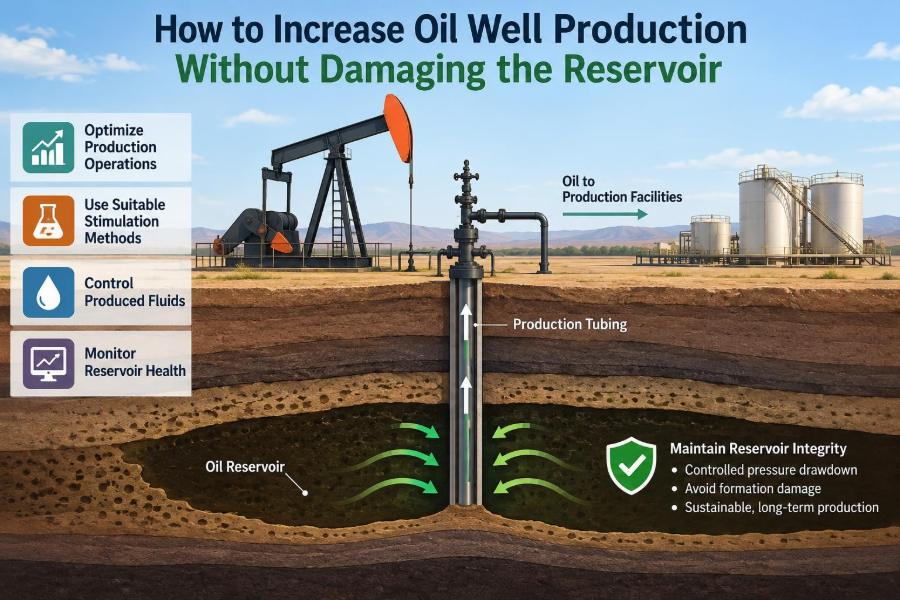

A well begins to underperform, and the immediate temptation is easy to understand: open the choke, raise the drawdown, add a stronger lift system, or schedule a stimulation treatment. Production rises quickly in some cases. Yet a short-lived increase can hide a more expensive outcome—water or gas breakthrough, sand production, fines migration, coning, or permanent loss of permeability.
This is the central tension in production engineering. A reservoir is not simply a tank that can be emptied faster. It is a connected rock-and-fluid system whose behavior changes as pressure, saturation, stress, and flow rate change.
The best production gains come from finding the actual restriction between the reservoir and the sales line, then removing that restriction at a rate the reservoir can tolerate. That calls for data, disciplined diagnosis, and a willingness to choose a smaller sustainable gain over a dramatic but damaging surge.
For students, this is where reservoir engineering, petrophysics, completion design, and operations stop being separate subjects. For working teams, it is the daily challenge of protecting recovery while meeting production targets.
🧭 Start With the Right Objective
Increasing oil rate is not always the same as increasing value or recovery. A well can produce more fluid while delivering little extra oil, consuming more power, accelerating water handling, and leaving a damaged near-wellbore region.
A better objective is sustainable, economic oil production within reservoir and equipment limits. The word “sustainable” means the operating condition does not trigger an avoidable mechanism that reduces future performance.
Before changing a well, define what success means: incremental oil, lower water cut, reduced downtime, stable bottomhole pressure, improved recovery, or lower operating cost. The diagnosis and the acceptable risk depend on that target.
🪨 Think of the Reservoir as a Flow System
Oil moves through pore spaces in rock toward the well because of a pressure difference. The ability of the rock to transmit fluid is called permeability, while the ease with which each phase moves at a given saturation is described by relative permeability.
Flow also encounters resistance in the completion, perforations, tubing, choke, flowline, separator, and artificial-lift equipment. A production problem may therefore be in the reservoir, near the wellbore, or entirely above ground.
Like diagnosing a weak shower, increasing pump power will not solve a clogged pipe upstream. The first task is to locate the dominant pressure loss rather than assuming the reservoir itself is the constraint.
📉 Understand Drawdown Before Raising It
Drawdown is the difference between reservoir pressure and flowing bottomhole pressure. Increasing drawdown usually increases inflow, but the relationship is not limitless and may become harmful when fluid contacts or weak formations respond.
In a simple undersaturated oil reservoir, moderate additional drawdown may be productive. In a well close to a water contact, gas cap, or unstable sand interval, the same action can pull in unwanted fluids or solids.
Maximum drawdown is rarely the optimum drawdown. The practical goal is to identify a rate window where oil response is attractive and adverse behavior remains controlled.
🧪 Establish a Reliable Baseline
Changes should not be made against an uncertain baseline. Gather recent oil, water, and gas rates; flowing and static pressures where available; choke settings; artificial-lift settings; fluid properties; downtime history; and operating events.
Trend data matters more than a single test. A gradual oil decline with stable water cut suggests a different problem from a sudden liquid-rate drop after a workover, or a rising water cut following a choke change.
Confirm measurement quality before building an interpretation. Allocation errors, faulty flowmeters, unstable test conditions, and poor gauge calibration can send an intervention toward the wrong problem.
📊 Separate Reservoir Inflow From Wellbore Outflow
Inflow performance describes what the reservoir can deliver into the well at different flowing bottomhole pressures. Outflow performance describes the pressure required to lift that fluid through the well and surface system at different rates.
The operating point occurs where those two relationships meet. If inflow is weak, reducing surface backpressure may help only modestly. If outflow is restrictive, a tubing, choke, flowline, or lift change can unlock production without imposing much extra reservoir drawdown.
Production-system analysis connects these curves and is a useful guard against one-sided solutions. It turns “the well is slow” into a testable question: is the limitation inflow, outflow, or both?
🔍 Diagnose the Restriction Before Choosing a Remedy
A structured diagnosis often considers several possible restrictions at once:
- Reservoir depletion or low effective permeability
- Near-wellbore skin from damage, scale, fines, or completion effects
- Restricted perforations or inadequate perforated interval
- Liquid loading, tubing friction, or excessive surface backpressure
- Artificial-lift underperformance
- Water, gas, or solids entering the well
Each mechanism leaves clues, but few clues are unique. For example, falling rate can result from reservoir pressure decline, pump wear, wax deposition, scale, or a changing gas-liquid ratio. Multiple data sources are safer than a single explanation.
🧫 Use Well Tests to Estimate What the Reservoir Sees
Pressure transient testing can help estimate permeability-thickness, skin, average pressure, and boundaries under suitable conditions. Build-up and drawdown responses are interpreted alongside the completion and production history, not in isolation.
Skin is a dimensionless expression of extra flow resistance near the wellbore. Positive skin indicates restriction relative to an idealized case; negative skin can reflect improved flow around the well. It is useful, but it is not a direct instruction to stimulate.
Tests can be distorted by multiphase flow, changing rates, gauge limitations, and complex geology. A good interpretation states its assumptions and uncertainty instead of treating one calculated value as exact.
🧱 Recognize Formation Damage Mechanisms
Formation damage is any reduction in near-wellbore flow capacity. Common causes include incompatible fluids, clay swelling, fines migration, emulsions, scale, organic deposition, drilling or completion solids, and water blocking.
Damage is especially costly because pressure losses are concentrated near the well, where radial flow converges. A relatively thin impaired zone can substantially reduce deliverability.
The preventive lesson is simple: fluid compatibility, solids control, clean completion practices, and controlled pressure operations often create more value than repairing avoidable damage later.
🧴 Treat Stimulation as a Targeted Tool
Matrix acidizing, solvent treatments, and hydraulic fracturing are not interchangeable “production boosters.” Their suitability depends on rock mineralogy, permeability, damage mechanism, stress state, fluid compatibility, and completion condition.
Matrix acidizing is intended to dissolve or bypass selected damage near the wellbore without intentionally fracturing the formation. Hydraulic fracturing creates a conductive fracture pathway, generally to access more reservoir volume or overcome low-permeability flow resistance.
A treatment designed without diagnosing the damage can fail to help or introduce risk. For example, an incompatible chemical system may mobilize fines, while an uncontrolled stimulation may communicate with unwanted water-bearing intervals.
🧰 Design Clean, Compatible Intervention Fluids
Every fluid introduced into a well can interact with formation minerals, brine, hydrocarbons, and existing deposits. Salinity, pH, suspended solids, iron content, additives, and temperature can all matter.
Compatibility testing and treatment design should reflect the actual reservoir and produced-fluid chemistry. The question is not whether a fluid works in a generic application, but whether it can enter and return from this well without creating precipitation, swelling, emulsions, or residue.
Operational cleanliness matters too. Tanks, hoses, filters, and mixing practices can become sources of solids that defeat an otherwise sound treatment.
🕳️ Optimize Perforations Carefully
Perforations create the connection between casing and reservoir, but they also introduce flow restriction, crushed zones, and nonuniform inflow. Poorly chosen intervals can produce more water or gas without improving useful oil contribution.
Perforation review considers interval quality, net pay, saturation, pressure, distance from contacts, cement isolation, orientation, penetration, shot density, and expected stress effects. In cased-hole wells, production logging can be particularly valuable for identifying which intervals are actually contributing.
Adding perforations is not automatically beneficial. Opening a water-prone layer can overwhelm oil gains and make later conformance control more difficult.
💧 Control Water Before It Controls the Well
Water production increases hydrostatic load, friction, corrosion exposure, treatment demand, and disposal requirements. It can also reduce oil relative permeability as water saturation rises around the well.
The origin of the water matters. It may be normal aquifer encroachment, channeling behind casing, a fracture connection, a high-permeability streak, a water-producing perforation, or water coning from below.
Water shutoff methods—such as mechanical isolation, cement repair, selective gels, or reperforating—must match the flow path. Treating the wrong path can restrict oil while leaving the water source active.
🌊 Manage Water Coning With Rate Discipline
Water coning occurs when a water-oil interface rises locally toward a producing well because the pressure gradient near the well exceeds stabilizing forces. It is more likely when a well is close to the water contact, vertical permeability is favorable, or drawdown is excessive.
Once water breaks through, simply reducing rate may not fully restore the earlier condition. The local saturation distribution and relative permeability can have changed.
Useful controls can include lower drawdown, selective completion, interval isolation, horizontal well placement, and managed production schedules. The appropriate method depends on reservoir geometry and completion access.
🔥 Prevent Gas Coning and Gas Locking
Gas from a gas cap or liberated solution gas can move toward the well under high drawdown. Gas coning reduces oil efficiency and can complicate artificial lift, particularly where free gas enters equipment designed mainly for liquid handling.
In pumped wells, excessive free gas may cause gas interference or gas lock, reducing pump fillage and creating unstable operation. Raising pump speed does not necessarily solve the problem; it may worsen the pressure reduction at the intake.
Potential responses include moderating drawdown, adjusting intake depth, improving gas separation, changing lift design, or selectively isolating a gas-producing interval.
🏖️ Respect the Risk of Sand Production
Sand production can erode chokes, valves, tubing, and surface equipment. It can fill the wellbore, damage pumps, impair control valves, and create safety concerns during handling and cleanout.
Weak or poorly consolidated formations may fail when effective stress rises as pore pressure falls, or when local pressure gradients around perforations become too high. Water breakthrough and changing saturation can further alter rock strength and sanding behavior.
Sand management may involve conservative drawdown, sand screens, gravel packs, frac-pack completions, oriented perforating, or controlled cleanup. The safest rate is not always the highest rate the well can briefly achieve.
⚙️ Match Artificial Lift to the Well’s Current Conditions
Artificial lift should be selected and operated for the actual fluid rate, gas fraction, depth, deviation, solids risk, viscosity, and power availability—not simply for nameplate capacity. Reservoir conditions change, so a once-suitable system can become inefficient.
Rod pumps, electric submersible pumps, gas lift, progressive cavity pumps, and hydraulic systems each have different strengths and operating limits. A deviated, sandy, viscous-oil well poses a different lifting problem from a deep, high-rate well with abundant gas.
Regular surveillance of pump performance, intake pressure, fluid level, power, vibration, and gas behavior helps identify whether lift is limiting production or merely responding to an inflow limitation.
🔧 Improve Pump Operation Without Overpumping
Overpumping happens when the pump capacity exceeds sustainable inflow. It may lower fluid level excessively, increase gas interference, cause pump-off behavior, accelerate wear, and impose damaging drawdown on the reservoir.
For rod-pumped wells, dynamometer cards, fluid-level surveys, pump fillage, and run-time control can guide adjustments. For ESP wells, intake pressure, motor loading, vibration, temperature, and operating frequency provide essential context.
A controlled lower setting can outperform an aggressive setting if it keeps the pump full, reduces cycling, and preserves stable inflow. Production optimization is often a balancing exercise rather than a capacity contest.
🛢️ Reduce Tubing, Choke, and Flowline Losses
Surface and wellbore constraints are often the least risky opportunities because they can improve rate without requiring a major decrease in bottomhole pressure. Restrictions may come from undersized tubing, scale, wax, hydrates, tight chokes, high separator pressure, or long flowlines.
Review pressure losses across the full path: reservoir to perforation, tubing, wellhead, choke, flowline, manifold, separator, and export system. A pressure survey or calibrated model can reveal where intervention produces the greatest benefit.
Any debottlenecking change must still consider erosion, slugging, vibration, hydrate risk, separator capacity, and downstream handling limits.
🧊 Control Scale, Wax, and Organic Deposits
Deposits can progressively reduce effective tubing diameter and restrict valves, perforations, and downhole equipment. Scale forms when water chemistry and changing pressure or temperature cause minerals to precipitate. Wax and other organic deposits become more likely when crude cools or pressure conditions change.
Prevention relies on knowing produced-fluid behavior. Chemical inhibition, thermal methods, mechanical scraping, solvent treatments, and scale removal can be effective in the right setting, but each has operational constraints.
Recurring deposition is a diagnostic clue, not merely a maintenance nuisance. It may indicate a temperature profile, mixing condition, water chemistry, or operating change that needs to be addressed at its source.
🧠 Use Surveillance as a Continuous Process
Production optimization is not a one-time well test followed by a permanent answer. Reservoir pressure declines, water saturation changes, lift equipment wears, and surface constraints shift as field operations evolve.
A practical surveillance plan may combine well tests, pressure measurements, fluid levels, production logging, chemical records, failure analysis, and rate trends. The right frequency depends on well risk and value; high-risk wells warrant closer observation.
Use a simple decision loop: measure, interpret, change one meaningful variable, observe the response, and update the model. Changing many variables at once may raise rate, but it makes the reason unclear.
🧩 Integrate Reservoir, Production, and Facilities Data
Different disciplines see different portions of the same system. Reservoir engineers may identify pressure support and contacts; production engineers examine drawdown and lift; completion engineers assess access and integrity; facility teams understand backpressure and processing limits.
The strongest decisions combine these views. A proposed choke increase, for instance, should be checked for reservoir coning risk, lift response, separator capacity, water handling, corrosion exposure, and erosion potential.
Integrated review is not bureaucracy. It is how teams avoid shifting a constraint from one part of the system to another while calling the result optimization.
🧮 Rank Opportunities by Value and Reversibility
Not all interventions deserve equal urgency. Start by ranking opportunities according to expected oil response, confidence in the diagnosis, cost, execution risk, reservoir risk, and whether the action can be reversed.
Low-risk opportunities often include correcting an obvious surface restriction, restoring a known equipment issue, or optimizing an existing lift system. Higher-risk actions may include aggressive drawdown, opening new intervals, or large stimulation treatments.
A reversible test can be especially valuable when uncertainty is high. A carefully monitored choke trial, for example, may reveal the well’s sensitivity before a more permanent capital decision is made.
📝 Set Operating Limits Before the Change
A well test or intervention needs pre-defined guardrails. These might include maximum water-cut change, minimum intake pressure, maximum sand rate, stable gas-handling capacity, allowable vibration, or a defined bottomhole-pressure limit.
Set the observation period and decision criteria in advance. Without them, teams can be tempted to continue a harmful change because the first day’s oil rate looks attractive.
Clear stop conditions protect both the reservoir and the people operating the asset. They also make post-job reviews more objective.
🚫 Avoid the Most Common Optimization Mistakes
Several mistakes recur because they offer an appealingly simple response to a complicated system:
- Choking back or opening up without diagnosis: rate changes alone do not identify the constraint.
- Stimulating based only on low production: low rate does not prove near-wellbore damage.
- Ignoring water and gas trends: extra liquid or gas can mask poor oil performance.
- Over-sizing artificial lift: greater capacity can deepen drawdown beyond what the reservoir tolerates.
- Using isolated measurements: a single test can be unrepresentative during unstable multiphase flow.
Most of these errors are prevented by treating production changes as controlled experiments rather than emergency adjustments.
📌 Learn From a Hypothetical Well Example
Consider a hypothetical mature oil well whose liquid rate declines while water cut remains broadly stable. The first response might be to increase pump speed. But fluid-level data shows the pump is already pulling the level down, while pressure data and inspection history suggest scale restriction in the tubing.
In this case, faster pumping could increase gas interference and drawdown with little oil benefit. Removing the tubing restriction and then retuning the pump may improve throughput at a similar or lower reservoir stress.
Now change one detail: suppose water cut rises sharply after opening the choke. The leading concern becomes coning or unwanted interval contribution, and the appropriate next step is diagnosis of water origin—not another increase in lift capacity.
📈 Measure Success Beyond Initial Oil Rate
A production change should be evaluated over a period long enough to distinguish a transient response from a durable improvement. Track stabilized oil rate, water and gas rates, cumulative oil, downtime, energy use, chemical use, equipment condition, and pressure behavior.
Economic success may be reduced if additional water requires substantial treatment or disposal, or if high velocities accelerate erosion and failures. Similarly, a stimulation may raise rate but disappoint if decline steepens rapidly.
The most useful scorecard combines production, reliability, reservoir behavior, and operating cost. It keeps the decision focused on asset performance rather than one attractive headline number.
🛡️ Protect Well Integrity and Operating Safety
Optimization must remain within the well’s mechanical and operating envelope. Higher rates and pressures can affect tubing loads, erosion, corrosion, annular pressure behavior, valve performance, and containment barriers.
Changes involving chemicals, high pressure, energized equipment, produced gas, or solids require established operating procedures and competent review. Field execution should include communication between the people interpreting data and the people controlling the equipment.
A production gain is not a success if it compromises barriers, causes repeated failures, or introduces avoidable exposure for personnel.
🌱 Consider Recovery and Environmental Trade-Offs
Producing a reservoir too aggressively can increase unwanted fluid production and reduce operational efficiency. More water may mean more pumping, treatment, transport, and disposal; more gas may require compression, handling, or curtailment.
Conversely, overly conservative operation can leave economic oil inaccessible when a carefully designed completion, lift, or facility improvement could produce it responsibly. The objective is not minimal intervention, but proportionate intervention based on evidence.
Good optimization aligns reservoir stewardship with practical resource use: deliver useful oil, manage associated fluids properly, and avoid preventable rework.
🤝 Build a Repeatable Optimization Workflow
A disciplined workflow makes decisions easier to review and repeat across a field:
- Verify production and pressure data quality.
- Define the desired outcome and operating constraints.
- Locate the likely restriction using integrated analysis.
- Generate options, including a no-change case.
- Rank options by value, confidence, reversibility, and risk.
- Set monitoring, limits, and stop criteria.
- Execute the smallest sensible change and evaluate the stabilized response.
This approach does not eliminate uncertainty. It makes uncertainty visible and prevents a fast operational decision from becoming an unexamined reservoir decision.
🎯 The Core Principle: Optimize the System, Not Just the Rate
The safest production gains come from matching reservoir inflow, completion performance, artificial lift, and surface capacity. When those elements are balanced, a well can deliver more oil with less wasted energy and less pressure on the reservoir.
When they are not balanced, forcing rate usually transfers the problem: a weak inflow becomes gas interference, a water-prone interval becomes a disposal burden, or a surface bottleneck becomes equipment damage.
Ask a consistent question before every action: what is restricting useful oil flow, and what consequence will this change create in the reservoir and the production system? That question turns optimization from rate chasing into engineering judgment.
Increasing oil production without damaging the reservoir means diagnosing the true constraint, applying the least harmful effective remedy, and verifying that the gain remains stable over time. Patient, integrated decisions protect both today’s production and tomorrow’s recovery. 🛢️📈🪨