
A car pulls away from a fuel station, a delivery truck crosses town, and a plastic medical package arrives at a clinic. These ordinary scenes depend on an industry that began not with giant offshore platforms or computerized control rooms, but with people noticing dark, sticky material seeping from the ground.
Early oil producers faced a deceptively simple question: if oil appears naturally at the surface, could people reach more of it by digging or drilling? Answering that question changed transportation, manufacturing, geopolitics, and engineering education.
The first oil wells were modest by modern standards. Yet they introduced problems that remain familiar: how to locate a resource, drill safely through rock, keep a well open, move fluids to market, and decide whether a project can pay for itself.
Understanding this history gives petroleum engineering students and professionals useful perspective. The tools have changed enormously, but the central task remains the same: manage subsurface uncertainty to recover energy responsibly.
🌍 Petroleum Began at Natural Seeps
Petroleum is a naturally occurring mixture of hydrocarbons: compounds made mainly of hydrogen and carbon. In some places, oil and gas migrate upward through porous rock, fractures, or faults and reach the surface as oil seeps, gas vents, or asphalt deposits.
Long before drilled wells, communities collected these materials where nature made them accessible. Bitumen, the heavier and more viscous part of petroleum, was useful as a waterproofing and binding material. Lighter oils could be used in lamps, medicines, and limited industrial applications.
See pages of history carefully: using a seep is not the same as producing from a well. A seep offers only what geology releases naturally; a well is an intentional engineered pathway into the subsurface.
🏺 Early Uses Created the First Demand
Ancient societies in the Middle East and elsewhere used bitumen in construction, boat caulking, roads, and ceremonial practices. Its water resistance made it practical wherever masonry, wood, and water met.
In parts of Asia, shallow wells and brine operations also encountered natural gas and oil. Historical accounts describe the use of bamboo in early Chinese drilling and fluid-handling systems, demonstrating that people had already recognized the value of reaching underground fluids rather than waiting for surface seepage.
These uses did not yet create a global petroleum industry. They did, however, establish a key idea: subsurface fluids could be deliberately obtained, transported, and put to work.
🕯️ Lighting Was the First Major Market
During the nineteenth century, lighting created a powerful commercial incentive. Homes, shops, streets, and factories needed dependable illuminants, but common options had drawbacks. Candles were relatively expensive, whale oil supplies were constrained, and many fuels produced smoke, odor, or inconsistent light.
Refined petroleum products, especially kerosene, became attractive because they could provide a practical lamp fuel when produced and handled properly. This growing market gave entrepreneurs a reason to seek oil in quantities far beyond what surface collections could provide.
Demand alone did not create an industry. Producers also needed a repeatable way to access underground accumulations.
⛏️ From Hand-Dug Pits to Drilled Holes
The earliest attempts to obtain underground oil often resembled mining. Workers dug pits, trenches, or shafts where seepage suggested oil-bearing ground. Such methods were limited by groundwater inflow, unstable walls, toxic or flammable vapors, and depth.
Drilling offered a different approach. Rather than removing a large volume of earth, a drill could make a narrow hole through selected formations. That concept reduced some excavation problems and made greater depths possible, though it created new challenges in borehole stability and fluid control.
The transition was not instantaneous. Early oil development borrowed heavily from water-well drilling, salt production, mining, and cable-tool methods.
🧭 The Geological Idea Behind an Oil Well
Oil is not usually found in large underground caverns waiting to be tapped. In conventional reservoirs, hydrocarbons occupy tiny connected pore spaces within rock, much like water held within a sponge. Sandstone and carbonate formations are common reservoir rocks because they can contain and transmit fluids.
For an accumulation to persist, several geological elements must align: a source rock, migration pathways, a porous reservoir, a sealing rock, and a trap geometry. A trap may be created by folding, faulting, salt movement, or changes in rock properties.
Early drillers did not have modern basin models or seismic images. They relied on surface clues, local knowledge, nearby production, and considerable trial and error.
🧪 Oil Is Not One Uniform Substance
Crude oil varies widely in density, viscosity, sulfur content, dissolved gas, and chemical composition. Some oils flow readily; others are thick enough to require heating, dilution, or specialized recovery methods. Associated natural gas may be dissolved in the oil or occupy separate zones in the reservoir.
This variability matters because it affects nearly every engineering choice, from well completion and artificial lift to refinery design and emissions management. A technique that works well for a light, mobile crude may perform poorly in a viscous oil reservoir.
The early industry learned this lesson through experience, often after equipment and business plans had already been committed.
🇨🇦 Oil Springs Showed Commercial Potential
Oil Springs, Ontario, was an important early center of petroleum production. In 1858, James Miller Williams developed a commercial oil operation there, often recognized in Canadian petroleum history as an early successful oil well.
The significance was not simply that oil was encountered underground. The operation helped show that petroleum could be produced as a business and processed into saleable products, rather than treated only as a local curiosity or surface material.
Claims about the “first” oil well require context. Different regions had earlier wells, oil collection systems, and drilling traditions. Historical importance depends on whether the comparison concerns drilling method, commercial scale, refining, or long-term industrial influence.
🇺🇸 Drake’s Well Became a Turning Point
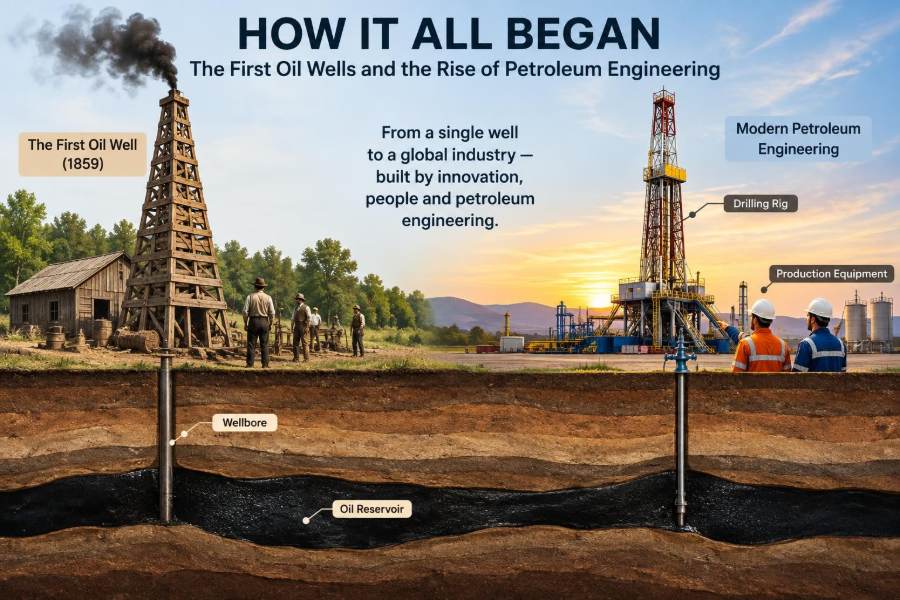
In 1859, Edwin Drake supervised the drilling of a well near Titusville, Pennsylvania, for the Seneca Oil Company. The well reached oil at a relatively shallow depth, but its influence was large because it helped trigger rapid development in the region.
Drake did not invent drilling, nor was his well the first human attempt to obtain petroleum from below ground. Its lasting importance lies in its role as a widely recognized catalyst for the modern American oil industry: it demonstrated a practical, repeatable commercial approach at a moment when markets and capital were ready to respond.
The Pennsylvania oil boom that followed attracted workers, speculators, toolmakers, refiners, and transport businesses. Petroleum was becoming an organized industrial system.
🔨 Cable Tools Powered the Earliest Boom
Many early oil wells used cable-tool drilling. A heavy bit was repeatedly lifted and dropped to crush rock at the bottom of the hole. Workers periodically removed the broken rock, called cuttings, using a bailer.
The method was slow compared with modern drilling, but it was robust and understandable. It was adapted from established well-drilling practice and could be operated with relatively simple machinery.
Cable tools also revealed an enduring truth: drilling is not merely making a hole. The crew must remove cuttings, prevent the hole from collapsing, manage incoming fluids, and maintain the equipment over long operating hours.
🔄 Rotary Drilling Changed the Pace
Rotary drilling gradually became dominant because a rotating bit could cut continuously while drilling fluid circulated down the drill string and back up the annular space between pipe and hole. The returning fluid carried cuttings to the surface.
Drilling mud did more than transport rock fragments. Properly designed mud can cool and lubricate the bit, support the borehole wall, and apply hydrostatic pressure that helps control formation fluids.
Rotary systems made deeper and more complex wells increasingly practical. They also increased the need for disciplined engineering, because poor fluid design or pressure management can quickly turn a drilling problem into a serious well-control event.
🧱 Casing Turned a Hole into a Well
A drilled hole is not automatically a usable well. Loose or reactive formations may collapse, and different underground zones may contain fresh water, saltwater, oil, gas, or incompatible pressures. Casing—steel pipe run into the wellbore—provides structural support and separation.
Cement is placed around much of the casing to anchor it and isolate formations. This barrier system is essential for protecting groundwater, preventing unwanted fluid movement between zones, and enabling controlled production.
Early wells often struggled with water influx and unstable ground. Modern casing design and cement evaluation are among the clearest examples of how petroleum engineering transformed practical drilling into controlled well construction.
⚙️ The Wellhead Made Control Possible
At the surface, the wellhead supports casing strings and provides pressure-containing equipment where the well transitions from subsurface construction to production operations. Valves and fittings allow operators to direct, monitor, and shut in flow.
In the earliest oil fields, uncontrolled flow and spills were common risks. The industry gradually developed better valves, production trees, and blowout-prevention equipment as well pressures and operating depths increased.
Pressure control is not a single device or a final inspection. It is a system involving equipment integrity, procedures, trained people, monitoring, and the willingness to stop when conditions become uncertain.
🌡️ Reservoir Pressure Is the Original Energy Source
When a well first connects a reservoir to the surface, the pressure difference may drive fluids toward and up the wellbore. This is called primary recovery. Gas expansion, dissolved-gas drive, water influx, and gravity drainage can all contribute.
Production changes the reservoir. As fluids leave, pressure can decline, gas may come out of solution, water may advance, and the flow behavior around the well changes. A strong initial flow rate therefore does not guarantee long-term performance.
Reservoir engineering developed to forecast these changes and plan production rates, well spacing, pressure maintenance, and eventual recovery methods.
📈 Production Engineering Solved the Flow Problem
Even if a reservoir contains oil, the well may not flow at an economic rate. Restrictions can occur in the reservoir rock, near the wellbore, inside perforations, through tubing, or at surface equipment. Production engineering examines the full path from pore space to sales line.
Common interventions include perforating selected reservoir intervals, stimulating damaged or tight zones, controlling sand production, and installing artificial lift. The aim is not simply to maximize rate on day one; it is to produce reliably while protecting equipment, reservoir value, and safety.
A useful analogy is a drinking straw: flow depends on both the liquid supply and every restriction along the route. Enlarging only one part of the system may not solve the overall problem.
🪜 Artificial Lift Extended a Well’s Life
As reservoir energy declines, many oil wells need help lifting fluids to the surface. Beam pumping units, commonly recognized by their walking-beam motion, became a familiar symbol of onshore oil production. Downhole pumps driven by surface equipment can lift liquid from shallow and moderate depths.
Other systems include electric submersible pumps, gas lift, progressive cavity pumps, and hydraulic methods. Each has strengths and limitations related to depth, fluid viscosity, gas content, solids, power availability, and operating cost.
Selecting artificial lift is a practical engineering decision, not a matter of choosing the newest technology. The best method fits the well’s changing conditions and the operator’s ability to maintain it.
🚂 Transport Was as Important as Discovery
An early oil field had little value if producers could not move crude oil or refined products to buyers. Barrels, wagons, waterways, railroads, and eventually pipelines each played roles in connecting fields to refineries and markets.
Transport bottlenecks could leave producers with oil but no profitable outlet. Pipelines later reduced handling, improved volume movement, and reshaped the geography of the industry by linking remote production areas with refining and export centers.
Modern projects still face this constraint. A reservoir assessment must consider gathering systems, processing capacity, storage, pipeline access, shipping options, and the specifications required by the customer.
🏭 Refining Made Crude Oil More Useful
Crude oil is a feedstock, not one finished product. Refining separates and transforms hydrocarbon mixtures into fuels and other materials. Distillation is an early and central step, separating fractions by differences in boiling range.
Refineries later added complex conversion and treating processes to make products such as gasoline, diesel, jet fuel, lubricants, asphalt, and petrochemical feedstocks. Product demand has repeatedly influenced what kinds of crude are valuable and how fields are developed.
This connection matters for engineers: upstream production and downstream refining are distinct disciplines, but they are commercially and physically linked by crude quality, volume, timing, and logistics.
📐 Petroleum Engineering Became a Profession
As wells went deeper and projects became more expensive, intuition alone was no longer enough. The industry needed people who could apply geology, physics, chemistry, mechanics, mathematics, and economics to subsurface fluid production.
Petroleum engineering emerged as a distinct professional field in the early twentieth century, building on mining engineering, geology, mechanical engineering, and chemical engineering. Universities, technical societies, service companies, and operating companies all contributed to the development of shared methods and terminology.
The profession’s purpose was never just to drill more wells. It was to make decisions under uncertainty: where to drill, how to complete, how fast to produce, and when intervention is justified.
🧭 Four Disciplines Still Shape Field Development
Modern petroleum engineering is commonly organized around several overlapping specialties. Their boundaries vary by company and project, but their core questions are recognizable.
| Specialty | Primary question | Typical contribution |
|---|---|---|
| Reservoir engineering | What is in the reservoir, and how will it behave? | Forecasts, reserves estimates, depletion plans |
| Drilling engineering | How can the target be reached safely and efficiently? | Well design, hydraulics, trajectory, pressure planning |
| Completions engineering | How should the well connect to the formation? | Casing, perforating, stimulation, sand control |
| Production engineering | How can fluids flow reliably to the surface? | Artificial lift, flow assurance, surveillance, interventions |
Strong projects integrate these disciplines early. For example, a reservoir target may look attractive until drilling hazards, completion constraints, or surface handling limits are included.
🗺️ Better Data Reduced—but Never Removed—Uncertainty
Early drillers used surface indications and nearby wells. Today, teams may use seismic data, wireline logs, cores, mud logs, pressure measurements, production history, and numerical simulation. Each data type reveals a different part of the subsurface picture.
A well log, for example, measures physical responses in the borehole that can help infer rock and fluid properties. It does not directly provide a perfect map of every pore or fracture. Interpretation requires calibration, assumptions, and comparison with other evidence.
The key professional habit is to distinguish observation from interpretation. Data can improve decisions, but it cannot eliminate geological uncertainty.
🧠 Reservoir Models Are Decision Tools, Not Reality
A reservoir model combines geological structure, rock properties, fluid behavior, and operating assumptions into a representation that can be tested. Simulation models estimate how pressure, saturation, and production may change under different development plans.
Models are valuable because they make assumptions visible. Teams can compare scenarios: fewer wells versus more wells, natural depletion versus water injection, or conservative production rates versus aggressive drawdown.
But a model can look precise while resting on uncertain inputs. Good engineers update models as drilling and production provide new evidence, rather than treating an early forecast as a fixed promise.
💧 Secondary and Enhanced Recovery Raised Recovery Factors
Primary recovery leaves a substantial portion of oil in the reservoir because of capillary forces, fluid viscosity, pressure decline, and imperfect sweep. Secondary recovery commonly uses water injection or gas injection to maintain pressure and displace hydrocarbons toward producing wells.
Enhanced oil recovery uses additional mechanisms, such as thermal methods for heavy oil, miscible gas injection in suitable reservoirs, or chemical processes under specific conditions. These projects can be technically demanding and sensitive to reservoir heterogeneity and commodity economics.
More recovery is not automatically better if the added energy, water handling, emissions, cost, or operational risk outweighs the value of the additional production. Evaluation must consider the whole system.
🌊 Offshore Development Tested Every System
Moving operations offshore required solutions for waves, wind, corrosion, limited space, remote logistics, and emergency response. Fixed platforms, floating production systems, subsea wells, and long export lines expanded access to resources beneath continental shelves and deep water.
Offshore projects often require extensive front-end engineering because changes after installation can be costly and difficult. Reliability, redundancy, inspection access, and maintainability are not secondary concerns; they are central design requirements.
The offshore experience also reinforced the consequences of failures. Complex operations require barriers that are designed, verified, monitored, and maintained throughout the asset life.
🧯 Well Control Became a Defining Safety Discipline
A blowout is an uncontrolled release of formation fluids from a well. It can occur when formation pressure exceeds the pressure and barriers intended to contain it. Preventing such events requires understanding the pressure balance between the reservoir, drilling fluid, wellbore, and equipment.
Modern well-control practice uses multiple barriers, including drilling-fluid management, casing and cement, blowout preventers, tested procedures, and trained crews. No single layer should be assumed infallible.
For students, the lesson is broader than any formula: technical calculations matter, but safety depends equally on communication, procedural discipline, equipment condition, and the ability of people to recognize abnormal indicators early.
🌿 Environmental Responsibilities Evolved with the Industry
Early oil fields often operated with limited environmental controls. Spills, produced-water disposal, gas flaring, land disturbance, and poorly abandoned wells showed that producing hydrocarbons creates impacts that must be managed, not ignored.
Current operations may involve environmental baseline work, spill prevention, emissions management, produced-water treatment or reinjection, waste handling, habitat protection, and well-integrity programs. Requirements differ by jurisdiction and setting, but the engineering principle is consistent: identify pathways by which fluids or emissions could cause harm, then design controls and monitoring.
Abandonment is part of the well life cycle. A well that is no longer productive must be properly plugged and its site managed to reduce the risk of future leakage or contamination.
⚖️ Petroleum’s Benefits and Trade-Offs Need Honest Context
Petroleum has supported mobility, heating, agricultural supply chains, industrial equipment, and materials used in healthcare, communications, and construction. Its high energy density and established infrastructure have made it difficult to replace quickly in every application.
At the same time, extracting, processing, and using petroleum can produce greenhouse-gas emissions and local environmental impacts. These concerns are not solved by pretending oil has no benefits, nor by denying its costs.
Engineers increasingly work within a changing energy system that emphasizes efficiency, methane reduction, electrification where practical, lower-emissions operations, carbon management, and careful asset retirement. Sound decisions require technical realism rather than slogans.
📊 Economics Has Always Shaped Engineering Choices
A technically successful well may still be a poor project if its costs exceed the value of its production. Early producers faced this through uncertain markets, transport constraints, and volatile local prices. Modern projects add capital intensity, regulation, processing requirements, and long development timelines.
Economic evaluation considers production forecasts, operating costs, taxes and contractual terms, infrastructure, abandonment obligations, and uncertainty. Price assumptions matter, but they should not be used to disguise weak technical fundamentals.
A practical rule is to ask what would have to be true for a project to succeed. If success depends on several optimistic assumptions occurring at once, the development deserves closer scrutiny.
🧰 Common Historical Myths Can Mislead Learners
One common myth is that Drake “discovered oil.” People had known and used petroleum for centuries. Drake’s well is better understood as an influential event in the commercialization of drilled oil production in the United States.
Another is that finding oil means instant wealth. Many early ventures failed, and even productive wells faced declining rates, water problems, transport costs, fires, and market swings. The same uncertainty exists today, although it is managed with far better data and tools.
A third mistake is to view petroleum engineering as only drilling. Drilling is vital, but a successful asset also depends on geoscience, completions, production operations, facilities, commercial planning, safety, and environmental stewardship.
🎓 What Students Can Learn from the First Wells
The first wells reward curiosity, but they also reward disciplined fundamentals. Learn how pressure, fluid properties, rock permeability, heat transfer, mechanics, and material behavior connect to real equipment and operating decisions.
Develop the ability to explain a technical issue in plain language. A reservoir forecast, casing program, or safety concern must often be understood by people from other disciplines, including operations teams and decision-makers.
- Practice separating known facts from assumptions.
- Study failures as carefully as successes; both reveal system behavior.
- Build fluency with data, but question data quality and representativeness.
- Treat safety and environmental performance as engineering requirements, not paperwork.
These habits are useful whether your career leads to conventional production, geothermal wells, carbon storage, subsurface hydrogen, or another energy field.
🔮 The Legacy Extends Beyond Oil Production
Many technologies developed for petroleum operations now support other subsurface industries. Directional drilling, well logging, reservoir simulation, corrosion management, pressure control, and injection monitoring are relevant to geothermal energy, carbon capture and storage, underground gas storage, and some mining applications.
The transfer is not automatic. Each application has different fluids, temperatures, regulations, economics, and risk profiles. Still, the core capability—understanding and managing wells that connect surface systems with deep formations—remains highly transferable.
This is one reason the history of petroleum engineering is more than a story about one commodity. It is a story about the growth of subsurface engineering as a discipline.
🧩 The Core Principle: Manage the Whole System
From a shallow nineteenth-century cable-tool well to a modern horizontal offshore completion, the central challenge has remained interconnected. A reservoir cannot be evaluated apart from the well; the well cannot be designed apart from surface facilities; and none of it can be separated from safety, environmental protection, economics, and eventual closure.
The first oil wells made petroleum commercially visible. Petroleum engineering made it increasingly possible to develop that resource systematically, using measurements, models, barriers, and continuous learning rather than luck alone.
The most durable lesson is that good engineering does not chase production in isolation. It balances recovery with uncertainty, integrity, responsibility, and the full life cycle of the asset.
The rise of petroleum engineering began when people turned a natural seep into a controllable well—and it continues wherever careful subsurface knowledge is used to make complex energy systems safer and more responsible. 🛢️🧭🌍