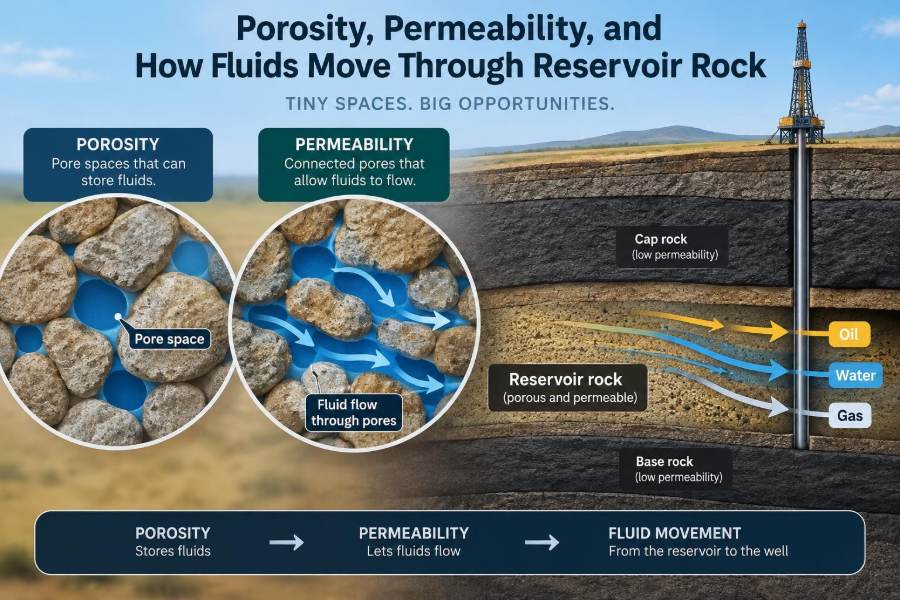

A core sample arrives at the laboratory looking like an ordinary cylinder of stone. Yet within that rock may be the pore space that holds hydrocarbons, the connected pathways that let fluids move, and the clues that determine whether a reservoir can produce at an economic rate.
That distinction matters in the field. Two sandstone intervals can have similar porosity, meaning they contain a similar volume of open space, while one delivers oil readily and the other barely flows. The difference is often hidden in the size, shape, and connection of pores.
For petroleum engineers, porosity and permeability are not abstract petrophysical terms. They influence hydrocarbon volumes, well productivity, water breakthrough, pressure behavior, completion design, and recovery strategy.
The useful starting point is simple: rocks store fluids in pores, and fluids move through connected pore throats when a pressure difference exists. The real engineering work lies in understanding what makes that simple statement succeed—or fail—in an actual reservoir.
🪨 Reservoir Rock Is a Fluid Storage System
A reservoir is not usually an underground cavern filled with oil. It is a body of rock containing a network of tiny spaces between or within mineral grains. Those spaces can contain water, oil, gas, or some combination of the three.
Most conventional reservoirs are sandstones or carbonates. Sandstone commonly contains spaces between deposited grains, while carbonate pore systems can result from deposition, dissolution, fractures, and biological textures. Their fluid-flow behavior can therefore be very different even when their average porosity appears similar.
🕳️ Porosity: The Fraction of Empty Space
Porosity, usually written as φ, is the fraction of a rock’s bulk volume occupied by pore space. If a 100 cm³ rock plug contains 20 cm³ of pores, its porosity is 20%, or 0.20.
Porosity says how much potential storage space exists; it does not identify which fluid occupies that space. A porous rock below the hydrocarbon-water contact may be almost entirely water-filled, whereas the same rock higher in the structure may contain movable hydrocarbons.
📦 Bulk Volume, Grain Volume, and Pore Volume
The porosity definition follows directly from a volume balance: φ = pore volume divided by bulk volume. Bulk volume includes mineral grains plus pores; grain volume is the solid portion alone.
This distinction prevents a common interpretation error. A rock may look dense and solid at hand-sample scale but still have enough microscopic pore volume to store significant fluids. Conversely, a visibly vuggy carbonate may have large holes but poor connected storage between them.
🔍 Total Porosity Versus Effective Porosity
Total porosity includes all pores, whether or not they connect to a flow path. Effective porosity includes only pore space that is interconnected and potentially available for fluid storage and movement under reservoir conditions.
Isolated pores matter less to production because fluids trapped there cannot readily communicate with a well. Clay-bound water and disconnected micropores can make total porosity look attractive while contributing little to producible hydrocarbon volume.
🧱 Where Pores Come From
Primary porosity forms during deposition or early rock formation. Intergranular spaces in a well-sorted sand are a familiar example. Secondary porosity develops later through processes such as mineral dissolution, dolomitization, fracturing, or grain alteration.
Secondary porosity can improve storage, but its effect on flow depends on connectivity. Dissolution may create connected channels, or it may create isolated vugs. Fractures may provide highly conductive pathways, but their reach and openness can vary sharply across a reservoir.
🏖️ Grain Size Is Not the Whole Story
It is tempting to assume coarse grains always create a more porous rock. In reality, sorting often matters more. Well-sorted grains of similar size leave more consistent void space than a mixture in which fine particles fill the gaps between larger grains.
For example, a hypothetical clean, well-sorted sand can retain open intergranular pores after burial more effectively than a poorly sorted sand containing abundant silt and clay. Grain size still affects pore-throat size and permeability, but it cannot predict reservoir quality by itself.
🧪 Compaction and Cementation Reduce Pore Space
As sediments are buried, increasing overburden stress pushes grains closer together. This compaction reduces pore volume and can narrow the passages connecting pores.
Minerals precipitating from formation water may also bind grains together. This process, called cementation, can preserve rock strength while reducing both porosity and permeability. Quartz, calcite, and clay minerals are common cements, but their effects depend on where and how they occur within the pore network.
💧 Permeability: The Ability to Transmit Fluids
Permeability, commonly represented by k, describes how readily a rock transmits a fluid through its connected pores under a pressure gradient. It is a property of the pore network, not simply a count of pores.
Permeability is commonly expressed in darcies or, more often in reservoir work, millidarcies. A numerical value should always be interpreted in context: fluid type, stress, layering, saturation, and measurement direction can all influence what the value means operationally.
🔗 Pore Throats Control the Flow Path
Large pore bodies can store fluid, but the narrow connections between them—called pore throats—often control flow. A useful analogy is a city with large parking areas connected by narrow streets. Storage may be ample, but traffic is limited by the bottlenecks.
That is why a rock with moderate porosity can have high permeability if its throats are wide and well connected. A highly porous rock with very fine or poorly connected throats can have low permeability.
⚖️ Why Porosity and Permeability Do Not Rise Together
Porosity and permeability often show a broad positive relationship in a single, clean rock type, but there is no universal one-to-one conversion. Different depositional facies, diagenetic histories, and clay contents can produce distinctly different permeability at the same porosity.
| Rock condition | Likely porosity behavior | Likely permeability behavior |
|---|---|---|
| Well-sorted, clean sandstone | Intergranular storage can be preserved | Often good if pore throats remain open |
| Clay-rich sandstone | May retain measurable total porosity | Can be low because throats are small or blocked |
| Vuggy carbonate | Can be high and highly variable | Depends strongly on vug and fracture connection |
| Tight siltstone or shale | May contain substantial microporosity | Usually very low at core scale |
The practical lesson is clear: do not estimate deliverability from porosity alone.
📏 Darcy’s Law Connects Pressure and Flow
At the core scale, single-phase flow through porous media is commonly described by Darcy’s law. In one simplified linear form, flow rate is proportional to permeability, cross-sectional area, and pressure drop, and inversely proportional to fluid viscosity and flow length.
q ∝ (kA/μL) ΔP
Here, q is flow rate, A is flow area, μ is viscosity, L is flow length, and ΔP is pressure difference. The relation expresses a physical idea: wider flow capacity and a stronger driving force increase flow, while a more viscous fluid or longer path resists it.
📉 Pressure Gradients Provide the Driving Force
Fluids move because pressure varies from one location to another, not because a reservoir merely contains fluid. During production, pressure near the wellbore is lowered relative to the surrounding reservoir, creating a pressure gradient toward the well.
Gravity also matters. In a vertical reservoir column, denser water tends to occupy lower positions and lighter gas higher positions when fluids can segregate over geologic time. Local flow is determined by the combined effects of pressure, gravity, capillarity, and rock structure.
🛢️ Viscosity Changes How Easily a Fluid Flows
Viscosity is a fluid’s resistance to flow. Water generally has lower viscosity than many crude oils, while heavy oils can be much more resistant to movement. Under otherwise identical conditions, a more viscous fluid requires a larger pressure gradient to achieve the same rate.
This is why rock quality cannot be assessed apart from fluid properties. A permeability that supports useful water flow may be insufficient for a viscous oil at the desired production rate. Temperature and pressure can also alter fluid viscosity and phase behavior.
🌊 Absolute, Effective, and Relative Permeability
Absolute permeability is measured when one fluid fully saturates the connected pore system. Reservoirs rarely operate in that simple state because oil, water, and gas commonly share the pore space.
Effective permeability is the permeability available to one phase at a particular multiphase saturation condition. Relative permeability expresses that effective permeability as a fraction of a reference permeability. These concepts are central to predicting multiphase production.
🧩 Fluid Saturation Defines Who Occupies the Pores
Water saturation, oil saturation, and gas saturation describe the fractions of pore volume occupied by each phase. Their sum is approximately one when all pore space is accounted for.
High hydrocarbon saturation does not automatically mean high production. Some hydrocarbon can be held in small pores or as disconnected droplets. Conversely, a reservoir with notable water saturation may still produce oil effectively if oil has sufficient relative permeability and the completion is placed appropriately.
🧲 Wettability Shapes Fluid Distribution
Wettability describes which fluid preferentially spreads on the rock surface. In a water-wet rock, water tends to coat mineral surfaces and occupy smaller pores, while oil more often resides in larger pore centers. Other systems may be mixed-wet or oil-wet.
Wettability influences capillary pressure, residual saturations, and relative-permeability behavior. It is not a minor laboratory detail: changing the way fluids arrange themselves inside pores changes the pathways each phase can use.
🫧 Capillary Pressure Holds Fluids in Small Pores
Capillary pressure arises at the interface between immiscible fluids, such as oil and water, in narrow pore throats. Smaller throats generally require a larger pressure difference for a non-wetting phase to enter or leave.
A sponge offers an everyday analogy. Water is not released from every small opening equally; some remains held until enough force is applied. In reservoir rock, capillary effects help create transition zones near fluid contacts rather than perfectly sharp boundaries.
🚰 Irreducible Water and Residual Oil
Some water remains trapped in a rock even after hydrocarbons have displaced much of it. This is often called irreducible or connate water saturation. The water may coat grains or occupy the smallest pores where capillary forces are strong.
Likewise, after water displaces oil, some oil can remain as disconnected ganglia or films; this is residual oil saturation. These terms describe saturation states under particular displacement histories, not permanently fixed values for every operating condition.
🧭 Anisotropy Means Direction Matters
Many reservoir rocks transmit fluids more readily horizontally than vertically because sedimentary layers, laminations, and shale streaks create directional structure. This is called permeability anisotropy.
Vertical permeability is especially important for crossflow, waterflood sweep, gas movement, and communication between layers. Assuming isotropic flow can overstate vertical communication and lead to poor predictions of coning or breakthrough behavior.
📚 Heterogeneity Creates Uneven Flow
Heterogeneity means reservoir properties vary from place to place. A field may contain clean high-permeability channels beside tighter floodplain deposits, or fractured carbonate zones beside dense matrix rock.
Fluids seek easier paths. During injection, water can move rapidly through high-permeability streaks while bypassing oil in tighter intervals. Average porosity and permeability may therefore conceal the flow paths that actually control recovery.
🧱 Shale Layers Can Compartmentalize a Reservoir
Thin shale beds, cemented layers, faults, and low-permeability barriers can restrict communication between intervals. A pressure response in one perforated zone may not represent the behavior of another zone only a short distance away.
Such barriers are not always complete seals. Engineers must distinguish between no communication, limited communication, and delayed communication using cores, logs, pressure data, production behavior, and geological interpretation. Each source contains uncertainty and should be integrated rather than used alone.
🧫 Core Analysis Measures Rock Properties Directly
Conventional core analysis uses physical rock plugs to measure porosity, permeability, grain density, and fluid saturations under defined laboratory conditions. Special core analysis can investigate capillary pressure, relative permeability, wettability-related behavior, and electrical properties.
Core data provide valuable direct evidence, but plugs sample only small volumes. A plug can miss a fracture, a thin shale lamina, or a vuggy feature that materially affects flow at well or field scale. Preservation, cleaning, stress conditions, and sample selection also affect interpretation.
📡 Well Logs Extend Measurements Along the Wellbore
Well logs infer properties continuously along a borehole. Density, neutron, sonic, and nuclear magnetic resonance measurements can support porosity estimation, while resistivity and other logs help evaluate fluid saturation when interpreted with suitable models.
Logs do not measure permeability as directly as a laboratory flow test. Permeability estimates from logs usually rely on calibrated relationships with core, pore-size indicators, or production data. Their reliability depends on rock type, borehole conditions, and the validity of those relationships.
🧠 Petrophysical Interpretation Requires Calibration
Petrophysics converts measurements into a reservoir description: net reservoir, porosity, water saturation, lithology, and sometimes permeability indicators. The workflow must account for clay effects, invasion by drilling fluids, thin beds, tool resolution, and changing mineralogy.
A formula that works in a clean sandstone may be misleading in a shaly sand or complex carbonate. Calibration against core and local production evidence is not optional polish; it is how an interpretation becomes tied to the actual reservoir.
🛠️ Well Productivity Depends on More Than k
Permeability strongly influences productivity, but well rate also depends on reservoir thickness, pressure drawdown, fluid viscosity, drainage geometry, completion efficiency, skin, and multiphase effects. A high-permeability interval can underperform if it is damaged near the wellbore or poorly connected to perforations.
Skin is a convenient way to describe additional resistance near the well. Positive skin can result from drilling-fluid invasion, fines migration, scale, or incomplete penetration. Stimulation may reduce this resistance, but it cannot create sustained reservoir energy or connectivity where neither exists.
💦 Water Injection Changes the Flow Problem
Waterflooding injects water to support pressure and displace oil toward producing wells. Success depends on more than placing injectors and producers on a map. The injected water must enter suitable intervals and sweep enough of the reservoir rather than taking a fast route through the most permeable streaks.
Mobility ratio, relative permeability, layering, faults, and injection rate all influence sweep. Early water breakthrough can reflect high-permeability channels, fractures, completion communication, or coning; diagnosing the cause matters before selecting a remedy.
🔥 Gas and Thermal Processes Add Complexity
Gas has low viscosity and can move readily, but its compressibility and tendency to segregate upward can complicate sweep. Gas injection may be useful for pressure maintenance or displacement under appropriate phase and miscibility conditions, yet channeling and gravity override require careful management.
Thermal methods reduce heavy-oil viscosity by adding heat. They can improve mobility substantially in suitable settings, but heat losses, water handling, rock properties, operational constraints, and emissions considerations all affect feasibility. No enhanced-recovery method is a universal answer.
🧱 Tight Reservoirs and Hydraulic Fractures
In tight rocks, matrix permeability may be too low to deliver commercial rates without creating conductive fractures. Hydraulic fracturing forms or extends fractures that connect the wellbore to a larger volume of rock, improving flow area and shortening the effective path through low-permeability matrix.
Fracture performance depends on geometry, conductivity, stress contrast, proppant placement, fluid recovery, and interaction with natural fractures. A fracture treatment changes the near-well flow architecture; it does not eliminate uncertainty about reservoir extent, fluid distribution, or long-term interference.
⚠️ Common Interpretation Mistakes
Several shortcuts repeatedly lead to weak reservoir decisions:
- Equating high porosity with high permeability.
- Using core permeability without considering in-situ stress or directional effects.
- Treating a log-derived permeability estimate as a direct measurement.
- Ignoring relative permeability when oil, water, and gas flow together.
- Assuming a field-average property represents every layer and every well.
- Calling all produced water “breakthrough” without diagnosing completion and reservoir causes.
Each mistake simplifies a coupled rock-fluid system too far. The cure is not endless complexity; it is choosing the measurements and model detail that address the decision at hand.
🧮 A Simple Conceptual Flow Example
Imagine two equal-thickness reservoir layers exposed to the same drawdown. Layer A has connected, relatively wide pore throats; Layer B has similar porosity but smaller throats partly lined with clay. If both contain the same-viscosity oil, Layer A will usually contribute more flow because its permeability is higher.
Now introduce water. If Layer A also has a high water relative permeability at the current saturation, it may deliver water preferentially after breakthrough. The best operational response is not automatically to shut the entire interval: engineers first investigate layer contribution, completion placement, pressure behavior, and the risk of losing productive oil flow.
🗺️ From Measurements to Reservoir Models
Static models distribute facies, porosity, permeability, faults, and contacts through three-dimensional space. Dynamic simulation then uses those properties with fluid models, wells, and operating constraints to forecast pressure and production.
Every model is an approximation. Good practice includes testing multiple plausible property distributions, matching against observed data where possible, and updating interpretations as new cores, logs, pressure surveys, tracers, or production history become available.
✅ The Core Principle for Reservoir Flow
Reservoir performance emerges from the interaction of storage, connectivity, fluid properties, saturation, and driving forces. Porosity answers how much pore space exists. Permeability answers how effectively the connected network can transmit fluid. Relative permeability and capillary effects explain why several fluids do not simply move independently through that network.
When evaluating any reservoir interval, ask a sequence of practical questions: Is there connected pore volume? Which fluids occupy it? What paths are open to each fluid at current saturation? What pressure gradient is available? And how do layering, fractures, and well completion alter the route to the wellbore?
Those questions turn basic rock properties into engineering judgment. They also explain why reliable reservoir decisions combine geological description, laboratory data, logs, pressure information, and production evidence instead of relying on a single attractive number.
Porosity tells us what a rock can hold, but permeability and multiphase flow behavior determine how—and whether—that fluid can be produced. Reading reservoir rock through both lenses is the foundation of sound petroleum engineering decisions. 🛢️🪨📈