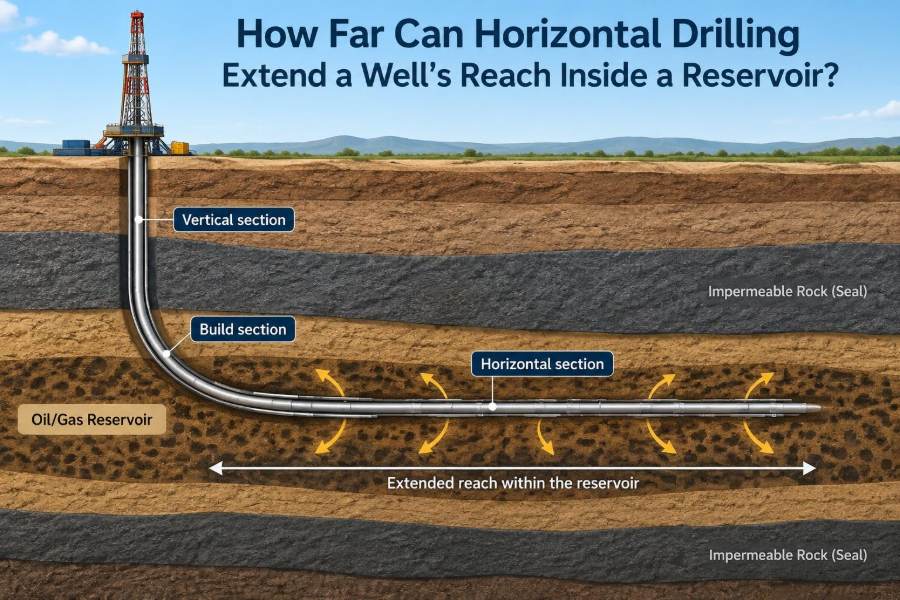

A reservoir may hold hydrocarbons across a wide underground area, but a vertical well contacts only a narrow slice of that rock. For an operator trying to drain a thin oil-bearing layer or a broad shale interval, that narrow contact can leave much of the reservoir poorly connected to the well.
Horizontal drilling changes the geometry. Rather than stopping after drilling downward, the well is gradually turned and drilled laterally through the target formation. The result can be a much longer section of wellbore inside the productive rock.
But “longer” does not automatically mean “better.” The practical reach of a horizontal well is constrained by drilling mechanics, reservoir quality, pressure loss, completion design, and the economics of recovering additional hydrocarbons.
The useful question is therefore not simply how many kilometres a well can extend. It is: how much productive reservoir can the well reliably contact, complete, and drain?
🧭 Start With the Meaning of Well Reach
In drilling discussions, reach can mean several different distances. Measured depth is the total length along the well path, while true vertical depth is the vertical distance below the surface. A horizontal well may have a very large measured depth without being especially deep vertically.
For reservoir engineering, the most relevant measure is often lateral length: the length of wellbore placed approximately parallel to the reservoir bedding within the target zone. This is the section intended to create extensive reservoir contact.
📐 Vertical Wells and Horizontal Wells See the Reservoir Differently
A vertical well cuts through rock layers like a needle passing through stacked sheets of paper. It may penetrate a reservoir interval only a few metres or tens of metres thick, depending on the formation.
A horizontal well can travel within one of those sheets. In a thin reservoir, this changes the exposed wellbore length from the thickness of the layer to a lateral distance that may be measured in hundreds or thousands of metres.
🗺️ The Reservoir Is the First Boundary
No drilling technology can create productive rock beyond the reservoir itself. The lateral must remain inside a zone with sufficient hydrocarbon saturation, permeability, pressure, and thickness to justify completion.
Reservoir boundaries can be structural, such as faults and folds, or stratigraphic, such as a change from porous sandstone into tight shale. A long lateral that leaves the pay zone may add drilling cost while contributing little or no production.
📏 Thickness Controls How Precise the Well Must Be
A thick reservoir gives the drilling team more vertical room to work. A thin bed demands much tighter geosteering, which is the practice of using downhole measurements to keep the bit in the desired rock.
Imagine driving along the middle floor of a multistorey car park versus trying to keep a vehicle centered inside a narrow tunnel. Both are possible, but the narrow tunnel leaves less tolerance for steering error, structural dip, and unexpected geological change.
🧱 Why Horizontal Contact Improves Flow Potential
Fluid must move through reservoir pores before entering a well. More wellbore length inside productive rock can reduce the average distance that oil, gas, or water travels through the formation to reach the well.
This is especially valuable in formations with low permeability, where the rock resists fluid flow. It can also help in thin, laterally extensive reservoirs where a vertical well would expose only a limited interval.
🔄 From Surface Hole to Build Section
A typical horizontal well begins with a vertical or near-vertical section. The trajectory then enters a build section, where the inclination is increased until the well approaches horizontal.
The turning intensity is described by dogleg severity, usually expressed as an angular change over a given drilled length. A sharper turn reaches the target direction sooner, but it can create higher mechanical stresses and more difficult drilling conditions.
➡️ The Lateral Is Not Always Perfectly Horizontal
“Horizontal” is convenient shorthand, not always a literal description. Many laterals follow a planned inclination close to 90 degrees from vertical, but the best path may rise, fall, or follow a dipping formation.
What matters is landing in and tracking the target interval. In some reservoirs, a slightly inclined path is preferable because it follows bedding, avoids a fluid contact, or improves the completion design.
🧠 Geosteering Keeps the Bit in the Best Rock
Geosteering combines directional drilling with real-time geological interpretation. Measurements transmitted from tools near the bit can indicate formation properties, boundaries, resistivity contrasts, and the well’s position relative to the target.
The team compares these signals with the geological model and updates the trajectory. This is not a guarantee of perfect placement: measurements have uncertainty, formations vary, and information arrives from a limited volume around the wellbore.
🛰️ Measurement While Drilling Makes Long Laterals Practical
Measurement-while-drilling and logging-while-drilling tools provide directional data and formation measurements while the well is being drilled. Without this feedback, maintaining a long path within a narrow target would be far more uncertain.
Tool placement, signal quality, formation response, and operational limits all affect what the team can infer. Good data supports good decisions, but it does not eliminate geological ambiguity.
🪨 Rock Quality Can Change Along the Same Lateral
Reservoirs are rarely uniform. Porosity, permeability, natural fractures, clay content, stress, and fluid saturation may all change along a lateral, sometimes over relatively short distances.
A well may therefore cross excellent rock, mediocre rock, and nonproductive rock in one continuous trajectory. Completion engineers use this variability when deciding where to place perforations or stimulation stages.
🧪 Conventional Reservoirs and Unconventional Reservoirs
In a conventional reservoir, natural permeability may be sufficient for hydrocarbons to flow toward a horizontal well. The lateral creates more contact, but the reservoir itself supplies much of the flow capacity.
In unconventional shale or tight formations, permeability is extremely low. The horizontal well is commonly paired with hydraulic fracturing, creating conductive fractures that extend outward from the wellbore and provide pathways for fluid flow.
| Reservoir setting | Why lateral length matters | Main limitation |
|---|---|---|
| Thin conventional oil zone | Increases exposure to a limited-thickness pay interval | Water or gas breakthrough, heterogeneity |
| Fractured carbonate | May intersect productive natural fractures | Uncertain fracture connectivity |
| Tight shale | Provides a platform for many stimulation stages | Fracture interaction and pressure loss |
| Heavy-oil reservoir | Can improve contact for thermal recovery layouts | Heat delivery and conformance |
💥 Fracture Coverage Matters More Than Wellbore Length Alone
For hydraulically fractured wells, the reservoir is not drained by the open wellbore alone. Production depends heavily on whether fractures are created where intended and whether they connect effectively to productive rock.
A longer lateral offers room for more treatment stages, but stage count is not the same as effective fracture coverage. Rock stress, barriers, fluid placement, perforation design, and nearby wells can all influence the result.
🌊 Pressure Drop Grows Along a Long Well
Fluids entering the heel, the portion of the lateral nearer the vertical section, have a shorter path to surface than fluids entering the toe, the far end. As fluids flow inside the wellbore, friction creates pressure loss.
If this pressure drop becomes substantial, inflow can become uneven. The heel may contribute disproportionately while the toe is underproduced, even if the reservoir quality is similar along the entire lateral.
🚰 Inflow Distribution Is a Completion Problem Too
Completion design can influence where fluids enter the well. Perforation clusters, liner configuration, stimulation sequencing, and inflow-control devices may be selected to promote a more balanced contribution.
These tools are not universally needed or equally effective in every reservoir. Their value depends on the expected contrast in permeability, pressure, fluid mobility, and the consequences of early water or gas production.
💧 Water and Gas Can Limit Useful Reach
Extending a lateral closer to an aquifer, gas cap, or fluid contact can increase the risk of unwanted fluid production. Water or gas may move preferentially through high-permeability streaks, fractures, or coning paths toward the well.
A longer well can also create more opportunities to intersect such pathways. The best lateral length is therefore often a compromise between more reservoir contact and maintaining acceptable fluid production.
⚙️ Torque and Drag Set Mechanical Limits
As drill pipe extends through a curved and horizontal hole, friction against the wellbore increases. This produces torque while rotating the drill string and drag while moving it in or out of the hole.
Excessive torque and drag can limit how far the bit can be pushed, impair weight transfer to the bit, and complicate running casing or completion equipment. Lubricity, trajectory design, hole cleaning, and drill-string configuration all matter.
🧹 Hole Cleaning Becomes Harder at High Inclination
Drilled cuttings must be transported out of the well by circulating drilling fluid. In a horizontal section, cuttings can settle along the low side of the hole and form beds if transport is inadequate.
Accumulated cuttings raise friction, increase the risk of pack-off, and can make the hole difficult to circulate or trip. Flow rate, fluid properties, pipe rotation, annular velocity, and operational practices are managed to reduce this risk.
🧷 Casing and Cementing Need a Clear Path
Drilling the lateral is only one part of reaching the reservoir. Casing, liners, packers, plugs, and other completion components must also be conveyed to the planned depth.
A long lateral with poor hole condition can prevent equipment from reaching the toe. In that case, the theoretical reservoir reach is larger than the completed and usable reach.
🔧 Extended-Reach Drilling Is a Different Challenge
Extended-reach drilling refers broadly to wells designed with unusually large horizontal displacement relative to their vertical depth. Such wells can access reservoirs far from the drilling location, including offshore targets beneath areas where surface access is restricted.
These designs require careful planning because small problems compound over distance. Hydraulics, torque and drag, equivalent circulating density, vibration, casing design, and contingency planning must work together.
🏗️ Surface Location Can Be a Major Advantage
A long horizontal reach can allow multiple wells to be drilled from one pad. This may reduce the number of surface locations, roads, and associated site disturbances compared with placing a separate vertical location above every target.
It can also help access reservoir areas beneath infrastructure, environmentally sensitive land, or offshore areas from a fixed platform. Those advantages depend on local rules, land access, costs, and the feasibility of the subsurface trajectory.
📊 The Economic Limit Comes Before the Physical Limit
Even when a drilling system could extend farther, the final part of a lateral may not recover enough additional value to justify the added cost and risk. Longer wells generally require more drilling time, more tubulars, more completion materials, and more operational complexity.
Economic decisions consider expected productivity, commodity prices, service costs, decline behavior, reservoir uncertainty, and the chance that additional length will interfere with nearby drainage or fracture systems. There is no single profitable length for all plays.
🧩 Well Spacing Determines Whether Reach Adds Recovery
In a development with many horizontal wells, laterals are arranged with planned spacing. If wells are too far apart, productive rock may remain poorly drained; if too close, they may compete for the same fluids or interact during stimulation.
Spacing is not merely a map-drawing exercise. It is linked to reservoir permeability, fracture geometry, depletion history, pressure communication, and the operator’s recovery strategy.
🤝 Parent-Child Interactions Complicate Development
A newly drilled well placed near an older producing well is sometimes called a child well, while the existing producer is called a parent well. Pressure depletion and hydraulic-fracture communication can affect both wells.
The outcome is reservoir-specific. Interactions may reduce stimulation effectiveness, redirect fluids, or change production behavior. Development sequencing and pressure management can be as important as the nominal lateral length.
📈 Production Data Reveals the Effective Reach
Initial production rates alone do not show which parts of a lateral are contributing. Engineers may combine production history with pressure data, tracer results, temperature or acoustic diagnostics, and other surveillance methods where appropriate.
The goal is to distinguish drilled length from effective producing length. A well can be physically long while only part of it delivers sustained, economically meaningful inflow.
🧮 Reservoir Simulation Tests Competing Designs
Reservoir simulation uses a mathematical model of fluid flow through rock to test possible well locations, lengths, spacing, and operating strategies. It cannot remove uncertainty, because the underlying geology and fracture behavior are never known perfectly.
Its value lies in making assumptions explicit. Teams can compare scenarios such as a shorter lateral in consistently good rock versus a longer lateral that reaches a lower-quality or higher-water-risk area.
🛠️ A Hypothetical Design Choice
Consider a hypothetical thin oil reservoir with a productive central corridor and poorer rock toward one boundary. A 1,500-metre lateral may remain largely within the corridor, while a 2,500-metre option extends into uncertain rock near an aquifer.
The longer design could add contact, but it may also increase drilling difficulty, water risk, and pressure loss. If the outer section is unlikely to contribute effectively, the shorter well can be the stronger engineering choice despite its smaller headline length.
⚠️ Common Mistake: Treating Length as the Main Performance Metric
Long laterals are visible, easy to report, and often technically impressive. Yet length by itself says little about reservoir quality, completion effectiveness, equipment reliability, fluid handling, or ultimate recovery.
A better question is whether each added section contacts productive rock and can be completed so that it contributes at an acceptable cost and risk. Useful reach is not the same as drilled reach.
🧯 Common Mistake: Ignoring Operational Margins
A plan that works only under ideal drilling conditions has little resilience. Unexpected lithology, lost circulation, tool failures, cuttings accumulation, pressure changes, or casing-running problems can force changes to the planned lateral.
Prudent designs include operational margins and decision points. Teams should define what measurements or conditions would justify altering the trajectory, shortening the lateral, or changing the completion approach.
🌍 Environmental Performance Depends on Execution
Horizontal drilling can concentrate surface operations, but it does not remove environmental responsibilities. Drilling fluids, cuttings, water use, well integrity, emissions, produced-water management, and eventual abandonment all require disciplined control.
Longer wells can reduce the need for some surface locations while increasing material use and operational duration per well. Environmental comparisons should consider the full project design rather than assuming one geometry is automatically superior.
🎓 What Students Should Remember
Horizontal drilling is a combined drilling, geology, completion, and reservoir-engineering problem. The well must be placed accurately, drilled safely, completed effectively, and operated in a way that matches the reservoir’s flow behavior.
When evaluating a proposed lateral, ask: Is the target continuous? How thick is it? What limits placement? How will fluids enter the well? What happens near boundaries and neighboring wells? Those questions reveal more than lateral length alone.
✅ The Core Principle of Horizontal Reach
Horizontal drilling can extend a well’s reach from a short vertical intersection to a long path through a reservoir, often spanning distances that make development from a single surface location feasible. Modern directional tools and completion methods have expanded what can be attempted.
Yet every added metre must overcome mechanical friction, maintain hole quality, stay in productive rock, and produce enough value to justify its cost. The limiting factor may be the drill string, the completion, the reservoir boundary, the pressure system, or the development economics.
The sound engineering objective is not to drill the longest possible lateral. It is to design the length that provides the best balance of reservoir contact, reliable execution, recoverable volume, and responsible field development.
Horizontal drilling reaches farther when geology, drilling mechanics, completion design, and reservoir behavior are aligned—not when length is pursued for its own sake. 🛢️🧭📐