
When an oil well is first drilled into a productive reservoir, underground pressure may be high enough to push oil and gas toward the surface naturally. ⛽⬆️ For a time, the well may flow without requiring any mechanical assistance.
But reservoirs do not maintain that pressure forever.
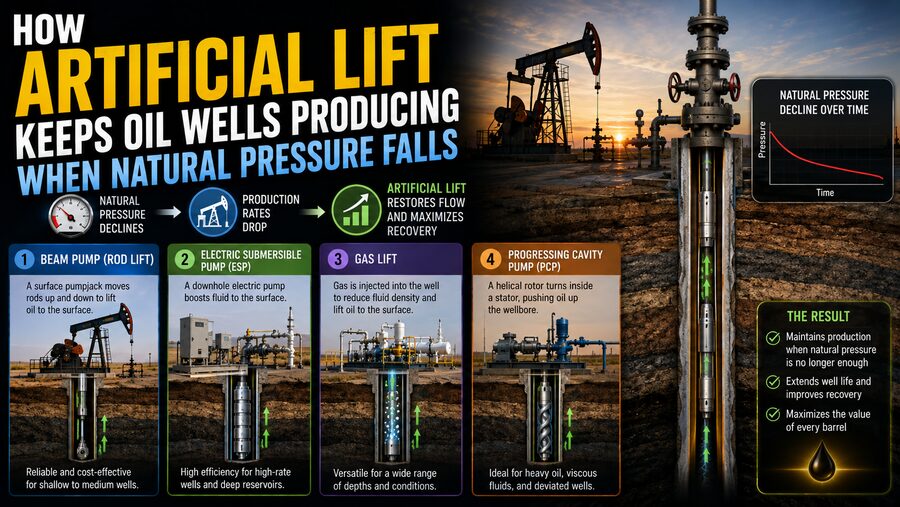
As oil, gas, and water are removed, the pressure inside the reservoir often declines. At some point, the natural energy of the formation may no longer be strong enough to lift fluids all the way to the surface at an economic rate.
That does not necessarily mean the well is empty.
There may still be a large amount of recoverable oil underground. The problem is that the available pressure is no longer sufficient to move the fluid efficiently through thousands of feet of wellbore.
To solve this, petroleum engineers use systems collectively known as artificial lift. ⚙️🛢️
Artificial lift adds energy to the fluids inside the well or reduces the difficulty of moving them upward. Different technologies accomplish this in different ways, from mechanical pumps deep underground to injected gas that makes the fluid column lighter.
🌍 Why Oil Can Flow Naturally at First
Oil and gas are stored underground in porous rock formations.
Although people sometimes imagine a reservoir as a giant underground lake, hydrocarbons are more commonly trapped within tiny connected spaces in rock.
The reservoir may contain:
- Crude oil
- Natural gas
- Formation water
- Dissolved gases
These fluids exist under pressure created by geological conditions.
When a well penetrates the reservoir, the pressure difference between the underground formation and the surface creates a driving force.
If reservoir pressure is high enough, fluid moves toward the well and rises through the production tubing.
This is known as natural flow.
Early in a field’s life, natural flow can sometimes produce substantial quantities of oil without a downhole pump.
📉 Why Reservoir Pressure Declines
Producing fluids changes conditions inside the reservoir.
As oil and gas are withdrawn, pressure may gradually fall.
The rate of decline depends on the type of reservoir and the natural mechanisms supplying energy.
These mechanisms can include:
- Expansion of dissolved gas
- Expansion of a gas cap
- Water moving into the reservoir
- Rock and fluid expansion
Over time, however, the pressure available to move oil toward the surface may become insufficient.
The well may begin producing more slowly.
Eventually, fluids may stop reaching the surface continuously even though substantial hydrocarbons remain underground.
That is when artificial lift often becomes important.
🧱 The Challenge of Lifting a Column of Fluid
Imagine a well several kilometers deep.
The oil inside the tubing has weight.
The deeper the fluid column, the greater the pressure required to support and move that column upward.
This pressure is known in general terms as hydrostatic pressure.
A reservoir must overcome several forms of resistance, including:
- The weight of the fluid column
- Friction inside the tubing
- Surface backpressure
- Flow restrictions
If reservoir pressure drops below what is needed to overcome these forces, production declines.
Artificial lift changes this balance.
It either:
Adds mechanical energy to the fluid
or
Reduces the effective weight of the fluid column
so that oil can continue reaching the surface.
⚙️ What Is Artificial Lift?
Artificial lift is a broad term covering technologies used to assist the upward movement of fluids in a producing well.
It does not create oil.
Instead, it helps recover oil that already exists in the reservoir but can no longer flow efficiently to the surface under natural pressure alone.
Common artificial-lift systems include:
- Sucker-rod pumps
- Electric submersible pumps
- Gas lift
- Progressive cavity pumps
- Hydraulic pumping systems
- Plunger lift
Each method is suited to different well conditions.
Petroleum engineers select a system based on factors such as:
- Well depth
- Production rate
- Oil viscosity
- Gas content
- Water production
- Sand production
- Well geometry
- Temperature
- Pressure
- Operating cost
There is no single best artificial-lift system for every well.
🐎 Sucker-Rod Pumps: The Classic Pumpjack
One of the most recognizable artificial-lift systems is the pumpjack.
These machines are often seen slowly moving up and down above oil wells.
The surface structure is only one part of the system.
A long series of steel rods extends from the surface down the well to a pump located near the producing zone.
As the surface unit moves, the rods move up and down.
The downhole pump uses this reciprocating motion to lift fluid upward in stages.
The system typically contains valves that allow fluid to move in the desired direction during each pumping cycle.
Over repeated strokes, oil is gradually raised through the production tubing to the surface.
Pumpjacks are particularly common in mature oil fields where wells produce at moderate or relatively low rates.
🔄 How a Rod Pump Moves Oil
A simplified rod-pump cycle can be imagined as two alternating movements.
During part of the stroke, fluid enters the pump chamber.
During another part, valves redirect the movement so fluid is pushed upward.
The exact mechanical arrangement is carefully engineered, but the overall concept resembles a reciprocating piston pump.
The repeating motion:
Fill → Lift → Discharge → Repeat
allows production to continue even when the reservoir cannot naturally push the entire fluid column to the surface.
Rod pumps are popular because they are relatively well understood and can operate for long periods with appropriate maintenance.
⚡ Electric Submersible Pumps
For wells producing large volumes of fluid, engineers may use an Electric Submersible Pump, commonly abbreviated ESP.
Instead of mechanically moving rods from the surface, an ESP uses an electric motor installed deep inside the well.
The motor drives a long multi-stage centrifugal pump.
Each stage adds a small amount of pressure to the fluid.
By passing through many stages in sequence, the fluid gains enough pressure to travel toward the surface.
Conceptually:
Electric motor → Rotating pump stages → Higher fluid pressure → Surface production
ESPs can move very large amounts of liquid and are widely used in high-rate wells.
🌀 How an ESP Creates Pressure
An ESP generally contains many rotating components called impellers.
As an impeller spins, it transfers energy to the fluid.
A stationary component then redirects the fluid into the next stage.
Each stage increases the fluid pressure slightly.
With dozens or even hundreds of stages, the pump can create a significant pressure boost.
This makes ESPs particularly useful when a well contains large quantities of oil and water that must be lifted from substantial depth.
However, because the motor and pump operate underground, reliability and equipment selection are extremely important.
🔌 Supplying Electricity Deep Underground
An ESP requires electrical power.
A protected power cable runs down the well alongside the production tubing.
Surface equipment supplies and controls the electrical energy.
Modern ESP systems may include sensors that monitor conditions such as:
- Temperature
- Pressure
- Motor behavior
- Vibration
- Electrical load
These measurements help operators evaluate pump performance and detect developing problems.
Because retrieving a failed downhole pump can require a major maintenance operation, monitoring is valuable.
💨 Gas Lift: Making the Fluid Column Lighter
Gas lift uses a completely different strategy.
Instead of using a mechanical pump to push the fluid upward, gas is injected into the production tubing.
The injected gas mixes with the well fluids.
This reduces the average density of the fluid column.
A lighter fluid column requires less pressure to lift.
As a result, the remaining reservoir pressure may once again be sufficient to move the mixture toward the surface.
A simple analogy is the difference between lifting a pipe filled with heavy liquid and one containing a mixture of liquid and gas bubbles.
The gas-containing mixture is effectively lighter.
🫧 How Gas Enters the Production Stream
In a gas-lift well, compressed gas is usually supplied from the surface.
The gas travels down the well through a separate flow path and enters the production tubing through specially designed gas-lift valves.
Once inside the tubing, it mixes with produced fluids.
The mixture then flows upward.
At the surface, separators can divide the production stream into:
- Oil
- Gas
- Water
In some operations, part of the gas can be recompressed and reused.
This makes gas lift particularly attractive where an adequate gas supply and compression infrastructure already exist.
📈 Continuous and Intermittent Gas Lift
Gas lift can operate in different ways.
Continuous gas lift injects gas steadily into the production stream.
It is commonly used when the well can support relatively continuous flow once the fluid column is made lighter.
Intermittent gas lift introduces gas periodically to help move accumulated liquid toward the surface.
The exact design depends on the well’s pressure, production characteristics, and fluid behavior.
Engineers model the interaction between gas injection and liquid production to determine an appropriate operating strategy.
🧬 Progressive Cavity Pumps
Another artificial-lift technology is the Progressive Cavity Pump, or PCP.
A PCP contains a rotating component called a rotor inside a specially shaped stationary component called a stator.
As the rotor turns, sealed cavities move along the pump.
Fluid becomes trapped inside these cavities and is transported upward.
Progressive cavity pumps can be particularly useful for fluids that are:
- Viscous
- Heavy
- Contaminated with some solids
- Difficult for certain other pumps to handle
They are used in some heavy-oil applications because they can move thick fluids relatively smoothly.
🛢️ Why Heavy Oil Can Be Difficult to Produce
Not all crude oils flow easily.
Some are light and mobile.
Others are extremely viscous and resemble thick syrup.
High-viscosity oil creates greater resistance as it flows through reservoir rock and production tubing.
A well producing heavy oil may therefore require artificial lift even when some reservoir pressure remains.
Pump selection becomes especially important because different pump types handle thick fluids, gas, water, and solids differently.
Engineers must match the artificial-lift system to the characteristics of the produced fluid.
🔧 Hydraulic Pumping Systems
Some wells use hydraulic energy transmitted through fluid to operate downhole pumping equipment.
In these systems, pressurized power fluid is sent from the surface to drive a downhole pump.
The system then transfers energy to produced fluids so they can move upward.
Hydraulic systems can be useful in certain well configurations, although they are less visually obvious than a surface pumpjack.
Like every artificial-lift method, they involve tradeoffs involving complexity, efficiency, maintenance, and well conditions.
🪠 Plunger Lift
Plunger lift is another technique used particularly in wells where gas is present and liquids tend to accumulate.
A free-moving plunger travels within the production tubing.
Pressure differences move the plunger through the well, helping carry accumulated liquid toward the surface.
Removing liquid can reduce the load on the well and allow gas production to continue more effectively.
Plunger lift often relies on the well’s own energy rather than a large continuously powered downhole pump.
It is therefore conceptually different from many pump-based systems.
💧 Water Production Changes the Problem
As oil fields mature, wells often begin producing increasing quantities of water.
This can happen because formation water naturally moves toward producing zones or because water is injected elsewhere in the reservoir to help maintain pressure and sweep oil toward wells.
A mature well might eventually produce much more water than oil.
Artificial-lift equipment must therefore move the total fluid volume, not just the oil.
This can strongly influence system selection.
For example, an ESP may be useful in wells that need to move very large quantities of liquid.
💨 Gas Can Also Complicate Pumping
Gas affects pumps differently from liquid.
A centrifugal pump designed primarily to move liquid may perform poorly if large amounts of free gas enter it.
Gas can interfere with the pump’s ability to generate pressure.
Engineers may therefore use special gas-handling equipment or locate the pump to improve fluid conditions at the intake.
Rod pumps and other lift systems also have operating limits related to gas.
Understanding the proportions of oil, water, and gas is therefore fundamental to artificial-lift design.
🏖️ Sand and Solids Create Wear
Some reservoirs produce sand along with their fluids.
Sand can:
- Erode components
- Block flow passages
- Wear valves
- Damage pumps
- Increase maintenance requirements
Artificial-lift equipment must be chosen with these conditions in mind.
A pump that works well in a clean liquid may have a much shorter life in an abrasive production stream.
Engineers may use equipment designed for better solids tolerance where needed.
📡 Sensors Help Optimize Artificial Lift
Modern oil wells can contain extensive instrumentation.
Sensors may monitor:
- Downhole pressure
- Downhole temperature
- Surface pressure
- Flow rate
- Motor current
- Pump speed
- Vibration
This information helps engineers understand how the artificial-lift system is performing.
For example, if an ESP begins drawing abnormal electrical current, the change may indicate developing mechanical or fluid-handling problems.
If production drops while pressure changes unexpectedly, engineers may adjust operating conditions or investigate the well.
🤖 Variable-Speed Control Improves Flexibility
Some artificial-lift systems use variable-speed drives.
These electronic controllers allow the speed of a pump or motor to be adjusted.
Increasing pump speed can often increase fluid movement.
Reducing speed may be useful when reservoir inflow is lower.
This flexibility allows operators to better match pump performance to what the reservoir can actually supply.
Operating a pump far beyond the well’s inflow capacity can be inefficient and may create undesirable conditions.
Modern control systems therefore try to keep the surface equipment, downhole pump, and reservoir behavior in balance.
⚖️ The Reservoir and Pump Must Work Together
An artificial-lift pump does not independently determine production.
The reservoir must still deliver fluid into the well.
Engineers therefore consider both:
Reservoir inflow and wellbore lifting capacity.
If the pump attempts to remove fluid much faster than the reservoir can supply it, the fluid level inside the well may fall excessively.
If the pumping rate is too low, the well may not produce efficiently.
Successful artificial lift requires matching the lift system to the reservoir’s ability to provide fluid.
📊 Engineers Use Production Curves and Models
Petroleum engineers use mathematical models to estimate how a well will behave under different conditions.
They may analyze relationships involving:
- Bottom-hole pressure
- Flow rate
- Tubing pressure
- Fluid density
- Gas fraction
- Pressure loss
The objective is to identify operating conditions where the reservoir and artificial-lift equipment work effectively together.
Modern software can simulate the entire flow path from:
Reservoir → Wellbore → Production tubing → Surface equipment
This allows engineers to evaluate different lift technologies before installing expensive equipment.
🔄 Artificial Lift Often Changes During a Well’s Life
The best artificial-lift system may change as a well ages.
For example, a well might begin with natural flow.
Later it may use gas lift.
As production declines further, another system may become more economical.
A simplified lifecycle could look like:
Natural flow → High-rate artificial lift → Lower-rate lift system → Late-life production
The actual sequence varies greatly between fields.
Artificial-lift planning is therefore a long-term engineering problem rather than a one-time decision.
💰 Economics Matter as Much as Mechanics
Artificial lift requires equipment, maintenance, energy, and monitoring.
Engineers must evaluate whether the additional oil recovered is worth the operating cost.
Economic considerations include:
- Electricity consumption
- Gas compression
- Maintenance
- Equipment replacement
- Workover operations
- Production revenue
- Expected well life
A technically powerful pump may not be the most economical choice for a low-rate well.
Conversely, an inexpensive system may be unsuitable for a well producing very large volumes.
The objective is not simply maximum pumping power—it is reliable and economically sustainable production.
🧰 Why Maintenance Can Be Challenging
Much of the important artificial-lift equipment may be thousands of feet below ground.
If a surface pump component fails, technicians may be able to access it relatively easily.
A downhole failure can be much more complicated.
Retrieving tubing, rods, or pumps may require specialized well-servicing equipment.
For this reason, engineers consider reliability when selecting materials and operating conditions.
Monitoring systems can also help identify deterioration before a complete failure occurs.
🌊 Artificial Lift vs. Reservoir Pressure Support
Artificial lift should not be confused with techniques used to maintain or enhance reservoir pressure.
For example, some fields inject water or gas into the reservoir through dedicated injection wells.
The purpose can be to maintain pressure or move oil toward producing wells.
Artificial lift, by contrast, primarily helps fluids move inside the producing well toward the surface.
The two strategies can be used together:
Reservoir management helps oil reach the well.
Artificial lift helps oil travel up the well.
That distinction is important.
🌱 Energy Efficiency Is Increasingly Important
Artificial-lift systems can consume significant amounts of energy.
Large ESPs require electricity.
Gas-lift systems require compression.
Surface pumping units require mechanical power.
Operators therefore analyze efficiency carefully.
A poorly optimized system may waste energy by moving unnecessary fluid, operating at an inefficient speed, or creating excessive pressure losses.
Modern optimization may use:
- Improved pump design
- Variable-speed drives
- Better well models
- Automated controls
- Real-time monitoring
Reducing energy consumption can lower both operating costs and the environmental footprint of production.
🛡️ Safety Is Built Into Production Systems
Oil and gas production involves pressurized fluids and potentially flammable hydrocarbons.
Artificial-lift systems therefore operate within larger well-safety and process-control systems.
Facilities may include:
- Pressure monitoring
- Emergency shutdown systems
- Flow-control valves
- Gas detection
- Electrical protection
- Equipment isolation systems
The exact safety systems vary depending on the type of well, lift equipment, location, and applicable engineering requirements.
Artificial lift is therefore not just a pump—it is one component within a carefully controlled production system.
🧠 Choosing the Right Artificial-Lift Method
A petroleum engineer considering artificial lift may ask questions such as:
How much fluid does the well produce?
How deep is the well?
How viscous is the oil?
How much gas is present?
Is sand being produced?
How much water is present?
What power is available at the site?
How often can the well be serviced?
The answers help determine which technology is most appropriate.
A simplified comparison might be:
Rod pump: Proven and widely used for many moderate- and low-rate wells.
ESP: Excellent for moving large liquid volumes.
Gas lift: Useful when injected gas can efficiently lighten the production column.
PCP: Well suited to some viscous and solids-containing fluids.
Plunger lift: Useful in certain gas-producing wells with liquid accumulation.
Real-world selection involves much more detailed engineering, but these basic characteristics explain why multiple technologies exist.
🏭 From Reservoir to Surface Facility
Once artificial lift brings fluids to the surface, production is not finished.
The well stream may contain a mixture of:
Oil + Gas + Water
Surface facilities separate these phases.
Oil can then be treated and sent toward storage or transportation.
Gas may be processed, sold, used on site, or—in some fields—recompressed for gas-lift operations.
Produced water is managed according to the field’s engineering and environmental requirements.
Artificial lift therefore forms one link in a much larger production chain.
✅ Final Thoughts
When natural reservoir pressure declines, an oil well may stop flowing efficiently even though substantial recoverable hydrocarbons remain underground. 🛢️📉
Artificial lift gives engineers a way to continue production by changing the energy balance inside the well.
Some systems, such as sucker-rod pumps, electric submersible pumps, progressive cavity pumps, and hydraulic pumps, mechanically add energy to the fluids.
Others, particularly gas lift, reduce the effective density of the fluid column so the remaining reservoir pressure can move it more easily toward the surface.
Plunger systems can help remove accumulated liquids in certain gas-producing wells.
The appropriate technology depends on the unique characteristics of each well, including depth, fluid properties, production rate, gas content, water production, solids, operating cost, and available infrastructure.
Modern artificial-lift systems also use sensors, automation, variable-speed drives, computer modeling, and performance monitoring to remain efficient and reliable. 📡⚙️
The important idea is that declining natural pressure does not automatically mean an oil well has reached the end of its productive life.
Instead, engineers can provide the extra assistance needed to move underground fluids to the surface.
In that sense, artificial lift acts as the mechanical or fluid-powered helping hand that takes over when the reservoir’s natural energy is no longer enough—allowing mature wells to continue producing long after natural flow begins to fade. 🏭🛢️⬆️