
It is 2 a.m. at a process facility. A control-room alarm sounds, an operator sees an unfamiliar trend, and a routine task suddenly becomes a decision with consequences far beyond the unit boundary.
Oil and gas operations handle hydrocarbons at high pressure, high temperature, and sometimes in toxic or oxygen-deficient environments. Most shifts pass safely because layers of engineering, procedures, inspection, and human judgment work together.
Major incidents occur when those layers are weakened, bypassed, misunderstood, or overwhelmed. Their outcomes can include fatalities, environmental damage, asset loss, and long-lasting harm to nearby communities and workforces.
Studying incidents is not about assigning blame from a distance. It is about recognizing recurring conditions early enough to prevent the next loss of containment, ignition, explosion, or release. 🧯
🔍 1. Process safety is different from personal safety
Personal safety focuses on preventing frequent, lower-consequence injuries such as slips, strains, and hand injuries. Process safety focuses on preventing releases of hazardous energy or materials that can escalate into rare but catastrophic events.
A site can report few recordable injuries while still carrying serious process-safety risk. Good housekeeping, proper gloves, and safe lifting matter, but they cannot by themselves prevent a vessel overpressure or a vapor-cloud explosion.
🏭 2. Major incidents usually have a long prehistory
Large accidents rarely begin with one dramatic error. They often develop through years of deferred maintenance, weak alarm management, unclear procedures, unresolved technical concerns, and production pressures.
The final event may be a valve operated at the wrong time or an ignition source finding a flammable cloud. But prevention depends on noticing the smaller warnings before the final barrier fails.
📚 3. The five lessons are connected
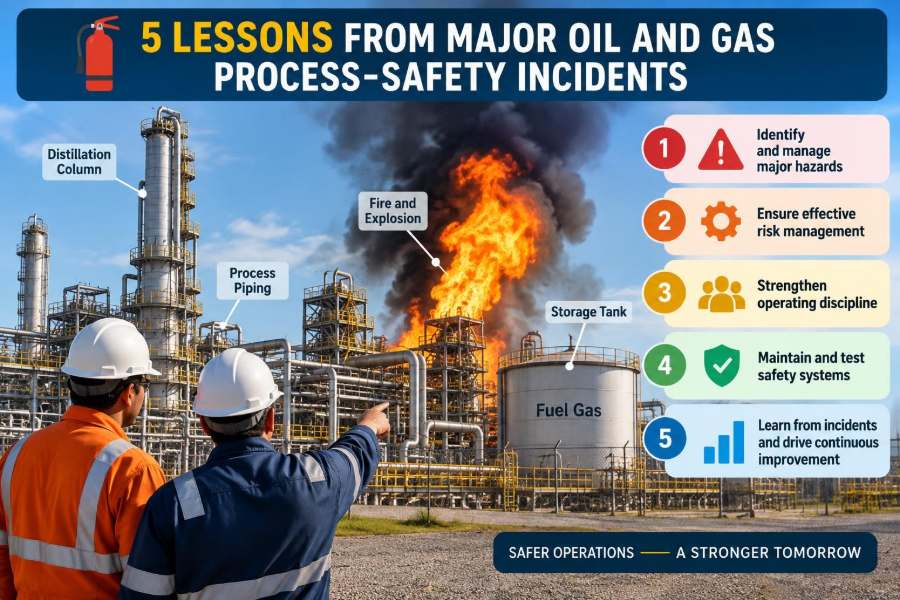
This article organizes learning from major incidents into five linked lessons: understand hazards, protect barriers, manage change, design work for people, and learn from warning signs. These are not separate programs.
For example, a poor change review can leave an operator with a misleading procedure. That human-performance problem may then defeat a safeguard that was never verified after the modification.
🔥 4. Lesson one: know the hazard, not just the equipment
Equipment names can create false comfort. A separator, tank, furnace, compressor, or pipeline is not inherently safe or unsafe; its risk depends on inventory, pressure, temperature, chemistry, confinement, and possible ignition sources.
Teams need a shared picture of what could be released, where it could travel, how it could ignite, and what would limit escalation. This is the practical foundation of process safety.
💨 5. Flammable vapor clouds can travel before ignition
A hydrocarbon release does not have to ignite at the leak point. Vapors and gases may disperse, collect in congested areas, enter enclosed spaces, or encounter ignition sources some distance away.
This explains why layout, drainage, ventilation, electrical classification, and rapid isolation are crucial. It also explains why responders must not assume that an apparently small leak has a small hazard zone.
☠️ 6. Toxic hazards require equal respect
Hydrogen sulfide is a well-known oil and gas hazard, but toxic risk also arises from chemicals used in treating, cleaning, corrosion control, and laboratory work. Exposure pathways and protective actions must be understood before work begins.
Odor is not a reliable warning for toxic exposure. Fixed detection, personal monitors where appropriate, ventilation, respiratory protection, and an immediate evacuation response can be essential safeguards.
🌡️ 7. Pressure and temperature create stored energy
Pressurized systems store energy even when they contain nonflammable fluids. A sudden release can produce projectile hazards, severe cold from expansion, noise, spray, or structural damage.
Temperature adds another dimension. Hot oil, steam, cryogenic fluids, and heated equipment can cause injury and can alter material behavior, vapor generation, reaction rates, and pressure relief demands.
🧪 8. Chemistry can change the scenario quickly
Contamination, incompatible chemicals, oxygen ingress, unstable deposits, and unintended reactions can turn a familiar process into an unfamiliar one. The hazard review must consider credible abnormal chemistry, not only normal operation.
Before introducing a new chemical or cleaning method, teams should ask what it can react with, what gases it may generate, and whether existing materials and safeguards remain suitable.
🗺️ 9. Hazard studies must lead to usable action
Methods such as hazard and operability studies, what-if reviews, and layers-of-protection analysis help teams identify deviations and controls. Their value lies in the quality of the discussion and follow-through, not in completing a worksheet.
Recommendations need owners, due dates, technical closure criteria, and a way to confirm that the field installation matches the intended solution. An open action can represent an open pathway to harm.
🛑 10. Lesson two: barriers must work when demanded
A barrier is a measure that prevents an initiating event, detects a developing problem, controls its consequences, or protects people after a release. Barriers include equipment, instrumentation, procedures, training, and emergency systems.
In major incidents, multiple barriers often exist on paper. The key question is whether each one is independent, available, understood, maintained, and capable of handling the actual scenario.
⚙️ 11. Do not confuse a safeguard with a hope
“The operator will notice” is not always a dependable safeguard, especially during complex transitions, upset conditions, or alarm floods. Neither is “the system should trip” if trip settings, bypasses, testing, or final elements are uncertain.
A credible safeguard has a clear purpose and defined performance expectations. It must be protected from impairment and periodically tested under a disciplined assurance process.
🚨 12. Alarms need a meaningful operator response
An alarm is valuable only if it provides enough time and information for an operator to take an effective action. Too many alarms, nuisance alarms, poor prioritization, or unclear response instructions can turn the control room into a source of confusion.
Alarm management should identify which alarms warn of serious process deviations, what action is expected, and when an automatic protective function is needed instead of reliance on manual response.
🔧 13. Safety-critical equipment needs disciplined maintenance
Relief devices, shutdown valves, gas detectors, firewater systems, level instruments, and emergency generators can sit unnoticed until the day they are needed. Their apparent physical presence is not proof of function.
Inspection and testing programs should account for failure modes, service conditions, proof-test intervals, repair quality, and overdue work. A temporarily impaired device deserves visible control and formal risk assessment.
🧱 14. Independence matters in protective layers
Several controls may appear to provide redundancy while sharing the same instrument, power supply, transmitter, procedure, or human action. A single failure can then remove all of them at once.
Barrier reviews should ask whether one initiating event, maintenance error, or common-cause failure could defeat supposedly separate layers. Real redundancy is stronger than repeated reliance on the same weak point.
🧯 15. Relief and flare systems are part of the process design
Pressure relief is not merely a compliance item attached to a vessel. A relief path must be suitable for credible overpressure causes, discharge loads, backpressure, fluid behavior, and the destination of released material.
Flare, vent, blowdown, and closed-drain systems need their own capacity and operability review. A relief valve can open correctly while the downstream system still creates an unacceptable hazard.
🔄 16. Lesson three: every change can create a new risk
Management of change, often called MOC, is the structured review of modifications to equipment, chemicals, procedures, operating limits, organization, or software. It exists because a local improvement can alter the wider process system.
Changes are risky when they are treated as obvious, temporary, or too small to document. A temporary hose, revised set point, bypassed interlock, or substitute material can change the protection philosophy.
📝 17. Define the technical basis for a change
A good MOC explains what is changing, why it is needed, what hazards are affected, and what approvals are required before startup. It should identify drawings, calculations, operating procedures, training, and inspection tasks that need updating.
“Equivalent replacement” should be used carefully. Equipment that looks similar may differ in materials, pressure rating, control behavior, dimensions, or suitability for the actual process fluid.
⏳ 18. Temporary changes are not low-risk changes
Temporary modifications often survive longer than intended because they solve an immediate operational problem. Over time, people may forget their limitations, and original design assumptions may quietly disappear.
Each temporary change needs a documented purpose, risk controls, authorization, expiration date, and periodic review. Removal or conversion to a permanent engineered solution should be actively managed.
🚀 19. Pre-startup review verifies readiness
A pre-startup safety review asks whether construction is complete, recommendations are resolved, procedures are available, people are trained, and protective systems are ready before hazardous material enters the system.
This is not an administrative pause before production. It is a last, deliberate opportunity to compare the physical plant with the approved design and identify what still needs correction.
👷 20. Lesson four: design operations for real human performance
People make decisions using the information, time, tools, procedures, workload, and workplace conditions available to them. Process safety improves when systems are designed around this reality rather than expecting flawless behavior under stress.
Human factors engineering considers display design, valve accessibility, labeling, lighting, communication, staffing, fatigue, and task complexity. These features strongly influence whether the intended safe action is the easy action.
📋 21. Procedures must support critical work
Operating and maintenance procedures should identify critical steps, hazardous conditions, limits, required verification, and response to deviations. Vague instructions such as “isolate the system” can be dangerous when multiple energy sources or flow paths exist.
Field validation matters. The procedure should match actual valves, tags, equipment orientation, and job sequence, including what personnel do when conditions differ from the expected state.
🔐 22. Isolation is a process-safety control
Mechanical isolation prevents hazardous energy or material from reaching a work area. Its required strength depends on the service, pressure, inventory, task, and consequences of isolation failure.
Line breaking, confined-space entry, intrusive maintenance, and equipment opening demand careful isolation planning, verification, drainage, depressurization, and communication. Locks and tags are part of a system, not substitutes for understanding the flow path.
🗣️ 23. Shift handover transfers risk knowledge
Many significant events develop across a shift boundary. A good handover communicates unit status, abnormal conditions, inhibited safeguards, ongoing work, temporary changes, key trends, and actions that remain unfinished.
Written logs are helpful, but face-to-face discussion and review of critical displays may be necessary during complex operations. The incoming team should be able to state what could go wrong next.
🧠 24. Training must build judgment, not memorization
Operators need more than normal operating steps. They need to recognize abnormal trends, understand consequences, know safe operating limits, and practice recovery from realistic upsets.
Simulator exercises, drills, mentoring, and scenario-based discussions can reveal gaps that classroom testing misses. Competence includes knowing when to stop, escalate, isolate, or seek technical support.
📈 25. Lesson five: weak signals deserve strong attention
Small releases, repeated alarms, near misses, corrosion findings, unexpected trips, and procedure deviations are information about barrier health. Treating them as isolated inconveniences allows common causes to persist.
A strong reporting culture makes it easier to surface these signals before they align into a major event. Reporting should be simple, respectful, and followed by visible action.
🔎 26. Investigate systems, not only actions
After an event, it is tempting to stop at the last unsafe action. A deeper investigation asks why that action made sense at the time and what organizational conditions shaped the decision.
Useful questions address equipment condition, design, supervision, workload, training, procedures, risk assessment, communication, and management decisions. Accountability matters, but simplistic blame prevents durable learning.
📊 27. Use leading and lagging indicators together
Lagging indicators describe events that have already occurred, such as loss-of-containment incidents or fires. Leading indicators examine the health of controls before an event, including overdue safety-critical maintenance, overdue actions, test completion, and alarm performance.
| Indicator type | Main question | Example focus |
|---|---|---|
| Leading | Are barriers being maintained? | Completion of required tests and action closures |
| Lagging | Did containment or control fail? | Releases, demands on protective systems, or fires |
Neither type is sufficient alone. Leaders need evidence that controls are healthy as well as honest evidence of when the system has failed.
🤝 28. Contractors must be inside the safety system
Contractor personnel often perform construction, maintenance, inspection, cleaning, and specialized technical work at hazardous facilities. Their work planning and field knowledge are integral to process safety, not an add-on to it.
Clear interfaces are essential: who controls the area, who authorizes permits, how hazards are communicated, what changes during the shift, and who can stop work. Shared standards must be matched by shared understanding.
🌍 29. Emergency preparedness limits consequences
Prevention is the first priority, but facilities must still prepare for credible loss-of-control scenarios. Emergency plans should connect detection, notification, evacuation or shelter decisions, incident command, medical response, and communication with external responders.
Exercises should test practical realities: access routes, wind changes, accountability, radio coverage, unfamiliar personnel, and simultaneous events. Plans improve when drills expose uncomfortable gaps. 🚒
🧭 30. The core principle: keep hazards controlled by verified barriers
The central lesson from major oil and gas process-safety incidents is simple: understand the hazards, then maintain multiple effective barriers against them throughout the life of the facility. Design, operations, maintenance, change management, and leadership all serve that purpose.
Students can carry this mindset into design calculations and field placements. Working professionals can apply it during routine rounds, permit reviews, troubleshooting, and decisions that seem too minor to matter.
Process safety is sustained when every person treats containment, control, and learning as essential parts of the job—not as work that begins only after something goes wrong. 🧯⚙️🌍