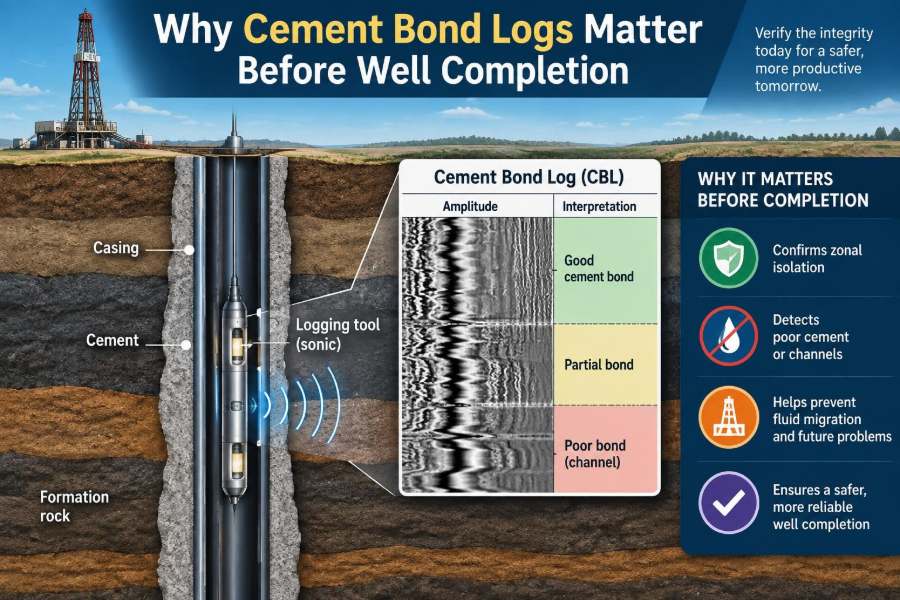

A production casing string has been run, cement has been pumped, and the job appears finished at surface. The well is ready to move toward perforating and completion operations, where every decision becomes more expensive and more difficult to reverse.
But cement that was placed is not necessarily cement that is providing effective isolation. Channels, microannuli, incomplete annular fill, or poor bonding can remain hidden behind steel casing until pressure communication, unwanted water, sustained casing pressure, or poor zonal performance reveals them.
A cement bond log gives the completion team a chance to investigate that hidden barrier before opening the well to production or injection. It does not simply answer whether cement exists; it helps evaluate whether the casing, cement, and formation system is likely to behave as an effective seal.
That distinction matters because well completion is where a questionable cement job can become a long-term integrity problem. A carefully acquired and interpreted log can support a repair decision while the well is still in a controllable, lower-risk stage. 🧱
🧱 1. The barrier behind the casing
Primary cementing places slurry in the annulus between casing and formation. After the slurry sets, the cement sheath is intended to support casing and isolate permeable zones from one another.
In a completed well, this barrier may need to separate hydrocarbons from water-bearing intervals, isolate gas-bearing formations, protect usable water zones, and contain injected fluids. Effective cement is therefore part of the well’s pressure-containment system, not just a material left over from drilling.
🎯 2. Why the timing is before completion
Before perforations, tubing, packers, and production equipment are installed, the operator generally has greater access to the casing and more options for corrective work. A bond evaluation at this stage can identify intervals that warrant attention.
Once the well is completed, diagnosing a barrier problem may involve production interruptions, restricted access, complex intervention equipment, and uncertainty about the source of unwanted fluids. Early evaluation shifts the decision from reaction to prevention.
🔍 3. What a cement bond log measures
A conventional cement bond log, often called a CBL, is an acoustic measurement. A transmitter sends an acoustic pulse through the casing, and a receiver records the remaining signal after it has traveled along the pipe.
Free casing rings strongly because little acoustic energy leaves the steel. When casing is well coupled to cement, more energy is transmitted away from the casing, and the received casing signal is reduced.
The log therefore responds primarily to acoustic coupling around the casing. It is an indirect measurement, and that fact is essential when interpreting it.
📉 4. Why signal amplitude is important
CBL interpretation often begins with amplitude. High amplitude commonly indicates free-pipe-like behavior, while lower amplitude commonly indicates better attenuation of the casing signal.
Low amplitude alone does not prove perfect zonal isolation. It can result from cement bonded to casing, but the actual hydraulic effectiveness of the full annular system also depends on cement condition, formation contact, channeling, and the presence of any microannulus.
Amplitude should be interpreted as evidence, not as a single pass-or-fail number.
🌊 5. The role of the variable density log
A variable density log, or VDL, presents acoustic waveform information as a density-style display. It helps the interpreter see whether arrivals are dominated by casing signal or whether later arrivals associated with formation energy are present.
Strong formation arrivals can support the interpretation that acoustic energy is traveling through casing, cement, and formation. The VDL adds context that a single amplitude curve cannot provide.
Useful interpretation questions
- Is the casing arrival coherent and strong?
- Are formation arrivals visible and continuous?
- Do waveform changes correspond with lithology, casing changes, or known cement-job events?
🛰️ 6. Cement bond logs are not cement maps
A conventional acoustic CBL samples an azimuthally averaged response. A channel on one side of casing can be masked by good bonding over much of the remaining circumference.
This means a favorable CBL response may not rule out localized channeling. Conversely, a less favorable response does not always mean the annulus has no useful hydraulic isolation.
Understanding this limitation prevents both false confidence and unnecessary remedial work.
🧭 7. Ultrasonic tools add circumferential detail
Ultrasonic cement evaluation tools can provide more detailed information around the casing circumference. They commonly analyze acoustic impedance or related responses to distinguish free pipe, solid material behind casing, and fluids in the annulus.
These tools can be especially useful where partial circumferential coverage, narrow channels, or patchy cement are concerns. Their interpretation also has limits, particularly where lightweight cement, gas-bearing cement, rough casing, or unusual annular materials affect acoustic response.
CBL and ultrasonic measurements are often complementary rather than interchangeable.
🧪 8. Cement quality is different from cement presence
Seeing a response consistent with material behind casing is not the same as proving that material is competent cement. A low-density cement, contaminated slurry, unset material, mud, or other annular fluid can complicate the response of acoustic tools.
For completion decisions, the important question is usually broader: does the system provide the required isolation across the interval of concern? The answer should combine log evidence with the well’s construction history and operating objective.
🏗️ 9. The three interfaces that matter
Reliable isolation depends on more than one bond. The well needs appropriate contact at the casing-to-cement interface, continuity through the cement sheath, and effective contact at the cement-to-formation interface.
A tool may respond favorably to casing-to-cement coupling even where cement-to-formation bonding is poor. A fluid pathway can exist outside the cement sheath despite attenuation of the casing signal.
That is why log interpretation must focus on barrier performance, not a simplified idea of “good cement.”
🫧 10. Microannulus can change the answer
A microannulus is a very small separation between casing and cement that may develop after pressure or temperature changes. Even a narrow gap can reduce acoustic coupling and make a bonded interval appear more like free pipe.
Logging under different casing-pressure conditions may help test whether the response is pressure sensitive. If applied carefully within the well’s approved operating limits, this can help distinguish a debonding effect from a permanently poor cement placement.
Pressure manipulation is not a routine shortcut; it requires engineering review and safe execution.
🌡️ 11. Temperature can influence the measurement
Temperature changes during and after cementing affect fluid properties, casing dimensions, cement curing, and acoustic behavior. A log run too soon may capture a system that is still changing.
The required wait time depends on slurry design, well conditions, and the purpose of the evaluation. The team should verify that the cement has had adequate time to develop the properties needed for the intended assessment.
A technically sound tool run at the wrong time can still lead to a poor decision.
⏳ 12. Why waiting on cement matters
Waiting on cement allows the slurry to transition from a pumpable fluid to a solid sheath with increasing strength and stiffness. The acoustic response evolves during this process.
Logging before the cement is sufficiently set may create ambiguity: weak attenuation could reflect early-age cement rather than a lasting placement defect. Waiting too long, however, can delay the completion schedule.
The practical objective is not merely to save time; it is to obtain data representative of the barrier that will support the well.
📏 13. Depth control is a completion-critical discipline
A bond log only helps if its depth is accurately related to casing accessories, formation tops, planned perforations, and cement placement intervals. Errors in depth matching can cause a team to repair the wrong interval or overlook the actual concern.
Correlation should use available references such as casing collars, open-hole logs, radioactive markers where present, and documented completion depth conventions. The same reference must carry through to perforating and remedial operations.
🧰 14. Casing hardware affects acoustic responses
Centralizers, collars, scratchers, stage tools, liners, and changes in casing weight can all influence the recorded waveform or amplitude. Tool response near collars is particularly important when using collar locations for depth correlation.
Hardware does not make the log unusable, but it requires context. The interpreter should know the casing tally, accessory placement, and any changes in tubular configuration before declaring an interval poorly bonded.
🛢️ 15. Mud removal largely determines cement placement
Many cementing problems begin before the slurry enters the annulus. If drilling mud is not effectively displaced, residual mud can remain between cement and casing or formation and create weak interfaces or flow paths.
Hole cleaning, fluid compatibility, spacer design, displacement rate, casing movement where feasible, and centralization all influence displacement efficiency. Bond logs are valuable partly because they test the practical outcome of these earlier decisions.
⚙️ 16. Centralization matters in deviated wells
In a deviated or horizontal section, casing tends to rest against the low side of the hole unless properly centralized. A narrow low-side annulus can make mud removal difficult and may prevent uniform cement coverage.
Good centralization supports more even annular flow and improves the opportunity for cement to contact both casing and formation. It cannot guarantee isolation, but poor centralization is a recognized risk that should shape expectations before interpreting the log.
🧱 17. Channeling is a hydraulic problem
A cement channel is a continuous or partly continuous pathway through or around the cement sheath. It may permit fluid migration even when much of the annulus contains cement.
The severity of a channel depends on its continuity, pressure differential, fluid properties, and connection to permeable zones. A small localized imperfection may be operationally acceptable in one interval and unacceptable across a gas zone or a critical water-bearing formation.
Completion decisions should be based on the isolation objective for that specific interval.
💧 18. Water control begins with isolation
Producing water from an unintended interval can reduce hydrocarbon productivity and complicate surface handling. If water enters behind casing, simply changing perforation strategy may not solve the underlying communication path.
Bond evaluation before completion helps assess whether the cement barrier is likely to separate the planned producing zone from nearby water-bearing intervals. This is particularly important when the vertical separation is limited or pressure contrasts are significant.
🔥 19. Gas migration raises the stakes
Gas can migrate through a weak or discontinuous cement system because it is buoyant and can move under relatively small pressure differences. Gas-bearing intervals often demand careful barrier verification because migration can create safety, environmental, and well-control concerns.
A bond log does not independently prove gas-tight isolation. It provides evidence that must be considered with cement design, annular pressure behavior, pressure tests, and the geological setting.
💉 20. Injection wells need dependable zonal separation
For water injection, gas injection, disposal, or other injection operations, cement isolation helps keep injected fluid in the intended interval. Unwanted vertical communication can reduce sweep efficiency, compromise storage objectives, or expose formations not designed to receive the injected fluid.
The required standard of evidence may be more demanding where the well will experience repeated pressure cycles or long-term injection. Cement evaluation is part of confirming that the completion design matches the operating duty.
🧾 21. Read the cementing record alongside the log
No log should be interpreted in isolation. The cementing report can reveal displacement volumes, returns, losses, slurry stages, density observations, pump schedule changes, and events that explain a log response.
A low-amplitude interval where good returns and expected volumes were observed may have a different interpretation from the same response following lost returns or an incomplete displacement. The log is strongest when integrated with operational evidence.
Useful records to review
- Casing tally and centralizer placement
- Cement slurry and spacer program
- Pumping schedule, returns, and losses
- Formation tops and pressure information
- Planned perforation and isolation intervals
🧠 22. Interpret the log in the geological context
Formation properties affect acoustic energy transmission. A hard, fast formation may produce a different VDL character from a soft formation, even with similar cement conditions.
Washouts, rugosity, fractures, and naturally variable lithology can also influence cement placement and tool response. Comparing the evaluation with caliper data, formation logs, and drilling observations helps separate geological effects from cement-related effects.
📊 23. Comparing the main evaluation methods
| Method | Primary contribution | Key caution |
|---|---|---|
| Conventional CBL amplitude | Indicates acoustic attenuation and casing coupling | May not reveal localized circumferential channels |
| VDL waveform display | Shows waveform character and possible formation arrivals | Requires experienced, context-based interpretation |
| Ultrasonic evaluation | Provides more circumferential information behind casing | Response can be affected by annular materials and casing condition |
| Pressure testing and monitoring | Tests barrier behavior under defined conditions | May not locate the source of a communication path |
Using multiple lines of evidence is generally more reliable than relying on one curve or one tool type.
🚦 24. A poor log does not automatically mean a squeeze job
Remedial cementing carries its own risks, costs, and uncertainty. Before deciding on a squeeze, the team should define the isolation requirement, verify depth, evaluate tool limitations, and determine whether the observed response represents a meaningful hydraulic risk.
Some intervals may require repair before perforating. Others may be managed by changing perforation placement, adding mechanical isolation, conducting further diagnostics, or accepting a response that is adequate for the intended service.
The correct action is risk-based, not reflexive.
🔧 25. When remediation is justified
A remediation decision is more compelling when evidence indicates likely communication across a critical barrier interval. The plan may involve perforating and squeezing, section milling, cement retainer work, or another engineered isolation method.
Success criteria should be defined before the operation. After remediation, verification may include a repeat cement evaluation, pressure test, mechanical test, or another appropriate barrier assessment.
Repair without verification merely replaces one uncertainty with another.
📝 26. Common interpretation mistakes to avoid
- Treating low amplitude as proof of hydraulic isolation. Acoustic coupling is valuable evidence, but not a complete barrier test.
- Using a universal cutoff without context. Tool response varies with casing, formation, fluids, and acquisition conditions.
- Ignoring the VDL or waveform information. A single curve contains less diagnostic value than the full acoustic record.
- Forgetting depth uncertainty. A correct interpretation at the wrong depth can still damage the completion plan.
- Overlooking pressure and temperature history. Microannulus and evolving cement conditions can alter the response.
🤝 27. Completion decisions need cross-functional input
Cement evaluation sits at the intersection of drilling, cementing, subsurface, petrophysics, production, completions, and well integrity. Each discipline contributes information that changes the meaning of the log.
The completion engineer needs to know whether an interval is safe to perforate. The cementing specialist can explain placement risk. The subsurface team defines the consequences of crossflow, while well integrity personnel frame the barrier requirement.
A shared interpretation is more defensible than a log read in isolation.
✅ 28. The core principle: verify the barrier before relying on it
Cement bond logs matter before well completion because they provide an opportunity to assess the unseen annular barrier before the well is exposed to production or injection pressures. They help identify uncertainty where it is still possible to investigate, redesign, or repair.
The most useful approach combines CBL amplitude, waveform information, ultrasonic data where appropriate, cementing records, geology, pressure behavior, and the specific isolation objective. No individual measurement replaces engineering judgment.
The core principle is simple: do not ask cement evaluation only whether cement was pumped; ask whether the well has the isolation required for its next stage of life. 🧱🔍✅