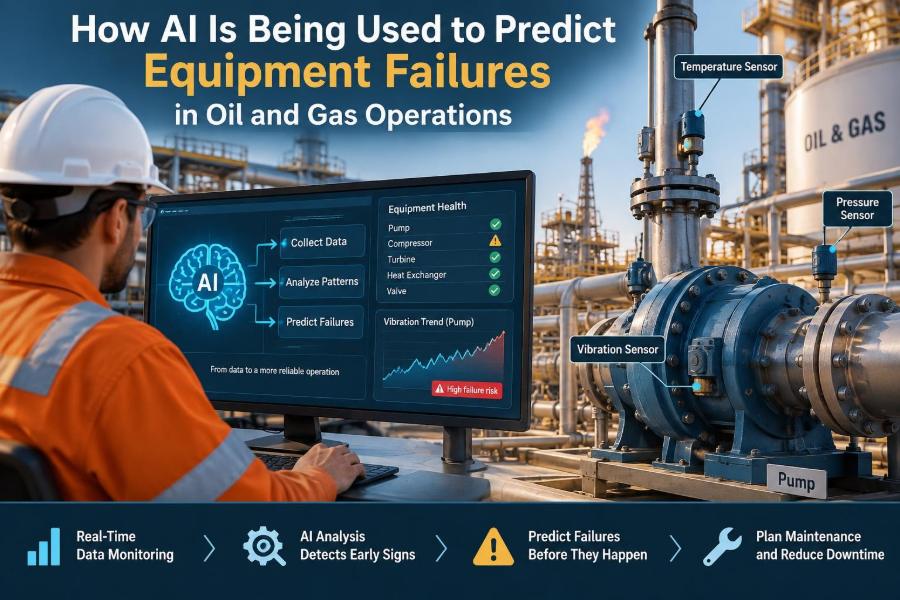

A produced-water pump begins to sound slightly different during a night shift. The change is subtle: no visible leak, no alarm, and no immediate loss of throughput. In a conventional maintenance routine, the pump may continue running until its next scheduled inspection—or until a bearing fails and forces an unplanned shutdown.
Oil and gas facilities depend on thousands of assets that must work together: compressors, pumps, turbines, separators, pipelines, valves, generators, drilling equipment, and control systems. When one critical component fails, the consequences can range from a manageable maintenance job to lost production, safety exposure, environmental risk, and difficult logistics.
Artificial intelligence is increasingly being used to spot early warning patterns in operating data. Rather than replacing mechanics, operators, or engineers, it can help them focus attention on equipment that is showing credible signs of deterioration.
The value is not that AI can predict every failure perfectly. Its value is that it can turn large, fast-moving data streams into earlier, better-supported maintenance decisions.
🔧 What “predicting failure” really means
Failure prediction usually means estimating the likelihood that an asset, component, or operating condition will cross an unacceptable limit within a useful time window. It may identify a developing bearing defect, compressor surge risk, pump cavitation, heat-exchanger fouling, or an abnormal valve response.
A useful prediction is more specific than “something is wrong.” It should indicate which asset is affected, what evidence triggered concern, how urgent the issue may be, and what action is reasonable. In many cases, the best outcome is not a precise failure date but enough lead time to inspect, plan spares, and intervene safely.
🏭 Why failures are unusually costly offshore and onshore
Equipment failure is disruptive in any industrial setting, but oil and gas operations often have additional constraints. Assets may be remote, continuously operating, pressurized, corrosive, exposed to severe weather, or difficult to access during certain operating conditions.
An unplanned shutdown can interrupt production and trigger work that must be coordinated with process safety controls, permits, isolation procedures, specialist crews, and spare-parts availability. Offshore, a repair may also depend on marine logistics or weather windows.
For this reason, a small warning detected weeks early can be more useful than a more accurate warning detected after the maintenance opportunity has passed.
🧭 From reactive to predictive maintenance
Reactive maintenance fixes equipment after it breaks. It is sometimes appropriate for low-consequence, inexpensive, noncritical items, but it is risky for production-critical machinery.
Preventive maintenance uses fixed intervals: replace a part every set number of operating hours, for example. This approach is straightforward, but a component may be changed before its useful life is exhausted or fail between planned intervals.
Predictive maintenance uses the observed condition of the asset to guide action. AI is one tool within this broader strategy, alongside inspections, vibration analysis, oil analysis, thermography, and engineering judgment.
📡 The data behind an AI prediction
AI models learn from data collected by instruments and operational systems. The most useful signals depend on the asset and failure mode, but common inputs include temperature, pressure, flow, vibration, current, voltage, speed, position, and process composition.
Operational context matters as much as the raw measurement. A pump drawing more current may be normal at higher flow. A compressor’s discharge temperature must be interpreted alongside suction conditions, gas composition, speed, recycle position, and ambient temperature.
- Historian data from control systems
- Condition-monitoring sensors and portable inspection readings
- Maintenance work orders and failure reports
- Operator logs and shift notes
- Laboratory results such as lubricant or fluid analysis
- Asset design, configuration, and operating-envelope information
🌡️ Sensor data is only the starting point
Most facilities already generate more data than people can manually review. A historian may record thousands of tags at frequent intervals, yet these readings were often installed for control and protection rather than diagnosis.
AI helps combine signals that would be difficult to evaluate together over long periods. For example, a model may recognize that a modest rise in vibration becomes more concerning when it occurs with changing bearing temperature, increasing power demand, and a recurring load pattern.
That said, more data does not automatically produce a better model. A poorly located sensor can create a detailed record of the wrong phenomenon.
🧹 Why data quality determines model quality
Missing values, incorrect timestamps, stuck transmitters, unit mismatches, maintenance-period readings, and sensor recalibration can all mislead a model. A temperature tag frozen at one value may look stable to an algorithm while hiding a failed instrument.
Data preparation usually includes checking ranges, aligning sampling rates, marking downtime, removing clearly invalid readings, and documenting changes in equipment configuration. Engineers must also decide whether a change is a real degradation signal or a normal consequence of a new operating mode.
An AI system cannot compensate reliably for unreliable process data. Data validation is an engineering task, not just a software task.
🧠 Machine learning in practical terms
Machine learning is a group of methods that identify relationships in historical data. Instead of programming every possible rule, engineers provide examples, operating data, or both, and the model estimates patterns associated with normal and abnormal behavior.
In equipment reliability work, models commonly answer three practical questions: Does this behavior differ from normal? Which variables are changing in a concerning way? How likely is a defined failure or intervention within a selected horizon?
The output should be treated as decision support. It is not a license to bypass operating procedures, shutdown logic, or qualified technical review.
🔍 Anomaly detection for unknown problems
Anomaly detection learns what normal operation looks like and flags meaningful deviations. This is useful when there are few well-documented historical failures, which is common for highly reliable critical equipment.
For instance, a model can compare a compressor’s actual discharge temperature with the temperature expected under current suction conditions, flow, speed, and ambient conditions. A persistent gap may indicate fouling, a sensor problem, recirculation, or another issue worth investigating.
An anomaly is not automatically a failure. It is a prompt to ask a structured engineering question: What has changed, and is it explainable?
🏷️ Supervised models for known failure modes
Supervised learning uses labeled examples. If historical records reliably identify bearing failures, seal failures, or specific trips, a model can learn the patterns that appeared before those events.
This approach can be powerful when the failure definition is consistent and enough examples exist. It is less reliable when work-order descriptions are vague, failure dates are uncertain, or different mechanisms are grouped under one broad label such as “pump failure.”
Good labels often require collaboration among reliability engineers, maintenance planners, operators, and data specialists. The work-order database may need careful review before it becomes training data.
📈 Remaining useful life estimates
Some systems attempt to estimate remaining useful life, or RUL: the time until a component is expected to reach a defined condition limit. This can support shutdown planning and spare-parts decisions.
RUL is difficult because degradation is rarely smooth. Load changes, process upsets, repairs, lubrication quality, and operating environment can alter the rate of wear. An estimate should therefore be expressed as a range or risk-informed planning signal, not a promise of an exact date.
For many assets, a well-calibrated health score and an intervention window are more defensible than a countdown clock.
🎧 Vibration analytics for rotating equipment
Rotating equipment is a natural application for AI because vibration signals contain information about mechanical condition. Pumps, compressors, motors, gearboxes, fans, and turbines can develop recognizable patterns related to imbalance, misalignment, looseness, bearing damage, and gear defects.
Traditional vibration analysis remains highly valuable. AI can add scale by reviewing continuous waveform or spectral data, comparing similar machines, and prioritizing assets whose signatures are changing faster than expected.
However, interpretation still requires knowledge of shaft speed, bearing geometry, mounting arrangement, process load, and recent maintenance. A vibration pattern without machine context can lead to a wrong diagnosis.
💧 Pumps: cavitation, seals, and bearings
Pumps frequently operate under changing suction conditions, fluid properties, flow rates, and control-valve positions. AI can combine these variables with vibration, pressure, motor current, and temperature to identify behavior associated with cavitation, blockage, recirculation, seal deterioration, or bearing distress.
Consider a hypothetical injection pump. Its discharge pressure may remain acceptable while suction pressure fluctuates, vibration slowly increases, and motor current becomes less stable. A model may flag the combination before the pump reaches a trip point, allowing the team to check suction restrictions, fluid conditions, and internal wear.
🌀 Compressors and operating envelopes
Compressors have narrow regions where operation can become unstable, including surge and excessive recirculation. Control systems protect against these conditions, but predictive analytics can help identify gradual performance changes before protection limits are approached repeatedly.
Models can track efficiency-related indicators, temperature relationships, vibration, anti-surge valve movement, recycle flow, and deviations from expected performance maps. These insights may point to fouling, leakage, instrumentation issues, changing gas conditions, or control tuning concerns.
AI should complement—not override—established compressor protection systems. Protective logic must remain deterministic, tested, and governed through formal management of change.
🔥 Gas turbines and combustion health
Gas turbines generate rich operational data, including exhaust temperatures, shaft speed, fuel flow, inlet conditions, vibration, and emissions-related measurements where available. AI can identify performance drift after accounting for ambient conditions and load.
Uneven exhaust temperature patterns may warrant investigation into combustion hardware, fuel distribution, sensors, or operating conditions. Likewise, gradual changes in power output or heat rate can inform cleaning, inspection, or performance testing plans.
The model’s role is to identify unusual trends early. Confirming root cause still depends on OEM guidance, field inspection, and disciplined engineering review.
🧪 Corrosion and integrity monitoring
Corrosion management involves more than a single sensor. Wall-thickness measurements, corrosion probe results, fluid chemistry, water cut, pressure, temperature, inhibitor records, pigging data, and inspection findings may all contribute to the picture.
AI can help organize these inputs and identify conditions associated with elevated corrosion risk or unexpected degradation rates. It may be particularly useful for prioritizing inspection locations across a large asset base.
But corrosion mechanisms are complex and site-specific. A model cannot replace the integrity management program, inspection strategy, or qualified interpretation of degradation mechanisms.
🛢️ Detecting heat-exchanger fouling
Heat exchangers gradually lose performance as deposits build on heat-transfer surfaces. The effect may appear as changing temperature approach, increasing pressure drop, greater utility consumption, or difficulty meeting downstream process conditions.
AI models can normalize exchanger performance for changing flow rates and inlet temperatures. This helps distinguish real fouling trends from ordinary production variability.
Earlier detection supports better cleaning schedules. Cleaning too late can constrain throughput; cleaning too early consumes labor, introduces operational disruption, and may not solve the actual problem.
⚡ Electrical assets and power-quality clues
Motors, variable-frequency drives, switchgear, generators, and transformers can show early warning signs through electrical measurements. Current signature analysis, temperature trends, insulation-monitoring information, harmonic behavior, and operational events may reveal developing issues.
For a motor-driven pump, a change in electrical behavior could originate in the motor, drive, mechanical load, process conditions, or instrumentation. AI may narrow the investigation, but it should not assume every electrical anomaly is an electrical fault.
This cross-domain reasoning is one reason maintenance and operations teams need to review alerts together.
🧾 Maintenance records make predictions actionable
A technically impressive model has limited value if its alert never reaches the maintenance workflow. Integration with computerized maintenance management systems can convert validated alerts into inspection recommendations, planned work, or follow-up tasks.
Work orders also provide feedback. Did technicians find a damaged bearing? Was the alert caused by a process change? Was a sensor faulty? Recording this outcome improves future model evaluation and helps distinguish useful warnings from noise.
Clear failure coding and concise technician notes are operational assets, not administrative burdens.
🚦 Alert design prevents alarm overload
A dashboard full of red indicators is not predictive maintenance. If alerts are frequent, vague, or poorly prioritized, users learn to ignore them—an outcome sometimes called alarm fatigue.
Useful alerts include an asset name, severity, confidence or evidence level, leading variables, trend duration, likely failure mode when justified, and recommended next step. They should also account for criticality: the same anomaly deserves different urgency on a standby utility pump and on a sole-source export compressor.
- Low: observe or review during routine rounds
- Medium: inspect, trend, and plan corrective work
- High: assess promptly with operations and reliability personnel
- Critical: follow established operating, safety, and escalation procedures
👷 The human-in-the-loop principle
Experienced operators often recognize changes that are not fully represented in historian data: unusual noise, weather effects, a recent lineup change, chemical injection problems, or behavior following a maintenance intervention.
AI works best when it makes this expertise easier to apply. A reliability engineer can use an alert to focus analysis; an operator can confirm whether the process context makes sense; a technician can inspect the physical asset.
The strongest systems combine statistical pattern recognition with plant knowledge, not one in place of the other.
🧩 Digital twins and physics-informed models
A digital twin is a digital representation of an asset or process that is updated with operational information. Some twins are primarily visualization tools; others include engineering equations, equipment curves, or simulations.
Physics-informed approaches combine first-principles knowledge with data-driven learning. For example, a pump model can incorporate expected relationships among flow, head, speed, and power, then flag deviations that cannot be explained by normal conditions.
This can improve interpretability and reduce the risk of learning accidental correlations. It also helps when failure examples are scarce.
🧪 Pilot projects should start with a defined problem
Organizations often begin with a broad ambition to “use AI.” A better starting point is a specific operational problem: repeated seal failures on a pump family, unexpected compressor trips, or difficulty prioritizing exchanger cleaning.
Choose an asset with measurable consequences, accessible data, engaged users, and a feasible response when an alert occurs. Define success in operational terms, such as earlier detection, fewer unnecessary inspections, better planning lead time, or improved diagnosis—not merely model accuracy.
A small, well-governed pilot can reveal data gaps and workflow barriers before a system is scaled across a facility.
📏 Measuring whether a model is useful
Model metrics such as precision and recall are useful, but they do not tell the entire operational story. Precision asks how many alerts were meaningful; recall asks how many relevant events the model identified. Both matter because missed failures and excessive false alarms have different costs.
Teams should also measure lead time, inspection outcomes, avoided unplanned work where attribution is credible, user adoption, and whether alerts changed decisions. A model that performs well in a test environment may fail in practice if it sends warnings too late or offers no actionable explanation.
⚠️ False positives and false negatives
A false positive occurs when a model raises concern but no relevant equipment issue exists. Too many false positives waste attention and erode trust. A false negative occurs when a developing problem is missed, which can be more serious for high-consequence equipment.
There is no universal threshold for acceptable error. The setting should reflect asset criticality, available inspection methods, cost of intervention, and consequences of failure. A low-cost check may justify a more sensitive alert threshold; an intrusive shutdown inspection requires stronger evidence.
🔄 Model drift and changing operations
Models can degrade when the world changes. New equipment, altered control logic, different feedstock, revised operating targets, sensor replacement, or a major overhaul may make historical patterns less representative.
This is known as model drift. Monitoring should identify when inputs move outside the conditions used for training, when alert rates change unexpectedly, or when confirmed outcomes no longer match predictions.
Retraining is not automatically the answer. First determine whether the change reflects a real asset issue, a data problem, or a legitimate new operating regime.
🛡️ Cybersecurity and data governance
Predictive maintenance platforms often connect operational technology data with analytics environments. That creates value, but it also requires careful architecture, access control, network segmentation, monitoring, and change management.
Data governance includes knowing who owns each data source, how tags are defined, who can change models, how versions are approved, and how recommendations are audited. In safety-sensitive environments, traceability matters.
AI outputs should never become an uncontrolled pathway into process control. Analytics can advise; authorized control and safety systems must retain their designed roles.
📚 Skills petroleum engineers need
Petroleum engineers do not need to become full-time data scientists to contribute effectively. They do need to understand data limitations, process context, asset criticality, failure mechanisms, and how a model’s output affects operations.
Useful capabilities include asking whether a signal is physically plausible, defining a meaningful failure label, interpreting uncertainty, and communicating with automation, maintenance, integrity, and data teams.
For students, familiarity with time-series data, basic statistics, condition monitoring, process systems, and reliability concepts creates a strong foundation for this work.
🗺️ A practical implementation path
A disciplined deployment generally follows a repeatable sequence:
- Identify a high-value equipment problem and the decision it should improve.
- Map failure modes, operating context, available sensors, and maintenance history.
- Validate data quality with operations and engineering personnel.
- Build a baseline using rules, physics, statistics, or machine learning as appropriate.
- Test alerts against historical and live conditions without overclaiming performance.
- Embed validated alerts in inspection and maintenance workflows.
- Review outcomes, update the model, and expand only when users trust the process.
🌍 Where AI has the clearest role
AI is most useful where there are repeatable assets, meaningful data, detectable degradation patterns, and a realistic action that can follow an alert. Large fleets of pumps, compressors, artificial-lift equipment, rotating machinery, and process equipment often fit this profile.
It is less suitable when data are sparse, the failure mechanism is poorly understood, or the only possible response is immediate shutdown regardless of prediction. In those cases, robust protection layers, inspections, and conservative operating limits may matter more than advanced analytics.
✅ The core takeaway for reliable operations
AI-based failure prediction is not a crystal ball. It is a structured way to detect deviations, relate them to operating context, and give people more time to make sound maintenance decisions.
Its effectiveness depends on trustworthy data, clearly defined failure modes, sensible alert design, engineering validation, and a workflow that turns insight into action. The technology becomes valuable only when it improves the real work of operating and maintaining assets safely.
The central principle is simple: use AI to strengthen disciplined reliability engineering, not to replace it. When data, physics, operating experience, and maintenance execution reinforce one another, early warning becomes a practical operational advantage.
Predicting equipment failure works best when intelligent analytics help skilled people act earlier, with clearer evidence and appropriate caution. 🤖🔧🛢️