
A discovery well reaches its target, the logs look encouraging, and a promising hydrocarbon interval appears on the screen. That moment can feel like the finish line. In petroleum engineering, it is closer to the moment a prototype first works in a laboratory.
The central question is not simply whether oil or gas is present. It is whether the reservoir can deliver hydrocarbons safely, predictably, and profitably over time—and whether the facilities, wells, people, approvals, and markets can support that delivery.
Between an exploration success and first commercial production lies a chain of decisions. Each one narrows uncertainty, commits capital, or changes the technical plan. A weak link can delay the project even when the subsurface resource is substantial.
Understanding this path helps students see how geoscience, drilling, reservoir engineering, facilities engineering, economics, and operations connect. It also helps working professionals recognize why apparently local decisions can reshape an entire field development.
🧭 A Discovery Is a Starting Point, Not a Development Plan
An exploration well establishes that hydrocarbons may exist in a particular geological setting. It does not, by itself, establish the size of the accumulation, fluid behavior, reservoir continuity, or commercial value.
Early data are sparse: one or a few well penetrations, seismic interpretation, cuttings, logs, and possibly a drill stem test. The development team must turn those fragments into a defensible picture of a reservoir that may extend far beyond the wellbore.
Commercial production requires both a producible resource and a workable project. A field can be technically interesting yet unsuitable for development because of poor deliverability, remote infrastructure, complex fluids, environmental constraints, or unfavorable economics.
🧱 The Petroleum System Behind the Find
Before designing wells, the team confirms the petroleum system: source rock, migration pathway, reservoir rock, seal, trap, and timing. This framework explains why hydrocarbons accumulated and where they may be retained.
A structural trap may hold fluids against a fault or fold. A stratigraphic trap may depend on a pinch-out, facies change, or unconformity. The trapping mechanism matters because it affects expected boundaries, compartmentalization, and the risk of hydrocarbons escaping through faults.
Geological interpretation remains probabilistic. Seismic resolution is limited, faults can seal or transmit flow, and rock properties can change sharply over short distances.
📊 Defining the Resource Before Calling It a Reserve
Volume language is often misunderstood. Resources describe estimated quantities in place or potentially recoverable; reserves are the subset expected to be commercially recoverable under defined conditions and with an approved development basis.
Engineers estimate original hydrocarbons in place from mapped area, reservoir thickness, porosity, water saturation, and fluid volume factors. Each input has uncertainty, so the result is usually expressed as a range rather than a single exact number.
Recovery factor is separate from in-place volume. It depends on reservoir drive, fluid properties, well placement, completion quality, pressure support, operating limits, and recovery method. A large in-place volume does not automatically translate into large sales volumes.
🔍 Appraisal Wells Reduce the Most Valuable Uncertainties
Appraisal begins after discovery and asks targeted questions: How far does the reservoir extend? Where is the fluid contact? Are pressures connected? Does reservoir quality persist away from the discovery well?
An appraisal well should be placed where its information changes a decision, not merely where it is easiest to drill. A well near a suspected fault may test compartmentalization; one on the flank may constrain the oil-water contact.
Appraisal is a balance. More wells improve understanding but consume time and capital. Too little appraisal can lead to oversized facilities, misplaced development wells, or a production forecast built on assumptions rather than evidence.
🧪 Cores, Logs, and Fluids Tell Different Parts of the Story
Wireline logs provide continuous indirect measurements of rock and fluid response along the wellbore. They help estimate lithology, porosity, fluid saturation, and net pay—the portion of rock likely to contribute economically to flow.
Core samples provide direct rock material for laboratory analysis. They can reveal pore structure, permeability, wettability, capillary behavior, and depositional features that logs cannot fully resolve.
Fluid samples support pressure-volume-temperature, or PVT, analysis. PVT work identifies whether the field contains black oil, volatile oil, gas condensate, dry gas, or a mixture with problematic components such as carbon dioxide or hydrogen sulfide.
🌊 Pressure Data Reveals Reservoir Communication
Pressure measurements are among the most decision-relevant appraisal data. Similar pressure gradients across wells may support fluid communication, while pressure differences can indicate barriers, separate compartments, or different fluid systems.
Pressure transient tests add another layer. By observing how pressure responds when a well is produced or shut in, engineers can infer permeability, skin, boundaries, and sometimes the presence of faults or nearby aquifers.
A test result is not a perfect reservoir map. It samples a limited region and is influenced by wellbore storage, completion quality, and test duration. It must be integrated with geology and seismic rather than treated as a standalone answer.
🗺️ Building a Static Reservoir Model
A static model is a three-dimensional representation of reservoir structure and rock properties. It combines seismic horizons, faults, well markers, facies interpretation, porosity, permeability, saturation, and contacts into a shared spatial framework.
Grid cells represent portions of the subsurface. Their properties are populated from well data and geological rules, with interpolation between wells. The model is not the reservoir itself; it is a disciplined representation of what the team currently believes.
Multiple realizations are useful when uncertainty is material. For example, alternative fault interpretations or facies distributions can produce different connected volumes and different well-placement decisions.
🧮 Dynamic Simulation Tests Development Choices
Reservoir simulation adds time and flow to the static model. It calculates how pressure, saturation, and production may change as wells produce, inject water, or inject gas.
Engineers use history-matched models when production data exist, adjusting uncertain parameters until the model reasonably reproduces observed rates and pressures. In a new field, simulation is more predictive and therefore carries wider uncertainty.
Useful questions include whether pressure support is required, how quickly water may break through, whether wells interfere with one another, and which drilling sequence produces the best value. Simulation informs decisions; it does not remove uncertainty.
💧 Understanding the Field’s Natural Drive
Hydrocarbons flow only when there is sufficient energy and a path to the well. Reservoir drive may come from solution gas expanding from oil, a gas cap expanding, water encroachment from an aquifer, rock and fluid expansion, or a combination of mechanisms.
Each mechanism creates different production behavior. Strong water drive can sustain pressure but may bring early water production. Depletion drive may require compression, artificial lift, or injection sooner than expected.
Recognizing the drive mechanism shapes facility sizing, produced-water handling, injection strategy, and expected recovery. It is not merely a reservoir-engineering classification.
🛢️ Fluid Properties Shape the Entire Surface Design
Viscosity affects how easily oil flows. Gas-oil ratio affects separator design and gas-handling capacity. Wax, asphaltenes, scale-forming ions, sand, and corrosive gases can create flow-assurance and integrity challenges from the reservoir to export.
For instance, a wax-prone crude may require insulation, heating, chemical treatment, or operating procedures that prevent deposits during shut-in. A sour fluid containing hydrogen sulfide requires specialized materials, detection, emergency planning, and personnel protection.
Sampling must be representative. Contamination by drilling fluids, poor sample quality, or loss of volatile components can produce misleading PVT results and poor downstream design choices.
⚖️ Selecting a Development Concept
The development concept is the integrated physical plan for extracting, processing, storing, and exporting fluids. Onshore it may involve pads, gathering lines, a central processing facility, and an export pipeline. Offshore it may involve subsea wells tied back to an existing host or a new production platform.
Concept selection compares alternatives against reservoir performance, water depth or terrain, drilling access, export route, schedule, emissions, safety, and cost. The lowest initial cost is not always the lowest life-cycle cost.
| Concept | Often suits | Key trade-off |
|---|---|---|
| Existing-facility tieback | Smaller or nearby discoveries | Lower new infrastructure, but host capacity may constrain rates |
| New central facility | Larger fields or long field life | More control and capacity, but major capital and schedule exposure |
| Phased development | High uncertainty or modular opportunities | Earlier learning, but later expansion may be less efficient |
🎯 Well Placement Turns a Map into a Drainage Plan
Development wells are placed to contact the most productive rock, manage fluid movement, and drain the reservoir efficiently. A vertical well may be sufficient in thick, laterally continuous rock, while a horizontal well can expose much more reservoir contact in a thin or low-permeability interval.
Directional drilling also allows several wells to be drilled from one pad or platform. This can reduce surface footprint and avoid sensitive areas, but it introduces trajectory, torque-and-drag, collision, and completion challenges.
Well spacing is not chosen from a universal rule. It depends on permeability, heterogeneity, anticipated drainage radius, completion design, economic limits, and the risk of wells competing for the same mobile fluids.
🧰 Completion Design Connects Rock to Wellbore
A completion is the equipment and flow path that allows a drilled well to produce or inject safely. It may include casing, cement, perforations, tubing, packers, valves, sand-control hardware, and downhole monitoring devices.
Perforating creates communication through casing and cement into the formation. The chosen intervals influence rate, water or gas coning risk, and how evenly the reservoir is drained.
In unconsolidated formations, sand production can damage equipment and reduce productivity. Screens, gravel packs, or other sand-control approaches may be required, each with consequences for cost, operational complexity, and flow capacity.
🧪 Stimulation Can Improve Flow—but Not Every Problem
Stimulation aims to reduce near-wellbore restrictions or create more conductive flow paths. Matrix acidizing may dissolve formation damage or acid-soluble material near the well. Hydraulic fracturing creates fractures to improve connection with low-permeability rock.
These methods require a credible diagnosis. Acid will not solve a field-wide low-permeability problem if the mineralogy is unsuitable, and a fracture can become counterproductive if it connects to a water zone or bypasses the intended pay.
Post-job evaluation matters. Production response, pressure behavior, tracer data, and operational observations help distinguish a genuine reservoir improvement from a short-lived cleanup effect.
🏭 Facilities Separate, Treat, and Measure the Stream
Well fluids rarely arrive at surface as market-ready oil or gas. A production system typically separates oil, gas, and water; removes unwanted components; stabilizes liquids; compresses gas when needed; and measures each stream for allocation and sales.
Produced water may need treatment before reinjection or permitted disposal. Gas may require dehydration, removal of acid gases, compression, or processing to meet pipeline specifications.
Facility design must accommodate changing conditions. Early life can bring high pressure and gas rates; later life can bring falling pressure and rising water cut, meaning the water fraction in produced liquid. Designing only for day-one conditions creates avoidable bottlenecks.
🚚 Export Routes Can Make or Break a Development
Oil needs a route to a refinery, terminal, or market: pipeline, truck, rail, shuttle tanker, or storage and loading system. Gas needs pipeline access, local demand, reinjection capacity, or another viable disposition route.
Export reliability affects production reliability. A reservoir can perform well while revenue stops because a pipeline is unavailable, storage is full, or a downstream specification is missed.
Early alignment with midstream operators and marketers is therefore practical engineering, not an afterthought. Interface points, custody-transfer measurement, pressure limits, composition specifications, and outage arrangements should be understood before first production.
📈 Forecasts Must Link Subsurface and Surface Limits
A production forecast begins with reservoir deliverability but must respect well, facility, export, and operating constraints. The field rate is limited by the tightest practical bottleneck at a given time.
Suppose a hypothetical field could produce more oil from its wells, but its water-treatment capacity is reached first. The production target must then be reduced, wells choked back, or capacity expanded. Reservoir potential alone is not an operating plan.
Forecasts should show ranges and assumptions: well uptime, drilling schedule, decline behavior, injection response, processing capacity, and export availability. A single curve can conceal more uncertainty than it communicates.
💰 Economic Screening Sets the Commercial Boundary
Economic evaluation compares expected revenues with capital expenditure, operating expenditure, taxes, royalties, abandonment obligations, and timing. It is conducted across scenarios because production, costs, prices, and schedule are uncertain.
Net present value discounts future cash flows to reflect time and capital cost. Other measures may include internal rate of return, payout period, or unit development cost. No single metric should replace engineering judgment.
A marginal project may be highly sensitive to drilling cost, water handling, gas value, or export tariffs. Sensitivity analysis identifies which uncertainties deserve more appraisal, design effort, or contractual protection.
📝 Reserves and Sanction Require Evidence
Before a major investment decision, the project team assembles an integrated basis: resource and reserves estimates, development plan, cost and schedule estimate, environmental and social assessments, commercial arrangements, risk register, and execution strategy.
Project sanction, sometimes called final investment decision, authorizes significant capital commitment. It does not mean uncertainty has vanished; it means the remaining uncertainty is considered manageable within the selected business case.
Clear decision gates prevent premature commitment. They also expose situations where a development concept depends on an untested assumption, such as reservoir connectivity, injector performance, or access to third-party infrastructure.
🏗️ Drilling and Construction Must Be Sequenced Carefully
Once sanctioned, drilling, procurement, fabrication, civil work, pipeline installation, and facility construction must be coordinated. Long-lead equipment—items requiring substantial manufacturing and delivery time—can control the overall schedule.
Drilling all wells before facilities are ready can create prolonged shut-in exposure. Building facilities before confirming critical well performance can create stranded capacity. The best sequence depends on uncertainty, contract structure, seasonal constraints, and cash-flow needs.
Interfaces deserve active management: wellhead pressure versus flowline rating, chemical selection versus metallurgy, control systems versus vendor packages, and commissioning procedures versus operating readiness.
🦺 Process Safety Is Designed In, Not Added Later
Oilfield development handles flammable hydrocarbons, pressure, rotating equipment, chemicals, and sometimes toxic gases. Process safety focuses on preventing loss of containment and limiting consequences if barriers fail.
Design includes pressure relief, emergency shutdown systems, hazardous-area classification, gas detection, fire protection, isolation, containment, and procedures for abnormal conditions. These systems must be matched to credible hazards and maintained through operations.
Personal protective equipment is necessary, but it is the last line of defense. Safer layouts, reliable barriers, competent operating procedures, and disciplined management of change reduce reliance on individual intervention.
🌱 Environmental Planning Continues Through Field Life
Environmental planning considers emissions, water use, spills, waste, habitat disturbance, noise, flaring, methane management, and eventual site restoration. The relevant issues differ markedly between a desert pad, a mature onshore basin, and an offshore installation.
Good design can reduce impacts through pad consolidation, vapor recovery, leak detection, produced-water management, electrification where suitable, and minimizing routine flaring. Each option has practical limits tied to power access, reliability, cost, and site conditions.
Permits and monitoring obligations vary by jurisdiction. Teams should use applicable legal and regulatory requirements rather than assuming a design accepted in one region is automatically acceptable in another.
🤝 Stakeholders Affect Project Durability
Landowners, nearby communities, regulators, workforce representatives, suppliers, and partners can all influence whether a project proceeds smoothly. Engagement is more useful when it begins before detailed designs become difficult to change.
Concerns often focus on traffic, water, land access, jobs, noise, safety, and closure plans. Listening does not guarantee agreement, but it can identify practical modifications and prevent avoidable misunderstandings.
For joint ventures, governance is equally important. Partners need clear processes for approving budgets, work programs, technical decisions, and changes in scope.
🔧 Commissioning Proves That the System Works Together
Construction completion is not the same as readiness to produce. Commissioning checks that equipment, controls, utilities, safety systems, instrumentation, and procedures function as an integrated system.
Start-up is deliberately staged: lines may be cleaned and tested, utilities energized, equipment run under controlled conditions, and wells brought online gradually. This protects people and equipment while allowing the team to identify control or separation problems.
First oil or first gas is a milestone, but stable commercial operation requires reliable measurement, product specification compliance, trained operators, maintenance plans, and a safe response to upsets.
📡 Surveillance Converts Production into New Reservoir Knowledge
Once production starts, field surveillance tests the development model against reality. Engineers track rates, pressures, water cut, gas-oil ratio, fluid composition, well tests, injection volumes, and equipment performance.
Unexpected water can indicate coning, a completion problem, fracture communication, or a different reservoir architecture than anticipated. Falling productivity can reflect pressure depletion, scaling, sand, wax, liquid loading, or reservoir damage.
The response should be diagnostic, not automatic. Choking a well, changing lift, isolating intervals, stimulating, adjusting injection, or drilling a sidetrack each addresses different mechanisms and carries different risks.
🔄 Reservoir Management Is a Continuous Feedback Loop
Reservoir management integrates subsurface understanding with daily operating decisions. The team updates geological and simulation models, compares forecasts with actual performance, and revises drilling, injection, and intervention plans.
Water injection may be adjusted to improve sweep, but increased injection can also accelerate breakthrough through high-permeability paths. Gas reinjection may support pressure, yet it competes with near-term gas sales and requires compression capacity.
Strong teams preserve uncertainty ranges as they learn. Replacing an old assumption with a new single “correct” answer too quickly can hide unresolved risks.
📉 Decline, Artificial Lift, and Late-Life Choices
As reservoir pressure declines, many oil wells need artificial lift such as gas lift, electric submersible pumps, rod pumps, or other systems. The best choice depends on depth, fluid rate, gas handling, solids, deviation, power availability, and intervention access.
Late-life operations often face lower hydrocarbon rates and higher water volumes. A well may still flow, yet be uneconomic once lifting, treatment, maintenance, and export costs are considered.
Optimization can extend useful life, but it should not defer necessary closure planning. Integrity risk tends to grow as wells and facilities age.
🧯 Integrity Management Protects Wells and Facilities
Mechanical integrity means wells, pipelines, pressure vessels, and safety-critical equipment continue to contain fluids and perform their intended functions. Corrosion, erosion, fatigue, scale, cement degradation, and barrier failure require systematic monitoring.
Well integrity management uses documented barrier status, inspections, pressure testing where appropriate, annulus monitoring, and planned interventions. Facility integrity relies on inspection programs, corrosion control, maintenance, and clear operating envelopes.
Production pressure must never justify operating outside safe limits. A loss of containment can harm people and the environment while also destroying the commercial value the project was built to create.
🚪 Decommissioning Begins with Early Design Decisions
Every field eventually reaches cessation of production. Decommissioning may include plugging and abandoning wells, cleaning and removing facilities, managing waste, restoring land, and monitoring where required.
Design choices made early can simplify later closure: accessible wellheads, accurate records, manageable materials, provision for isolation, and realistic abandonment funding. These obligations belong in life-cycle economics, not only in an end-of-field checklist.
In some settings, reuse of infrastructure for storage, other energy systems, or nearby developments may be considered. Feasibility depends on integrity, regulation, commercial alignment, and technical compatibility.
⚠️ Common Development Mistakes and Better Responses
Many costly outcomes begin with understandable but avoidable shortcuts. The goal is not to eliminate uncertainty; it is to identify it, value it, and manage it before it becomes embedded in construction or operations.
- Mistake: Treating one strong well as proof of a uniform reservoir. Response: test boundaries, pressure communication, and rock variability through focused appraisal.
- Mistake: Sizing facilities only for early production. Response: evaluate water, pressure, and gas-handling needs across field life.
- Mistake: Separating reservoir, well, and facility forecasts. Response: maintain one integrated production basis with visible constraints.
- Mistake: Deferring integrity and abandonment costs. Response: include life-cycle obligations in design and economic decisions.
🧠 The Core Principle: Integrate, Learn, and Adapt
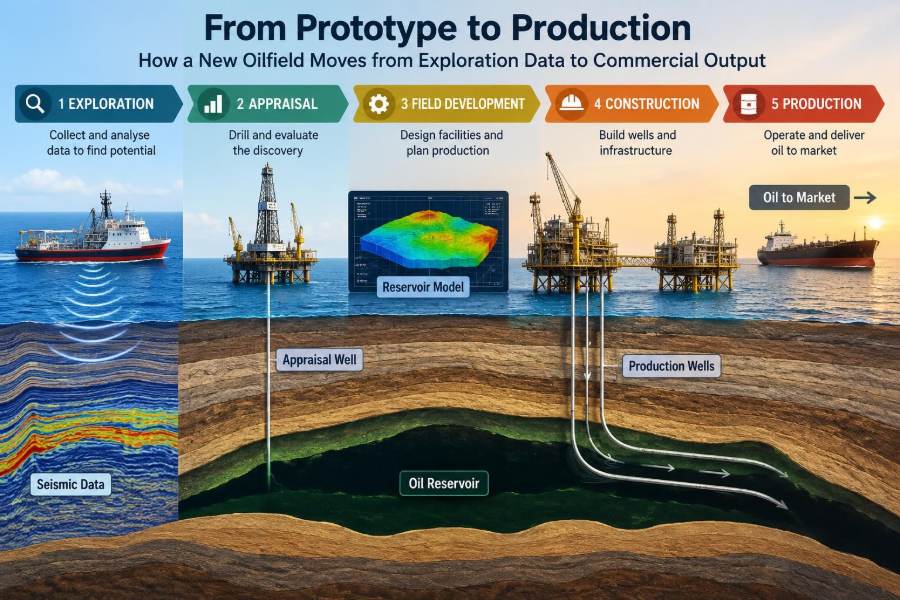
A new oilfield moves to commercial output through a sequence of evidence-based choices, not a single discovery announcement or a single engineering calculation. Subsurface uncertainty, well performance, processing capacity, export access, safety, environmental obligations, and economics must be evaluated as one connected system.
The most durable development plans are designed to learn. They use appraisal to target decisive uncertainties, build flexibility where it has value, monitor performance after start-up, and update the plan when field evidence challenges the original model.
For petroleum engineers, the essential skill is integration: understanding how a pore-scale property can affect a well, how a well can constrain a facility, and how a facility constraint can alter the value of the reservoir.
Commercial oilfield development succeeds when technical promise is repeatedly tested against operational reality—and the plan is adjusted before uncertainty becomes irreversible cost. 🛢️📊🦺