
A well can be online, the pump can be running, surface pressures can look normal, and yet monthly oil production may keep slipping. To someone watching only the equipment, this can feel like a contradiction: if nothing broke, why is the well making less?
The answer is usually below the surface. An oil well is not a pipe connected to an unlimited underground tank. It is a connection to a complex rock-and-fluid system whose pressure, flow paths, and fluid behavior change as hydrocarbons are withdrawn.
This matters for production engineers planning interventions, operators interpreting daily data, and students learning why a production curve is rarely flat. Decline is often an expected reservoir response, not evidence of neglect or mechanical failure.
Understanding the mechanisms behind decline makes it easier to separate normal depletion from a fixable restriction, choose sensible surveillance, and avoid spending money on the wrong solution.
🛢️ Production Decline Is Usually a Reservoir Story
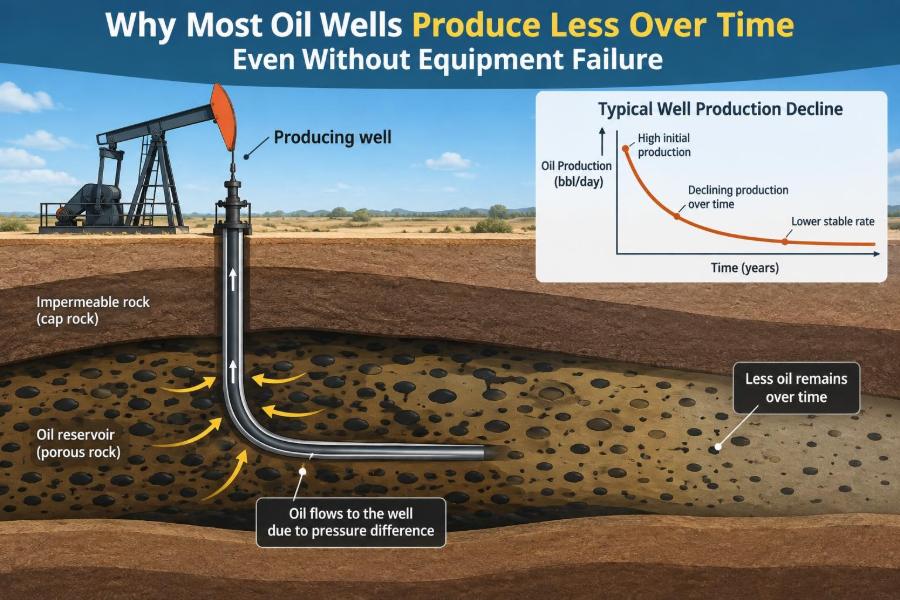
Most wells produce less over time because the reservoir delivers fluids to the wellbore less effectively as depletion progresses. Production depends on a pressure difference: reservoir pressure must exceed the flowing pressure near the well enough to move oil, water, and gas through porous rock.
As fluids leave the reservoir, that pressure support commonly weakens. Even with unchanged tubing, a healthy pump, and an open choke, the driving force pushing oil toward the well can become smaller.
🪨 A Reservoir Is Porous Rock, Not an Underground Lake
Oil is generally stored in tiny connected pore spaces within rock, alongside water and sometimes gas. The rock may look solid in a core sample, but its pores and narrow pore throats form a complicated flow network.
That network controls how readily fluids move. Reservoir quality varies widely: a high-permeability sandstone may transmit fluids readily, while a tight formation may need a large pressure drawdown or hydraulic fractures to sustain useful rates.
📉 The Pressure Difference That Drives Flow
A useful simplified relationship is that production rate rises with drawdown: the difference between average reservoir pressure and flowing bottomhole pressure. Drawdown is the energy available to pull fluids through the reservoir and into the well.
Lowering bottomhole pressure can increase drawdown, but only within operating limits. Excessive drawdown can encourage gas or water entry, mobilize fines, damage the near-wellbore region, or exceed the capability of artificial-lift equipment.
🔋 Depletion Removes Part of the Reservoir’s Energy
At the start of production, a reservoir may have substantial natural energy from compressed fluids, dissolved gas, a gas cap, an aquifer, or gravity segregation. Producing fluids gradually changes that energy balance.
In a volumetric reservoir with little water support, pressure can decline as fluids are removed. In a water-drive reservoir, pressure may be maintained better, but water can eventually occupy more of the flow path to a producing well. Different energy systems produce different decline behavior.
💨 Solution Gas Changes the Flow Problem
Crude oil often contains dissolved natural gas at reservoir conditions. When pressure falls below the bubble-point pressure, gas can come out of solution and form a separate gas phase in the pores.
Some liberated gas can help provide expansion energy. But once mobile gas accumulates near a well, it may reduce the relative ease with which oil flows. In vertical or deviated wells, gas can also create handling challenges in pumps and flowlines.
🧩 Relative Permeability Explains Fluid Competition
When more than one fluid occupies the same rock, each phase does not flow as easily as it would alone. Relative permeability describes the effective ability of oil, water, or gas to flow at a particular saturation.
As water saturation rises, the oil relative permeability usually falls. As free-gas saturation rises, oil flow may also be impaired. The rock has not disappeared, but the portion of its connected pathways effectively available to oil has shrunk.
💧 Water Breakthrough Can Reduce Oil Rate
Water may arrive from an aquifer, an injected-water flood, a nearby high-permeability streak, or a coned interval below the well. Water production does not automatically mean the well is failing; it can be part of the intended displacement process.
However, increasing water cut means a larger share of the produced liquid is water rather than oil. Water also adds lifting and disposal load, which can limit total fluid rate and indirectly reduce the oil rate that the system can sustain.
🌊 Water Coning Is a Local Flow Effect
In a reservoir with mobile water beneath oil, strong drawdown near the well can pull the oil-water contact upward toward the perforations. This upward movement is called water coning.
A similar process can pull gas downward from a gas cap. Coning depends on reservoir geometry, vertical permeability, fluid properties, completion placement, and production rate. Reducing rate may help in some cases, but it is not a universal cure.
🫧 Gas Coning and Gas Breakthrough
Gas reaching a well can reduce oil production in several ways. It occupies pore space, changes multiphase flow near the well, and may lower pump efficiency or create gas-locking problems in certain artificial-lift systems.
Gas breakthrough can also follow fractures or high-permeability layers rather than a smooth cone. The production response must therefore be interpreted with pressure, gas-oil ratio, completion information, and, where available, production logs.
🧪 Fluid Properties Change as Pressure Changes
Oil viscosity, gas content, density, and formation volume factor vary with pressure and temperature. These changes affect both reservoir flow and lifting requirements at the well.
For example, gas liberation may raise oil viscosity below bubble point in some systems, making the oil harder to move. In other cases, thermal changes, wax behavior, or emulsions add further resistance. A declining rate is often the combined result of several small changes rather than one dramatic event.
🛤️ Long Flow Paths Become More Limiting
Early in a well’s life, the pressure disturbance may reach only a limited region around the wellbore. Over time, the well draws fluids from farther away, through longer and sometimes less favorable paths.
Boundary effects, compartmentalization, faults, low-permeability zones, and uneven fracture conductivity can become visible only after production has continued for a while. A well may initially access its easiest-to-produce volume before relying on less productive rock.
🕳️ Skin Can Restrict Flow Near the Wellbore
Skin is a measure used to describe extra resistance to flow near the wellbore compared with an ideal completion. Positive skin indicates restriction; negative skin may indicate improved connection, often after stimulation.
Skin can increase because of scale, fines migration, clay swelling, drilling or completion damage, organic deposits, or perforation impairment. Unlike broad reservoir depletion, some skin-related decline may be treatable through a targeted intervention.
🧱 Formation Damage Is Not the Same as Equipment Failure
A pump failure happens in the well hardware. Formation damage occurs in the rock or pores close to the well. Both can reduce production, but they require different diagnoses and different remedies.
For instance, a well might have clean tubing and a functioning pump but still produce poorly because solids or incompatible fluids have reduced permeability around the perforations. Pulling and replacing equipment alone would not restore that lost inflow.
🧂 Scale, Wax, and Asphaltenes Add Restrictions
Changes in pressure, temperature, and fluid composition can cause deposits to form. Mineral scale may restrict perforations or tubing; wax can accumulate as oil cools; asphaltenes can precipitate when fluid conditions change.
These mechanisms are often manageable, but diagnosis matters. A gradual oil decline with rising tubing pressure may suggest one type of restriction, while a production change tied to water chemistry or pressure conditions may point elsewhere.
🔧 Artificial Lift Can Be Healthy but Mismatched
Artificial lift does not create reservoir fluids; it reduces bottomhole pressure or helps carry fluids to surface. As reservoir conditions evolve, the original pump, gas-lift design, or rod-string configuration may no longer match the well’s inflow and fluid load.
A rod pump may become inefficient with more free gas. An electric submersible pump may operate away from its preferred range as rate falls. Gas lift performance can change as operating pressures and produced-fluid composition change. None of these conditions necessarily means the equipment has failed.
⚙️ Inflow Performance and Lift Performance Must Meet
The well’s operating rate is found where the reservoir’s inflow performance relationship meets the vertical-lift system’s outflow requirement. In simple terms, the reservoir must be able to supply what the wellbore system can lift.
If reservoir inflow weakens, a previously suitable lift system can become inefficient. If fluid loading increases, the outflow requirement can rise. Production optimization often means shifting that operating point, not merely installing larger equipment.
📊 A Decline Curve Is Evidence, Not a Diagnosis
Decline-curve analysis describes how production changes with time and can support forecasting. Exponential, hyperbolic, and harmonic forms are commonly used approximations, but a fitted curve does not identify the physical cause by itself.
A rate trend can be influenced by shut-ins, choke changes, workovers, changing allocation, facility constraints, or changing operating strategy. Engineers should pair decline analysis with pressure data, water cut, gas-oil ratio, and operating history.
🧭 Normal Decline Has More Than One Shape
A conventional well with stable operating conditions may show a relatively smooth decline. A hydraulically fractured low-permeability well may show a steeper early decline as transient flow evolves, followed by a different behavior later.
Neither shape should be judged in isolation. The relevant question is whether the observed trend is consistent with the reservoir model, completion design, nearby well activity, and known changes in the production system.
🧠 A Hypothetical Well Example
Imagine a well producing oil with a modest amount of water. Over several months, oil rate falls while total liquid rate stays similar and water cut climbs. Surface equipment checks show no obvious failure.
One plausible explanation is that water is taking a larger share of flow near the well, reducing oil relative permeability and consuming lift capacity. The right next step is not automatically a workover; it may include reviewing pressure behavior, completion intervals, water source, and artificial-lift operating conditions.
🧾 Data Needed to Separate Causes
Good diagnosis relies on trends rather than a single production test. The most useful information often combines reservoir, wellbore, and surface observations.
- Oil, water, gas, and total-liquid rates, with reliable allocation.
- Water cut, gas-oil ratio, flowing pressures, and temperatures.
- Static or buildup pressure data when practical and interpreted carefully.
- Choke settings, lift-system operating conditions, and downtime records.
- Fluid samples, scale history, chemical treatments, and workover details.
- Production logging or surveillance tools when the source of unwanted fluids is uncertain.
📈 Pressure Data Gives Context to Rate Data
A falling production rate with falling reservoir pressure can be consistent with depletion. A sharp rate loss with little pressure change may instead point toward a completion restriction, changing lift performance, or a facility limitation.
Pressure measurements have limitations: shut-in time may be insufficient, wells may communicate unevenly, and calculated average pressure depends on the reservoir model. Still, pressure is one of the most valuable pieces of context for interpreting decline.
🔍 Production Logging Can Locate the Problem
When a completed interval contains multiple layers, total well rates may hide what individual zones are doing. Production logging can help identify where oil, water, or gas enters the wellbore.
This is especially useful before isolating an interval or performing a water-shutoff treatment. A rising water cut does not prove that every perforated zone is wet; a targeted diagnosis can prevent a broad treatment from damaging productive inflow.
🚫 The Mistake of Chasing Rate at Any Cost
Increasing drawdown may temporarily raise the rate, but it can also accelerate water or gas coning, worsen sanding risk in susceptible formations, or reduce long-term recovery efficiency. A higher instantaneous oil rate is not always the best reservoir-management decision.
The appropriate operating target depends on fluid contacts, completion geometry, lift limits, disposal capacity, economics, and the field’s recovery strategy. Optimization requires looking beyond today’s production number.
🧰 Interventions Should Match the Mechanism
Possible actions include adjusting lift settings, removing deposits, stimulating damaged near-wellbore rock, reperforating, isolating a water-producing zone, changing choke strategy, or modifying injection patterns. Each has a different purpose and risk profile.
For example, acidizing may improve a damage-related restriction in a compatible formation, but it will not restore reservoir pressure. A larger pump may help fluid handling, but it cannot overcome poor inflow without potentially increasing harmful drawdown.
💉 Pressure Maintenance Can Slow Some Decline
Water injection or gas injection can help maintain pressure and displace oil in suitable reservoirs. These are field-scale recovery strategies, not simple fixes for an individual underperforming well.
Injection must be designed around reservoir connectivity, sweep efficiency, fracture pressure, fluid compatibility, and surveillance. Poor conformance can send injected fluid preferentially toward a producer, increasing early water or gas breakthrough instead of improving broad reservoir sweep.
🧱 Completion Design Influences Future Decline
Well placement, perforation intervals, fracture design, sand-control selection, and zonal isolation all influence which fluids a well will access over time. Early production success does not guarantee that the completion will remain well balanced as pressures and saturations change.
Reservoir heterogeneity is a major reason. A thin high-permeability layer may dominate initial flow, while a lower-permeability oil-bearing layer contributes less unless the completion and drawdown are managed carefully.
🤝 Nearby Wells Can Change the Picture
In developed fields, a well does not always behave independently. Nearby producers can alter pressure distribution, while injectors can change saturation patterns and support pressure.
Interwell communication may be beneficial or problematic depending on the recovery plan. An unexpected decline or water increase may reflect changing field operations rather than deterioration inside the individual well.
🧮 Economics Changes the Meaning of “Worth Fixing”
A technically valid intervention is not automatically economic. Incremental oil must be weighed against workover cost, deferred production, water handling, disposal, chemical needs, operational risk, and expected duration of benefit.
Conversely, a modest intervention can be valuable when it prevents escalating water handling or protects a strategically important area of the reservoir. Decisions should use uncertainty ranges rather than assuming a single forecast will occur exactly.
🦺 Safety and Integrity Remain Separate Priorities
A gradual production decline may be normal, but abnormal pressure behavior, unexpected gas handling issues, sand production, corrosion indicators, or loss of containment require prompt engineering attention. Production optimization must never override well-integrity controls.
Any intervention should follow the operator’s approved procedures, barrier requirements, chemical handling practices, and regulatory obligations. Reservoir uncertainty is not a reason to relax operational discipline.
🎓 What Students and New Engineers Should Remember
It is tempting to explain every declining well with one phrase: “the reservoir is depleted.” Real wells are more nuanced. Depletion, multiphase flow, near-wellbore damage, lift mismatch, and field interactions can occur at the same time.
Start with a simple material-balance mindset: what energy remains, which fluids are moving, where are they entering, and what resistance exists from reservoir to separator? Then test that explanation against actual data.
✅ The Core Principle Behind a Declining Well
Most oil-well decline is the visible result of a changing subsurface system. Reservoir pressure falls or redistributes, oil competes with water and gas for flow paths, and the well’s original completion and lift design gradually become less well matched to the conditions it now faces.
The best response is neither to assume failure nor to accept every decline as unavoidable. It is to distinguish natural reservoir behavior from correctable restrictions, quantify uncertainty, and select interventions that address the real limiting mechanism.
A well can produce less while every major piece of equipment still works because the reservoir-to-well flow system is changing continuously beneath the surface. Reading that change correctly is the foundation of sound production engineering. 🛢️📉🔍