
A producing well rarely fails in one dramatic moment. More often, a field team notices a gradual decline: less oil reaches the surface, water handling costs rise, pressure behavior changes, or a pump needs attention more often than it used to.
For an operator, the question is not simply whether a well is old. The practical question is whether the well still contains recoverable hydrocarbons and whether they can be produced safely, reliably, and economically.
That question matters in mature fields around the world. A well with declining output may still have substantial oil or gas left in the reservoir, yet the pathways, pressures, equipment, and fluids that once made production straightforward may have changed.
Technology can often extend a well’s useful life, but it is not a magic reset button. The best results come from diagnosing the real constraint, selecting a proportionate intervention, and knowing when continued operation no longer makes technical, economic, or environmental sense.
🛢️ What “Aging” Means for a Well
An aging well is not defined only by calendar years. Some wells face production problems early because of difficult fluids, weak rock, sand production, or equipment limitations. Others produce steadily for decades with careful surveillance and maintenance.
In petroleum engineering, a mature or aging well usually has declining rates, increasing operating complexity, or both. Its original completion, artificial-lift system, and operating strategy may no longer match current reservoir conditions.
📉 Why Production Declines Over Time
Reservoirs produce because fluid pressure and pressure differences drive oil, gas, and water toward the wellbore. As fluids are withdrawn, reservoir pressure commonly falls unless natural recharge or pressure support offsets the decline.
At the same time, water may move toward the well, gas may break out of solution, and the easy-flowing portion of the reservoir may be depleted first. A falling production rate is therefore normal; the engineering task is to determine whether the decline is expected or caused by a correctable restriction.
🧭 Start With the Real Production Constraint
“Low production” is a symptom, not a diagnosis. A well may be limited by the reservoir’s ability to deliver fluid, a blockage near the wellbore, inadequate lift equipment, excessive backpressure at surface, or mechanical failure.
These constraints require very different remedies. Stimulating a well with a failed pump will not solve the problem, and installing a larger pump may worsen conditions if the reservoir cannot supply enough liquid.
🧪 Reservoir Surveillance Reveals What Remains
Reservoir surveillance combines production history, pressure measurements, fluid samples, well tests, and subsurface models. Its purpose is to estimate how the reservoir is changing and where mobile hydrocarbons may still remain.
Pressure-transient testing, for example, can help engineers infer permeability, boundaries, and possible formation damage from how pressure responds to controlled changes in flow. Results must be interpreted cautiously because real reservoirs are layered, heterogeneous, and rarely as simple as a textbook model.
📊 Production Data Can Act as an Early Warning System
Routine measurements of oil, gas, water, pressures, temperatures, power use, and downtime can reveal deterioration before a total failure occurs. Trends are often more useful than a single reading.
A slowly rising pump intake pressure or a changing gas-to-oil ratio may signal a shift in well behavior. Good data quality matters: an inaccurate meter, an inconsistent test method, or missing downtime records can lead to an expensive but misguided intervention.
🕳️ Understanding the Near-Wellbore Zone
The few feet or meters around the wellbore strongly influence productivity. This area can become damaged during drilling, completion, production, or workover operations when fine particles, drilling fluids, scale, wax, or incompatible fluids restrict pore spaces.
Engineers often describe the resulting added flow resistance as skin. Positive skin indicates restriction near the wellbore; reducing it can improve flow without changing the reservoir’s overall hydrocarbon volume.
🧼 Removing Scale, Wax, and Other Deposits
Mineral scale can form when pressure, temperature, or water chemistry changes cause dissolved minerals to precipitate. Wax can deposit as crude cools, while asphaltenes—heavier organic components—can also create flow restrictions under certain conditions.
Mechanical scraping, chemical treatments, hot-oil operations, solvent treatments, and inhibitor programs may help, depending on the deposit. The first step is identifying what is actually present; treating carbonate scale as though it were wax wastes time and may create new compatibility problems.
⚗️ Matrix Acidizing Can Restore Flow Paths
Matrix acidizing places reactive fluid into the formation at pressures below those intended to fracture the rock. In carbonate formations, acid can dissolve part of the rock and create or enlarge conductive pathways. In sandstone reservoirs, treatment design is more sensitive because mineralogy and fines migration can complicate results.
Acidizing is not universally appropriate. It requires laboratory work, fluid-compatibility checks, placement design, corrosion control, and realistic expectations about whether damage—not depletion—is the principal limitation.
💥 Hydraulic Fracturing Can Reconnect the Reservoir
Hydraulic fracturing creates fractures that extend away from the wellbore, usually propped open with solid particles so fluids have a higher-conductivity flow path. In a mature well, refracturing may be considered when the original fracture no longer effectively contacts productive rock.
Success depends on reservoir quality, existing fracture geometry, well integrity, nearby wells, and the ability to place treatment where it adds value. A poorly targeted treatment can communicate with water-bearing zones or merely accelerate production that would have occurred later.
🔧 Recompletion Opens Untapped Intervals
Many reservoirs contain multiple layers, but an original completion may produce only selected intervals. A recompletion can isolate watered-out zones, perforate a bypassed interval, or change the producing configuration.
Before opening another zone, engineers assess pressure, fluid type, rock quality, cement isolation, and the risk of crossflow. The presence of hydrocarbons in a log does not automatically mean that interval will produce commercially.
🧱 Zonal Isolation Controls Unwanted Flow
When water or gas enters from a particular interval, isolation tools can sometimes reduce its contribution. Packers, bridge plugs, cement squeezes, resin systems, and selective treatments are among the possible methods.
The challenge is selectivity. A treatment must reach the unwanted pathway while preserving the desired hydrocarbon flow path. Behind-pipe channels and poor cement can be especially difficult because the problem may not be inside the production tubing at all.
💧 Water Management Often Determines Viability
As fields mature, many wells produce increasing volumes of water along with oil or gas. Handling, treating, pumping, and disposing of water can become more costly than lifting the hydrocarbons themselves.
Water-control technology can reduce avoidable production, but no method eliminates the need for sound water management. Produced water chemistry, disposal capacity, corrosion risk, environmental controls, and injection-well performance all influence the operating plan.
⬆️ Artificial Lift Keeps Fluids Moving
When reservoir pressure is insufficient to lift fluids to surface efficiently, artificial lift supplies additional energy or reduces bottomhole flowing pressure. Common systems include rod pumps, electric submersible pumps (ESPs), gas lift, progressive cavity pumps, and hydraulic pumping systems.
The right system depends on rate, depth, fluid viscosity, free gas, solids, well deviation, power availability, and maintenance access. There is no best lift method for every well.
⚙️ Matching Lift Design to Changing Conditions
A lift system selected for an early, high-rate well may operate inefficiently after water cut rises and fluid rate falls. Conversely, an undersized system can leave recoverable fluid in the well because it cannot maintain a sufficiently low flowing pressure.
Optimization may involve adjusting pump speed, stroke length, gas-lift injection rate, tubing size, or operating schedule. A larger pump is not automatically better: pumping off the fluid level can increase gas interference, wear equipment, and cause damaging pressure cycling.
🤖 Automation Helps Wells Respond Faster
Remote monitoring and automated controls allow operators to track pressures, temperatures, tank levels, pump behavior, and alarms without relying solely on site visits. For dispersed mature assets, this can shorten the time between a developing issue and a corrective response.
Automation is most valuable when it supports a clear operating decision. An alarm that nobody reviews, or a control system tuned to poor data, simply makes a problem harder to see.
📡 Downhole Sensors Add Context
Permanent or retrievable downhole gauges can measure pressure and temperature closer to the reservoir and lift equipment. These measurements help distinguish surface-related issues from changes occurring downhole.
Sensor data also have limits. Instruments can drift, fail, or represent conditions only at their installation depth. They should be checked against well tests, operating records, and physical understanding of the system.
🧠 Digital Models Support Better Decisions
Digital tools combine reservoir models, wellbore-flow models, equipment data, and operating history. A digital representation of a well or field can help engineers test scenarios before changing equipment or scheduling a workover.
Machine-learning tools may identify unusual operating patterns or estimate failure risk from historical data. They are aids to engineering judgment, not substitutes for it: models trained on incomplete or biased records can confidently produce poor recommendations.
🔍 Predictive Maintenance Reduces Avoidable Downtime
Many mature-well losses come from repeated equipment failures rather than reservoir depletion. Vibration, motor current, pressure behavior, temperature, and run-time data can provide warning signs of worn components, gas interference, rod wear, or pump problems.
A predictive approach aims to intervene before a failure causes extended shutdown or collateral damage. It should still be balanced against the cost of frequent preventive work; replacing every component early is not efficient maintenance.
🧰 Workovers Repair the Well’s Mechanical System
A workover is a substantial intervention using a rig or specialized unit to repair, replace, clean, or reconfigure downhole equipment. Typical objectives include replacing tubing, repairing a pump, retrieving stuck equipment, setting isolation, or changing completion intervals.
Workovers can restore production, but they involve cost, operational risk, and temporary lost production. The value case should include the probability that the planned repair will solve the identified problem—not merely the potential upside if everything goes perfectly.
🩺 Well Integrity Is the Non-Negotiable Foundation
Tubing, casing, cement, packers, and wellhead equipment must contain fluids and prevent unintended migration between formations or to the surface. Aging wells may face corrosion, mechanical wear, pressure cycling, or degradation of barriers over time.
Technology such as casing inspection logs, pressure testing, corrosion monitoring, and leak-detection methods can identify concerns. If integrity is uncertain, production-enhancement plans should not outrun barrier assessment and repair.
🧯 Corrosion Management Protects Equipment and Barriers
Produced fluids may contain water, carbon dioxide, hydrogen sulfide, oxygen introduced during operations, or bacteria that contribute to corrosion. The precise mechanism depends on the fluid system and materials in service.
Corrosion control can include chemical inhibitors, material selection, coatings, water-chemistry monitoring, and operational changes. Effective programs verify performance through inspection and sampling rather than assuming that chemical injection alone has solved the risk.
🌍 Methane Detection Changes Mature-Asset Priorities
Older wells, tanks, compressors, and pneumatic equipment can be sources of methane emissions if seals, valves, or connections leak. Detection methods may include handheld surveys, fixed sensors, aerial measurements, or other remote monitoring approaches.
Finding and repairing leaks can reduce product loss and improve safety and environmental performance. It also changes intervention priorities: a low-rate well with a persistent leak may demand attention even if its production economics appear marginal.
♻️ Carbon Dioxide and Enhanced Recovery Have Limits
Enhanced oil recovery (EOR) seeks to mobilize additional oil through methods such as water injection, gas injection, or thermal processes. Carbon dioxide injection can be effective in suitable reservoirs because it may improve oil displacement and, under certain conditions, mix with oil.
However, EOR requires compatible reservoir characteristics, injectivity, containment, facilities, monitoring, and a viable development plan. It is a field-scale strategy in many cases, not a quick fix for an individual underperforming well.
🏭 Surface Constraints Can Strangle a Good Well
Not every production problem begins underground. High separator pressure, undersized flowlines, restricted chokes, failing compressors, excessive backpressure, or limited water-treatment capacity can reduce a well’s deliverability.
A nodal analysis connects reservoir inflow, wellbore lift, and surface flow behavior. It helps locate the bottleneck so that engineers do not spend money downhole when a surface-system modification would deliver the needed improvement.
💰 Economic Limit Is Not a Fixed Production Rate
A well reaches its economic limit when expected revenue no longer justifies operating, maintenance, regulatory, and future closure obligations under the operator’s assumptions. That point varies with fluid volumes, energy costs, transportation, water handling, reliability, taxes, contracts, and commodity prices.
Technology can shift the economic limit by lowering downtime, reducing lifting costs, or unlocking incremental production. It cannot make every low-rate well a rational candidate for continued operation.
⚖️ Compare Interventions Before Committing Capital
Decision-making improves when alternatives are compared on a consistent basis. A modest chemical cleanout, a lift adjustment, a workover, and permanent abandonment may each be reasonable options depending on uncertainty and risk.
| Option | Best suited to | Key uncertainty |
|---|---|---|
| Optimization | Operating mismatch or surface restriction | Whether production response is sustained |
| Targeted treatment | Identified deposits or near-wellbore damage | Placement and formation response |
| Workover or recompletion | Mechanical failure or bypassed interval | Barrier condition and intervention success |
| Abandonment | Unsafe, uneconomic, or exhausted opportunity | Accurate closure scope and long-term integrity |
A disciplined evaluation includes downside cases, not just a single forecast. Uncertainty in reservoir response is normal and should be made visible rather than hidden in optimistic assumptions.
🚫 Common Mistakes in Late-Life Well Management
One common mistake is treating every decline as a stimulation opportunity. Another is focusing on gross fluid rate while overlooking rising water costs, emissions, integrity concerns, or frequent failures.
- Using one diagnostic test as the entire basis for an intervention.
- Ignoring wellbore and surface constraints while modeling reservoir potential.
- Installing advanced monitoring without staff, workflows, or thresholds for action.
- Deferring integrity repairs because a well is still producing cash flow.
- Judging success only by a brief initial production spike.
Late-life assets reward disciplined basics: accurate data, barrier management, clear operating envelopes, and post-job evaluation.
🛑 Knowing When to Plug and Abandon
Eventually, continued operation may no longer be responsible or economic. Plugging and abandonment permanently isolates subsurface zones using barriers designed for the well’s conditions and applicable requirements.
Planning early matters because closure costs and technical complexity should be recognized before the final month of production. A well should not be kept online solely to postpone an unavoidable integrity or abandonment obligation.
🧑🔧 A Practical Workflow for Mature Wells
A repeatable workflow prevents technology from becoming a collection of disconnected tools. It begins with a production and integrity review, then narrows the diagnosis before selecting the least intrusive option likely to address the constraint.
- Verify production, pressure, fluid, and downtime data.
- Confirm well-integrity status and immediate safety risks.
- Identify the dominant reservoir, wellbore, lift, or surface constraint.
- Generate alternatives, including doing nothing and abandonment.
- Assess expected value, uncertainty, operational risk, and environmental impact.
- Execute, measure the response, and update the well model.
This loop is especially useful because mature wells change continuously. A solution that works this year may need adjustment as water cut, pressure, or equipment condition evolves.
🎯 The Core Principle: Diagnose Before You Optimize
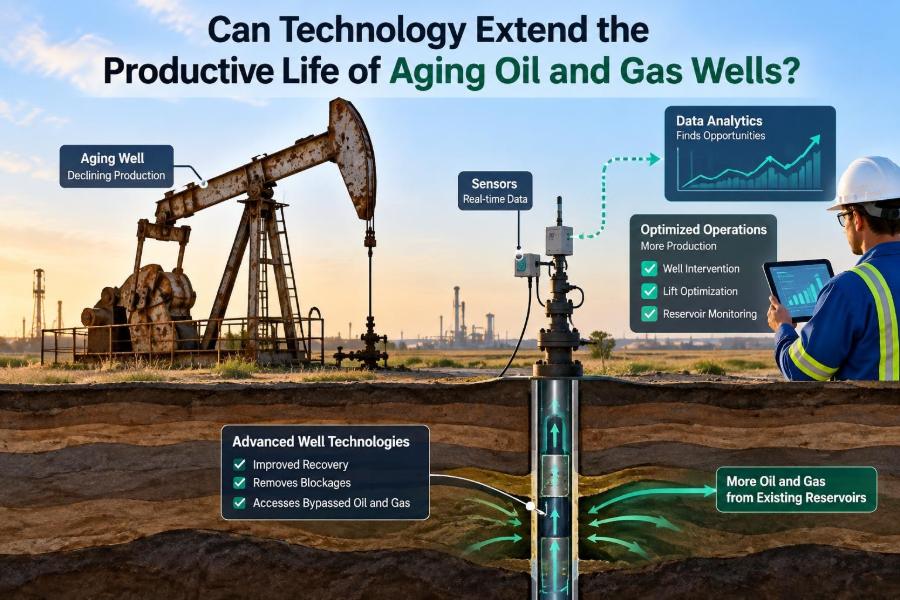
Technology can extend the productive life of aging oil and gas wells when it removes a specific, verified constraint. Sensors can expose changing behavior, analytics can prioritize work, interventions can restore flow, and better lift design can reduce unnecessary pressure losses.
But longevity is not the same as producing forever. The responsible objective is to recover viable resources while maintaining well integrity, controlling emissions and water, protecting people, and preparing for proper closure when the opportunity is exhausted.
The most valuable late-life technology is the one matched to the true cause of decline—and used within sound engineering, safety, environmental, and economic limits. 🛢️🔧🌍