
A production engineer opens the morning dashboard and sees that a separator is drifting away from its normal pressure range. The equipment has not failed, and no alarm has forced a shutdown. But the pattern looks familiar: if operating conditions continue in the same direction, liquid carryover and lost production may follow.
Traditionally, the team might compare trends, call the field, inspect available data, and adjust settings cautiously. A digital twin promises a more structured option: test likely causes in a virtual representation of the asset before changing the real process.
That promise is appealing in oil and gas, where wells, flowlines, compressors, separators, and export systems interact in ways that are difficult to see from one screen or one discipline. Small decisions can affect production, energy use, equipment life, safety margins, and emissions.
Yet a digital twin is not a magic dashboard or an infallible copy of a facility. Its value depends on sound engineering, reliable data, clear operating decisions, and people who understand its limits.
🧩 What a Digital Twin Actually Is
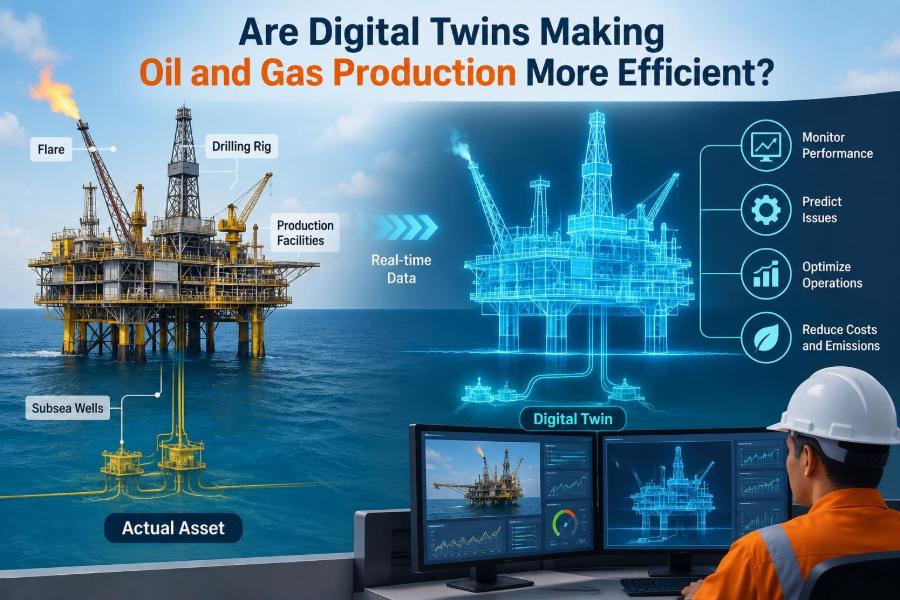
A digital twin is a living digital representation of a physical asset, process, or system that is connected, to some degree, with real operating data. In petroleum operations, it may represent a single artificial-lift well, a compressor train, a production network, or an entire processing facility.
The word “living” matters. A static simulation built for a design study is useful, but it becomes a twin when it is maintained and informed by current or regularly updated field information.
🔍 More Than a 3D Model
A realistic 3D view can help crews locate equipment, but appearance alone does not make a digital twin. The engineering value comes from representing behavior: pressure losses, heat transfer, fluid properties, equipment constraints, control actions, and degradation mechanisms.
A useful twin answers operational questions such as: What happens to separator performance if well rates change? Which compressor configuration uses less power? Is a pressure decline caused by reservoir behavior, a restriction, or an instrument problem?
🏗️ The Layers Inside a Production Twin
Most production twins combine several layers rather than relying on one software model. Their depth should match the decision being supported.
- Physical layer: wells, pipelines, vessels, rotating equipment, and instruments.
- Data layer: sensor readings, laboratory results, maintenance records, test data, and historian data.
- Engineering layer: reservoir, wellbore, flow assurance, process, and equipment models.
- Decision layer: alerts, forecasts, scenario comparisons, work recommendations, and operator workflows.
Not every twin needs all layers in equal detail. A pump-health twin may focus on vibration and operating envelope, while a field-wide twin needs production-network relationships.
🛢️ Why Oil and Gas Systems Are Good Candidates
Hydrocarbon production is an interconnected physical system. A choke setting at the wellhead can change flowing pressure, which affects lift performance, gathering-line hydraulics, separation conditions, compression demand, and downstream constraints.
That interdependence makes isolated optimization risky. Maximizing one well’s rate, for example, may increase backpressure on other wells or exceed a separator, water-handling, flare, or compressor limit. A system-level twin can expose these trade-offs before action is taken.
📡 Where the Twin Gets Its Information
Production data often comes from pressure, temperature, flow, vibration, level, valve-position, and power sensors. It can also include well tests, fluid samples, production allocations, corrosion inspections, maintenance histories, and manually entered observations.
Some inputs arrive continuously, while others update weekly, monthly, or after a campaign. A twin does not need every variable in real time. It needs the right variables at a frequency appropriate for the operating decision.
🧹 Data Quality Is the First Engineering Problem
A sophisticated model cannot rescue unreliable inputs. Sensors can drift, communications can drop out, tags can be mapped incorrectly, and a meter may report a plausible value that is physically wrong.
Teams need routines for timestamp alignment, unit checks, range checks, missing-data handling, and reconciliation against independent measurements. A sudden production gain in a dashboard may be a real improvement, an allocation change, or a faulty transmitter; the twin should not treat those possibilities as identical.
🧠 Physics Models Keep the Twin Grounded
Physics-based models use engineering relationships to describe how a system should behave. Examples include multiphase pressure-drop calculations, nodal analysis for wells, compressor maps, mass and energy balances, and separator calculations.
These models are especially valuable when conditions shift outside previously observed data. They help prevent a prediction system from recommending behavior that fits historical patterns but violates known physical constraints.
📈 Data-Driven Models Add Pattern Recognition
Machine-learning models can identify relationships in large operating datasets, estimate hard-to-measure variables, detect unusual patterns, or forecast selected outcomes. They are often strongest when the historical data is representative and the target is clearly defined.
For example, a model may flag compressor behavior that differs from its normal operating signature. That is not the same as proving a specific failure mode; it is a prompt for engineering review and targeted inspection.
⚖️ Hybrid Twins Often Work Best
A hybrid twin combines physics with data-driven correction or estimation. The physics model supplies structure and operating boundaries, while field data tunes uncertain parameters or captures effects that are difficult to model exactly.
This approach is practical in mature assets, where fluid behavior, equipment condition, and operating practices evolve over time. It also makes the twin easier to explain to engineers who need to trust its recommendations.
🕳️ Reservoir Twins Address Subsurface Uncertainty
A reservoir twin may integrate geological interpretation, petrophysical data, pressure history, production performance, and reservoir simulation. Its aim is not to reveal the subsurface with certainty; the subsurface remains only partly observed.
Instead, it helps compare plausible reservoir descriptions and production strategies. Teams can examine questions about depletion, water breakthrough, pressure support, infill opportunities, or injection response while explicitly recognizing uncertainty.
⬆️ Well Twins Connect the Reservoir to the Surface
At the well level, a twin can combine inflow performance from the reservoir with vertical lift performance in tubing and constraints at the surface. This is the basis of nodal analysis: finding the operating point where inflow and outflow behavior meet.
It can support choke selection, gas-lift review, electric submersible pump operating-envelope checks, or diagnosis of declining rate. The model must be updated when tubing condition, water cut, gas-oil ratio, artificial-lift configuration, or fluid properties change.
🌊 Flow Assurance Twins Follow Fluids Through the Network
Flow assurance concerns the reliable movement of multiphase fluids from reservoir to processing. Water, gas, oil, sand, wax, hydrates, scale, and changing temperatures can all influence the risk of restrictions or unstable flow.
A network twin can estimate pressures, temperatures, and flow regimes across wells and pipelines. In cold or deepwater settings, it may support operating envelopes for hydrate management, but predictions should always be checked against approved operating procedures and field evidence.
🏭 Process Twins Improve Facility Decisions
At a facility, a twin may represent separators, heat exchangers, produced-water treatment, dehydration, compression, fuel systems, and export equipment. It uses mass and energy balances to show how a change in feed conditions moves through the plant.
This helps engineers test whether a bottleneck is genuinely in a vessel, control loop, heat exchanger, compressor, or downstream system. It also helps distinguish a capacity constraint from an operating problem that can be corrected without capital work.
🔄 Production Optimization Is a System Problem
A common use case is testing combinations of well choke settings, lift-gas distribution, compressor modes, and processing constraints to find a feasible production plan. “Feasible” is crucial: the best answer is not simply the highest calculated oil rate.
A credible optimization respects pressure limits, liquid handling, water disposal, gas capacity, equipment envelopes, integrity limits, contractual conditions, and safety requirements. It should make those constraints visible rather than hiding them behind one production target.
⚡ Energy Efficiency Can Be Modelled, Not Assumed
Compression, pumping, heating, and treating can consume substantial energy. A twin can compare operating cases, such as compressor loading strategies or pump configurations, while maintaining required throughput and process conditions.
Lower energy use is not automatic. Running equipment closer to a perceived optimum may reduce efficiency if it creates instability, surge risk, poor separation, or more frequent maintenance. The model needs real equipment limits and operator knowledge.
🔧 Predictive Maintenance Changes the Timing of Work
Condition monitoring can feed a twin with vibration, temperature, pressure, electrical, and performance data. The goal is often to identify deterioration early enough to plan intervention, order parts, and avoid avoidable production losses.
For rotating equipment, performance deviation can be as informative as a single alarm. A compressor may still run while delivering less head than expected, or a pump may draw unusual power for its duty. Investigation should combine model output with inspection and maintenance expertise.
🚨 Anomaly Detection Is Not Automatic Diagnosis
An anomaly is a condition that differs from an expected pattern. It may be caused by a process upset, sensor fault, changing fluid composition, maintenance activity, or a genuine equipment issue.
One of the most common mistakes is turning an anomaly score directly into a maintenance diagnosis. A good workflow uses the alert to prioritize checks, compare related tags, inspect recent operating changes, and decide whether escalation is warranted.
🧪 Virtual Experiments Reduce Operational Guesswork
Digital twins are useful because they allow controlled “what-if” experiments. Engineers can compare alternatives without first exposing the live asset to every possible adjustment.
Consider a hypothetical field with declining gas-lift availability. A twin can evaluate different allocation plans, identify wells most sensitive to reduced injection, and reveal surface constraints. The field team still validates the recommendation and implements changes under its operating controls.
🧭 Operators Need Explainable Recommendations
A recommendation that simply says “change choke by 4%” is difficult to trust, especially if it affects a complex operating system. Operators and engineers need to see the expected benefit, key assumptions, constraints checked, confidence level, and possible downside.
Explainability also improves learning. When the outcome differs from the forecast, the team can determine whether the issue was data quality, an invalid assumption, an unmodelled event, or execution in the field.
👷 Digital Twins Change Roles Rather Than Remove Judgment
Routine monitoring and scenario calculations can be automated, but accountability remains human. Reservoir engineers, production engineers, process engineers, operators, maintenance specialists, and data teams each hold knowledge that a model may not contain.
The strongest implementations create a shared view of the asset without pretending that one discipline can replace the others. A field operator’s observation of slugging, noise, vibration, or changing fluids may explain a deviation long before it appears neatly in data.
🛡️ Cybersecurity and Access Control Matter
A production twin may connect operational technology data with enterprise systems and analytical platforms. That connection increases the need for careful network segmentation, identity management, access control, logging, patching, and incident response.
Read-only monitoring has a different risk profile from a system that can write setpoints or issue control commands. Any move toward closed-loop optimization requires rigorous safety review, clear authority boundaries, and safeguards independent of the optimization model.
🧾 Governance Preserves Trust in the Model
Model governance means knowing which version is in use, where inputs came from, which assumptions apply, who approved changes, and when validation was last performed. Without this discipline, a twin can quietly become outdated while still displaying polished results.
Useful practices include documented ownership, calibration schedules, change-management links, performance monitoring, and a defined process for retiring or revising models when equipment or operating philosophy changes.
📏 Validation Is Continuous, Not a Launch Event
Before operational use, a twin should be checked against known conditions and independent measurements. After launch, teams should compare predicted and observed behavior across normal operation, transient events, and changed conditions.
Validation is not a demand for perfect agreement. Every physical system and measurement has uncertainty. The practical question is whether the prediction is accurate enough, and transparent enough about uncertainty, for the decision being made.
💰 Start With a Decision, Not a Platform
Many projects struggle because they begin by buying a broad technology platform and then searching for a use case. A better starting point is a repeatable decision that is currently slow, uncertain, or constrained by fragmented information.
- Which wells should receive limited lift gas?
- When does compressor performance justify inspection?
- What production plan stays within facility limits?
- Which operating changes may reduce energy demand without harming reliability?
A narrow use case creates measurable learning and clarifies what data, model fidelity, and workflow integration are actually required.
🪜 A Sensible Implementation Path
Implementation usually works best in stages. First define the decision and its owner, then map the data and constraints, build the smallest credible model, validate it with users, and embed it in a regular operating routine.
Only after the twin consistently improves understanding should the scope expand. Scaling too early can spread inconsistent tags, weak data practices, and unclear ownership across many assets.
🚧 Common Failure Modes
Projects often disappoint for familiar reasons: they model too much too soon, neglect sensor maintenance, use models without defined decision rights, or present uncertain predictions as precise answers. Another frequent problem is treating deployment as the end rather than the beginning of model maintenance.
There is also a cultural failure mode. If the twin is imposed as a replacement for experienced personnel, people may reasonably resist it. If it is built with operating teams and visibly incorporates their constraints, adoption is more likely.
🌱 Emissions and Environmental Decisions Need Context
Twins can help identify energy-intensive operating modes, quantify flaring-related scenarios, track methane-monitoring signals, and compare process changes. These are valuable capabilities, but model outputs do not substitute for direct measurement, regulatory obligations, or emissions-management programs.
Environmental value comes when the insight leads to verified operational action, such as repairing a leak, reducing unnecessary fuel use, or preventing an upset. A digital model is a decision aid, not environmental performance by itself.
🔮 What Digital Twins Are Likely to Become
Digital twins will probably become more connected across the reservoir, well, network, and facility. Better data integration and computational tools can shorten the path from observed change to tested operating response.
But the most credible future is not a fully autonomous oil field making unchecked decisions. It is a better-informed operating system in which models surface options, quantify trade-offs, preserve knowledge, and support disciplined human decisions.
✅ The Core Takeaway for Production Efficiency
Digital twins can make oil and gas production more efficient when they connect reliable field data with appropriate engineering models and a real operational decision. Their greatest strength is not predicting the future perfectly; it is helping teams test options and understand system-wide consequences before acting.
Efficiency gains are most likely when the twin is focused, validated, explainable, maintained, and used within safety and integrity boundaries. A poor-data, poorly governed model can create false confidence, while a well-managed twin can turn scattered information into practical operational insight.
Digital twins improve production not by replacing petroleum engineering judgment, but by giving that judgment a clearer, faster, and more connected view of the asset. 🛢️📊⚙️