
A mature oil field can look deceptively healthy from the surface. Wells are still flowing, facilities are familiar, and the reservoir has produced for years. Yet water handling costs may be climbing, oil rates may be declining, and each new well intervention may deliver less than the last.
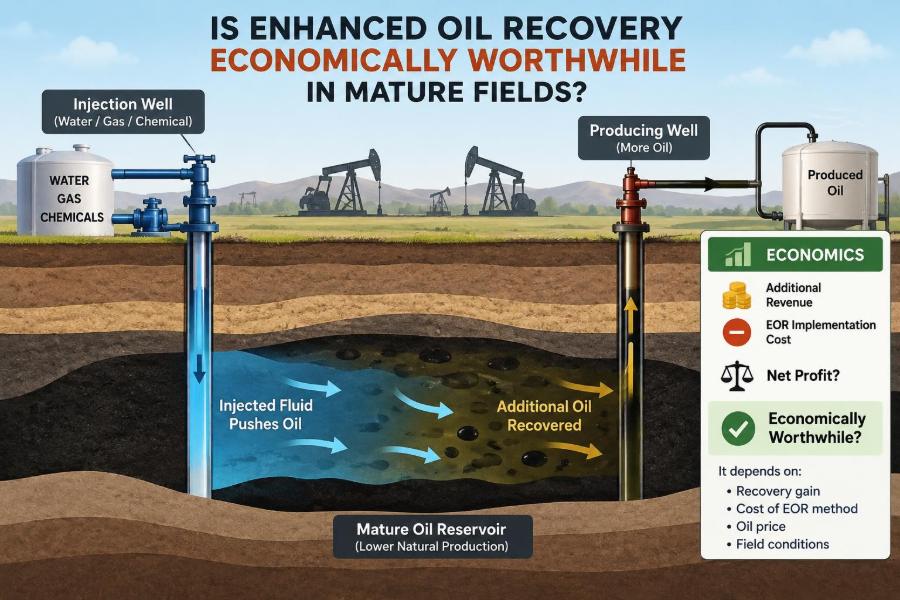
At that point, an enhanced oil recovery project can sound like the obvious next move. Inject gas, chemicals, steam, or another fluid to mobilize oil left behind by primary production and waterflooding. The prize can be substantial because a large share of the original oil commonly remains in the reservoir after conventional recovery.
But “more recoverable oil” is not the same as “profitable oil.” EOR changes the physics of the reservoir, but it also changes the cost structure, operating risk, emissions profile, facility requirements, and exposure to oil-price volatility.
The practical question for petroleum engineers and asset teams is therefore not whether EOR can work. It is whether a particular EOR method can create enough reliable, timely value in a particular mature field to justify the capital, uncertainty, and long-term operating commitment.
🧭 The economic question behind EOR
Enhanced oil recovery, or EOR, refers to methods designed to recover oil beyond what primary depletion and secondary recovery, usually water injection, can economically produce. It is often called tertiary recovery, although some projects are planned earlier in field life.
An EOR investment is worthwhile only when the value of incremental production exceeds all relevant costs on a risk-adjusted basis. “Incremental” matters: the comparison is not total field production after the project, but production attributable to EOR above the forecast case without it.
This means the decision must include capital spending, injection-fluid supply, energy use, workovers, produced-fluid treatment, abandonment effects, taxes or royalties where applicable, and the time value of money.
🛢️ Why mature fields create both opportunity and pressure
Mature fields often have extensive well data, established export routes, existing facilities, and teams familiar with the reservoir. Those advantages can lower the barrier to an EOR project compared with a remote greenfield development.
They also carry constraints. Aging tubulars may not tolerate higher pressures or corrosive fluids. Water-processing systems may already be near capacity. Old well records can conceal behind-pipe communication, poor cement, or unrecognized thief zones.
The opportunity is created by remaining oil; the pressure comes from declining cash flow and rising unit operating costs. EOR should not be used merely to postpone a difficult abandonment decision. It must improve the asset’s economic trajectory.
🧪 The recovery mechanisms that create value
Oil remains trapped for several reasons: capillary forces hold droplets in pore spaces, reservoir pressure declines, injected water bypasses zones, and oil may be too viscous to move efficiently. EOR methods target one or more of these limitations.
Gas injection can improve oil swelling, reduce viscosity, and under suitable conditions become miscible with oil, reducing interfacial tension. Thermal methods lower heavy-oil viscosity. Chemical methods can alter mobility or improve microscopic displacement.
Economic value emerges only if the physical mechanism produces a measurable, sustained increase in oil reaching producing wells. A technically elegant mechanism that remains confined near injectors has little commercial value.
🧩 The main EOR families
| Method | Primary purpose | Typical economic challenge |
|---|---|---|
| CO₂ or hydrocarbon gas injection | Improve displacement and, where feasible, achieve miscibility | Reliable fluid supply, recycle compression, containment, corrosion |
| Steam and other thermal methods | Reduce viscosity in heavy-oil reservoirs | Fuel or power demand, water treatment, heat losses, emissions |
| Polymer flooding | Improve water-to-oil mobility ratio and sweep | Polymer quality, mixing, injectivity, degradation and cost |
| Surfactant or alkaline-surfactant-polymer flooding | Mobilize residual oil and improve sweep | Complex chemistry, salinity sensitivity, adsorption, facility needs |
There is no universal ranking. A steam process may be compelling for shallow, viscous oil but unsuitable for a deep, high-pressure reservoir. CO₂ flooding may fit a light-oil reservoir yet fail economically if transport and recycle costs are excessive.
📍 Reservoir screening comes before economics
Economics cannot rescue a method that does not fit the reservoir. Initial screening evaluates oil viscosity and composition, depth, temperature, pressure, permeability, porosity, formation-water salinity, rock mineralogy, heterogeneity, and existing fluid contacts.
For example, miscible gas injection requires reservoir conditions that can achieve or approach the pressure needed for favorable phase behavior. Polymer floods require enough injectivity and chemical stability for polymer solution to propagate through the formation.
Screening does not prove viability. It eliminates clearly poor matches and identifies the uncertainties that require laboratory work, simulation, surveillance, or a pilot.
🧱 Remaining oil is not automatically producible oil
Engineers frequently describe large volumes of oil remaining in place after conventional recovery. That volume is a resource indicator, not a revenue forecast.
Some oil may sit in low-permeability rock, isolated compartments, poorly contacted layers, or zones that cannot be swept without unacceptable water production. Other volumes may be technically accessible but require costly wells or injection volumes.
The valuable number is the incremental recoverable volume at an acceptable cost and rate. A smaller, higher-confidence increment can be more attractive than a much larger but poorly defined upside case.
🗺️ Heterogeneity can decide the project
Reservoir heterogeneity means that rock properties vary across the field and through the vertical section. High-permeability streaks, natural fractures, faults, shale barriers, and changing facies can redirect injected fluids away from unswept oil.
Think of pouring water through a layered sponge. If one layer contains a fast channel, most of the water uses that path while other areas remain relatively dry. The same behavior can cause early gas breakthrough or rapid water cycling in a reservoir.
Detailed geological models, pressure data, tracers, production logs, and four-dimensional seismic where justified can reduce uncertainty. They do not remove it, which is why economics should test unfavorable sweep outcomes explicitly.
💧 Waterflood performance is a critical baseline
Before choosing EOR, teams should understand what the existing waterflood has achieved and why it is underperforming. Poor areal sweep, poor vertical conformance, insufficient pressure support, or inefficient well patterns may be correctable without a full tertiary process.
Pattern rebalancing, selective shutoff, injector conversion, targeted reperforation, and water-management improvements can sometimes generate attractive incremental oil at lower risk. These actions form the realistic “do more with the current system” alternative.
An EOR proposal should therefore compete not only with doing nothing, but also with lower-capital reservoir management options.
📈 Incremental barrels must be forecast honestly
A production forecast should separate the base decline from expected EOR response. If field decline slows after a project begins, the team must distinguish oil genuinely added by EOR from oil that would have been produced anyway.
Forecasts commonly include low, central, and high cases. The spread should reflect actual technical uncertainties: fluid retention, injectivity, breakthrough timing, pattern response, downtime, and the fraction of the reservoir contacted.
Using a single optimistic recovery factor creates false precision. Decision-makers need to see how project value changes when recovery is lower, delayed, or concentrated in only part of the field.
⏳ Timing matters as much as total recovery
A barrel produced earlier is usually more valuable than the same barrel produced years later because revenue arrives sooner and is discounted less. Long chemical propagation times, delayed pattern response, or extended construction can sharply reduce project value even when ultimate incremental recovery looks attractive.
Timing also affects operational exposure. A project that requires many years of injection and recycling faces more opportunities for equipment failures, supply disruptions, changing regulations, and price cycles.
Forecasts should show annual or monthly profiles, not only cumulative incremental oil. Cumulative volumes can hide a commercially damaging delay.
💰 Capital costs are broader than injection equipment
Major capital may include injection pumps or compressors, pipelines, water treatment, chemical storage and mixing, steam generation, heat recovery, flowlines, electrical upgrades, measurement systems, and modifications to production facilities.
Existing infrastructure can be a genuine advantage, but it must be inspected rather than assumed fit for purpose. Gas injection may need dehydration, compression, metering, and recycle capacity. Chemical flooding may require careful mixing and quality control that an ordinary waterflood plant does not provide.
Contingency should be tied to design maturity and uncertainty. Early concepts typically have less-defined scopes than projects following a successful pilot and detailed engineering.
⚙️ Operating costs often determine the long tail
Many EOR projects are not defeated by initial capital alone. They struggle when recurring costs rise as oil production declines: compression power, steam fuel, chemical purchases, produced-water treatment, corrosion control, surveillance, and workovers.
A field may produce more gross fluid after EOR while its oil fraction declines. Handling that extra water or recycled gas requires capacity and energy, even if the oil rate no longer supports the expense.
Economic models need time-varying operating costs. Applying a flat cost per barrel across the entire forecast can obscure expensive late-life conditions.
🔋 Energy intensity changes the business case
Thermal recovery requires energy to generate and deliver heat. Gas floods can require repeated compression and recycling. Pumping polymers or treating produced fluids also consumes power.
The local energy source matters. Fuel availability, electricity reliability, water supply, and power tariffs can alter operating cost and project resilience. Energy use may also affect emissions intensity and, in some settings, compliance obligations or stakeholder expectations.
Reducing energy intensity through heat integration, efficient compression, optimized injection, and reliable equipment can improve both operating economics and environmental performance. These gains should be quantified, not treated as assumptions.
🧫 Chemical compatibility is an economic variable
In chemical EOR, laboratory formulation is not a minor preliminary task. Polymer viscosity can degrade under high temperature, high salinity, or mechanical shear. Surfactants can adsorb onto rock or react unfavorably with formation brine.
Compatibility testing examines fluids, rock samples, and sometimes produced-water conditions. It helps estimate retention, injectivity, scaling tendency, emulsion behavior, and separation challenges at the surface.
A formulation that works in clean laboratory water but struggles with field brine can turn an apparently attractive project into an expensive injection experiment.
🌡️ Thermal recovery has a distinctive value equation
For viscous oil, heating can transform mobility dramatically. The economic test is not simply whether steam increases production; it is whether the additional oil justifies the heat generated, water treated, fuel consumed, and heat lost before reaching the reservoir.
Depth, thickness, permeability, oil viscosity, and overburden conditions influence heat delivery and containment. Surface facilities must also manage boilers or generators, water treatment, emissions controls, and operational safety.
Thermal projects can be robust in suitable reservoirs, but they require disciplined accounting of the energy and water systems that make production possible.
🌬️ Gas supply and recycle shape gas-flood economics
CO₂, hydrocarbon gas, nitrogen, and other injectants have different physical behavior, availability, and handling requirements. A gas flood needs a dependable supply over the period required to establish and maintain reservoir response.
Produced gas is often separated, dehydrated, recompressed, and reinjected. Losses, impurity management, compressor reliability, corrosion, and pipeline constraints all influence cost and uptime.
Where CO₂ is used, its storage potential may be relevant, but stored volumes, recycled volumes, purchased volumes, and operational emissions should be tracked clearly. Storage value does not automatically make an otherwise weak oil-recovery project economic.
🔧 Wells are often the hidden constraint
EOR performance depends on wells delivering fluids to intended intervals and producing the response safely. Mature wells may have corroded casing, uncertain cement integrity, failed packers, or completion designs unsuitable for new pressures and fluids.
Well remediation can be costly and technically uncertain, particularly in fields with many old wells. Injection can also expose communication paths to adjacent formations or abandoned wells if integrity is poor.
A credible development plan includes a well-by-well integrity review, intervention scope, monitoring plan, and allowance for failures. Ignoring these items produces an artificially low cost estimate.
🏭 Surface facilities can bottleneck incremental oil
More oil is valuable only if the field can separate, treat, measure, store, and export it. EOR may increase gas-oil ratio, emulsion tendency, produced-water volume, solids, or chemical carryover, placing new demands on separators and treatment equipment.
Produced-water disposal capacity is especially important in mature fields. If water handling is constrained, operators may need to curtail production or invest in additional treatment and injection capacity.
Facility debottlenecking should be integrated with reservoir forecasting. Designing the reservoir plan separately from the surface system is a common route to schedule slippage and lost production.
📊 Use discounted cash flow, not simple payout alone
Simple payout asks how long it takes for cumulative cash inflow to recover initial spending. It is intuitive but incomplete because it treats early and late cash equally and can ignore value after payout.
Discounted cash flow assigns less present value to future cash. Measures such as net present value, internal rate of return, and discounted payout can all inform a decision, provided their assumptions are transparent and consistent.
Net present value is usually the clearest value measure: it compares discounted future cash inflows with discounted capital and operating outflows. It should be evaluated alongside liquidity needs, risk tolerance, and strategic constraints rather than used mechanically.
🎲 Sensitivity analysis reveals what really matters
An economic model should test the variables capable of changing the decision: oil price, incremental recovery, response timing, capital cost, injectant or chemical price, energy cost, water-handling expense, uptime, and abandonment cost.
A tornado chart or comparable ranked sensitivity display can show which assumptions drive the most value. This helps teams target technical work toward uncertainties that matter instead of refining low-impact details.
If modest changes in recovery or cost turn NPV strongly negative, the project may need a staged pilot, redesign, or rejection. A fragile case is not necessarily wrong, but it requires a different risk-management approach.
📉 Price risk cannot be assumed away
EOR typically adds fixed commitments before it delivers its full production response. When oil prices fall, high injection and processing costs may remain while revenue declines.
Planning cases should use price assumptions consistent with the organization’s decision framework, then test lower-price scenarios. Teams should also examine whether the project can be slowed, optimized, or safely suspended without damaging reservoir value.
High prices can make marginal projects appear attractive, but a sound project should not rely on an unexplained permanent price premium to overcome weak reservoir performance.
🧮 Fiscal terms affect the value of every barrel
Royalties, production-sharing arrangements, income taxes, depreciation rules, import duties, carbon-related charges, and abandonment obligations can materially alter after-tax cash flow. Their effect varies by jurisdiction and contract.
For instance, an additional barrel may have a different net value once royalty thresholds, cost-recovery limits, or tax losses are considered. Similarly, imported chemicals or equipment can change both capital timing and operating cost.
Engineering estimates should be connected to commercial and fiscal models early. A technically sound pre-tax case may not remain attractive after the applicable terms are applied.
♻️ Environmental performance belongs in the decision
EOR can extend productive use of existing fields and infrastructure, which may avoid some impacts associated with entirely new developments. It can also increase energy use, water demand, chemical handling, emissions, and waste-management requirements.
Each method has a different profile. Thermal operations raise questions about fuel use and water sourcing; chemical projects require controls for storage and produced-fluid handling; gas injection requires robust containment and monitoring.
Environmental assessment should be specific to the field and method. Treating it as a late permitting exercise misses design choices that can reduce both impacts and lifecycle cost.
🛡️ Safety and containment are value protectors
High-pressure injection, hot fluids, chemicals, and corrosive gases introduce hazards that require engineered safeguards, procedures, training, and emergency planning. These are not optional add-ons to the economic model.
Loss of containment can harm people and the environment, interrupt production, trigger remediation costs, and damage the project’s operating license. Integrity management, pressure monitoring, corrosion control, and clear operating limits protect both safety and project value.
A low-cost design that omits safeguards is not a lower-cost project in any meaningful economic sense.
🔬 Pilots convert uncertainty into evidence
A pilot is a controlled, limited-scale test intended to answer the highest-value uncertainties before full-field spending. It may test injectivity, chemical retention, pressure behavior, conformance, breakthrough, production response, and facility operability.
A pilot needs measurable success criteria established in advance. “Some additional oil” is too vague; the plan should define expected response timing, surveillance data, acceptable operating behavior, and decision thresholds for expansion or exit.
Pilots cost money and take time, so they are not automatically justified. They are most valuable when full-field uncertainty is high and results can realistically change the investment decision.
📡 Surveillance prevents operating blind
Once injection begins, reservoir surveillance checks whether fluids are moving as expected. Pressure surveys, production and injection allocation, tracers, well tests, saturation logs, fluid sampling, and repeat seismic may each have a role depending on the project.
Surveillance is useful only when connected to decisions. If data show early channeling, the team may adjust injection rates, modify patterns, isolate intervals, or revise expectations before costs escalate.
Budgeting for monitoring from the outset is usually cheaper than discovering, years later, that the project’s apparent production response cannot be reliably interpreted.
🚦 Stage-gated development limits irreversible spending
A sensible EOR pathway often moves from screening to laboratory work, modeling, pilot design, pilot execution, evaluation, and phased expansion. Each stage should answer questions needed to justify the next commitment.
Stage gates do not mean endless analysis. They create disciplined points where teams compare new evidence with the original economic case and decide whether to proceed, redesign, pause, or stop.
Phased rollout can also preserve flexibility. Early patterns may identify where the method works best, allowing capital to be directed toward stronger areas rather than deployed uniformly across a heterogeneous field.
⚠️ Common ways EOR economics go wrong
- Counting all remaining oil as recoverable: volumetric potential is mistaken for a deliverable forecast.
- Using optimistic sweep assumptions: channeling and compartmentalization are underrepresented.
- Underestimating water and gas handling: surface constraints emerge after injection begins.
- Ignoring late-life costs: the project looks attractive at peak rates but weak over its full life.
- Treating old wells as fit by default: integrity work appears late and disrupts schedules.
- Skipping a decision-quality baseline: EOR is credited with production that conventional optimization could have delivered.
These failures often arise from disconnects between subsurface, facilities, operations, commercial, and environmental teams. Integrated review is not bureaucracy; it is how the full cost and value chain becomes visible.
🧑💼 A practical decision workflow
- Define the no-EOR base case and lower-capital alternatives.
- Screen methods against reservoir fluids, rock, pressure, and infrastructure.
- Identify the few uncertainties most likely to change value.
- Build integrated subsurface, well, facility, operating, and fiscal forecasts.
- Evaluate risked cash flow across realistic price and performance cases.
- Design a pilot or staged rollout where evidence can materially improve the decision.
- Set surveillance, safety, environmental, and abandonment requirements before approval.
The output should be a decision narrative, not just a spreadsheet: what must be true for success, what evidence supports it, what could fail, and what actions remain available if performance differs from plan.
🤝 When EOR is economically worthwhile
EOR is most likely to be worthwhile when a suitable reservoir contains accessible remaining oil, the chosen mechanism has a credible path to contact that oil, and existing or upgradeable infrastructure can handle the resulting fluids safely.
It also needs a production response early enough and large enough to support capital and recurring costs under realistic, risked assumptions. A reliable injectant or chemical supply, capable wells, clear monitoring strategy, and manageable environmental footprint strengthen the case.
The central principle is simple: EOR earns its place when incremental, risk-adjusted cash flow—not just additional barrels—creates durable value over the project life.
For mature fields, the best EOR decision is rarely a leap of faith or a blanket rejection. It is a disciplined match between reservoir physics, operating capability, commercial realism, and the willingness to learn before committing at full scale. 🛢️📊🌍